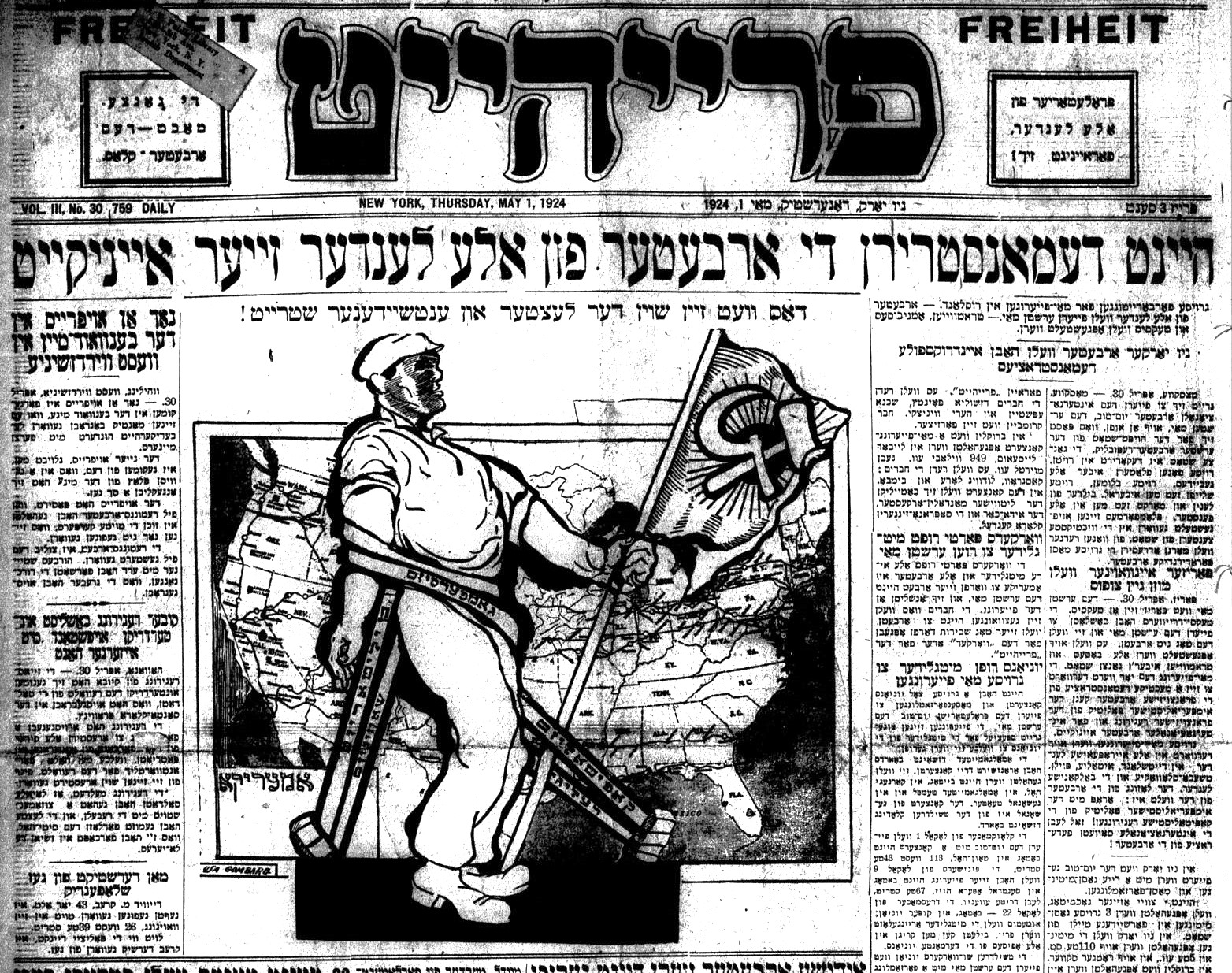
Morris Backall on the Communist Party’s popular Freiheit (often with larger circulation than the Daily Worker) and its competition with Abraham Cahan’s Jewish Daily Forward for the political allegiance of Yiddish-speaking workers, especially in the large textile and garment unions.
‘Fourth Birthday of the Jewish Daily Freiheit’ by Morris Backall from the Daily Worker Magazine. Vol. 3 No. 82. April 17, 1926.
THE Jewish workers who migrated to the United States in recent times were class conscious and socialistically inclined. They built institutions and organized into unions and developed newspapers and put their confidence and their ideals into these institutions. They came from countries of the old Russian empires, where the labor movement and the socialist organizations spread all over the towns and cities of the Jewish ghetto. The brought their class consciousness here, they fought in strikes and in demonstrations, they organized in the economic and political field.
But the organizations and institutions the Jewish workers built became financially solid and economically independent, and they developed into reactionary instruments of class collaboration. At the time of the world war, when the Jewish workers were strongly anti-militaristic, when the feeling against imperialism grew from day to day, the Jewish Daily Forward, then the only Jewish socialist paper in this country, betrayed the masses and became pro-war, while the official heads of the large Jewish unions, such as the International Ladies’ Garment Workers, the Amalgamated Clothing Workers and the Furriers, united with the capitalist class in the capitalist propaganda of pro-war sentiment.
Then came the Russian revolution. The break of class solidarity that took place in the hard and reactionary years of war became more vivid. The contradiction was expressed on the one hand in the relation of the Jewish workers towards the social revolution of the Russian workers and peasants, and on the other hand by the attitude of the official leaders and publications of the Jewish labor movement.
At the beginning of the Russian revolution the leaders of the Jewish labor movement in the United States and its publications could not do otherwise than maintain an attitude of friendliness toward the revolutionary workers’ and peasants’ republic. Their “friendship” was only in order that they could keep their hold on the Jewish workers. But among the Jewish workers of the United States many became conscious of the fact that the tactics of class collaboration and class peace which the social democratic leaders declared in the years of war and in the beginning of the revolutionary wave over the entire world was treason and betrayal of the class struggle. The Jewish workers began to look toward the tactics of the Communist Party of Russia and the program of the Third International as the only possible and necessary tactics and program for the workers all over the world. Then the Jewish Daily Forward and the official leaders of the Jewish labor movement revealed their real nature. They not only openly opposed the Communist International but they became enemies of the Union of Socialist Soviet Republics and wrote and spoke the same as the capitalistic press and counter revolutionary speakers did. The more class-conscious Jewish workers came to the Workers (Communist) Party, forming the Jewish section of the Workers’ Party. They also very logically founded a daily newspaper, the Jewish Daily Freiheit, as their organ of struggle in the field of the Jewish labor movement.
It is hard to understand the struggle and also the accomplishment of the Jewish Daily Freiheit, unless we picture to ourselves the organized field of the Jewish labor movement. Here the machine of the venal bureaucracy became probably as strong as anywhere else in opposition not only to Communism, but to any new element that challenged its rule and control. For these bureaucrats it was not merely a matter of principles and of ideas and ideals. To people like Abraham Cahan, editor of the Jewish Daily Forward, to Schlesinger or Sigman, the successive presidents of the International Ladies’ Garment Workers; to Hillman or Vladeck, it was more a question of personal position and power. In the earlier stages there was a certain period when rivalries between groups of bureaucrats in the needle trades caused the Hillman group of leaders of the Amalgamated Clothing Workers to make a gesture of support of the left wing, in the effort to utilize the vitality of the left wing for its own group struggle for wider power. But that period passed. There is now no more bitter or ruthless enemy of the workers in the needle trades than Hillman himself. To fight with people like Cahan. Sigman, Hillman or Vladeck is like fighting with the mythical devil come into reality. You could never know what their answer would be and in what way their tactics would be expressed, because to them every struggle was viewed as a personal struggle and in personal fights anything is permissible.
When the Freiheit was organized its financial resources were not only limited but somewhat of an impossible nature. It may be told that the first manager of the Jewish Daily Freiheit had something like $85 dollars to start the publication of the daily. Even the most intimate friends could not conceive that the life of the daily would be very long. But who thought of hesitating for lack of financial resources? We had a fight on hand We had to take the workers away from the influence of the yellow, treacherous Forward. We had to start a struggle to get rid of the cliques in the International Ladies’ Garment Workers that were ruining the union. We had to challenge the rule of the Forward element which was fighting the class-conscious workers in the Workmen’s Circle. We had to answer to all lies spread against the Soviet Republic.
And now, four years later, when we look at our successes, we can have an idea of what the Freiheit meant and means to the class-conscious Jewish workers in the labor movement of America.
The Jewish workers in the unions know now the reactionary role of the Forward. The Forward is branded in their eyes as a counter-revolutionary organ which exists only because of the comfortable livelihood it provides its associates, strategically placed agents of the capitalist class.
The Forward lost most of it power in the Jewish labor movement. The International Ladies’ Garment Workers is in fact now led by the leaders of the left wing movement in Chicago and in New York. The joint boards and the largest and most powerful locals are led by comrades that believe in the class struggle, that defend the interests of the rank and file and have confidence in the international solidarity of the workers all over the world. In the Workmen’s Circle the Communist elements are the most lively, most energetic, and are leading the fight for recognition of the true principles of international class struggle.
The Freiheit itself Is the expression and the reflection of all these activities and struggles and ideals in the Jewish labor movement.
Long live the Jewish Daily Freiheit!
The Daily Worker began in 1924 and was published in New York City by the Communist Party US and its predecessor organizations. Among the most long-lasting and important left publications in US history, it had a circulation of 35,000 at its peak. The Daily Worker came from The Ohio Socialist, published by the Left Wing-dominated Socialist Party of Ohio in Cleveland from 1917 to November 1919, when it became became The Toiler, paper of the Communist Labor Party. In December 1921 the above-ground Workers Party of America merged the Toiler with the paper Workers Council to found The Worker, which became The Daily Worker beginning January 13, 1924.
PDF of full issue: https://www.marxists.org/history/usa/pubs/dailyworker/1926/1926-ny/v03-n082-supplement-apr-17-1926-DW-LOC.pdf

