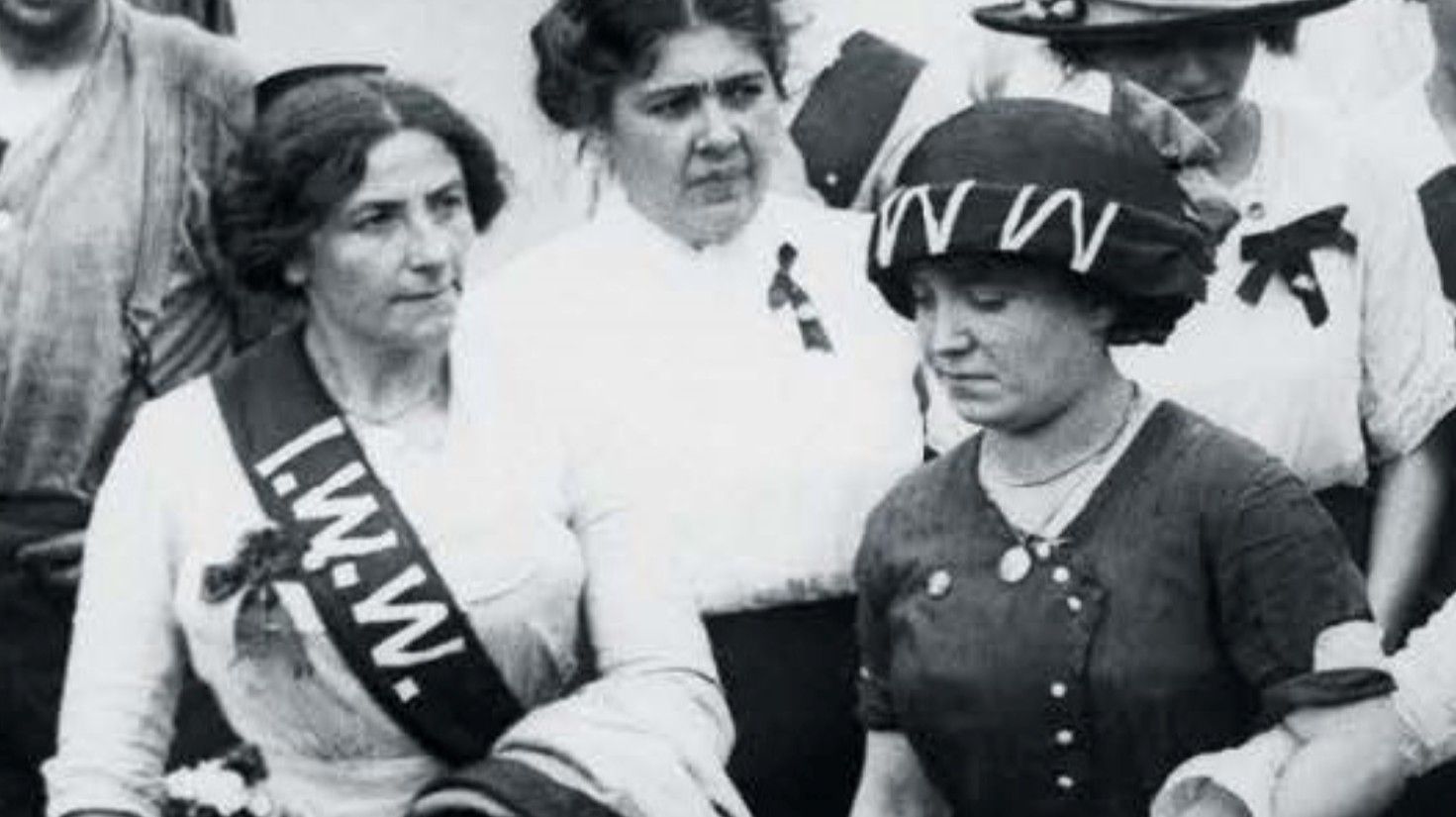
Teresa, a fifteen-year-old Italian immigrant on strike against Paterson, New Jersey’s Bamford Mill, tells her story. Not only was the the months-long general strike of multi-national, multi-lingual textile workers a high-point for I.W.W. organizing in the East, ‘Paterson’ remains an example of the best of the U.S.’s radical labor tradition. While Paterson saw strikes before, and many since, the 1913 strike was a militant lead of what was a national rise in labor struggles, and being across from New York City it received attention it might not have, including by magazines like The Masses, if the same struggle happened elsewhere.
‘I Make Cheap Silk’ from The Masses. Vol. 5 No. 2. November, 1913.
(The Story of a Fifteen-year-old Weaver in the Paterson Silk Mills, as Told by Her to Inis Weed and Louise Carey.)
TERESA led us through a narrow passage way and into an inviting little garden, containing patches of vegetables and a grape arbor. There were gates into the neighboring enclosures and pleasant goings to and fro. Children lived in these gardens, too–not on the street. What a contrast to the dreary back yards of so many American workers’ houses-wastes of trash and empty cans! One grew quickly aware of a definite contribution from these Italians to the civic life of Paterson.
“It is like Italy!” was our involuntary exclamation as we sat down on the little bench by the grape arbor. “Oh, no! It is not so beautiful like Italy,” protested Theresa, shaking her pretty head.
We asked for her story. “How long have you lived in America?”
“I came when I was four, with my mother and my brother, but I went back when I was eight. I was with my mother when she went home to die.”
“Do you like America?”
“No,” thoughtfully, “I do not like this country. My mother did not like this country either.” She paused broodingly. “She was not brought up to work. She spoke French as well as Italian, and she knew English before she came to America. Her father, my grandfather, has a silk mill near Naples. My mother was in school. She was only sixteen when she married. She made a mistake. After she married her life was very hard. When we came to America she went to work in the silk mills. She got consumption. The doctor said, ‘You must not work so hard,’ She said ‘I must work for my children.’ She got sick all the time. Some days the workers would bring her home fainting from the mills. She would tell people, ‘Only for my children I would like to die.’ All times she had a fever and some nights she was out of her head. Then she would say, ‘I am so tired–I am so tired.’
“One day she told father, ‘I do not want to die in this country; I want to go back to Italy to die.’ My mother had saved a little money. She took my brother and me and went back to her father in Caserta. In a few months my mother died.”
“What became of you then?”
“Then my brother and I lived four years with our grandfather. I went to school three hours in the morning. I had a governess, too. She taught me music and embroidery, and would take me out in the hills in the afternoon. It was not like here. There was flowers everywhere. Even the poor people had flowers.” Her eyes took on a far-away look. “I took my first Communion over there. It was lovely,” clasping her hands, “with all the little white dresses and veils and candles and flowers. I still have my medal,” fingering it on the slender chain at her neck.
“Then when I was twelve, my father came for my little brother and me. My grandfather he wanted to keep us always. But my father said, ‘No, they are mine.’ He got some law papers, and my grandfather had to give us up. Over here I went to school for a year. I made two grades in one year and I wanted to stay. But my father he kept talking about the day when I shall go to work. His wages had been cut a little at a time, so he received only half so much as when he first come. And my stepmother, she said, ‘Yes, Teresa will soon be able to go to the mills.’ The summer I was thirteen my father he said, ‘Now you must go,’ and he fixed it up at the City Hall. I cried, but I went to work as a winder in Hammil’s mill.”
There this child of thirteen walked back and forth ten hours a day, tending fifty-six spools. All Teresa remembers about that place is the ache in her feet, her longing to get out to play, and the crazing monotony of walking in front of the spindles like a little bear in a cage. One day she rebelled against this travesty on childhood and quit.
After resting a while Teresa became a ribbon pinner in Bamford’s mill, then a ribbon weaver. She was so little the bosses had to make a bench for her to stand on so that she could reach over the loom to put in the ends.
“No, Bamford’s is not a good place to work,” was Teresa’s reply to our questioning. “It’s fierce every way. The air is bad. The windows are nailed down. The little panes that turn are never opened in winter, ’cause the boss he say he is afraid he should catch cold. In summer they are not open unless you ask. The floor is so rough great splinters stick into your shoes. It is very dirty, too, and other things are something fierce. But the girls in Bamford’s other mill in Paterson say they have it worse; they are afraid of the rats. In winter they say there is no heat unless their fingers get so stiff they can’t work fast. No, I don’t know how it is in Bamford’s Pennsylvania mill.
“When I started weaving ribbon my father and Mr. Bamford they made a contract over me for one year. Yes, all the other weavers are young like me and work on contract.”
She began work at $3 a week. After a month of weaving her wage was raised to $3.75, then to $4, and just about a month before the strike she began to get $6. “Every pay we girls get only half. The mill holds back the other half until we’ve worked a year.” And then the fines–for every conceivable offense. When the fines had been deducted from the half pay, there was sometimes only 78 cents a week left! If a child leaves before the year is up, the mill retains the unpaid half of the wage.
“Most of the girls go before the year is up,” explained Teresa. “They rather lose the money than stay and be treated so mean. The bosses they holler and curse at you so. The superintendent and forelady, they aren’t so bad, but they have to holler when the bosses come round.”
Teresa tended two ribbon looms, a task too heavy for a strong man. She does not know how much she weaves. The little clocks that keep the count are locked up so the workers cannot see. The last day she worked on the single loom Teresa overheard the man who read the clocks say “twenty-two yards.” That would be 352 yards of ribbon in a day. “I ask sometimes, how much I weave? They say, ‘What for do you want to know? That girl over there weaves faster than you, you damn kid!'”
Indeed, Teresa’s story was one long record of “speeding up.” The child hurried out of bed by lamp light at half past five on winter mornings. She gulped her breakfast and arrived at the mill breathless from the haste born of anxiety lest she should not arrive before the door shut. If the children are late at Bamford’s they are frequently locked out half a day and one whole day taken off their wages. At noon the little workers must rush if they are to have a chance to wash their hands and get a drink before being locked out into the hall where the workers sit on the stairs to eat their lunch, stairs where the water leaks down on rainy days.
“Bye and bye,” added Teresa, “I got so I felt sick. Every week I would have to go home two or three afternoons. It was such a pain in the pit of my stomach. The doctor said it was because I hurry so.”
We continued to ply the child with questions–Had she had any other illness? “Yes, an accident. I was on the stairs one day eating my lunch. One of those big wheels with fire hose around came loose and fell on my head. And I don’t know nothing after that for the whole afternoon. But they tell me I had fits. No, they didn’t call in a doctor–not on your life. They had fear of a damage suit. They gave me a free ride home in their automobile that night. They would get enlargement of the heart and die if they did more. My father called the doctor. He said I should stay home a while and not go back to the mill until I felt good again. The top of my head hurt all the time, but I went back to work after five days. My father he had been on strike nine months and we needed the money.”
The father, in the stress of the strike, went to a lawyer to see if there was any way to get the child’s $70 of back pay which was being held beyond the contract year on the ground that Teresa, owing to her head, had not worked a full year; but the lawyer said there was no escape from the contract.
In the fourteen weeks since she stopped working under this vicious contract she has gained eleven pounds. It is significant when compared with the fact that during her two years in the mills she gained only six pounds.
“I hate to go back to that mill,” said Teresa, as we talked of her future. “I hate always to be fined and screamed at. Maybe a girl wastes a little silk. If they do not know who did it, they fine everyone of youse. Maybe you could not believe it, but they steal our hooks and scissors from us and then we have to buy them back again for thirty-five cents. Then we must clean up the mill Saturdays after twelve. No, we do not get paid for it. They take it out of our holiday.
“I want always to go back to Italy, but since the strike I am more happy here,” with an unconscious gesture toward her heart. “We are all together. We stand solid. My father he says there will always be bosses. I say, ‘Yes? Then we shall be the bosses.’
“Yes, I am still a Catholic. These days I feel different. You go to confess and the priest he tries to find out all about the strike and he scolds us that we belong to the union. I like I.W.W. better than God. God, he don’t talk for me like I.W.W.”
“Yes,” said Teresa after the strike, “for me it has paid me. I get 25 per cent, increase in my wages. All of us at Bamford’s get a raise, and no more children in the mill, so then there will be no more contract system after we have finished our contracts and got our back pay. Nor do they holler at us so.
“The labor inspector, he is on the job, too, since the strike. You should see how he makes Bamford’s take a brace. There are guards on the dangerous machinery. There are rattling fire alarms, and there is whitewash all over the place.”
“Will this last, do you think?” we asked. “I don’t know. If it don’t, we strike again.”
The Masses is among the most important, and best, radical journals of 20th century America. It was started in 1911 as an illustrated socialist monthly by Dutch immigrant Piet Vlag, who shortly left the magazine. It was then edited by Max Eastman who wrote in his first editorial: “A Free Magazine — This magazine is owned and published cooperatively by its editors. It has no dividends to pay, and nobody is trying to make money out of it. A revolutionary and not a reform magazine; a magazine with a sense of humour and no respect for the respectable; frank; arrogant; impertinent; searching for true causes; a magazine directed against rigidity and dogma wherever it is found; printing what is too naked or true for a money-making press; a magazine whose final policy is to do as it pleases and conciliate nobody, not even its readers — There is a field for this publication in America. Help us to find it.” The Masses successfully combined arts and politics and was the voice of urban, cosmopolitan, liberatory socialism. It became the leading anti-war voice in the run-up to World War One and helped to popularize industrial unions and support of workers strikes. It was sexually and culturally emancipatory, which placed it both politically and socially and odds the leadership of the Socialist Party, which also found support in its pages. The art, art criticism, and literature it featured was all imbued with its, increasing, radicalism. Floyd Dell was it literature editor and saw to the publication of important works and writers. Its radicalism and anti-war stance brought Federal charges against its editors for attempting to disrupt conscription during World War One which closed the paper in 1917. The editors returned in early 1918 with the adopted the name of William Lloyd Garrison’s The Liberator, which continued the interest in culture and the arts as well as the aesthetic of The Masses. Contributors to this essential publication of the US left included: Sherwood Anderson, Cornelia Barns, George Bellows, Louise Bryant, Arthur B. Davies, Dorothy Day, Floyd Dell, Max Eastman, Wanda Gag, Jack London, Amy Lowell, Mabel Dodge Luhan, Inez Milholland, Robert Minor, John Reed, Boardman Robinson, Carl Sandburg, John French Sloan, Upton Sinclair, Louis Untermeyer, Mary Heaton Vorse, and Art Young.
PDF of full issue: https://www.marxists.org/history/usa/pubs/masses/issues/tamiment/t32-v05n02-m30-nov-1913.pdf

