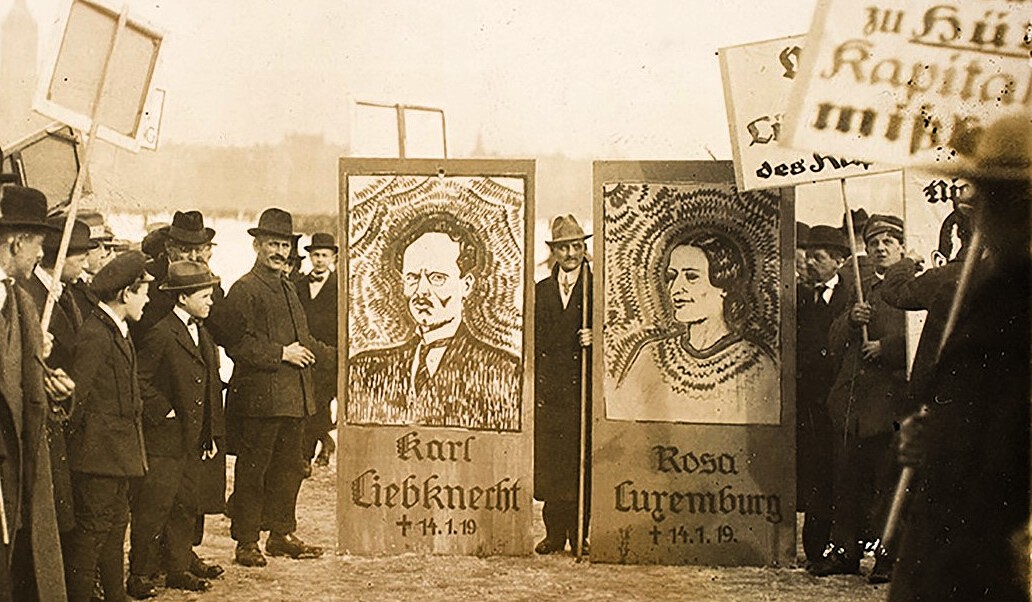
Wittman, a supporter of the militant minority, gives internationalist comrades in the U.S. an insider’s view into the splits among German Socialists that were already well developed before 1919.
‘Socialism and Patriotism in Germany’ by Carl Wittman from International Socialist Review. Vol. 17 No. 3. September, 1916.
(EDITORIAL NOTE. Carl Wittman was in Dresden from October, 1913, to April, 1916. From the beginning of the war he assisted in organizing the opposition. He was in intimate personal contact with Liebknecht, Rühle, and other leaders of the minority group. With regard to German party affairs he writes with authority.)
I. The Majority Group.
THE Social Democratic Party of Germany is divided into three groups. The so-called majority is in control of all excepting a few of the party papers. Most of the active politicians and labor leaders belong to this group. These are the ones who signed a treaty of peace with German capitalists on August 4, 1914, and joined in declaring war on foreign nations. They openly proclaim that in wartime the interests of the working class are identical with those of the capitalist class. Since the beginning of the war there has been no difference between their organization and the various bourgeois parties. The German government is for them the innocent and outraged party, acting solely in self-defense. They are asking German working people to hold out, to hunger and suffer for the sake of victory.
After the war, to be sure, they will fight for the people again and force the government to give them–a better suffrage law! In the meantime, the relations between them and the government is a very close one.
One day between August 1 and 4, 1914, when the whole world was asking “What will the German Socialists do?” there occurred a significant incident. The Socialist members of the Reichstag were holding a conference. Comrade Haase took the floor and offered to give proof that some Socialist was giving reports of their proceedings to the government. He presented a resolution that the matter be investigated. Instantly Carl Legien was on his feet with a motion that Haase’s resolution be tabled. The resolution was tabled and thus debate was shut off. Recently an imperial minister said to Haase that he finds it much easier to come to an agreement with Scheidemann than with a committee of two or more Socialists.
Bernstein was once called in by a member of the government and asked to write a series of articles with a certain tendency. Honest old Bernstein refused. But shortly afterward just such a series made the rounds of the press–signed by Scheidemann!
When Rosa Luxemburg, Clara Zetkin and dozens of other comrades were the guests of the army—in jail, Scheidemann, Eckert and other members of the Executive Committee were entertained by General von Bissing, the military governor of Belgium. This is the very von Bissing who wrote a book on How to Keep the Socialists in Check. A little later these “Socialists” voted to reduce the rations of the German people. Shortly afterward they were met in battle array by sundry German women armed with such primitive weapons as handbags and umbrellas. Despite their intimate association with a famous general they were ignominiously beaten.
Mrs. Dunker, an active Socialist organizer among the women, led an anti-war demonstration before the Reichstag building. She was denounced by “Comrade” Heine. On the floor of the Reichstag this same Heine called Karl Liebknecht, at various times, a traitor, a maniac, a crank, and a comedian.
At the time when the minority cut themselves loose and formed the group known as “the eighteen,” the majority gave proof of fidelity to the government. Haase had evidence that peace overtures had been made to Germany in March, 1915. He had started an address in which he intended to present this evidence. The Socialist majority turned on him with howls and threats. Haase was forced to stop and then he was denied the privilege of continuing.
Haenisch, another leader of the majority, wrote in a conservative paper that he stands nearer to the most conservative than to Liebknecht and his kind. It was, he said, the happiest day of his life when he could sing, with overflowing heart, Deutschland, Deutschland Uber Alles.
II. The Kautsky-Haase Group.
A greater danger to the International is the Kautsky-Haase group. Opportunists first and last, they live on compromise and make their way by keeping their ear to the ground. In Germany they are known as the “Sumpf,” which means the swamp. Kautsky is their spiritual leader. Long after the war had started Kautsky proclaimed that the International is an instrument to be used only in time of peace. Having labored long to build up the party, his one thought was to keep it intact. When this old world was bursting, and everything undergoing a change, he thought his party alone could remain unchanged. It was not for the purpose of taking up the fight against imperialism that Kautsky supported “the eighteen.” It was rather to prevent the radical wing from gaining control of the masses. With three or four exceptions the eighteen members of the Reichstag affirm the duty of national defense–as do the majority. They hold merely that the conditions which make it a duty do not exist at present. This appears clearly from the statement which they submitted when they refused to support the war budget. They said, in effect, that since Germany is not threatened, since German armies stand in the enemies’ territory, it is the duty of the government to open peace negotiations. Liebknecht and Rühle signed this declaration, because they wanted to encourage the others to take a first step in opposition to the government. They took occasion, however, to point out the inconsistency of considering any country safe as long as capitalist armies exist and the foolishness of this position became evident the moment the French Socialists took it under consideration. According to the principle involved the French Socialists are bound to support their government until French armies are on German soil. If this principle were accepted by the International there would have to be a change of policy with every shift of the fortunes of war. Kautsky and his group have not yet learned that all war taxes are bad taxes.
There is a good deal of dissatisfaction among members of the majority group. Many of them would rather follow Haase than Scheidemann. And it is quite possible that a combination will be formed in the near future. Then the great, harmonious Social Democratic Party of Germany, with its millions of followers, will again be the model of other national organizations. Conventions will be held, Ledebour will make speeches, resolutions will be passed, Kautsky will write more than ever, and the rank and file will pay dues. This is the program of the Kautsky-Haase group, the “Sumpf.”
III. The Militant Minority
We do not find members of this group on the benches of the Reichstag nor in well paid positions in labor unions or co-operative societies. They are behind the bars of jails up and down the country. The prosecuting attorney of his Majesty the Kaiser is their recording-secretary. He keeps the roll of membership free of charge. In the Reichstag they are represented by Rühle and Liebknecht–or were until Liebknecht was imprisoned. Clara Zetkin and Rosa Luxemburg have served their terms, Franz Mehring and Dr. Meier have had close calls. These are the best known members of the group.
These militants have very few papers, but they print and distribute millions of leaflets against the war. Some of these reach the front. Posters bearing the words, “We are hungry; we want peace!” are put up in public places. Many have been imprisoned for carrying on such work. These comrades, even though they have paid dues for years, have not received the customary legal assistance from the party.
For this, as well as for more important reasons, there must be a split in the party. What could be more ridiculous than to condemn the majority and at the same time to support an organization which they are using in the interests of war and patriotism? It is high time to dissolve partnership with those who have denied all the fundamental principles of Socialism. We have paid long enough for things which we do not want. We must build up a new party. The essential thing is quality, not quantity. We need the right spirit rather than great numbers. The little Socialist party of Servia gave a better account of itself than the great Social Democracy of Germany. The Italian party had just got rid of its reformists and in the face of the war it has stood up for Socialism and internationalism better than any other party in any warring nation.
With the Italians and Servians, with the Socialist parties of the United States and other neutral countries, with all the sections of England, France and Russia, and with the German minority we must found a new international. Kautsky and his followers do not see the necessity for such an organization. But surely those who believe that one’s first duty is to the nation, and that the International is to be used only in time of peace, cannot take part in the formation of an effectual organization of the international working-class. It is the militant minority–the Liebknecht group that will make it possible to have a German section in the new International.
The International Socialist Review (ISR) was published monthly in Chicago from 1900 until 1918 by Charles H. Kerr and critically loyal to the Socialist Party of America. It is one of the essential publications in U.S. left history. During the editorship of A.M. Simons it was largely theoretical and moderate. In 1908, Charles H. Kerr took over as editor with strong influence from Mary E Marcy. The magazine became the foremost proponent of the SP’s left wing growing to tens of thousands of subscribers. It remained revolutionary in outlook and anti-militarist during World War One. It liberally used photographs and images, with news, theory, arts and organizing in its pages. It articles, reports and essays are an invaluable record of the U.S. class struggle and the development of Marxism in the decades before the Soviet experience. It was closed down in government repression in 1918.
PDF of full issue:
 Revolution's Newsstand