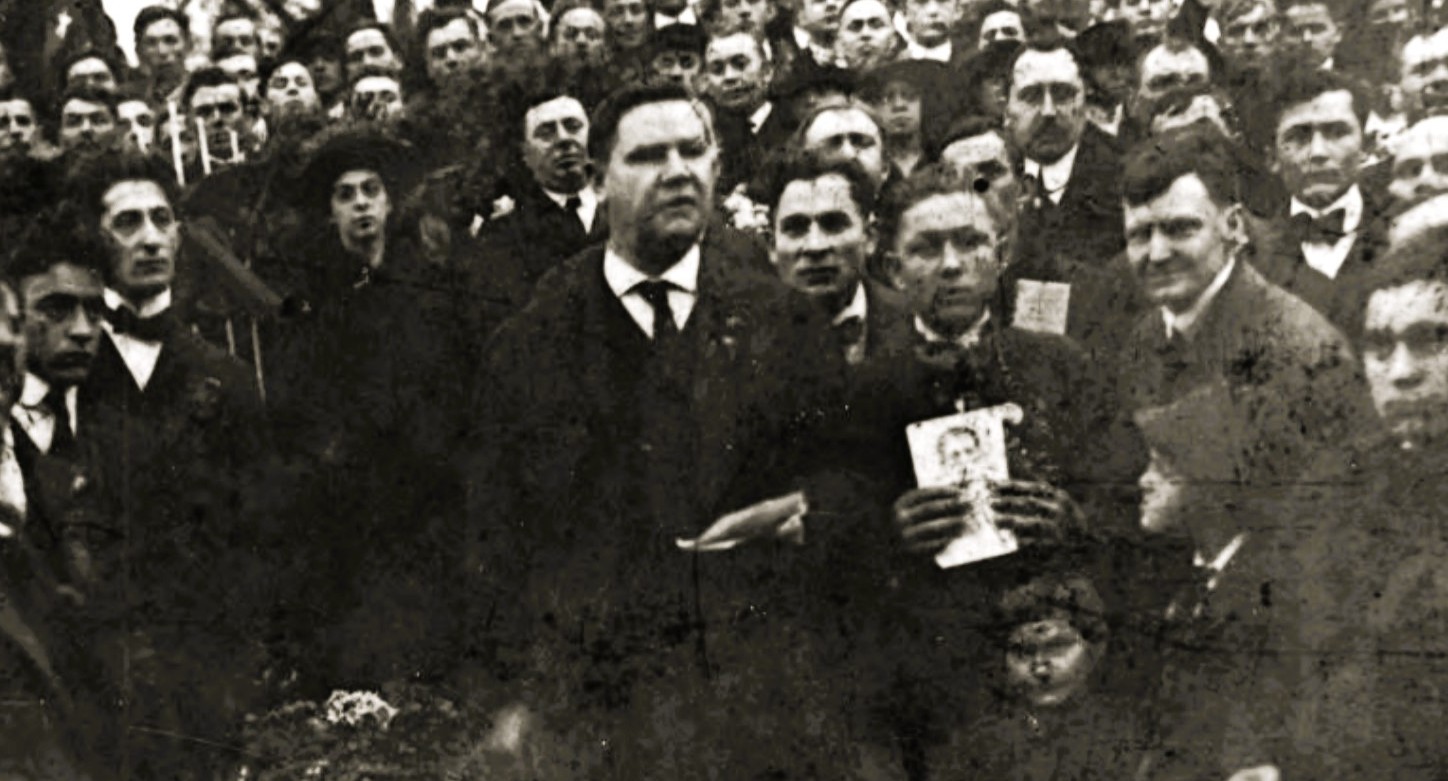
Haywood, the magnificent. No figure in the U.S. workers’ movement, before or since, compares to William D. Haywood. The big miner had a reputation, one he undeniably allowed if not fostered, of being as tough as his imposing size. Tough he was, but he was as intelligent, thoughtful, and ambitious as any political activist, and far more than most. Before he was the leader of the I.W.W., from his acquittal in 1907 until his recall from the Socialist Party’s national leadership in early 1913, Haywood would lead a Left Wing insurgency–though initially nuanced–in the Socialist Party based on the kind of politics below in his debate on ‘trades unionism’ with a leader of the Right. This is what revolutionary Marxism in the U.S. sounded like before the Communist movement.
‘Comrade Haywood Defends His Position’ from The New York Call. Vol. 3 No. 362. December 28, 1910.
Editor of The Call:
Comrade Gerber seems somewhat exercised over a statement made by me. “No Socialist can be a trades unionist.” It is very evident that Comrade Gerber has given no time to analyzing that statement. It is certainly not the principle involved with which he quarrels, but rather the words used in expressing it. If I had said. “All Socialists must be industrials,” there would have been nothing with which Comrade Gerber could take issue.
Omitting all personal references in the making of which Comrade Gerber but weakens his position, I will discuss the question involved.
If Comrade Gerber heard my lecture or read the report, he must know that the broad statement, “No Socialist can be a trades unionist,” was immediately followed by an exposition of the ethics of trades unionism, which are diametrically opposed to the fundamental principles of Socialism.
The program of Socialism involves the entire working class. And any organization that infringes upon the rights, or excludes any worker from privileges which he or she should enjoy, is opposed to the interests of the working class, and cannot be upheld by Socialists.
Comrade Bebel has said that membership in a labor union is a necessity of life for every workingman. Is it not a fact, Comrade Gerber, that there are trades unions that make it absolutely impossible for a worker to enjoy this necessity of life? Is it necessary for me to mention the means by which membership in trades unions is prevented? The apprenticeship system, technical examinations, prohibitive initiation fees, the books closed to all applicants, the refusal of some unions to accept women, the exclusion of negroes, and the closed door to those of foreign birth, no matter how skilled. Do not these and other provisions of trades unions deny the working class that which Comrade Bebel has described as a necessity of life for all workingmen? And if these facts are true, is there not some form of organization which is broad enough to take in all productive workers of every race, creed, sex and color?
During the next ten years, judging by the past decade, the trades unionists of the United States and Canada will contribute the aggregate sum of $400,000,000 in dues, fines, assessments and subscriptions with no guarantee to the membership of greater results than have been obtained within the last ten years. Meanwhile the purchasing power of the wages of organized and unorganized workers has vastly decreased and will continue to do so. Suppose this vast sum of four hundred millions could be turned into the channels of Socialist organizations, to unite the workers industrially and politically. What magnificent results could be achieved! Many Socialists, like Comrade Gerber, imagine that political victories mean Socialism. It would not. While I agree that the control of government is necessary to gain the means of wealth production, the election of political officeholders is not the ultimate triumph. There must be the well drilled army of the working class operating and controlling the industries before we can have Socialism. For Socialism is industrial self government by the workers. Debs says:
“Socialism must be organized, drilled, equipped, and the place to begin is in the industries where the workers are employed. Their economic power has got to be developed. or their political power, even if it could be developed, would but react upon them, thwart their plans, blast their hopes and all but destroy them.
“Such organization to be effective must be expressed in terms of industrial unionism. Each industry must be organized in its entirety and all working in the interest of all, in the true spirit of solidarity, thus laying the foundation and developing the superstructure of the new system within the old, from which it is evolving, and systematically fitting the workers, step by step, to assume entire control of the productive forces when the hour strikes for the impending organic change.”
“Voting for Socialism is not Socialism any more than a menu is a meal.”
And Bebel has told us that he was “convinced that no tongue, however eloquent, and no pen, however able, can long persuade the trade unionists of different factions that what has proved to be a great advantage to their natural enemies, the class of the employers, is a disadvantage to the workingmen.
“As centralization in the organization of the working class becomes necessity against the centralizing tendencies of capitalism, so the centralized united labor unions of the workingmen is necessary against the centralized industrial organization of the employers.”
Unions should not be organized to control the commodity labor power to the detriment of other workers who have the same commodity for sale. But there should be one great organization of all workers controlling their labor power, applying it when needed to the resources of the earth for the benefit of society.
WM. D. HAYWOOD. New York, Dec. 26, 1910.
The New York Call was the first English-language Socialist daily paper in New York City and the second in the US after the Chicago Daily Socialist. The paper was the center of the Socialist Party and under the influence of Morris Hillquit, Charles Ervin, Julius Gerber, and William Butscher. The paper was opposed to World War One, and, unsurprising given the era’s fluidity, ambivalent on the Russian Revolution even after the expulsion of the SP’s Left Wing. The paper is an invaluable resource for information on the city’s workers movement and history and one of the most important papers in the history of US socialism. The paper ran from 1908 until 1923.
PDF of full issue: https://www.marxists.org/history/usa/pubs/the-new-york-call/1910/101228-newyorkcall-v03n362.pdf

