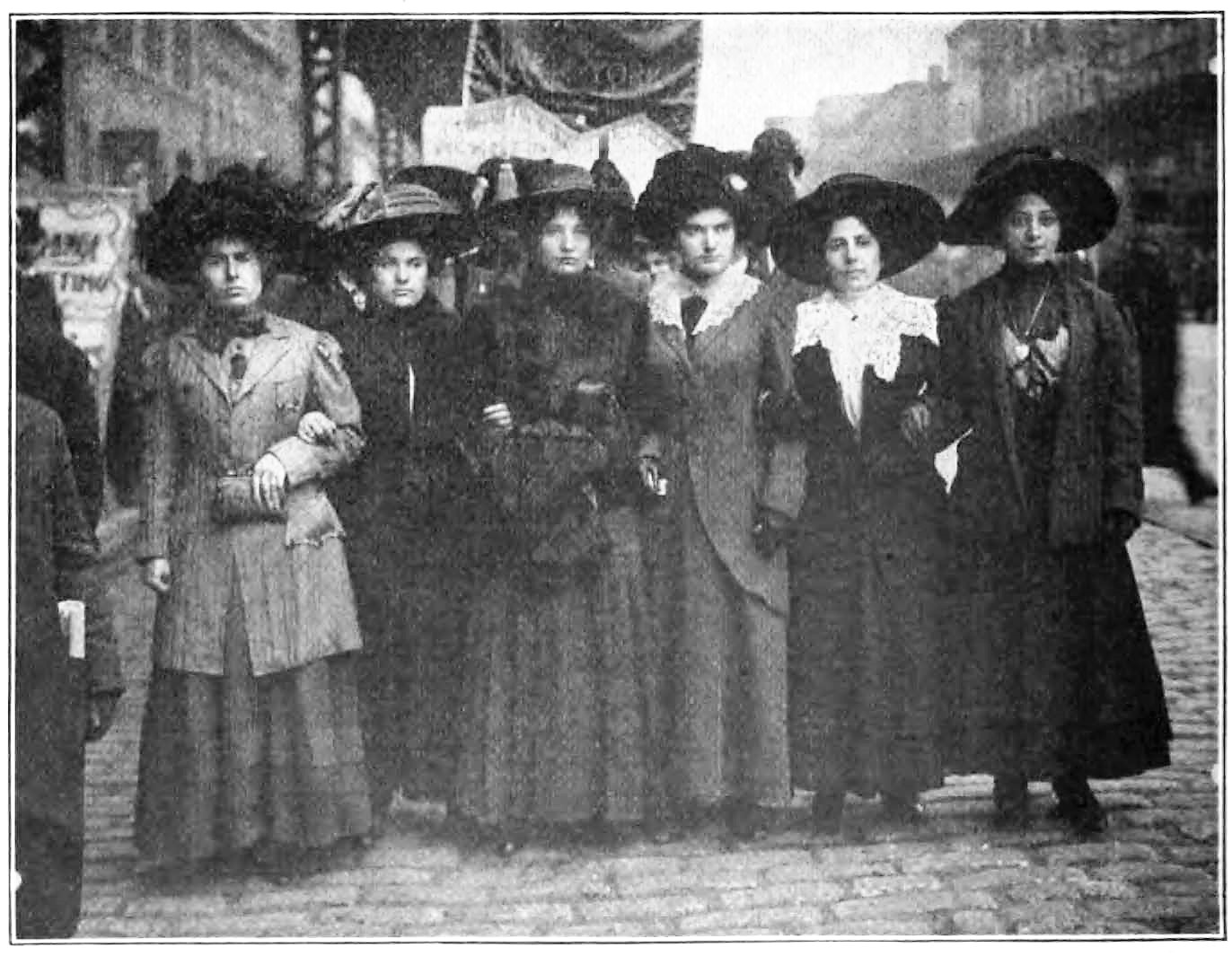
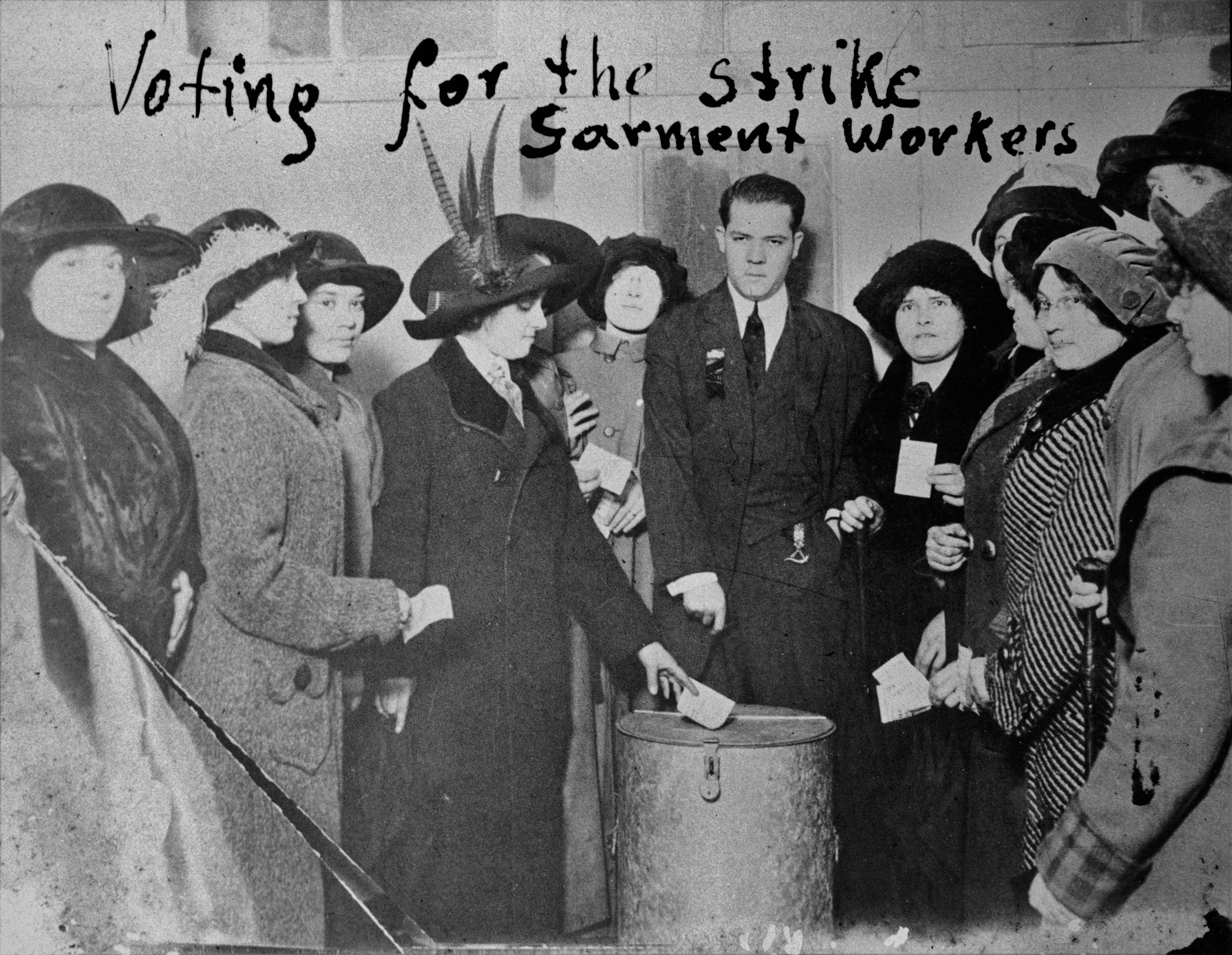
A defining strike for the U.S. labor movement, the ‘Uprising of the 20,000,’ begins. To support the workers in a dispute with the Triangle Shirtwaist Co., a general strike was voted on at a mass meeting of garment workers on November 22, 1909. That first day 15,000 workers answered the call with the number soon doubling. Largely involving women of immigrant families ,Jewish and Italian, and lasting until March, 1910, the strike saw mass support and was largely successful. A whole generation of New York activists, including many to have national profiles, came of age politically during those electric, momentous days. A flavor of which is given below.
‘Shirtwaist Strike in Full Swing’ from The New York Call. Vol. 2 No. 288. November 24, 1909.
Fifteen Thousand Workers Answer Cali for a General Walk-Out.
TWENTY BOSSES SETTLE
Immense Throng of Determined Women and Men Pack 14 Halls and Jam Streets.
Fifteen thousand waist makers walked out yesterday in response to the call for a general strike issued by the Ladies Waistmakers’ Union Monday night, after tumultuous scenes in four of the largest halls on the East Side. The general strike comes as the culmination of unrest which has been at boiling point for months because of the inhuman conditions under which the workers in the trade have been forced to toil. It is expected that the number of strikers will be swelled to twenty thousand or more today, and by tomorrow night it is expected that the entire trade in the greater city will be tied up. The strikers demand recognition of the union, an increase of 20 per cent in wages and shorter hours.
The strike was but a few hours old when the bosses began lining up in front of the offices of the union in Clinton Hall, and before the day was over, twenty of them had settled with the union and 500 strikers will return to work this morning, having gained all of their demands. The employers who settled with the union each de posited a bond for $300, guaranteeing that they will live up to the agreement and observe union rules in their shops.
Strikers Fill Fourteen Halls.
The East Side was a seething mass of excited women, girl and men. There was not halls enough to hold the vast crowd, although fourteen of the largest halls were jammed with excited strikers. So big was the crowd in the streets that 200 police reserves and plain clothes officers were required to maintain order. Everywhere, all over the East Side, a sea of excited faces, a mass of gesticulating women and men, blocked the streets. At the entrances to the hall the crowd pressed and jammed forward in the hope of getting in to hear the speakers.
Clara Lemlich, the young girl upon whose motion the general strike was declared, spent the entire day going from hall to hall speaking to the audiences, which jammed them to the doors. Another young girl, Becky Mushofsky, spoke to the vast crowds which poured into Great Central Palace during the day for inspiration and instruction.
The strike is in charge of the following committee of the United Hebrew Trades, the central body of the Jewish unions; Max Kasimireky, A. Miller. B. Weinstein, J. Goldstein and Lebovitz. The committee assisted. Organizers Frishwasser and Baroff, of the Waist Makers’ Union, conducted meetings for the strikers in fourteen of the largest halls.
Holds Scores of Shop Meetings.
Scores of shop meetings were held during the day in the following halls: Clinton Hall, 151 Clinton street; Great Central Palace, 96 Clinton street; Apollo Hall, 126 Clinton street; Odd Fellows Hall, 98 Forsythe street; Majestic Hall, 106 Forsythe street; Terrace Lyceum, 206 East Broadway; New Pythagoras Hall, 177 East Broadway; New Star Hall, 72 Ludlow street; Astoria Hall, 62 4th East street; Manhattan Lyceum, 66 East 24th street; Casino Hall, 85 East 4th Street; New Fulton Hall, 223 East 2d street; Beethoven Hall, 210 East 5th street; and Clinton Vaudeville House, 82 Clinton street.
The committee in charge of settlements with the bosses consists of: B. Witaskin, J. Goldstein, and Hyman Shoev.
Helen Marot, Mary E. Dreier, Gertrude Barnum and Leonora O’Reilly. representing the Women’s Trade Union League, assisted the officers of the union at strike headquarters in Clinton Hall in handling the employers, who came to seek settlements with the union, in helping to keep the vast crowd which thronged the hall in order, in answering the innumerable questions which were hurled at the information bureau.
The trade is so greatly subdivided that the problem of fixing prices for the various operations in making waists is a very difficult one. Most of the workers in the trade are piece workers. They are divided as follows: Body makers, sleeve makers, sleeve setters, yoke setters, lace runners, trimmers, tuckers, collar makers, closers, hemmers, joiners, drapers, finishers, pressers, buttonhole makers, button sewers, skirt and waist joiners.
Strike Leader Slugged by Boss.
Yesterday morning when Herman Shafer announced in the shop of the Reliance Waist Company, at 588 Broadway, that a general strike had been called, and asked the men and women to leave the shop, he was set upon by the proprietor and an assistant, he alleges, and brutally beaten up. He was taken from the shop to the office of a physician, where his wounds were dressed. It was announced at strike headquarters last night that a warrant would be sworn out today for the arrest of Shaffer’s assailants.
Miss Elizabeth Dutcher, a member of the Executive Board of the Womer’s Trade Union League, gave the following statement to The Call yesterday:
“The Women’s Trade Union League has, as you know, been doing picket duty for the last seven weeks on Washington place, in connection with the lock-out of the ladies’ waist makers, at the Triangle Waist Company,” said Miss Dutcher.
“We have been carrying this on under great difficulties, as, while we were on the one hand assured of police protection by Commissioner Baker, we also had the verdict of Magistrate Cornell, of the Jeferson Market Court, that we have no right to picket; no right to be on Washington place, and that if we should go there we would do so at our own risk.
“However, the results have been fairly satisfactory. In the four weeks before we went on this service. 146 of the strikers were arrested and fined amounts varying from $1 to $20. Since we started picketing with the strikers there have been but three arrests.
Bosses Arouse Race Prejudice.
“As the strikebreakers are all Italians, and the strikers Jewesses, there is danger of racial feeling, which we feel the masters are constantly inciting. The work of outside pickets in this strike, then, is to prevent police interference and race warfare.
The picketing hours are from 7:45 to 9 or 9:30 in the morning, and from 5:15 to 6:15 in the evening. Our league is not a large one, and we feel that the time has come when we must ask for assistance from our sympathizers in this matter.
“Now comes the declaration of a general strike of the Ladies’ Waist Makers, bringing out from 20,000 to 30,000 of these workers in New York city. This question of the right to picket must necessarily become more acute in the next few weeks, and we want the co-operation of every friend of labor.
“We look to the readers of The Call for men and women who will be willing to give some of their time to this work,” said Miss Dutcher.
“Will any man or woman who is in sympathy with the exploited wage workers of New York city, and who is willing to help by giving a part of their time and strength to this definite and practical work please send his or her name to Miss Violet Pike, at 43 East 224 street, as soon as possible.”
Fifteen out of twenty waist manufacturing shops in Brownsville were tied up yesterday when 1,100 girls walked out. Shop meetings were held in Washington Hall, American Star Hall and Metropolitan Saenger Hall during the day. Crowds of workers jammed into each hall.
It is expected that every waist manufacturer in Brownsville will be forced to close their shops today when the rest of the workers walk out.
A rousing mass meeting was held last night in Metropolitan Saenger Hall, Pitkin avenue and Watkin street, which was addressed by Jacob Panken, J. Goldstein, A. Miller, R. Weinstein, Max Pine, Charles Fromer and A. Baroft. G. Genzeloff presided. The crowd cheered the assurances of the speakers that if they stood together they would win all their demands.
The New York Call was the first English-language Socialist daily paper in New York City and the second in the US after the Chicago Daily Socialist. The paper was the center of the Socialist Party and under the influence of Morris Hillquit, Charles Ervin, Julius Gerber, and William Butscher. The paper was opposed to World War One, and, unsurprising given the era’s fluidity, ambivalent on the Russian Revolution even after the expulsion of the SP’s Left Wing. The paper is an invaluable resource for information on the city’s workers movement and history and one of the most important papers in the history of US socialism. The paper ran from 1908 until 1923.
PDF of full issue: https://www.marxists.org/history/usa/pubs/the-new-york-call/1909/091124-newyorkcall-v02n288-shirtwaiststrike.pdf

