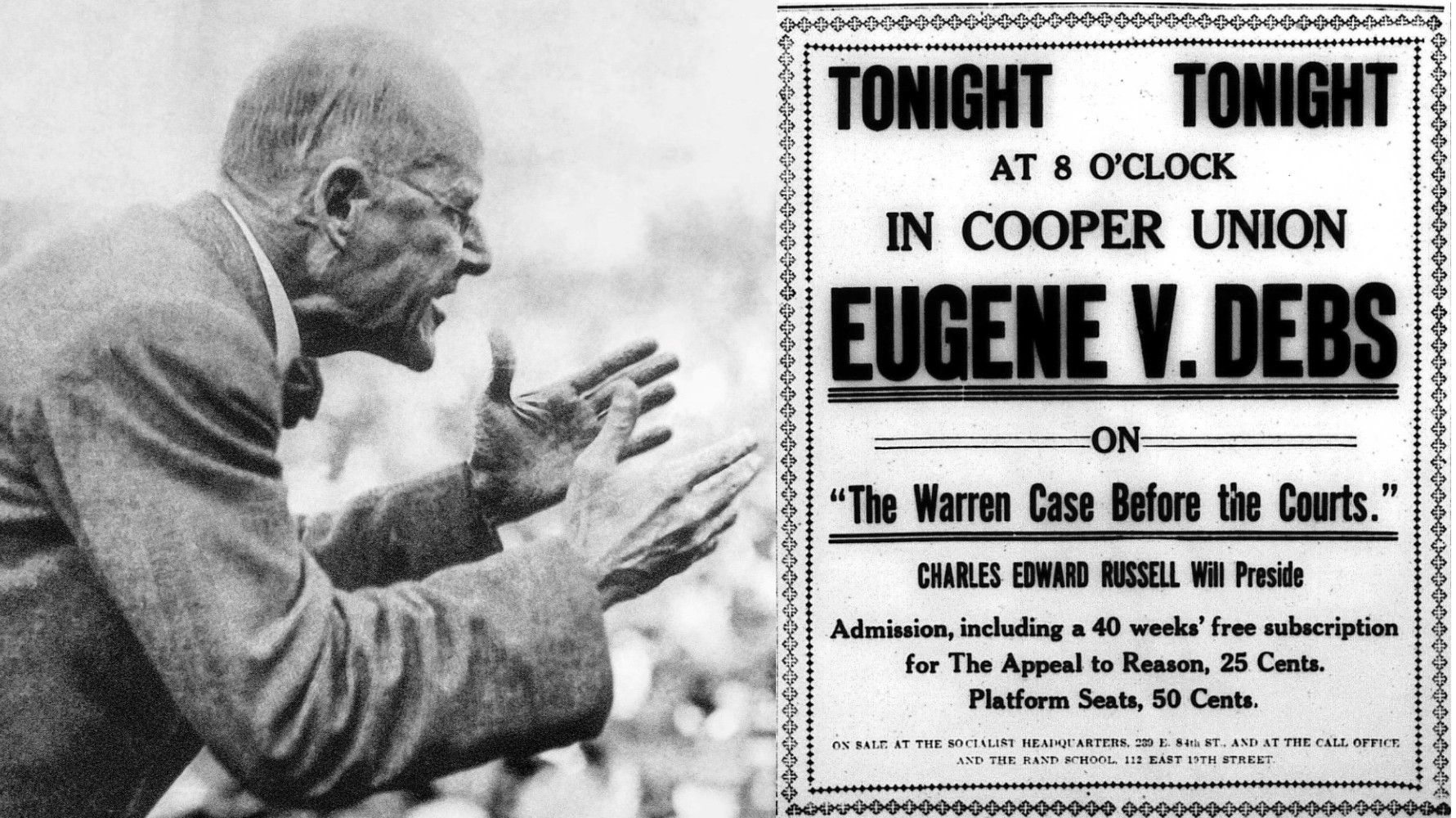
Debs speaks at New York City’s storied Cooper Union to thousands on April 7, 1910.
‘Debs Flays Courts in Passionate Speech’ from The New York Call. Vol. 3 No. 98. April 8, 1910.
Cooper Union Jammed With Thousands of Cheering Workers
THE WARREN CASE VIVIDLY TOLD
Vast Audience Moved by the Strong Denunciation of the Masters and Their Judicial Hirelings. Thunders Approval.
April 7, 1910 will live long in the history of Cooper Union. Never, it can be truthfully said, did a more intelligent and appreciative audience listen to the speech of a famous personage, with more interest and enthusiasm, than the immense gathering that filled the great hall at Cooper Union to overflow last night. It was, in its way, a revelation to the citizens of old New York, who have seen gatherings of a political nature within the walls of that historic edifice. No glaring posters had been conspicuously posted, where they would greet the eye in convenient places. No pages of space had been bought up in the large dailies. Just the mere passing of the word that Debs, Gene Debs. would be at Cooper Union, and that an admission of 25 and 50 cents would be charged to hear him expound the proposition that the Socialist movement held out to the working class was sufficient, and Cooper Union was the mecca for thousands, eager, nay, anxious to pay to hear him.
Long before 8 p.m. the hour for the opening of the meeting, the great hall and platform was densely packed, hundreds were compelled to stand who came after the 2,000 seats were taken.
Precisely at eight, Lucien Sanial, the grand old war horse and pioneer of the American Socialist movement, opened the meeting. He was tendered an ovation. His grand old head just peering over the flag-draped speakers’ stand, made a lasting impression upon the minds of the mighty throng that listened eagerly intently to the words of the grizzled old veteran.
He referred briefly to the great victory in Milwaukee and his statements were generously applauded.
“The capitalists realize,” said Sanial, “that the Socialists are beginning to play an active part in the political struggles In America. They are going to enter the halls of Congress. In co-operation with the Socialists the world over, we are going to take possession of the world. I will detain you but briefly. My function is merely to open the meeting, and introduce your chairman. I have played my part in the general movement and make way for the younger and more virile, not to say more able exponents of Socialism of the present day.”
“In my day, we were but a feeble light in the wilderness of industrial and political chaos compared with the powerful electric light that the present-day movement represents. It gives me great pleasure to present to you as your chairman tonight, a man who has made his mark in the intellectual world and who is promiseful of great things in the Socialist movement. I present to you Comrade Charles Edward Russell.” (Great applause.)
“We are at the dawn of a new day,” said Russell. The true significance of the Milwaukee victory is not that the revolution is at hand; it means that it is already on.” (Applause.)
“The answer to the misery, degradation and spoilation of the capitalistic regime is Milwaukee. And one of the significant factors of the times is the tremendous attack by the government upon the freedom of the press, as exemplified in the persecution of Fred D. Warren of the Appeal to Reason. I wish you to give attention for a few minutes to Comrade George D. Brewer, associate editor of that paper.”
Brewer briefly stated the success of the numerous meetings held all over the country by Debs, and recited a new version of the Twenty-second Psalm that was highly appreciated by the audience, winding up his talk with James Whitcomb Riley’s verse in appreciation of Debs:
“An’ there’s Gene Debs.
A man at stands
And jest holds out
A’tween his two hands
As warm a heart
As ever beat
Betwixt here and the
Judgement seat.”
And then Chairman Russell introduced Debs with the remark that “the man who will next address you needs no words of introduction to any gathering where oppression rules.” Cooper Union has been famous for the past fifty years as the place where the foremost speakers of the times have addressed the people upon topics of more than vital interest. Its walls have resounded with the echoes of tumultuous applause, that greeted the words of those famous emancipators of chattel-slavery, Abraham Lincoln and Wendell Phillips. Ingersoll, in his palmy days, was wont to move its gigantic audiences with his rapturous bursts of mellifluent oratory. The slivery tongue of the “Peerless One” had poured out its rhetorical nothings among the granite arches and pillars, to the plaudits of admiring throngs.
But last night the voice of the new emancipation charged through that historic edifice. Debs, the spokesman of the wage slaves, poured forth with torrents of economic and political facts with which he pilloried the system.
For fully ten minutes after he was introduced by Chairman Russell, the scene in the hall was awe-inspiring. Pandemonium appeared to have broken loose. Each vied with the other to pay their respects to the man who they loved. Staid old Socialists, who had spent lifetimes in the revolutionary movement, both here and in Europe, banged their canes and stamped their feet, while in the eyes of many there glistened tears of joy at the scene.
When quiet was secured, Debs opened up with a eulogy of Ben Hanford. “The last time I was in this hall,” said he, “I listened to the passionate eloquence of Ben Hanford. He was the very [] of the spirit of the working class, the intelligent awakening of that class to its own interests. He gave all be had, including life itself, to the movement, of which he had become a part. His spirit lives in the movement.
“Through all the ages of the past the few have ruled and the many have served. In the ancient ages the working class were abject slaves, and their lot of today is but little better. Their emancipation lies in the Socialist movement. With its triumph will begin march to the noblest civilization the world has ever known.”
In speaking of the Warren case, which was the important topic of his speech, his arraignment of the judicial system was severe and convincing.
The jury that tried Fred W. Warren was composed entirely of Republicans; they wouldn’t even chance Democrat on it for fear there might not be unanimity of opinion.
“Judge Pollock with his especially prepared jury had foredoomed Warren long before the first shred of evidence was introduced.
Supreme Court Corruption.
“As an evidence of the supreme corruption of the federal judges, permit me to state to you, upon unquestionable authority, that Judges Pollock McPherson and Phillips had before them a case of the railroads of Missouri and Kansas, where in it charged that they openly violated 2-cent fare bill. During the time they had this case under consideration they accepted an invitation from the corporation attorneys of the railroads go on a fishing trip down into Mexico. When they returned a verdict in which they maintained that the 2-cent fare bill was unconstitutional.
“Did you ever hear of a court allowed that a decision against labor unions was unconstitutional?
“You must assert your economic and political power if you ever expect to change the conditions that surround you. It is impossible for me to help you. Don’t expect a mythical Moses to come along and release you out of your bondage. I am more firmly convinced today than over before that Karl Marx was correct when he said that the working class must effect their own emancipation.
Must Combine Your Powers.
“The power is within your grasp and the duty is at hand.
“You have but to organize as does the capitalist; combine your powers upon the political and economic fields and the capitalist system with all its brutality, hideousness and corruption will vanish as an evil nightmare. Mankind will stand erect and, for once in the history of the human race, will enjoy in peace the plenty that abounds for all.
“The working class build palaces and live in shacks so miserable and disreputable that a beast wouldn’t live in them unless he was chained there, and you are expected to be only too glad to have this hovel or dugout to crawl into to shelter your weary frame from the elements.
“In poverty, misery and degradation the men and women of the future generation are being reared, without decent food, clothing, clean air or any of the other necessary that mean so much to the budding human life.
“You produce everything: the capitalist has everything.”
“They produce nothing: you have nothing.
“They own the tools; you use them.
“They might, by strict economy, continue to abide by this agreement indefinitely.
“You produce fine silks, satins and broadcloths and wear overalls and cheap linsey woolsey.
“But things are changing. The working class is beginning questions. They are beginning to ask why they must walk weary and homeless in the shadow of the palaces they have built.
“They are beginning to understand that divided as they are they are to craft inions on the economic hold and different parties on the political field, they are continually striking and voting themselves into starvation. It is a realization of this that is compelling them to adopt a more rational form of organization, more in keeping with the time in which they are living.
“Craft unions have outlived their usefulness. Today we are in a specialized age, wherein the capitalist has specialized his plant so that its efficiency as a profit producer is enhanced. Trades have become obliterated, and in their place we have the specialist or machine feeder into which the modern industrial employe is developing.
Need Organization.
“Against this the craft union is futile, therefore, the workers have got to organize themselves into industrial unions, not only for the purpose of protecting themselves, raising their wages and shortening their hours of employment now, but to form within the structure of capitalism the new society that is destined to supplant the present system, the Industrial Republic.
“Industrial unionism on the economic field and the Socialist party on the political field are the weapons that the working class experience has been forging and are now ready for use by him for his emancipation.
“Under Socialism industry will be co-operative, therefore, it will be also self-operative.
“The dirty work that we do today is due to the dirty system in which we live. When the workingman ceases to be a commodity, there will cease to be human scavengers and we will all have an opportunity to live a life that will be human.”
“The labor question is a question of all humanity. The working class is the only class that are essential. Without them the wheels of progress would cease to turn; would halt as if some mighty arm or the hand of Jehovah had stretched out and stopped their revolving.
“In the old feudal system, the feudal lords looked down upon the serfs, the hewers of wood and the drawers of water, as an inferior class to themselves; as a class that had to be domineered over, and upon themselves as an especially favored class, divinely created, bound to rule and enjoy the bountied of nature, while the workers, the beast of burden, groveled in the slough of despair.
Competition of the Workers.
“Feudalism has passed and with it has passed the legal ownership of the body of a human being. Today we have no legalized slavery, but the workers are tortured under capitalism by a worse form of slavery than has ever heretofore existed. They have to sell their labor-power, their ability to produce wealth, to the capitalist, who owns the tools with which they have to work, and they have to sell it to him for the price he is willing to pay, and that price is determined by what it costs for the worker to reproduce himself, his cost of subsistence. It is ever tending lower and lower in accordance with the ever increasing competition of the workers, who are contending with each other for the available jobs.
The New York Call was the first English-language Socialist daily paper in New York City and the second in the US after the Chicago Daily Socialist. The paper was the center of the Socialist Party and under the influence of Morris Hillquit, Charles Ervin, Julius Gerber, and William Butscher. The paper was opposed to World War One, and, unsurprising given the era’s fluidity, ambivalent on the Russian Revolution even after the expulsion of the SP’s Left Wing. The paper is an invaluable resource for information on the city’s workers movement and history and one of the most important papers in the history of US socialism. The paper ran from 1908 until 1923.
PDF of full issue: https://www.marxists.org/history/usa/pubs/the-new-york-call/1910/100408-newyorkcall-v03n098-debsspeech.pdf

