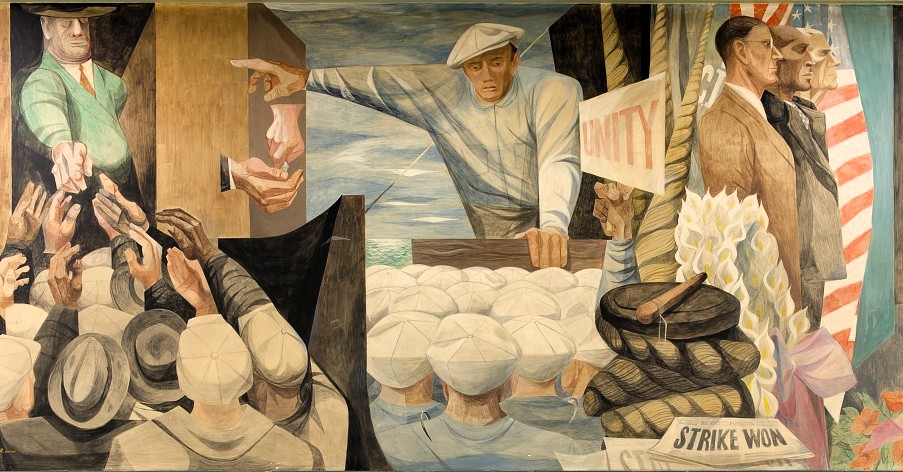
In the aftermath of 1934’s General Strike, the bosses attempt to isolate Harry Bridges and the militants in I.L.A. Local 38-79 by blacklisting, hot cargoing, vilification, and rival union leaderships.
‘Hot Cargo on the Coast’ by Amy Schechter from New Masses. Vol. 17 No. 3. October 15, 1935.
SAN FRANCISCO. “The shipowners are moving in on us,” is the word along the San Francisco waterfront. The situation is the tensest since the general strike. A membership meeting of Local 38-79 of the International Longshoremen’s Association of which Harry Bridges, leader of the general strike, is president, has just voted confidence in its leadership, voted to delegate emergency powers to its leadership and voted to empower its leadership to call a special meeting of the local any time the necessity arises.
The meeting sent greetings of solidarity to the Gulf port strikers. Harry Bridges reported on the status of the present controversy with the waterfront Employers’ Association, dealing with the mass blacklist instituted against the members of Local 38-79 following their refusal to handle “hot” or scab cargo; and the violation of the employers’ agreement with the local providing for the hiring of all longshore gangs through the union dispatching hall. Bridges stated that the shipowners must be tied down on the dispatching-hall question before the union will consider other controversial questions. He condemned the provocative union-smashing tactics of the Waterfront Employers’ Association directed toward breaking up the Pacific Coast Maritime Federation and especially Local 38-79 of the I.L.A.
The shipowners are playing a slick game. Several days before their agreement with the I.L.A. was due to expire (September 30), they agreed to its renewal with a fanfare of publicity designed to place them before the public as the righteous guardians of peace on the waterfront. But before the ink was dry on the contract they had began violating the spirit and letter of the agreement. They began baiting the longshoremen, trying in every possible way to create unrest in the union ranks, to undermine the prestige of the leaders and break the solidarity of the longshoremen with the seamen. The refusal of the shipowners to agree to the minor amendments to their agreement, requested by the International Seamen’s Union, also affiliated to the Maritime Federation, is another factor aggravating the situation.
Under Bridges’ leadership the San Francisco local of the I.L.A. which was instrumental in effecting the consolidation of the West Coast marine unions into the Maritime Federation, has carried on a constant struggle on the job through which it has maintained control over hiring and working conditions, has succeed in effecting a drastic reduction in the loads handled by individual longshoremen an in bringing wages to a level far above the average for other ports. It has maintained a hardfisted independence in its relations with the shipowners, It is a center for support of militant movements such as the United Labor Ticket which is developing a powerful front in the fight against Hearstism and vigilantism in the Bay area, is running Redfern Mason, president of the San Francisco Newspaper Guild, against bloody Mayor Rossi in the coming elections. The local played a leading role in the convention of the California State Federation of Labor, held in San Diego two weeks ago, where for the first time an effective left wing was mobilized behind progressive measures.
The shipowners see that the example of Local 38-79 is a source of inspiration for longshoremen throughout the country, specifically for the Gulf coast strikers and is mobilizing nation-wide support in the drive to destroy the local and its leadership. The war situation is speeding up the drive. The shipowners cannot afford militant unions on the waterfront. Rich war cargoes are already falling to Pacific Coast shipowners. For weeks past vessels have been sailing out of San Francisco with heavy cargoes of beans, rice and canned goods from California agricultural and cannery areas consigned to Italian ports.
In an open communication to Judge M.C. Sloss, longshore arbitrator, issued prior to last night’s meeting, Bridges stated the union position on the latest phase of the anti-union campaign as follows: “By what seems a preconceived plan to disrupt the waterfront peace of San Francisco and to instill the situation with tenseness and unrest, the Waterfront Employers’ Association has taken action to disrupt the method and rules of dispatching gangs of longshoremen as provided for in the Arbitration Award of October 12 and in the rules governing the operation of the Joint Labor Relations Committee.” He put the following questions to Sloss to be answered in the latter’s decision scheduled to be handed down the coming Monday (October 7):
“1. Can the employer create or use an agency to usurp the functions and duties of the joint dispatching hall and the dispatchers? (Union men elected by the local from its membership. A.S.)
“2. Can the employers violate and totally disregard the rules agreed upon by the Joint Labor Relations Committee providing for the joint dispatching hall or rules in the award relating to the dispatching of gangs?”
At the close of his communication to Sloss, Bridges declared that “unless the practices instituted by the Waterfront Employers’ Association are stopped at once, the eventual result will be the tying up of the entire commerce of this port and will affect the livelihood of thousands of men.”
Issues are so clear and feeling running so high on the waterfront that the reactionary William F. Lewis, heading the District Council of the I.L.A. was forced to state to the press today that the district will give the San Francisco local the fullest support in the present controversy.
The Waterfront Employers’ Association is employing peculiarly filthy and malicious frameup tactics in its attempt to break up the splendid solidarity maintained by West Coast marine workers since the first days of the general strike. The main outline of the frameup is the following: For many weeks I.L.A. members have refused to handle “hot” cargo or scab from Vancouver, where a longshore strike of major significance is in its fourth month. They also have refused to handle cargo involved in strikes of I.L.A. bargemen, Locals 38-101 and 38-102, and the lockout of employes of the Santa Cruz Packing Company, members of I.L.A. Warehousemen 38-44, discharged for organizing in the I. L. A. and driven from company’s warehouses at the point of guns.
On September 19 the officials of the River Lines, a notoriously anti-labor outfit belonging to the Waterfront Employers’ Association and one of the three companies still stubbornly refusing to sign agreements with the bargemen’s local although twenty-one companies have signed, openly declared through the columns of the press that the company was out to put the San Francisco longshoremen on the spot. They announced that two days later they intended to load the steamship Sutter with hot cargo and sprinkle this cargo in small amounts over every dock on the San Francisco waterfront and the East Bay docks.
The company was unable to get workers for the dirty job of handling this scab freight and depositing it on the piers and officials of the company were forced to handle it themselves. They had themselves deputized and landed the freight under the protection of guns. Employers demanded that on each dock this scab Sutter cargo be handled before any other cargo could be touched, even though in most cases this freight constituted only about five tons out of 1,000 tons or over on the dock.
As each gang refused to handle the hot cargo employers placed their names on the blacklist and called in another gang. Every gang they called refused and today, two weeks since the Sutter sailed into port, about 1,900 of the 3,500 members of the I.L.A. Local 38-79 are blacklisted! In order to make the blacklist possible employers took over the hiring of gangs in violation of the union agreement—and the central principle around which the general strike was fought.
The shipowners’ next move was to ask longshore arbitrator Judge M.C. Sloss for a decision endorsing their stand on forcing the longshoremen to handle het cargo, which Sloss immediately and obligingly handed down on September 27. Finally, to clinch matters, the shipowners brought in Assistant Secretary of Labor Edward McGrady from Washington. He commanded the longshoremen “as honorable men…to abide by the decision of Judge Sloss,” and attacked their leaders who are fighting this concerted attempt to drive the longshoremen into organized scabbing.
Notice of the intensified union-smashing campaign slated for the West Coast was given the men on the waterfront when The Voice of Federation, official organ of the Maritime Federation, printed the news of a secret conference held in San Francisco the first week in September of the Waterfront Employers’ Association with heads of the Industrial Association, the Chamber of Commerce and over 200 representatives of big business from San Francisco, Seattle and cities up and down the Pacific Coast. An Associated Press story of the meeting wired to Coast papers at 12:30 p.m. was followed at 12:45 p.m. by an urgent order to all A.P. clients to kill the item. The Voice of Federation, which obtained the story through confidential sources, was the only paper in the country to publish the story. The secret conference emphasized the necessity of getting rid of Harry Bridges. Roger Lapham, head of the American-Hawaiian Steamship Company, declared:
“Bridges is stronger today than he was a year ago and unless his influence is eliminated we won’t get anywhere.”
Lapham also stated:
“The forces of union labor are increasing in power. This is particularly true along the Pacific waterfronts. Public support is necessary if this tendency is to be checked.”
And A.H. Lundeen, president of the Seattle Chamber of Commerce, warned the conference with a frankness that explains the panicky haste to suppress the story of the conference sent out by the A.P. correspondent:
“Further progress of the maritime workers under their present leadership bodes disaster…We are afraid we will be jockeyed into a position where other business will demand that we arbitrate. We must have the backing of every branch of business if we are to win this struggle. And if we do not win, union labor will move in and organize your workers as it has organized ours.”
In line with the above, a “Vigilante Committee of 1,000” has been organized in the San Francisco area. The waterfront workers have answered by launching the “Committee of a Hundred Thousand” to which shore unions are rallying and which is also gaining the support of students and professionals. The shipowners’ paper, The Shipping Register, recently printed an editorial entitled “Are All the Vigilantes Dead?’, in which it says: “There are hundreds of thousands of red-blooded Americans here in San Francisco. What say we take off a day from our regular business and attend to the matter in a proper manner?”
A campaign is under way, backed of course by Hearst, for the adoption by the San Francisco Board of Supervisors of a so-called “Disaster Preparedness Ordinance.” The ordinance provides for the coordination of the activities of police, National Guards, American Legion, etc., in time of “disaster,” with an Emergency Council of twenty-two to run the works to which the mayor is required to invite seven ranking army, navy, coast guard, Red Cross, marine corps and national guard officers. For general consumption “disaster” is defined as an “act of God” such as fire, earthquake, etc. However, the original draft of the ordinance contained a clause defining disaster as including “widespread rioting and insurrection.” The phrase was removed at the instance of the Samuel Gompers Post of the Legion.
C.A. Turner, official of the Pacific Telephone and Telegraph Company, revealed the true purpose of the ordinance, in the following statement:
“The General Strike of 1934 is responsible for the origin of the plan…We have union men on the committee and there is no use in drawing any particular attention to that phase of our program at this time. The situation that faced us last year was a disaster from the standpoint of public welfare.”
1. Through the mass pressure and militancy of the longshoremen, the Waterfront Employers have been forced (October 6) to reinstate 1,600 union longshoremen. Judge Sloss ruled that employers had no authority under last year’s arbitration award to blacklist these men—The Editors.
The New Masses was the continuation of Workers Monthly which began publishing in 1924 as a merger of the ‘Liberator’, the Trade Union Educational League magazine ‘Labor Herald’, and Friends of Soviet Russia’s monthly ‘Soviet Russia Pictorial’ as an explicitly Communist Party publication, but drawing in a wide range of contributors and sympathizers. In 1927 Workers Monthly ceased and The New Masses began. A major left cultural magazine of the late 1920s and early 1940s, the early editors of The New Masses included Hugo Gellert, John F. Sloan, Max Eastman, Mike Gold, and Joseph Freeman. Writers included William Carlos Williams, Theodore Dreiser, John Dos Passos, Upton Sinclair, Richard Wright, Ralph Ellison, Dorothy Parker, Dorothy Day, John Breecher, Langston Hughes, Eugene O’Neill, Rex Stout and Ernest Hemingway. Artists included Hugo Gellert, Stuart Davis, Boardman Robinson, Wanda Gag, William Gropper and Otto Soglow. Over time, the New Masses became narrower politically and the articles more commentary than comment. However, particularly in it first years, New Masses was the epitome of the era’s finest revolutionary cultural and artistic traditions.
PDF of full issue: https://www.marxists.org/history/usa/pubs/new-masses/1935/v17n03-oct-15-1935-NM.pdf

