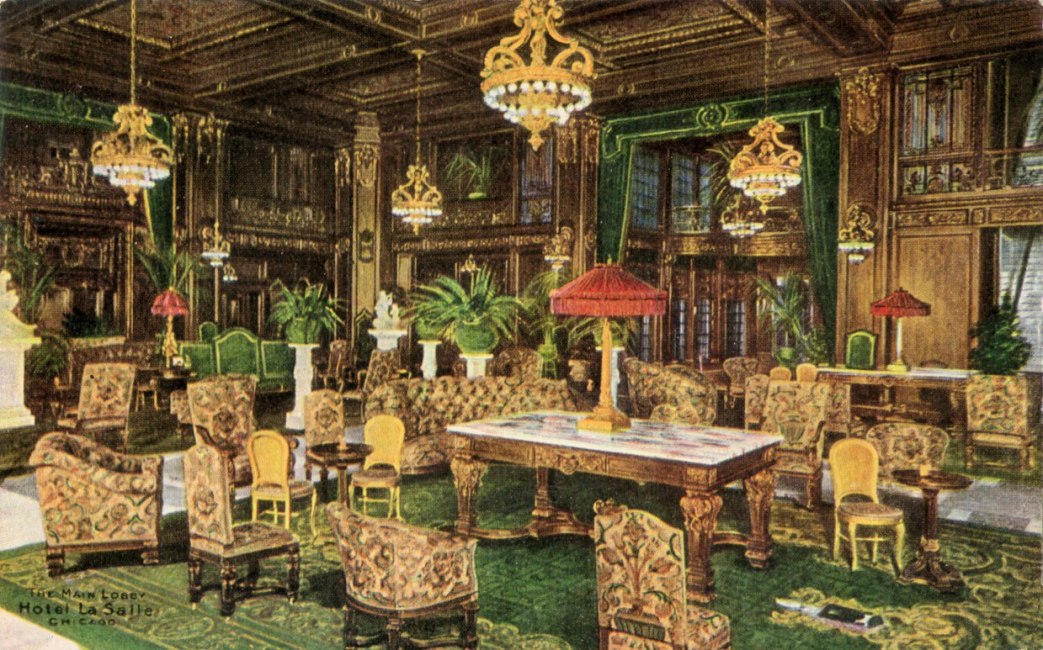
Hotels are microcosms of class, here a look downstairs at a world famous Chicago landmark.
‘Magnificent New Hotel La Salle is a Sweat Shop’ from The Chicago Socialist. Vol. 3 No. 272. September 15, 1909.
Hostelry Where 5,000 Bankers Meet Drives Employes to the Limit
ARE FED LIKE ANIMALS
Glimpses Behind Scenes Are Given by a Daily Socialist Reporter
Chicago has a new “jungle.” It huddles under a roof where 5,000 bankers are planning and plotting, where 200 waiters are cursing with the words of discontent and as many chambermaids and scrub girls groan and toll on, hours and hours, days and days.
The roof is that of the new Hotel La Salle, twenty-one stories toward the sky, under which everything is beautiful and sparkling if you look in the right place, but mean and repelling if you search for that, too.
Through the magnificent lobby and vaulted dining room floats classic music from a stringed orchestra, while the happy murmur of voices and bright smiles seem to be everywhere. Just below, down in the basement, a veritable cauldron of bitter complaint simmers and sputters. That’s where the human force that makes the wheels of the Hotel La Salle go round is generated.
Sweated to the Limit
It was just at the noon hour yesterday that a reporter for the Daily Socialist found himself in this “Jungle.” One waiter swore it was his last day. “Never again,” chirped a chamber maid, gaining some satisfaction at the thought. “Six waiters quit here during the rush hour last night,” says another, as the stream of dissatisfaction pours on continually. There is no joy, no pleasure, no content.
Why? It’s because the point of utmost endurance has been put too far to the wrong direction and something has snapped. There are about 700 people working at the Hotel La Salle. Of these about 200 are waiters.
Out of one kitchen they carry the food, rich and delicious, that goes to the vaulted dining rooms and banquet halls and look on while others eat. Out of another kitchen down there in the basement with just next to it a very crowded, small, ill-lighted dining room comes the food they must eat themselves. If that were all perhaps the difference would be unnoticed. The majority of those making up the masses look on class distinctions as inevitable.
Is Out to Make Profits
But the Hotel La Salle is out to make “profits.” “It started with only half an eye open, hardly that,” claim the employes, which means that nothing was in readiness when the first guests arrived the other night. “Not a bed was ready,” say the chambermaids, “when the hotel opened.” And now the hotel is trying to take care of the American Bankers association that has brought 6,000 bankers from all over the country to Chicago and to the Hotel La Salle. They have the money and demand the best. Everything is being done to see that they get it.
That’s why the cooks down in the kitchen where the food is prepared for those 700 employes use their hands instead of utensils which have not yet been recured. They are real “don’t care” cooks, not chefs. And no one likes to have others throw their food around like that! That’s why the complaint starts.
All the waiters, chamber maids and all the rest of the help, must wait on themselves. Because there are many of them the small dining rooms in which tables are not yet placed are very crowded. The girls sit around on boxes. Where there are no boxes they alt on the cement floors. They crowd the long dark passageways. They crowd each other everywhere.
Go Back to Work Hungry
And because they are disgusted, disheartened, discouraged at the whole proceeding they sometimes cast their food aside and go back to work hungry.
Because they are compelled to hurry back to work they leave all those dirty dishes, piles growing on piles and then more piles of them, until the whole becomes a sight to stifle appetite, banish contentment bring on the ugly looks and give voice to words that do not sound good.
“This is my reserved seat,” said a pretty chamber maid (she said she was 19 years old), as she sat outside of one of the small dining rooms in the darkened passageway. The whole proceeding seemed to appeal to her sense of humor. She was sitting on a small box and eating from a plate in her lap, eating food she didn’t really like.
Girls Eat in Silence
“Gee, I wouldn’t go in there,” she went on, “not on your life,” and pointed into the small, crowded dining room. Here nearly a score of scrub girls were crowded about one long hastily constructed table, tired and morose, eating because they had to keep alive. There were Irish girls, German girls and girls from Scandinavia, scrub girls who could hardly understand what each other said and so they remained silent.
Perhaps some of these things will be remedied later on. But because the men who own the Hotel La Salle wanted to open the hotel long before it was ready, its employes are enduring things unbearable now. And because things are so bad they quit jobs that they need. It is their only way of protesting. And because there are many others their absence is not noticed.
Turtles Are Boiled Alive
Over in that part of the basement where many of the fancy dishes that go on the tables in the Hotel La Salle’s big dining room is a man whose duty it is to make turtles eatable. He takes the live turtle, pulls its head out of the shell with hook, inserts a prong to keep it out and then throws it into the boiling kettle alive. The object of keeping the head out of the shell is to obviate the near impossibility of trying to get it out afterwards, after the turtle has undergone the torture of being bolled alive. Sometimes the turtles come out of the water quivering, still struggling, still alive. Opening a hotel before it is ready is probably an experience appreciated as much by its employes as the boiling water plunge administered to the turtle is appreciated by that animal. Some of the chamber maids say they go to work at six o’clock in the morning. It is midnight before they get through.
From the basement way up to the twenty-first floor under the roof, complaint was rampant, discontent was everywhere. On one floor a girl was struggling with a bundle of linen that nearly overcame her.
Longs for Old New York
“This certainly is the wild and woolly west,” said a chamber maid to the reporter. “If I had known that this was Chicago I certainly would have remained in the east. New York or Boston for mine. They know how to treat you, a little decent down there, anyhow.”
This girl had worked at a summer resort during the season now fast coming to an end. In order to have work for the winter she had grabbed a job st the Hotel La Salle at “$16 per,” as she put it. That’s less than four dollars a week. The scrub girls get $12 a month.
“This noon was the last for me,” said another girl. “Dirty dishes three feet high and swill all around–that’s too much for me,” and she was ready to hand in her “resignation.”
Tyranny, Tyranny Everywhere
Through the hallways one can almost hear the lash of the whip that drives the workers on. On every floor is a clerk who supplements the work of the staff of clerks down in the lobby. Everywhere on nearly every floor are detectives. Nearly everywhere is head the shrill commanding, scolding voice of one the many housekeepers. They drive the chamber maids and these, not to be outdone, occasionally take it out of the scrub girls. It’s a system where nearly everyone gets an opportunity to tyrannize over someone else and they make the most of it.
But probably it is the girls, the chamber maids and the scrub girls, who suffer the most.
Has a Sinister Meaning
“She’s all right, you bet she is,” passes the word from house detective to waiter, or from bell hop to some other man employe, and they mean some particular girl. The tip is going around and it has a sinister meaning.
In the meanwhile the 5,000 bankers are settling some of the questions of “greatest importance” to the country. They are enjoying the hospitality of Chicago built up on the backs of bending workers.
The Chicago Socialist, sometimes daily sometimes weekly, was published from 1902 until 1912 as the paper of the Chicago Socialist Party. The roots of the paper lie with Workers Call, published from 1899 as a Socialist Labor Party publication, becoming a voice of the Springfield Social Democratic Party after splitting with De Leon in July, 1901. It became the Chicago Socialist Party paper with the SDP’s adherence and changed its name to the Chicago Socialist in March, 1902. In 1906 it became a daily and published until 1912 by Local Cook County of the Socialist Party and was edited by A.M. Simons if the International Socialist Review. A cornucopia of historical information on the Chicago workers movements lies within its pages.
PDF of full issue: https://www.marxists.org/history/usa/pubs/chicago-daily-socialist/1909/090915-chicagodailysocialist-v03n272.pdf

