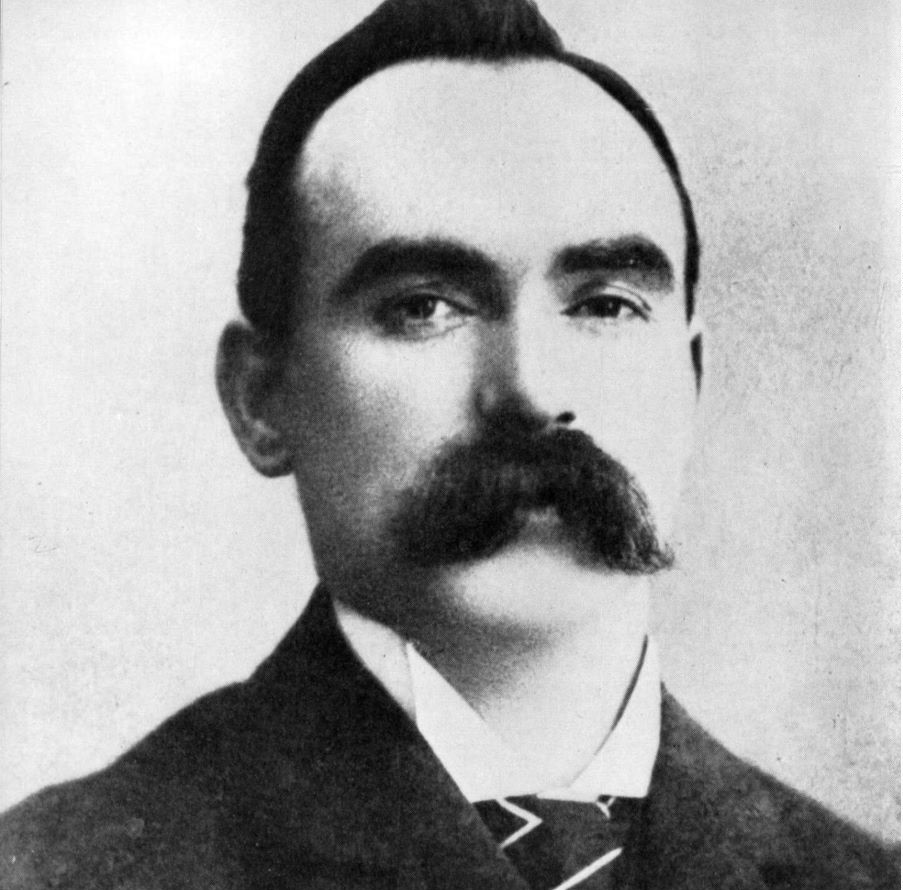
Connolly on the existential problem of workers scabbing on fellow workers, and how it was baked into existing labor organizations.
‘Industrial and Political Unity’ by James Connolly from Industrial Union Bulletin. Vol. 2 No. 30. February 27, 1909.
(From “The Harp,” Organ of the Irish Socialist Federation.)
At meetings throughout this country one frequently hears speakers laboring to arouse the workers to their duty, exclaiming:
“You unite industrially; why, then, do you divide politically? You unite against the bosses in strikes and lock-outs, and then you foolishly divide when you go to the ballot box. Why not unite at the ballot box as you unite in the workshop? Why not show the same unity on the political fold as you do on the industrial battlefield?”
At first blush this looks to be an exceedingly apt and forcible form of ap peal to our fellow workers, but when examined more attentively it will be seen that in view of the facts of our industrial warfare this appeal is based upon a flagrant mis-statement of facts. The real truth is that the workers do not unite industrially, but on the contrary are most hopelessly divided on the industrial field, and that their division and confusion on the political field are the direct result of their division and confusion on the industrial field. It would be easy to prove that even our most loyal trade unionists habitually play the game of the capitalist class on the industrial field as surely as the Republican and Democratic workers do it on the political field. Let us examine the situation on the industrial field and see if it justifies the claim that economically the workers are united, or if it justifies the contention we make that the division of the workers on the political field is but the reflex of the confused ideas derived from the practice of the workers in strikes and lock-outs.
Quite recently we had a great strike of the workers employed on the subway and elevated systems of street car service in New York. The men showed a splendid front against the power of the mammoth capitalist company headed by August Belmont, against which they were arrayed. Conductors, motor-men, ticket choppers, platform men, repairers, permanent way men, ticket sellers–all went out together and for a time paralyzed the entire traffic on their respective systems. The company, on the other hand, had the usual recourse to Jim Farley and his scabs and sought to man the trains with those professional traitors to their class. The number of scabs was large, but small in proportion to the men on strike, yet the strike was broken. It was not the scabs, however, who turned the scale against the strikers in favor of the men. That service to capital was performed by good union men with union cards in their pockets. These men were the engineers in the power houses which supplied the electric power to run the cars, and without whom all the scabs combined could not have run a single car. A scab is a vile creature, but what shall we say of the men who helped the scab to commit his act of treason? The law says that an accessory before the fact is equally guilty of a crime with the actual criminal. What, then, are the trade unionists who supplied the power to the scabs to help them to break a strike? They were unconsciously being compelled by their false system of organization to betray their struggling brothers. Was this unity on the industrial field? And is it any wonder that the men accustomed to so scab upon their fellow workers in a labor struggle should also scab it upon their class in a political struggle? Is it not rather common sense to expect that the recognition of the necessity for concerted common action of all workers against the capitalist enemy in the industrial battle-ground munt precede the realization of the wisdom of common action as a class on the political battlefield? The men who are taught that it is all right to continue working for a capitalist against whom their shopmates of a different craft are on strike are not likely to see any harm in continuing to vote for a capitalist nominee at the polls even when he is opposed by a candidate of a Socialist and Labor organization. Political scabbery is born of industrial scabbery; it is its legitimate offspring. Instances of this industrial disunion could be cited indefinitely. The long shoremen of the port of New York went out on strike. They at first succeeded in tying up the ships of the Shipping Trust, great as its wealth is, and in demonstrating the real power of labor when unhampered by contracts with capital. The Shipping Trust was taken by surprise, but quickly recovered, and as usual imported scabs from all over the country. Then was seen what the unity of the working class on the industrial field amounts to under present conditions. As scab longshoremen unloaded the ship, union teamsters with union buttons in their hats received the goods from their hands, loaded them into their teams, and drove merrily away.
As scab longshoremen loaded a ship union men coaled it, and when the cargo was safely on board union marine engineers set up steam, and union seamen and firemen took it out of the dock on its voyage to its destination. Can men who are trained and taught to believe that such a course of conduct is right and proper be expected to realise the oneness of the interests of the working class as a whole against the capitalist as a whole, and vote and act accordingly! In short, can their field of vision be so extensive that it can see the brotherhood of all men, and yet so restricted that it can see no harm in a brother labor organization in the one industry being beaten to death by capital!
Now, as an equally valuable object lesson in American unionism, an object lesson in how not to do it, let us picture a typical state of affairs in the machine industry. The moulders’ contract with the boss expires, and they go out on strike. In a machine shop the moulder occupies a position intermediate between the pattern-maker and the machinist, or, as they are called in Ireland, the engineers. When the moulders go out the boss, who has had all his plans laid for months beforehand, brings in a staff of scabs and installs them in the places of the striking workers. Then the tragi-comedy begins. The union pattern-maker makes his patterns and hands them over to the scab moulder; the scab moulder casts his moulds and when they are done the union machinist takes them from him, and placidly finishes the job. Then, having finished their day’s work, they go to their union meetings and vote donations of a few hundred dollars to help the strikers to defeat the boss, after they had worked all day to help the boss to defeat the strikers. Thus they exemplify the solidarity of labor. When the moulders are beaten the machinists and the pattern-makers, and the blacksmiths, and the electricians, and the engineers, and all the rest, take their turn of going up against the boss in separate bodies to be licked. As each is taking its medicine its fellows of other crafts in the same shop sympathize with it in the name of the solidarity of labor, and continue to work in the service of the capitalist, against whom the strike is directed, in the name of the sacred contract of the craft union.
When the coal miners of Pennsylvania had their famous strike in 1902 the railroad brotherhoods hauled in scabs to take their places, and when the scabs had mined coal the same railroad men hauled out this scab-mined coal.
Need we go on to prove our point that industrial division and discord is the order of the day amongst the workers, and that this disunion and confusion on the economic field cannot fail to perpetuate itself upon the political field? Those orators who reproach the workers with being divided on the political field, although united on the industrial, are simply mis-stating facts. The workers are divided on both, and as political parties are the reflex of economic conditions, it follows that industrial unity once established will create the political unity of the working class. We feel that we cannot too strongly insist upon this point. Political division is born of industrial division; political scabbery is born of industrial craft scabbery; political weak. ness keeps even step with industrial weakness. It is an axiom enforced by all the experience of the ages that they who rule industrially will rule politically, and therefore they who are divided and wrongly organized industrially will remain impotent politically. The failure of Mr. Gompers to unite politically the force of the American Federation of Labor was the inevitable outcome of his own policy of division on the industrial battle-ground; he reversed the natural process by trying to unite men on class lines whilst he opened every effort, as in the case of the brewers, to unite them on industrial lines. The natural lines of thought and action lead from the direct to the indirect, from the simple to the complex, from the immediate to the ultimate. Mr. Gompers ignored this natural line of development and preached the separation into craft organizations, with separate craft interests of the workers, and then expected them to heed his call to unity on the less direct and immediate battle-ground of politics.
failed, as even the Socialists would fail if they remained equally blind to the natural law of our evolution into class consciousness. That natural law leads us as individuals to unite in our craft, as crafts to unite in our industry, as industries in our class, and the finished expression of that evolution is, we believe, the appearance of our class upon the political battle-ground with all the economic power behind it to enforce its mandates. Before that day dawns our political parties of the working class are but propagandist agencies, John the Baptists of the New Redemption, but when that day dawns our political party will be armed with all the might of our class; will be revolutionary in fact as well as in thought.
The Industrial Union Bulletin, and the Industrial Worker were newspapers published by the Industrial Workers of the World (IWW) from 1907 until 1913. First printed in Joliet, Illinois, IUB incorporated The Voice of Labor, the newspaper of the American Labor Union which had joined the IWW, and another IWW affiliate, International Metal Worker.The Trautmann-DeLeon faction issued its weekly from March 1907. Soon after, De Leon would be expelled and Trautmann would continue IUB until March 1909. It was edited by A. S. Edwards. 1909, production moved to Spokane, Washington and became The Industrial Worker, “the voice of revolutionary industrial unionism.”
PDF of full issue: https://www.marxists.org/history/usa/pubs/industrialworker/iub/v2n30-feb-27-1909-iub.pdf

