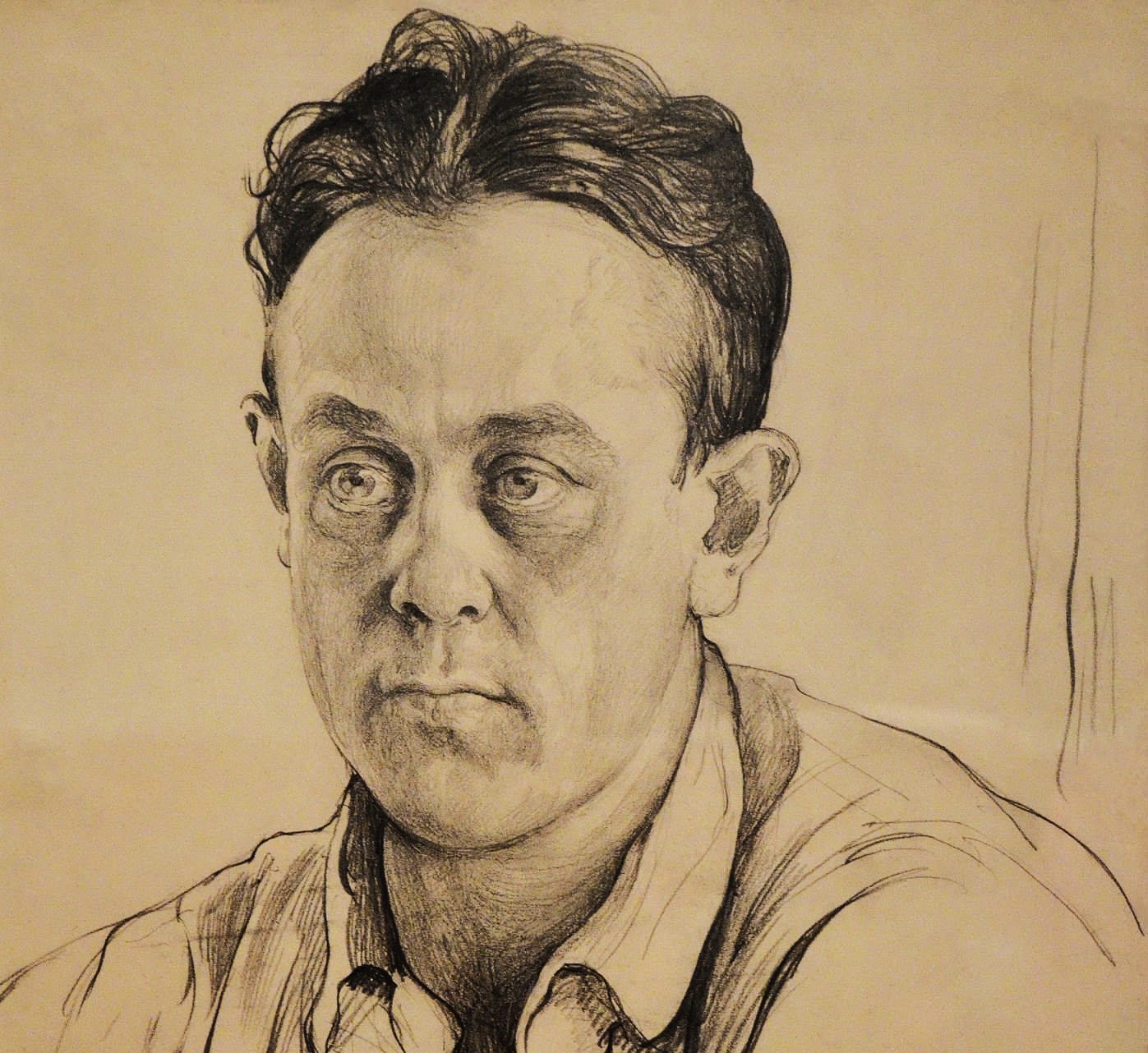
On the occasion of Granville Hicks’ biography, the Hollywood screenwriter recalls his Greenwich Village youth as a struggling writer and the already legendary character, his drinking buddy John Reed.
‘John Reed: A Footnote and a Tribute’ by Edwin Justus Mayer from Pacific Weekly. Vol. 5 No. 10. September 7, 1936.
I HAVE just read Granville Hicks’ “John Reed,” a good book about a good man. I knew Reed–knew him well, perhaps intimately, although our friendship covered only a short time. But then you’re dead broke with a man, you’re likely to get to know him, the inside of his head as well as the inside of his stomach, much quicker than otherwise. I had that kind of an experience with Jack. But all that was long ago–almost twenty years ago.
I knock thrice on a whiskey bottle, summoning the genii of my youth; and the spirits, rising thinly from the elongated neck of the bottle, diffuse themselves and assume the vague but still recognizable shapes of the days when I was twenty-one. That was in 1917.
I think that it was in that year I first saw Jack. Of course, he was a legend to me–as he was to most youngsters of that day who were groping for social ideas–long before I saw him. That event took place when he visited the office of the Socialist daily, The Call, where I was cutting my journalistic milk-teeth (although having served on the “Harlem Home News” I regarded myself as a veteran reporter). It is curious that I cannot remember if I met him at the time–I probably did; but I can remember that he was sitting on a desk, his feet swinging, when I recognized him. My mind seems always to remember the more important things only through the trivialities associated with them.
We were both living in Greenwich village then, and in that colony of voluntary exiles it would seem strange if we did not have at least a bowing acquaintance; but it was not until the early part of 1919 that I really got to know Jack. He had asked Horace Liveright, who was publishing “Ten Days that Shook the World,” to find someone to help him with the mechanical details of working on the proofs. Horace suggested me, and we got together.
Jack was at this time completely blacklisted by the capitalist press, and having long ago spent the generous advance which Liveright had given him for the book, was having a hard time of it to live. I was myself out of a job and trying to support myself and a family by the simple process of borrowing wherever I could. I recommend this process to all beginners: the exercise of dodging creditors keeps you absolutely fit physically, while the business of artfully acquiring new creditors while you are evading the old ones gives you a mental zip which I cannot praise too highly. Coolidge, who was a notorious fool, advocated thrift; but Disraeli knew what he was talking about when he said that the greatest incentive to drive a young man to success was debt.
It would seem, however, that I had abused that incentive at the time when Jack and I became friends. Possibly he had, also I speak without knowledge of that–because we frequently found ourselves without a penny in our pockets. On these occasions we would walk up town from Patchin place, where Jack lived, to the Harvard Club on Forty-third street, where we would lunch in state, blessing the fact that tips are banned in gentlemen’s clubs. Having played our parts of clubmen, with plenty of time to dawdle over the coffee, we would emerge onto the street, shrink to our proper proportions of paupers, and walk back to Patchin place to resume our labors on the proofs of Jack’s book.
On one occasion, in the club, some ill-advised patriot called Jack a traitor. Jack promptly knocked him down. I didn’t see him for a few days after this, and when I did, asked him if he had any more trouble at the club. Jack said, “Not since I knocked that fellow down.” “Drily” would be the stage-direction for that; but it wouldn’t do justice to the ironic glint in Jack’s eye and the ironic note in his voice as he said it. Nevertheless, for all his aplomb, whenever we managed to have enough money he avoided the club, and we lunched in a restaurant at Thirty-ninth street and Broadway–probably because we had acquired the money from Liveright, who published then on West Fortieth street.
We worked, talked, laughed, argued and drank together, and I fell completely under the spell of the man. Even after our collaboration on the proofs was over, we continued to see each other daily. It is very difficult to define greatness in a man apart from his work; how are you going to define life in terms of the dead? I can only say that John Reed is one of the few men I have known whose faults were obvious, and whose greatness of spirit was more obvious. He was vain, and in a sense, ambitious. He once remarked to me that he expected to be the next Socialist candidate for president. Stupidly, I laughed. Instantly, he fired up. “Why not?” he demanded, angrily. I sobered up at once. “Why not?” I repeated seriously, and he was mollified. As a matter of fact, he was the logical candidate for at least the left wing of the party, and I had laughed only at his naivete in admitting it.
Yes, he was vain, he was ambitious, and yet his integrity was absolute. In an adolescent book which I wrote a few years after his death, I made the mature observation that he was essentially a poet. And that was true: that was his integrity. It showed itself in big ways, and in little ways too. For instance, he literally could not understand a man degrading himself by simply working for a living and nothing else. I recall that he once met a mutual friend of ours who confided to him his hatred of his job.
“Come up to Croton with me, I’m on my way there now,” said Jack, referring to a little house he had in the country. The man demurred, said that he had to get back to the office. Jack looked at him in complete bewilderment. The man’s point of view, that he needed the money, was altogether beyond him.
And perhaps that is why John Reed is altogether beyond some of his critics; particularly, beyond those who have tried to draw him as the mere playboy of the Revolution. Nothing could be more false. He had an exuberant side to his nature which rounded out the man happily, but which did not constitute the man. He was a poet, and poets are basically serious people. But why shouldn’t he have had that other side to him? “We must all hang together or we shall all hang separately.” Franklin had his little joke as the Declaration of Independence was signed. If Robespierre was the sea-green incorruptible, Voltaire, who made Robespierre possible, was not exactly lacking in wit. Lenin’s gift of irony is well-known. When the Soviets were recognized by England, the first of the great powers to do so, he observed, “I fear I am becoming respectable.” No! the fact that a man has a sense of humor is no proof that he isn’t a revolutionist.
And make no mistake about John Reed: when I knew him, he was in deadly earnest. That doesn’t mean he wasn’t ready to laugh, for he was. But his laughter was only a backwash of the sea moving forward in the man. People who had known him when he was a playboy around town couldn’t perhaps realize that he had not so much changed as dug down to the essential poet in him, whose gift was not to write so much as to live. He had found himself by the time I knew him, and therefore he meant what he said: proving it by dying for his beliefs. I believe that if he had not died, he would have lived for them.
It is a source of pride to me that before he embarked on what was to be his last journey, he confided to me his plans, which were necessarily secret; and asked me to accompany him to Russia. I, hampered by personal responsibilities, felt that I had to refuse. He, owning only to greater responsibilities, went, and died. A few years later, when I published the book to which I have referred, I included in it fragments of a poem I wrote when I heard of his death. I have no illusions of their merit but I think that they have a place in this article.
New Roads to travel, Jack!
You knew the old ones, pavement, dust and gravel, Forward and back,
The old roads that you used to love to travel
From world’s end to world’s end!
But now you cannot spend
The flame you were, in old familiar ways,
Or waste on nights and days
A deeper light than either.
You have transcended weather,
And joined the great commune
Of earth and sun and moon!…
Yet hands like mine will miss his sturdy grip:
We know not now that he has taken ship,
If he will find the new ports half as good
As these ports, prosperous with flesh-and-blood.
And all the old roads mourn him since he went
On his mysterious journey bent,
And filled with cold white flame,
And guarded by his fame,
Great traveller, who now remote and far
Resumes his journey on death’s star…
New roads, new gospels, and new Moscows, Jack,
All lying in the virgin track!
Celestial revolutions to be seen
There, in that strange demesne,
And your part to be played, as brave as ever,
Source of the blooming fruit, the rising river,
New seed of newer seeds, new proof of rapture,
New winters to assail, new springs to capture,
New trumpets to be sounded! Much to give,
And prove your fecund self still “Manalive!”
There is a definitely obscurantist, perhaps even ecclesiastical note about some of those lines which I couldn’t have realized when I wrote them, and certainly don’t fancy now. Nevertheless, new seed of newer seeds and all that, the legend which has already gathered about the name of John Reed, and the inspiration which continues to be drawn from that name, justifies them, I think, and I still subscribe to them.
Ave Atque Vale, John Reed! So long, Jack!
Pacific Weekly, based in Carmel, California was edited by William K. Bassett, Lincoln Steffans, and Ella Winter from late 1934. A Popular Front-era ‘fellow-traveler,’ magazine that became more of a Party press over its life. With a strong literary and arts focus, something of a West Coast ‘New Masses’, the weekly did not survive long after Steffans death in June, 1936. Though its run was short, Pacific Weekly is a rich record of left-wing 1930s writing with authors like publishing work in its pages.
PDF of full issue: https://archive.org/download/ccarm_008420/ccarm_008420_access.pdf

