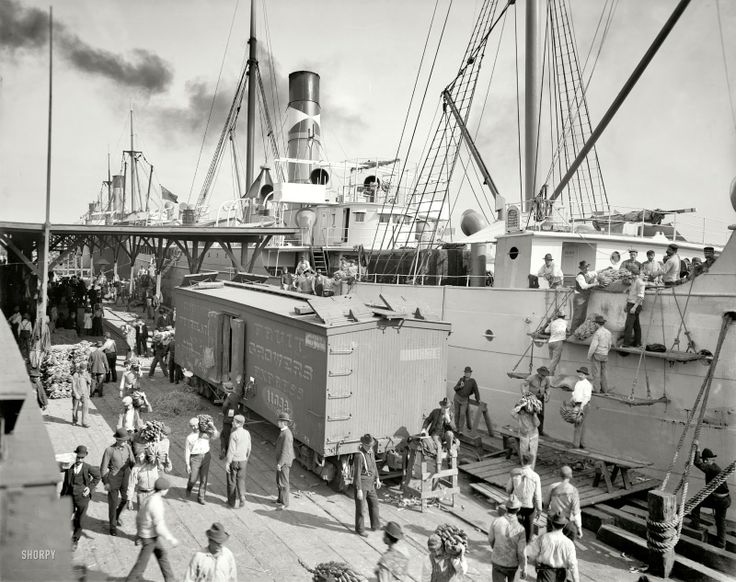
One of the places in the Deep South with a long-term, if inconsistent, labor fight was on the docks of New Orleans, one of the largest ports in the country. For generations there were bloody attempts to organize the inter-racial, international stevedores. Here, another heroic attempt to unionize the longshore workers, this time by the I.W.W.’s M.T.W.I.U. It too would go down to defeat not long after this.
‘Striking New Orleans Longshoremen Shut Port 90%’ from Industrial Worker. Vol. 5 No. 61. October 6, 1923.
NEW ORLEANS, Sept. 22. The situation is becoming more and more encouraging as the days pass by. There were less than 150 scabs working cargo yesterday. And this counting both scab longshoremen, and the crews of foreign vessels, most of whom seem very willing to scab. The work done by 150 scabs in one day could be done in one hour by union longshoremen.
But what’s the use, didn’t the steamship companies say they prefer “substitute labor?” Some of the scabs who were working on Thursday didn’t report for work Friday. The scabs are making such good progress at Poydras Street landing that we are figuring on starting a salvaging company for lost slings. The company would be composed of deep-water divers.
Only those who understand the marine industry can realize how solidly, the docks are tied up. The bosses are already squealing like stuffed pigs. They jumped into the mud and now they want the government to pull them out.
With the cotton season on the way and the docks tied up, the loss is tremendous and runs into hundreds of thousands. But the strikers are not losing dollars, they are getting a well earned rest and losing a few days slavery.
The Bosses “Bunk”
The boss is trying to make-believe that everything is fine and dandy. But he’s only kidding himself. The “Ethan Allen” is quoted as having sailed with a cargo. The “Ethan Allen” is lying in Johnson’s Dry Dock at the present time, without a pound of cargo in her holds, and with no crew aboard. She cleared for Port Arthur and would have sailed but she has no crew. The shipping board tried to get a crew all day yesterday. As proof that she has not sailed, a scab seaman fell down a hold yesterday afternoon and was taken to hospital in a very bad state.
The “Tampa”
This ship is working cargo with the mates at the winches and the crew in the holds. The “substitute labor” was getting a strong-back out of the hold. The scabs lost control of the strongback, the mate lost control of his head and the winch at the same time. The strongback went in the river and it cost $50 for a diver to go down and get it out. The Am. S.S. Southlands came in two days ago and has sailed without taking on any cargo. The crew tried to get paid off, but the captain wouldn’t pay them.
The German S.S. Fingal.–First and Second mates at the winches. One pantryman, the cook, and the carpenter and second engineer in the hold. All are receiving five dollars a day above their monthly wages. A scabherder by the name of Templeman, formerly a logger on the West coast, has been seen in the vicinity of Sixth St.
Keep Up The Picket Line
The towboat Lee L. Soloman took a barge to Chalmette slip with forty men aboard to work cargo. When pickets informed them not to work, thirty-three quit, and the other seven went to work on the American schooner Thann. They were joined by five or six more. One scab ran a loaded truck over another’s foot, resulting in the loss of a toe.
S.S. Persier
This ship has been leaving for the past five days, but she is still here. An attempt was made to load her yesterday. When the crew was asked to work cargo, they refused, so a crew of another Belgium ship was sent from Westwego to work her. They have not started yet.
West Cheswald
It being impossible to get any cargo in New Orleans, the American S.S. West Cheswald has cleared in ballast for Galveston, and will leave when she gets a crew.
S.S. Elkhorn
Rumor has it that the American S.S. Elkhorn will sail with only half cargo, this was put in by union longshoremen before the strike. “Substitute labor” is sure doing a hell of a lot of work when a ship leaves port only partly loaded.
A “Union” Supplying Scabs
Since the Marine Transport Workers of the I.W.W. called a sympathy strike, the I.S.U. of A. has been trying to get on the good side of the boss by supplying scabs when the Wobblies walked off. The latest act of this kind was on Saturday when the shipping board tried to hire five scabs for the “Carplaka.” Being unsuccessful in getting the five on Saturday, an order was given to the I.S.U. of A. to have five men on Monday morning. Men with principle will ignore these fakirs, as they are only there while the treasury lasts–when that is gone we will be free from these scabherders forever.
At The Shipping Board
There was unusual activity at the shipping board yesterday when several crews were wanted. The activity we are speaking of was the activity of the pickets. Only one man shipped, and he tore the slip up when accosted by pickets. The shipping board has given up hopes of hiring experienced seamen and has now adopted the policy of shipping anybody they can get as ordinary seamen. But this doesn’t help any as it is impossible to get anybody to ship.
Scabs
After running large advertisements, paying labor agents, and using every effort to obtain scabs, the steamship owners have succeeded in getting about 200 scabs, most of whom are unable to do a good day’s work, and are composed of the variety that only works when there is a little easy money. Strike time is easy money time for these characters as they don’t have to do much work to make a few dollars. All they are supposed to do is to be on the job to break the morale of the strikers. This is a fact, that cannot be denied. But the steamship owners are bucking a stone wall if they are trying to break the morale of the New Orleans waterfront strikers. The waterfront strike is spoken of as the most effective strike ever pulled in New Orleans.
NEW ORLEANS, Sept. 25. There were less than 200 scabs working on Monday and less than half that amount on Saturday. The two hundred scabs are divided amongst about fifteen ships, each one having an average of one hold working. The results are very costly to the steamship companies, The bosses have exhausted the quota of southern scabs, and from faraway New York comes the news that scabs are being hired there to be sent to New Orleans. Free transportation is offered, and subsistence) till they arrive. The agency hiring these scabs is located at 155 West St., New York City. We have notified our New York Branches, and the bosses are welcome to any scabs they can get from there. The few scabs who are working are getting all their food free, and in some cases, a place to sleep. Lots of scabs who were working on Saturday did not turn up for work on Monday. This has been going on all the time, all the professional scabs have taken a turn at it but don’t seem to fancy working in a hold, stripped to the waist and blinded by sweat. The bosses figured on getting the crews of the ships to scab, and break the strike, but they guessed wrong and now they are sore because they didn’t have the foresight to see what was coming. There are now over six thousand men on strike, and this number is increasing as every ship comes in.
Teamsters To Take Strike Vote
Teamsters have been quitting their jobs ever since the longshoremen came out. The C.F. and T. have been the hardest hit, and it looks like they will all be hit after today, when the teamsters take a vote.
Sugar Refinery Laying Men Off
The Sugar Refinery which employs over 800 men in normal times is now only employing 350, and if things keep up, some of these will be laid off. The reason is because there is not enough sugar unloaded to keep them busy. The Norwegian S.S. Tonjer is laying at the refinery and is unloading about 800 bags a day. The French S.S. Mont Kemmel is also there, but is not working. If the sugar continues to be discharged at this rate, the two ships will lay there for three more months. The Delecto is also due to arrive with a load of sugar. The wharf is congested already.
Complete Tie-up
With less than two hundred scabs on the docks, things look better than ever. There are about six hundred men on strike, and two hundred scabs can only do the work of fifty union men. The number on strike will be added to if the teamsters vote to strike today. The number of seamen on strike has more than doubled since the first day the strike was called in sympathy. Not only this, but the action of going out in sympathy has awakened some of the skeptical union men as to what can be accomplished if all are organized together. Every ship coming in brings more seamen to go on strike. If the general strike is on for two weeks more there will be a congestion never before seen in a U.S. port. The strike itself is being watched all over the United States, as being one of the most spectacular strikes ever seen in the south. There will be no let up until the boss comes through with a little more of what we produce for him. This is only another struggle of labor trying to get its own. When we are organized right we don’t have to go on strike to get the 44-hour week–we take it, it belongs to us.
The Boss And His Advertisements
We note in the “Item” of Saturday, that a group of “Leading Louisiana Institutions” are crying for the open shop. These advertisements have appeared consecutively for twelve weeks, each week with a full page advertisement. We quote the following from last Saturdays.
“Majority of people favor American Principles. The great growth of Los Angeles having demonstrated how a city thrives under the American Plan of employment, has at last awakened San Francisco. Always the minority are for the closed shop, and the majority for the open shop. Well conceived plans are being used to make San Francisco an open shop town. Trade unionists, in their attempt to make New Orleans a closed shop town are meeting with stiff resistance from those who have the advancement of the city at heart. If New Orleans is to grow, the carpenters’ strike, the longshoremen’s strike, and all other attacks of the few against the public should and must fail.”
Capitalists, Look at This and Answer
If the open shop is the American plan, and a city cannot prosper with the closed shop, then why don’t you capitalists adopt the American plan yourselves for an example? Why are you organized to raise the prices of the various commodities? Why have you organized the various trusts, such as the oil, lumber, beef, and coal trusts? You yourselves are not using the American plan, so we understand you as being unamerican, according to your own statements, is that it? You are organized internationally to make profits, and then you disguise yourselves as the public, to fight the workers when they ask for more of the profits they produce for you. You are telling the people of New Orleans that the attacks of the strikers must fail. When the Standard Oil Company raises the price of oil, do you tell the public that the attack of Standard Oil on the public must fail? We guess not. For your information, Mr. Capitalist, we are the public, we, the productive members of society, are the real public, so you may as well stop your bunk. Remember the Great Emancipator, and his words, “You can fool some of the people all the time, you can fool all the people some of the time, but you can’t fool all of the people all of the time.”
The Industrial Union Bulletin, and the Industrial Worker were newspapers published by the Industrial Workers of the World (IWW) from 1907 until 1913. First printed in Joliet, Illinois, IUB incorporated The Voice of Labor, the newspaper of the American Labor Union which had joined the IWW, and another IWW affiliate, International Metal Worker.The Trautmann-DeLeon faction issued its weekly from March 1907. Soon after, De Leon would be expelled and Trautmann would continue IUB until March 1909. It was edited by A. S. Edwards. 1909, production moved to Spokane, Washington and became The Industrial Worker, “the voice of revolutionary industrial unionism.”
PDF of full issue: https://washingtondigitalnewspapers.org/?a=d&d=IWW19231006

