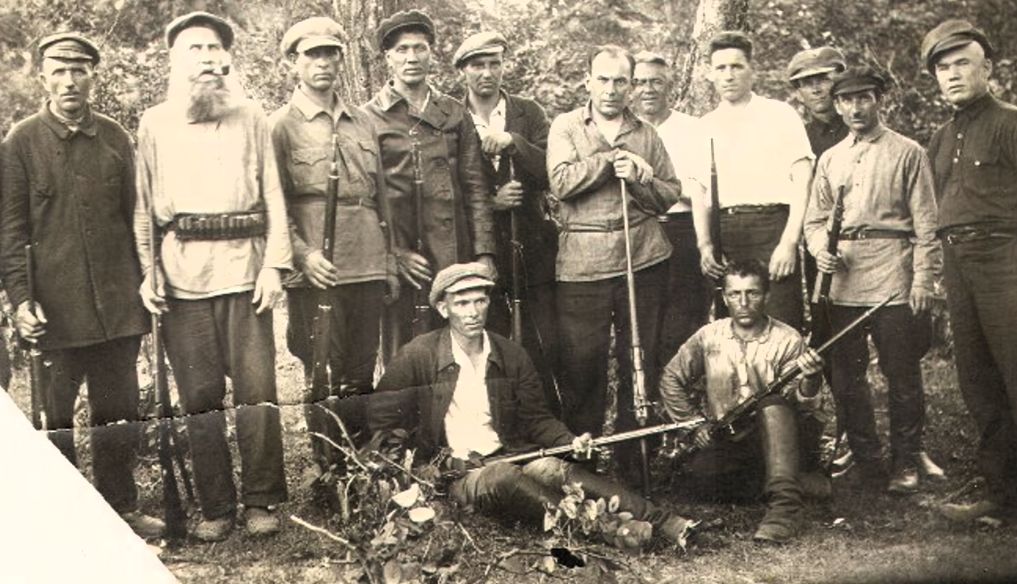
On a mission from Lenin by rail across a continent in chaos, Albert Rhys Williams’ train is ambushed by Bolshevik guerillas of the Siberian Red Army. Williams (1883-1962) was, along with his friend John Reed, one of the two great English language witness-participants of Russia’s 1917 Revolution. The Ohio-born progressive minister’s son was a Christian Socialist, himself an ordained protestant minister (organizing a union at Hartford Theological Seminary in the process), and Socialist Party activist since the early 1900s, particularly for Debs’ 1908 run, and as an ‘I.W.W. preacher’ serving in East Boston, Williams raised money for 1912’s Lawrence strike, where he first met Reed. Increasingly drawn to writing and journalism, as World War One began, he left his pastorage for Europe as a magazine war correspondent. From the Summer of 1917 he would travel Russia reporting on the unfolding Revolution, arriving in Petrograd to witness and record the October Revolution alongside his friends Reed and Louise Bryant. Like Reed, Williams became a partisan of the Revolution, offering to join the Red Army to which Lenin, who had extensively interviewed, objected, wishing him to return to the U.S. to pursue the cause there. Traveling the length of war-torn Russia in 1918 to U.S. occupied Vladivostok, Williams was arrested several times before booking passage on a Chinese merchant vessel to the U.S. Arriving back in the States, Williams toured and wrote his essential witness, Through the Russian Revolution, published in 1921. It is from that book this thrilling window into a world turned upside down is taken. Never joining any Party, Williams would travel to and write about the Soviet Union for the rest of his life, while also serving as a Unitarian minister.
‘The Steppes Rise Up’ by Albert Rhys Williams from Through the Russian Revolution. Boni and Liveright, New York. 1921.
CHAPTER XIII: THE STEPPES RISE UP
IT is the end of April, 1918. Kuntz and I are saying good-bye to the Red Commune of Petrograd. The snow-flakes are falling, the night descending. Stormy, hungry old city, but dear to us, with its thousand lights and shadows of the Revolution, for nearly every street and prospekt has staged some act in the colossal revolutionary drama.
The square we gaze upon from the steps of the Nicholas Station, has been sprinkled red by the first sacrifices of the Revolution, and we have helped to sprinkle it white with a shower of Soviet posters, flung from a plunging truck at midnight. It has rumbled beneath the tread of marching columns chanting their funeral hymn, bearing away their dead; and we have heard it ring with triumphant shouts proclaiming: “All Power to the Soviets” It has witnessed the rush of Cossack horses thru the ranks of workingmen, felling them to the cobbles. And it has seen the return of these workers, welded together in the iron battalions of the proletariat—the invincible Red Army of Russia.
A multitude of memories bind us to the city. But steam is up in the engine of the Trans-Siberian Express, and it does not wait on sentiment. Every week it starts on its 6,000-mile journey to the Pacific, heeding only the clanging signal-bell, whether rung by order of the Czar or by order of the Bolsheviks. On the third stroke we climb aboard and are off on our long journey to the distant East.
What will this East unfold to us? Shall we find that the spirit of the revolutionary centres carries out far toward the circumference or not?
The Émigré’s View of the Revolution
Already our fellow passengers are stretched out in their compartments, sipping tea and smoking cigarettes. In our car are about twenty landowners, speculators, war-profiteers, ex-officers in mufti, evicted officials, and three over-painted ladies—all members or retainers of the old privileged class.
Their ancient privileges are gone. But life still has its glamor. Even now, are they not engaged in the thrilling adventure known amongst their fellow-emigres as “Escaping out of the bloody clutches of the Bolsheviks”? And before them, a few weeks hence, lies another thrilling adventure in the salons of Paris, London and Washington, recounting the terrors and perils of their escape.
That it was an escape de luxe in an International sleeper, with excellent beds, dining-car and porter inclusive, will be omitted from their tales. Other details will be inserted however—little figments about Bolshevik murders, rapes and robberies. Every emigre must have his atrocity. At all costs his escape must be harrowing and dramatic. Otherwise no thrill for the jaded palates of the western democracies.
Supplied with Bolshevik passports, stamped with a Bolshevik seal, these emigres were driven to the station by Bolshevik cabmen; aided by Bolshevik porters they boarded this train, whose conductor, brakeman and engineer belonged to the Bolshevik faith. Riding now over a track tended by Bolshevik laborers, guarded by Bolshevik soldiers, guided by Bolshevik switchmen, and fed by Bolshevik waiters, they while away their hours in cursing these selfsame Bolsheviks as bandits and cutthroats. A curious spectacle! Damning, reviling, execrating the very ones upon whom they depend for food, shelter, travel—for the very breath they draw. For every member of this train-crew is a Bolshevik—all except the porter (provodnik).
He had the soul of a flunkey, and the creed of a monarchist. Though of peasant origin, he was more Czaristic than the Czar himself. All the emigres he still addressed as “my lords!” (barin).
“You see, my lords!” he said, “we dark people are a lazy, shiftless lot. Give us a bottle of vodka and we are happy. We don’t need more freedom. We need a club over us to keep us at work. We need a Czar.”
The emigres were delighted with him. He was to them a perpetual source of comfort—a flaming light in the Bolshevik darkness.
“In this honest mujik,” they declared, “you see the soul of the millions of Russian peasants, content to serve their master, to obey the church and love the Czar. True, a few have been misled by Bolshevik fantasies, but only a few. What have these millions of patient, plodding folks to do with that madness festering back there in Moscow and Petrograd?”
This seemed plausible. For out here it is hard even for us to sustain our interest in the Revolution at high pitch. Great concerns, political and personal, are dwarfed by the vastness of the panorama unfolding before our eyes on this, the longest railway journey in the world.
We pass over the wide stretching grain-fields of Central Russia, across the vast bridges spanning the broad rivers flowing north to the Arctic, thru the winding passes of the Urals, into the shadows of the giant virgin forest (taiga), almost unblazed by man, then out again upon the steppelands of Siberia.
Thru the day we watch on the horizon the peasant huts, huddled together for protection against wolves, and winds blowing from the frozen tundras; or take our places in the long lines that obtain hot water for tea from the tanks, buying bread and eggs and fish from the peasant women. At evening we watch the wood-burning locomotive flinging spark showers from its stack like a comet. Night after night we go to sleep with the wheels grinding beneath our car, and every morning we wake to see the track in two glistening ribbons of steel, still unrolling itself before the eastward plunging engine.
Slowly these immensities steal over us with mesmeric influence, creating the feeling the Russians call prostor, a sense of space and vastness. Under its spell things once mighty and imperative, become trivial and unimportant. Even the Revolution relaxes its grip upon us. May it not after all be a ferment confined to railwaymen and the industrial workers of the cities?
Back there the Revolution was an insistent fact, assailing us in eye and ear with banners and battlecries, parades and assemblages. Out here on the Siberian steppes we see no evidence of it. We see woodsmen with axes, drivers with horses, women with baskets, a few soldiers with guns; but beyond a few tattered remnants of red flags flapping on poles there are no marks of the Revolution.
“Is the revolutionary spirit as frayed out as those faded flags?” we ask. “Are the emigres right in summing up the aspirations of the Russian peasant as love and service to his master, his church and the Little Father? Is this after all ‘Holy Russia’?”
In the midst of our ruminations—Crash! Bang! The brakes clutch the wheels, grinding and grating, sending a shiver thru the car and hurling us out of our seats. The train comes abruptly to a standstill.
Everybody stares out of the window, asking excitedly: “Washout? Cave-in? Bridge gone?” But nothing appears save the same sere, level steppeland with drifts of snow, relics of the winter.
A Bolshevik Hold Up!
Suddenly from behind a snow-bank a figure shoots up, waves a signal behind him, and comes running violently towards the train. From behind a copse another formndarts out and follows after. From other snow-piles and bushes and from the far horizon, more and more figures keep emerging, until the whole plain is dotted with men racing headlong toward the train. Like the ground sown with dragon-teeth, in a trice these dead waste-lands spring to life, and teem with men in arms.
“My God! Look! Look!” exclaimed one of the painted ladies. “Guns! They carry guns!” The phantasies of her imagination have materialized. Here in flesh and blood are the Bolsheviks of her tales. They have become realities, carrying in their hands guns and grenades, and on their faces a most unpleasant look. The foremost runner checks his steps, cups his hands to his mouth and bellows out to us, “Windows down.”
No one argues the point. Along the whole train the windows go banging down. So do the spirits of the emigres, finding little cheer in the faces of these oncoming men. They are a harsh, determined lot. Many of them are grimy, nearly black. All of them have black looks for the train. By mien and gesture they clearly indicate that their weapons have a distinct bearing upon our case.
We have no inkling of our offense. We only know that some thunderbolt has stopped our train, and on all sides we face a cordon of violent-talking men. We catch wild words about “killing the bloody tyrant” and, as the face of the florid lady appears at the window, jeering cries of “Hey! Mrs. Rasputin!” She is certain that the ruffians are debating whether to take us out and murder us one by one, or destroy us en masse by burning or blowing up the train.
The suspense is racking. I volunteer to investigate the situation, and start to raise a window. When halfway open, I gaze into the muzzle of a gun thrust up into my face. A big peasant at the other end of the gun growls, “Put the window down quick or I’ll shoot.” He looks as though he would shoot, but my year in Russia has taught me that he won’t; that the peasant is uncivilized enough to retain an aversion to killing a human being. So I do not shut my window, but thrust my head out and address the big peasant as “Tovarish.”
“Don’t you tovarish me, you Counter-Revolutionist!” he snorted back. “You drinker of the people’s blood! You monarchist, you Czarist!”
Such were the usual epithets bestowed upon the enemies of the Revolution. But I had never heard them rolled into one broadside and shot forth with such malice. Hastily I produced a Soviet credential vouching for me and bearing the signature of Chicherin. But reading was not this peasant’s forte. The next man, a heavy set, scowling fellow, took it and scanned it critically.
“Forged!” was his instant verdict.
I passed out a credential signed by Trotzky. “Forged!” he repeated. I followed up with a document issued by the Bolshevik Railway Commissar. The same laconic comment “Forged!” Still obdurate, was he? As a climax I would play my trump card. I produced a letter signed by Nikolai Lenin. Not only his signature, but all the letter was written out in full by Lenin’s own hand. My inquisitor scrutinized it intently, while I watched to see the magic name of Lenin transform the thunder-cloud on his face into a smile. I was certain that this would settle the matter. And it did. Not in my favor, however, but against me, as I discerned by the set of his jaw. I had overplayed myself in this matter of credentials.
In his mind my case was clear. Here is a plotter up to some deviltry against the Revolution. To ingratiate himself with the Bolsheviks, he displays a grand array of Soviet documents pretending to come from even Lenin himself. This marks him as no ordinary spy. We must act at once!
He carried my sheaf of papers over to a tall man dismounting from his horse. “That’s Andrey Petrovich. He will know all about these papers,” declared the big peasant who had run the muzzle of his gun into my face. “He just got back from Moscow. He knows all the Bolsheviks and how they write their names. He knows the Counter-Revolutionists, and all their tricks. Those devils can’t fool Andrey Petrovich.”
Kuntz and I sincerely prayed that Andrey Petrovich would prove as wise as his reputation. And happily for us he did. He did know the leaders of the Bolsheviks. He knew their signatures. In a few questions he tested our knowledge. Satisfied, he shook hands with us heartily, greeted us as tovarishe, invited us to come outside where he would ask us a hundred questions.
“But we have a hundred questions to ask you” we rejoined, opening up on him forthwith. “Where did all these men suddenly spring from? Why is this train held up? What do you mean by this display of arms?”
“One question at a time,” he replied, laughing. “First: These men are miners from the great coal mines less than half a mile away, and peasants from the villages. Thousands more will be along directly. Second: We grabbed up these guns and grenades fifteen minutes ago, not for display but for immediate use. Third: We held up this Trans-Siberian Express to take off of it the Czar and the Royal Family.”
“Czar and Royal Family! On this train? Here?” we shouted.
“We don’t know that for sure,” replied Andrey Petrovich, “all we know is that about twenty minutes ago came a telegram from Omsk saying: Release of Nicholas just effected by clique of officers. Probably escaping with staff on Express. Plan to set up Czardom at Irkutsk. Stop him dead or alive.“
(So it was the Czar whom the crowd meant by “bloody tyrant” and the Czarina whom they were calling “Mrs. Rasputin!”)
The Czar’s Surprise-Party Disappointed.
“We sent two men running to the villages and two to the mines, shouting the telegram,” continued Andrey Petrovich. “Every man dropped his tools, snatched up his gun, and rushed for the train. A thousand here now, and they won’t stop coming till night. You see how deeply we feel for our Czar! Only twenty minutes advance notice and we got this nice big reception party ready for him. He likes military displays. Well, here it is. Not in regulation style, but quite impressive, is it not?”
It was! Never have I seen such a beweaponed set of men. They were like moving arsenals. In their hands were missiles enough to blow a thousand Czars into eternity, and in their hearts and eyes vengeance enough to annihilate ten thousand.
But there seemed to be no Czar to annihilate.
“Just as I thought,” Andrey Petrovich went on, “another ruse of the Counter-Revolution. That telegram is an act of provocateurs against the Soviet. They want it to demoralize the workings of the mines. And it will. Our men are too excited now to do anything more today. There will be other telegrams like this in the days to come. By crying out: The Czar is escaping, the Czar is escaping/ they think the men will get disgusted with false alarms. Then, when we have become careless they will try to slip the Czar through. But they don’t know our men here. For a chance to get a pot-shot at the Czar they will turn out every day in the year.”
The zest with which the searching party went thru the cars left no doubt as to their attitude towards the Little Father. They combed the train from end to end, opening trunks, ransacking beds, even shifting the logs on the engine tender to see if by chance Hit Imperial Majesty might be hidden in the woodpile.
There were two white-bearded old peasants who did a little investigating on their own account. They would run their guns up under a sleeper, ram their bayonets around and then withdraw them, shaking their heads sadly. The Czar of all the Russias they hoped to find riding the bumpers. Each time disappointed, they would hope for better luck at the next car and repeat the prodding. But there was no Czar, and so their bayonets did not puncture him.
But something else they did puncture—the hoary old tradition about the deep love and devotion of the Russian mujik to the Little Father. That pleasant myth could not survive the spectacle of these two devout, benign old peasants, plunging their bayonets into dark corners, and drawing them out again, aggrieved that on them were no fatal signs of the Little Father.
We Substitute for the Czar.
Andrey Petrovich was a man of resources. Having no Czar for his men, he used Kuntz and me as substitutes. “It is a strange world, tovarishe, full of strange surprises,” he said, addressing his comrades. “We came down here to get the greatest criminal in history. Not a man here but has known pain or misery thru the Czar. But instead of finding our worst enemy, we find here our best friends. This train, instead of carrying the ideas of our autocracy, is carrying the ideas of our Revolution—and carrying them to America. Long live the Revolution! Long live our American comrades!”
There was a riot of cheer-giving, hand-shaking and picture-taking and we were off again. But not for long. Again we were halted by a storming mass. And again and again. It was in vain to protest that the Czar was not aboard. Even the documents attesting this, they waved aside as counter-revolutionary forgeries. Each crowd must reassure itself through its own search. Thus the fastest express upon the Trans-Siberian, became the slowest.
At Marinsk, the Commissar of Transport gave a new turn to events, by despatching this telegram:
“To all Soviets: Kuntz and Williams, General Organizers of the Red Army, are on Train Two. I ask that representatives of the Soviets meet with them for consultation. Sadovnikov”
The telegram was read to the crowds assembling at every station to meet the express. With their appetites and implements whetted for a Czar, suddenly two comrades were handed them. It called for a swift reversal of their emotions, but they did nobly. We rode into each station in a storm of greetings. The new detachments of the Red Army saluted, the commissars solemnly laid before us their problems, the throngs pushed forward to gaze upon us as military geniuses.
It was embarrassing, but illuminating. We got a glimpse of a new civilization in the making, the future in the act of being born. In one town the foundations had just been laid—the peasants marching over had joined the workers in one central Soviet. In another they had scarcely got to the foundations—the intelligentsia were all on strike. In many centres the new structure was well along, the Soviet schools were filled, the peasants were bringing the grain to market, the factories were turning out goods, as well as oratory. The exhibits, though often crude and incomplete, testified to the release of real creative forces in the masses.
We pointed this out to the emigres, but they were busy weaving fictions for the western democracies, and the facts irritated them. Some became sullen and suspicious, treating us as apostates and traitors to our class. Others fatuously returned to their usual themes: The golden days of Czardom, the “darkness” of the Russian masses, the sheer idiocy of the Bolsheviks.
PDF of full issue: PDF of full book: https://archive.org/download/throughrussianre00will/throughrussianre00will.pdf

