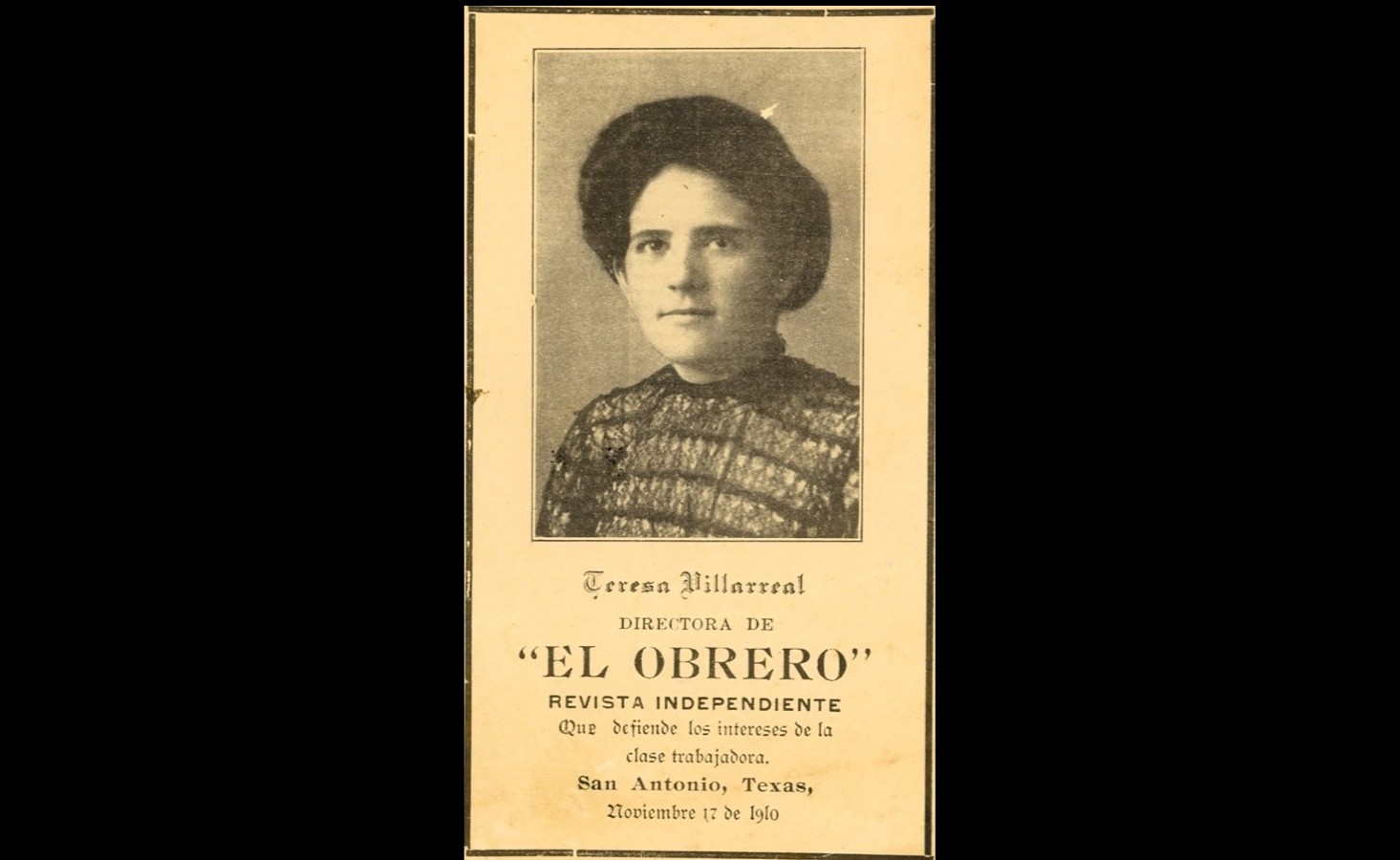
The Villarreal family played a central role in the early years of the Mexican Revolution along the borderlands as partisans of the Mexican Liberal Party, organizing workers and, notably, women to the cause of the overthrow of the Diaz regime. Luella Twining of the Political Refugee Defense League reports on the arrest of Therese Villarreal.
‘Miss Villareal Asks Socialists to Rescue Sister and Aged Father’ from The Chicago Daily Socialist. Vol. 4 No. 11. November 5, 1909.
ASKS AID FOR KIN IN PRISON
“Do something for them!” is the pitiful plea that comes from Andreas Villareal, sister of Antonio Villareal, Mexican patriot and Socialist, now in the federal prison at Florence. Ariz., as she tells of the kidnapping of her sister, Therese Villareal, and of her aged father by the Mexican rurales, in a letter just received by Miss Luella Twining of the Political Refugee Defense League, from El Paso, Tex.
Death Girl’s Penalty
This is the latest outrage of the minions of the Tyrant Diaz, carried out on ground recently hallowed by the presidents of the alleged Mexican and United States republics. Therese Villareal has been as active in fighting the rule of the Mexican czar as her brother. Her kidnapping is looked upon as a direct result. It is feared that death will be the penalty she will have to pay for the “crime” of protesting against the Diaz rule in Mexico.
“Isn’t it too horrible, Miss Twining? Papa and Therese have been taken by the rurales. Do something for them,” writes Andreas Villareal, and then tells how the kidnaping took place.
Sad Tale of Villareals
The Villareals have been making their home in Phoenix, Ariz., in order to be near their son and brother. Recently, however, it seems that they moved to El Paso, Tex., where they have been living for a short time. The Mexican home of the Villareals, from which they had been driven by the tyranny of Diaz, and made exiles in a foreign land, is at Lampazas, Mexico, where they have a small farm.
It was with the intention of selling this farm and getting what little they could for it that Therese and her father, who is 72 years of age, crossed the Rio Grande, took their lives into their own hands, and started for their old home. So far as could be learned they had not proceeded very far on their way when they were made prisoners by the rurales, agents of Diaz having dogged their every footstep.
Kidnapped Over the Border
Many of the friends of the Villareals in El Paso are strongly of the opinion that the girl and her father were not in Mexico when the soldiers of Diaz seized them, but still in Texas near the border. Many believe they were the victims of a carefully laid kidnapping plot, like that carried out in Douglas, Ariz., in June, 1907, when Manuel Sarabia, a revolutionist, was taken in the night, bound, gagged and blindfolded, hustled over the border and 70 miles down on the other side, where preparations were made to shoot him by the rurales, when his life was saved by the intervention of the United States government.
Ever since they left their home in Lampazas, Coahuila, in 1906, and came to the United States to follow the fortunes of Antonio, exiled for his revolutionary activity, the Villareals have been marked for victims of Diaz. Wherever they have resided they have been hectored and dogged by Mexican spies, who have tried through them to learn of movements of other revolutionists, who were carrying on their work of preparing for the overthrow of the Diaz government.
Therese and her sister, Andreas, devoted heart and soul to the cause of the exploited Mexican wage slaves, were not frightened by the persecution to which they were subjected. Torn from the beautiful home of their childhood where they had enjoyed every luxury, unused to poverty, they bravely endured their bitter lot, almost happy to make the sacrifice for their country’s sake. Their brother, imprisoned, could no longer work for the revolution, so they set about to do what he had been forced to leave undone. Andreas wrote fiery articles for the liberal papers at night and both worked at whatever they could find to do by day, and each gave all she could to the cause.
Movement Left Without Leader
They began in St. Louis, where they issued the Regeneracion, a Mexican newspaper, when the arrest of their brother with his comrades, Magon, Rivera and Sarabia, left the movement without a leader. When the trial of the men was held in Tombstone last June, the girls were there with the old father, not frightened by the spies with which the courthouse swarmed.
After the conviction of the men on the charge of violating the neutrality law and their sentence of two years in prison had been imposed. Andreas became more zealous than ever to working for the cause. Like a Joan of Arc the Mexicans rallied to her standard and when she spoke to them in the plazas of the Arizona towns they went wild with enthusiasm. Everywhere they called for “Los Parios” (the Pariahs), a poem she had composed, describing the wrongs of the enslaved peons of Mexico. Many times she has been threatened with arrest by Mexican consuls, but she has gone fearlessly on arousing the Mexicans along the border. For this she and her sister and father have incurred the hatred of the Diaz government.
What Will Be Their Fate?
Only two weeks ago Andreas wrote to a friend in Los Angeles from Wilcox, Ariz., saying they were about to go to El Paso, Tex., but there was nothing to indicate any intention of going over the border. On the other hand she and Therese have many times declared they would not go back to Mexico while Diaz ruled.
What will be the fate of Therese and her father one, hardly dares imagine. Will they meet the fate that other revolutionists have suffered, who, have died by the hundreds in Mexico in the last 15 years? Will they be thrown into the vile dungeons to perish by slow torture, as have many before them? Or will they be given the other punishment reserved for those who have dared to oppose the despotism of Diaz–being shot at sunrise behind the prison walls?
“Therese Villareal was one of the most faithful and interested spectators at the trials of her brother, Magon and Rivera at Phoenix, Ariz.,” says Miss Twining. “One incident in the trial I shall never forget. United States District Attorney Alexander had been especially vicious in his denunciation of the Mexicans, referring to them among other things as grafters–these men who had become penniless in their devotion to the cause of the Mexican toilers. It seems that Therese could not endure it.
“They Are Not Grafters”
“’They are not grafters, Mr. Alexander–that is untrue,’ she cried, jumping to her feet and facing the judge and the jury.
“I tried to make her sit down, but she would not. The spectators, who crowded the courtroom, began cheering, and a great turmoil ensued. A riot almost resulted when the judge ordered a marshal to take her from the courtroom.
“Why did you do it? I asked her afterwards.” said Miss Twining.
“’I couldn’t help it,’ she told me. ‘That judge is a friend of the Mexican government.’ It’s true,” added Miss Twining, “that the judge’s sympathies are with the Mexican government, he being partly of Mexican descent.”
Father Bent With Age
The father was a strong, healthy man when he took the two sisters to the trial of the son and brother in Tombstone, Ariz. The conviction of his sor broke him completely, however, and now he is bent with age. During the trial he brought food for the Mexican revolutionists every day, visiting them in prison.
Miss Twining will make a special report on the case to the Political Refugee Defense league, which meets Friday night. The case of De Lara will be taken up again at this meeting. Funds for the defense of De Lara are already beginning to pour into President John C. Chase, of the league, 180 Washington street.
The Chicago Socialist, sometimes daily sometimes weekly, was published from 1902 until 1912 as the paper of the Chicago Socialist Party. The roots of the paper lie with Workers Call, published from 1899 as a Socialist Labor Party publication, becoming a voice of the Springfield Social Democratic Party after splitting with De Leon in July, 1901. It became the Chicago Socialist Party paper with the SDP’s adherence and changed its name to the Chicago Socialist in March, 1902. In 1906 it became a daily and published until 1912 by Local Cook County of the Socialist Party and was edited by A.M. Simons if the International Socialist Review. A cornucopia of historical information on the Chicago workers movements lies within its pages.
PDF of full issue: https://www.marxists.org/history/usa/pubs/chicago-daily-socialist/1909/091105-chicagodailysocialist-v04n011.pdf

