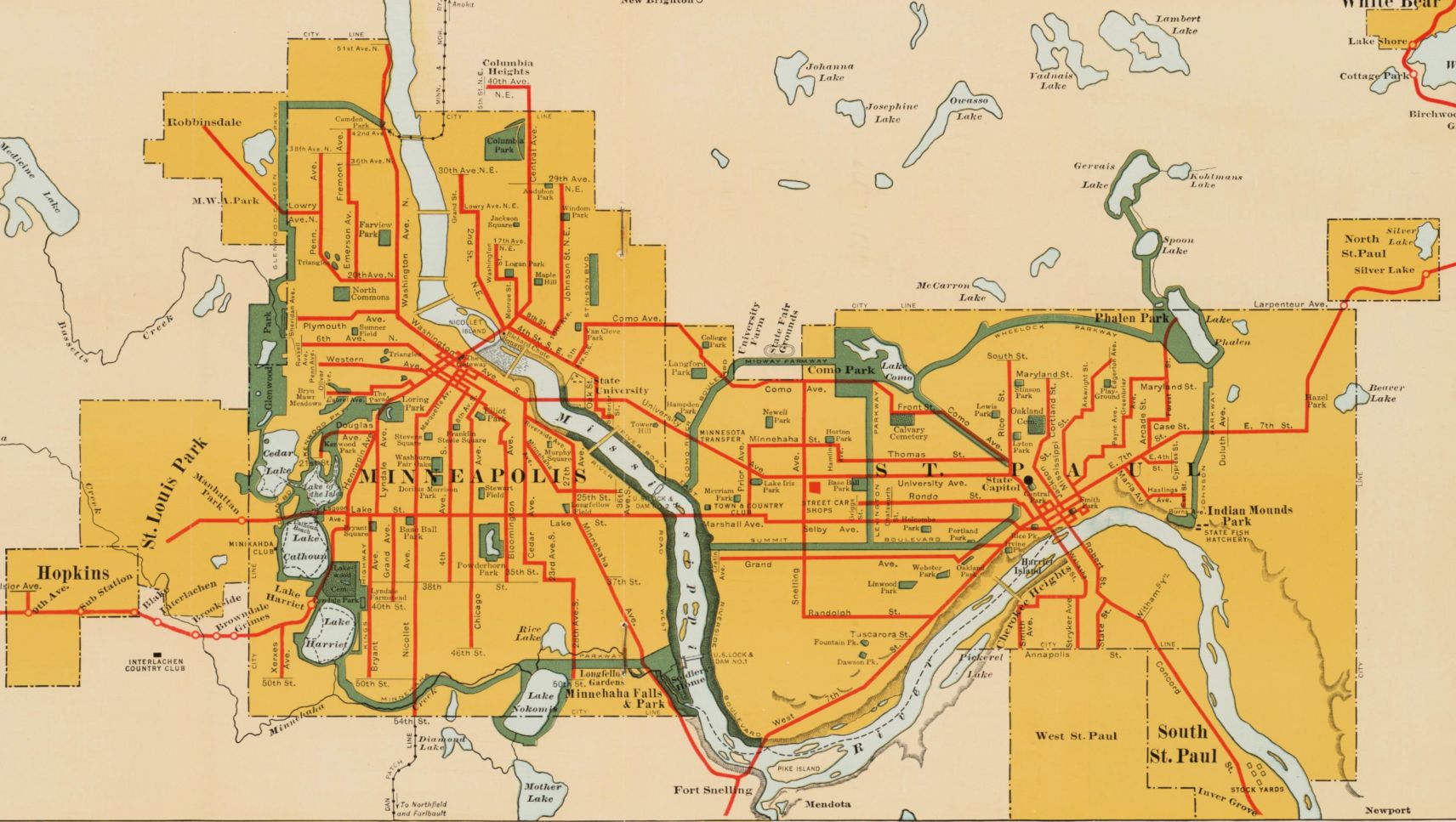
Detailing the stipulations of employment, a manifesto issued by the I.W.W. to the workers and patrons of the Minneapolis-St. Paul streetcar system asks for solidarity in their struggle for better wages and conditions.
‘Twin City Rapid Transit: Manifesto No. 2’ from Solidarity. Vol. 4 No. 25. June 28, 1913.
MANIFESTO NO. 2
Of The I.W.W. Street Car Workers Union Of Minneapolis Exposes Conditions in That industry
TO THE EMPLOYES OF THE TWIN CITY RAPID TRANSIT CO. AND TO THE WORKING CLASS OF ST. PAUL AND MINNEAPOLIS:
The reception tendered to our first manifesto by the public generally who patronize the Twin City System, and the words of encouragement and material expressions of sympathy from the workers of St. Paul and Minneapolis have served to strengthen us in the battle we are making for human working conditions and reasonable pay, considerate treatment and the right to organize.
We have thus far, through the necessarily limited space of a manifesto, been able to do little more than to lift a corner of the veil that hides the barrenness and hardships of a street-carman’s life–the denial he must practice, the patience he must exercise, the continuous strain to which he is subjected by the arbitrary rules, the observance of which are a condition of his employment. A set of rules covering twenty-six pages of fine type must be digested by the carman as set forth in the aforementioned book.
“STUDY RULES”
“Every employe whose duties are in any way prescribed in this book is required to CARRY A COPY WITH HIM AT ALL TIMES WHILE ON DUTY and to make himself fully acquainted with the whole of it, and to OBEY ALL INSTRUCTIONS contained therein.”
The street car workers on entering the service must stand an initial expense of dollars and cents out of wages that do not justify such an expenditure either as a risk or as an investment. The rules covering uniforms reads as follows:
“UNIFORMS”
“Trainmen will provide themselves with full new uniform within thirty days after receiving their appointment, unless especially excused by the Superintendent, and will be required to wear same at all times while on duty. This applies to all classes of service, regular, chartered or special.
“Trainmen will not be allowed to purchase second hand uniforms in poor condition. Trainmen desiring to purchase second hand uniforms must submit same to his foreman for approval before it will be accepted.
“Trainmen will not be permitted to remove cap or coat while on duty.
“The use of furs or sweaters which show above the uniform is prohibited.”
Realize, if you can, the hardships entailed in the strict observance of the last two paragraphs in the two weather extremes of a Twin City year. In the summer we swelter in overheated misery and in the winter we are subjected to colds, bronchial diseases, etc., that are only too often the starting point of that human scourge–consumption.
Passengers who have been any length of time in these cities and have observed carmen run ahead at steam railroad intersections to ascertain whether the line was clear or not will be able to appreciate the impossibility of carrying out the provision for “neat appearance” in wet or slushy weather.
And to keep “clean shaven” implies an expense entirely out of keeping with Twin City Rapid Transit Co.’s wages and a seven day week.
“PERSONAL APPEARANCE”
“Trainmen will not be permitted to take their car unless presenting a NEAT appearance. If a beard or mustache is not worn trainmen must keep themselves CLEAN SHAVEN.”
In view of the long, the exhaustingly long and weary day, the enforcement of the following rule indicates a heartless disregard, on the part of the management, for the health and comfort of the men out of whose labor is coined the dividends that swell the coffers of our street car magnates. Read it and decide.
“ATTITUDE ON CAR”
“Assuming any lounging attitude on car, while the same is in motion, will not be permitted.”
Verily, the misery of the workers is the foundation upon which rests the magnificence of our “Captains of Industry.” Our comparative destitution is the price of the splendor that dazzles a world. Servility and docility are the sole guarantees for the perpetuation of a tyranny industrial, political and social.
We have determined that we will endure no longer the autocratic sway that reduces us to chattels. We would be unworthy of the traditions of our forefathers who battled for their conception of human rights and who won for themselves as their descendants the inestimable prize of American citizen.
The management of the Twin City Rapid Transit Co. sets up its own code of laws that to its slaves constitute a far more sweeping denial of human rights than was embodied in all the enactments in King George’s colonial regime.
Some persons on reading our former manifesto expressed the belief that we had not taken typical schedules to illustrate the length of a carman’s day. It has been intimated that if we had not “invented” the schedules we had taken the worst ones possible. The exhibits were actual “runs” and two others are submitted this week to prove that we were moderate in our statements:
(a) “Plugged in” 4:36 a.m. Pulled out 4:46 a.m. to 8:45 a.m. Off until 6:17 p.m. Pulled out 6:27 p.m. until 1:38 a.m. and back at 4:36 a.m. to again “plug in.” Actual working time 11 hours and 30 minutes. From starting to quitting time 21 hours and 2 minutes, with 2 hours and 58 minutes to prepare for a similar experience as one day’s work.
(b) Sunday Owl. Plymouth and Bloomington. Plug in 5:21 p.m.; start out 5:31 p.m. to 12:25 a.m.; off until 1:23, a.m., when he works until 5:37 a.m. He is then relieved and reports back to take out another run at 6:29 a.m. and pulls in at 8:32 a.m. Actual working time 15 hours and 11 minutes. Length of day, 1511 minutes.
These runs require no comment from us. They stand out monumentally to testify to the unnecessary barbarism of the traction management and to plead the cause of the street car workers more eloquently than any words of ours.
Human endurance is over-taxed in the schedules of the car company, manhood is outraged and intolerable conditions prevail. We could not stand it if we would. We were compelled to get together for mutual assistance and we organized the union. Many of our members are now black listed. Every day men are called upon the carpet and interrogated about talking with their former fellow carmen and co-workers. Some of them are discharged in the vain hope of weeding out the men of spirit who dared to join the union. For every man discharged many come into the organization.
The company has Russianized the system so we organize through the underground. We are measuring our strength day by day. The time is almost at hand when we shall reap the crop that the traction autocracy has sown. We shall gather a harvest of shorter hours, better wages and decent working conditions on the street car lines of St. Paul and Minneapolis.
We feel that those who have been in contact with us daily, who know something more now than they did hitherto of our grievances will be behind us to assist in establishing American conditions in the transportation service that is the life blood of the cities’ industries.
Other phases of the traction service will be exposed in future manifestos.
We, like the immortal Abraham Lincoln, “are proud to live in a country where men have the right to organize.”
We are determined to exercise that right and despite the machinations of the management, notwithstanding its arrogance and its persecution of the pioneers in this movement, before the summer wanes the carmen will have demonstrated that they are both courageous and intelligent. The patrons, too, will recognize that their estimate of the carmen is justified when we gather fares and run cars under the protection of a union whose motto is “an injury to one is an injury to all.”
Who would be free, himself must strike the blow.–WE WILL.
PRESS COMMITTEE, Street Car Employes Industrial Union No. 263. Minneapolis, Minn., June 17th, 1913.
“Underground” is the term applied to the secret methods of organization made necessary by the repressive measures adopted by the government of the Czar to stay the progress of the revolutionary movement in Russia. It will also be recalled that fugitive slaves from the south were secretly protected and conveyed from the slave states of the South by Abolitionists in the days preceding the Civil War by what was then termed the “underground.” The term means nothing more than secret organization under compulsion.–Editor.
The most widely read of I.W.W. newspapers, Solidarity was published by the Industrial Workers of the World from 1909 until 1917. First produced in New Castle, Pennsylvania, and born during the McKees Rocks strike, Solidarity later moved to Cleveland, Ohio until 1917 then spent its last months in Chicago. With a circulation of around 12,000 and a readership many times that, Solidarity was instrumental in defining the Wobbly world-view at the height of their influence in the working class. It was edited over its life by A.M. Stirton, H.A. Goff, Ben H. Williams, Ralph Chaplin who also provided much of the paper’s color, and others. Like nearly all the left press it fell victim to federal repression in 1917.
PDF of full issue: https://www.marxists.org/history/usa/pubs/solidarity-iww/1913/v04n25-w181-jun-28-1913-solidarity.pdf

