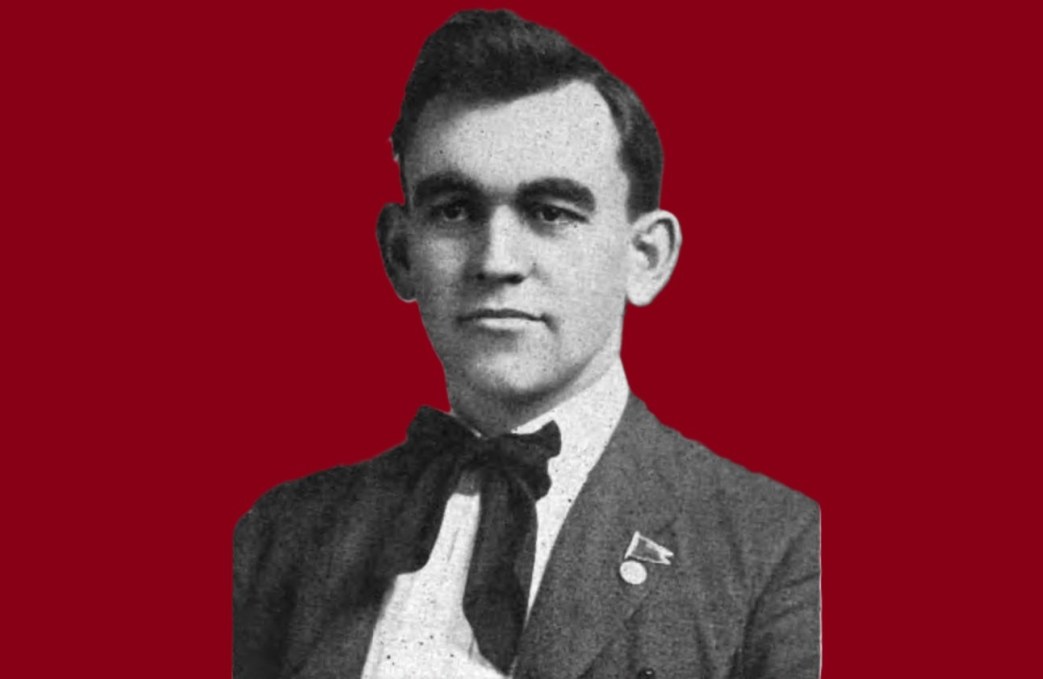
The hardscrabble, proletarian early life of Tom Mooney is made plain.
‘Childhood and Youth of Tom Mooney’ by Brena Morris from Pacific Weekly. Vol. 3 No. 17. October 28, 1935.
“BLACK, beetle-browed, an ominous man,” San Francisco papers wrote of Tom Mooney in 1916, 1917 and 1918: and not for a good many years did the description cease to be prevalent. The facts that Mooney was an Irish worker who talked with a hearty Irish accent and whose character, even when most grossly shaken from its ballast, never fitted into that phrase, counted practically nothing.
The nearest that Mooney came to being “ominous” was by his inheritance of social and personal deprivation, awaiting him first of all in the slums of Chicago, where he was born to Mary and to John Mooney, a coal miner.
John Mooney, Sr. was one of the throngs of Irish peasantry brought over to the United States to help develop its industry by furnishing its common labor; and, consequently, Tom was born to oppression that derived its sociological aspects from the fact that people of his class secured their food from garbage cans, had negligible opportunity for education (Life of Pope Pius XIII was the only book Tom ever saw in the house his father lived in); whose family life consisted in going from railway camp to railway camp and from mine to mine, or–at last wearied of company abuse and company thugs during miners’ strikes–cityward and to worse conditions; and, finally, whose children, in order that they might be put to work as early as possible, were forced, before reaching their teens, to leave the paternal home. It was no more than the general order of things, then, that Tom’s first job–that of sorting rags in a paper mill–began before he was ten. The Mooney family by this time had emigrated from Chicago and lived near a Baltimore and Ohio Railway camp in Idaho in a miner’s hut.
In one of the great coal strikes of 1895, John Mooney was hunted out of job and home for taking a shot at a strike-breaker. Tom’s role as a wage earner became more important with this event. He had to supplement the earnings of his mother and sister who did washing, and his mother hired him out as an apprentice in an iron foundry. At that time common solace of laborers was religion or alcohol; but it happened that Tom, though he might have acquired his father’s taste for both, found neither one nor the other agreeable. This dislike, in a sense, might have been one of the things the San Francisco papers truthfully could have described as “ominous”, indicating, as it did, that not the desire for escape from poverty, but active opposition to it, was the thing Tom Mooney wanted.
He stood head and shoulders above his companions in moral uprightness, differing from them not only in not having any of their petty vices, but, partly because he believed himself to be sexually subnormal, remaining exceptionally virtuous as a young man. He served out his apprenticeship, and it was hereafter his bitter experiences as an American worker started. He worked his way on a boat half-way around the world with another young fellow. When he came back he was a militant trade unionist. Now he commenced that period of his life which consisted in a series of scraps with foremen over wages in foundries and factories; getting the leadership of strikers’ committees and then fired and in arguing ceaselessly about the need of militancy. In the year 1907 to 1908, when he was wandering southward and eastward, he was hopeful of hardly more than keeping just a skip ahead of the wolf that was wandering over the country. It was Rena Herman, his future wife, who was his Plymouth Rock to Western labor organization and agitation.
Tom was introduced to her, a class-conscious music teacher, while on his way by horse and buggy through the Sacramento Valley for the purpose of selling pamphlets to aid Eugene Debs in his campaign for President as a candidate of the Socialist Party. One of the first things the couple did was enter a contest conducted by a Socialist magazine which offered as a prize a trip to the Socialist International at Copenhagen. Rena managed to bring in the last few subscriptions needed. He got second prize, the trip. Somewhat wistfully he mentions it today–and that some of the greatest Socialists in the world were there. But the prize hadn’t provided him with spending money, and he continually had to write to Rena for small sums, thus marring his Utopia a bit.
When he got back to California, two things had happened that had an important effect upon all that he was to do later: (1) he had been the most successful of any in selling Socialist literature for the Debs campaign, and Gene Debs had put a hand on his arm, praising and encouraging him; (2) he had traveled with the Red Special during Debs’ presidential tour, back to Indiana. Now, coming back from Europe, he stayed from 1909 to 1910 in New York and Chicago, listening to exponents of the Socialist movement. He was ambitious to improve himself–this also might have been considered ominous and he crammed ten hours a day in the library at Marshall Fields until, at last, the effort to learn in a short time everything he saw he should know fagged and discouraged him in so great an endeavor. He visited his mother and sister in Chicago and made arrangements to bring them to California.
In 1911, back in San Francisco and married to Rena Herman, Tom started the labor agitation which for five years confined itself to northern California and which became a worldwide cause the day in August, 1916, when he and Rena Mooney were brought back to San Francisco from their vacation at Guernieville and were jailed on the charge of participation in the Preparedness Day bombing. Thus ended the young manhood and freedom of that “ominous” ironmolder, Tom Mooney, whose imprisonment remains the sign most truly ominous of our courts’ perversion of justice.
I once asked Tom Mooney what was his most vivid impression of his childhood, and very quickly came his answer: “Looking through garbage pails for food, that’s my memory of childhood.”
Pacific Weekly, based in Carmel, California was edited by William K. Bassett, Lincoln Steffans, and Ella Winter from late 1934. A Popular Front-era ‘fellow-traveler,’ magazine that became more of a Party press over its life. With a strong literary and arts focus, something of a West Coast ‘New Masses’, the weekly did not survive long after Steffans death in June, 1936. Though its run was short, Pacific Weekly is a rich record of left-wing 1930s writing with authors like publishing work in its pages.
PDF of full issue: https://www.marxists.org/history/usa/pubs/pacific-weekly/1935/v03n17-oct-28-1935-pw.pdf

