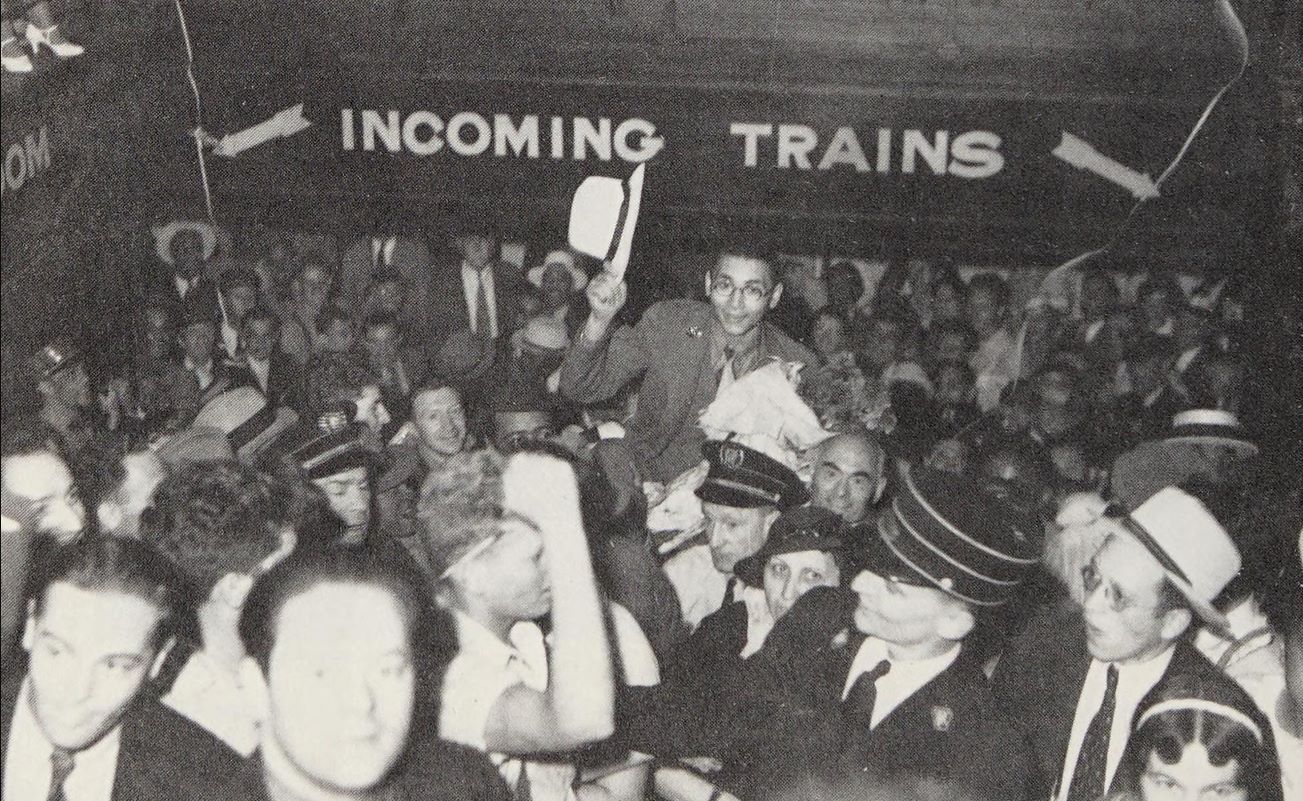
Otto Hall on the meaning of Angelo Herndon’s defiance. Herndon was a young Black coal miner who joined the Party in 1930 and quickly became a leading organizer. Arrested in July, 1932 by Atlanta police for “inciting insurrection”, he faced the death penalty, but was sentenced to 18-20 years hard labor; the chain-gang. The case would reach the Supreme Court, which finally cleared Herndon in 1937.
‘The Political Significance of the Herndon Case’ by Otto Hall from The Daily Worker. Vol. 10 No. 30. February 4, 1933.
THE Herndon case is one of the most important case in the history of our movement. There never has been a case that has brought forward so clearly, so many important aspects of the struggle of the American working class against capitalist exploitation. We have in this case the struggle of the workers against starvation and misery, and, as was brought out in the trial, the struggle for equal rights for Negroes and their right of self-determination in the Southern Black Belt.
This nineteen-year-old Negro boy who shocked the white ruling class out of their smugness and put fear in their hearts by his Bolshevik fortitude and stamina, is typical of the working class leadership in the south that is developing out of the sharpening struggles in that section. The Camp Hill fight, the very recent Tallapoosa struggles, in which the Negro toilers have demonstrated to the entire world their willingness to fight and their revolutionary potentialities, are indications that in many sections of the South they will be the ones who will lead the struggles and set the example to the white workers that the only way out of their misery is through organization and struggle.
TTHE renegade Lovestonites and Cannonites, and the leadership of the National Association for the Advancement of Colored People, (Picker, Du Bois, Schuyler, etc.) have repeatedly spread the canard that the Negroes in the South are ignorant, backward, and so terrorized that they won’t fight. The southern bourgeoisie would like to believe this, but they are becoming more and more convinced that this is not true. They also thought that the native southern white worker wouldn’t struggle, but the textile workers in North and South Carolina and Tennessee, and the fighting miners in Kentucky and West Virginia have changed this opinion. The vicious attacks of the southern capitalists against the workers, Negro and white, and their attempts to suppress the revolutionary movement that is developing down there, shows that they realize that they are sitting atop an active volcano that is likely to erupt at any moment. Due to the deepening crisis, they are finding it more and more difficult to bolster up among the white workers the ideology of race superiority that has served so long to hamper the united fight of the workers in that section. They can no longer afford to pay the white worker a little higher wages than those paid to the Negro for similar work. Consequently, the white worker is beginning to lose his feeling of race superiority and further is beginning to realize that unless he fights for Negro rights, he cannot better his own economic condition. The way the white workers of Atlanta rallied to the support of Angelo Herndon is an interesting example.
Never before had the workers of Atlanta, Negro and white, and in the whole South for that matter, witnessed such smashing of favorite southern traditions. The two Negro lawyers, B.J. Davis and John H. Geer, native southern Negroes, in their conduct of the defense of Herndon in the courts astounded every one by the way they bearded the bourdon lion in his den. They brought the question of Negro rights forward clearly and boldly during the trial in the splendid fight they made for the right of Negroes to serve on the jury. Never in the memory of any Negro in that court room had any lawyer attempted to stop white policemen and prosecutors from referring to their clients as “n***s” and “darkies.” When B.J. Davis objected to these terms, the judge was forced to sustain the objection.
ALL during the three days of the trial, the court room was crowded with Negro and white workers. The Jim Crow laws were broken for the first time when Negro and white workers occupied the same benches. The court room became a political forum; Negro and white workers alike learned that the basic reason the bosses were able to keep the down below the starvation level was through the southern system of Jim Crow and the national oppression of the Negro toilers in the black belt. The bosses through their prosecutor, Walter Le Craw, made the Communist slogan of self-determination and basic argument against the defendant. Le Craw shouted that, “if you don’t send this defendant to the electric chair we will have a Red Army marching through Georgia which will take all of the land away from the white people and give it to the Negroes!”
Every opportunity the judge had to overrule objections made by the defense attorneys was utilized. The prosecutors were allowed to use every trick in the calendar to inject race prejudice in order to inflame the jury. A witness for the defense Professor Evans, a native southerner, and professor of economics at Emory University, and whom the judge disqualified as an expert on Communism, was asked the following questions by prosecutor Hudson, a former baptist preacher. Question: “Do you believe in equal rights for Negroes?” Answer: “Yes under the law.” Question: “Would you want your daughter to marry a Negro?” Answer: “It’s against the law in this state.”
This question was allowed in spite of the objections by the defense. These tactics of the prosecution did not get them anywhere with the white workers who crowded the court room. Many openly expressed indignation at the tactics of the bosses.
THUS the fight for the release of Angelo Herndon becomes one of the most important tasks facing the working class today. As a result of this fight we are getting the support of a large section of the Negroes, including petty bourgeois intellectuals, who are attracted by the raising of the national question in the struggle for Negro rights. Also the white workers are in considerable numbers supporting this fight. The revolutionary movement is going forward with increasing tempo and the opportunity to break through the terror in that section was never better. Even the vicious sentence given Herndon did not dampen the spirit of the workers. Many Negroes said that they were going to join the Communist Party and carry on the fight.
The Daily Worker began in 1924 and was published in New York City by the Communist Party US and its predecessor organizations. Among the most long-lasting and important left publications in US history, it had a circulation of 35,000 at its peak. The Daily Worker came from The Ohio Socialist, published by the Left Wing-dominated Socialist Party of Ohio in Cleveland from 1917 to November 1919, when it became became The Toiler, paper of the Communist Labor Party. In December 1921 the above-ground Workers Party of America merged the Toiler with the paper Workers Council to found The Worker, which became The Daily Worker beginning January 13, 1924. National and City (New York and environs) editions exist.
PDF of full issue: https://www.marxists.org/history/usa/pubs/dailyworker/1933/v010-n030-Nat-feb-04-1933-DW-LOC.pdf

