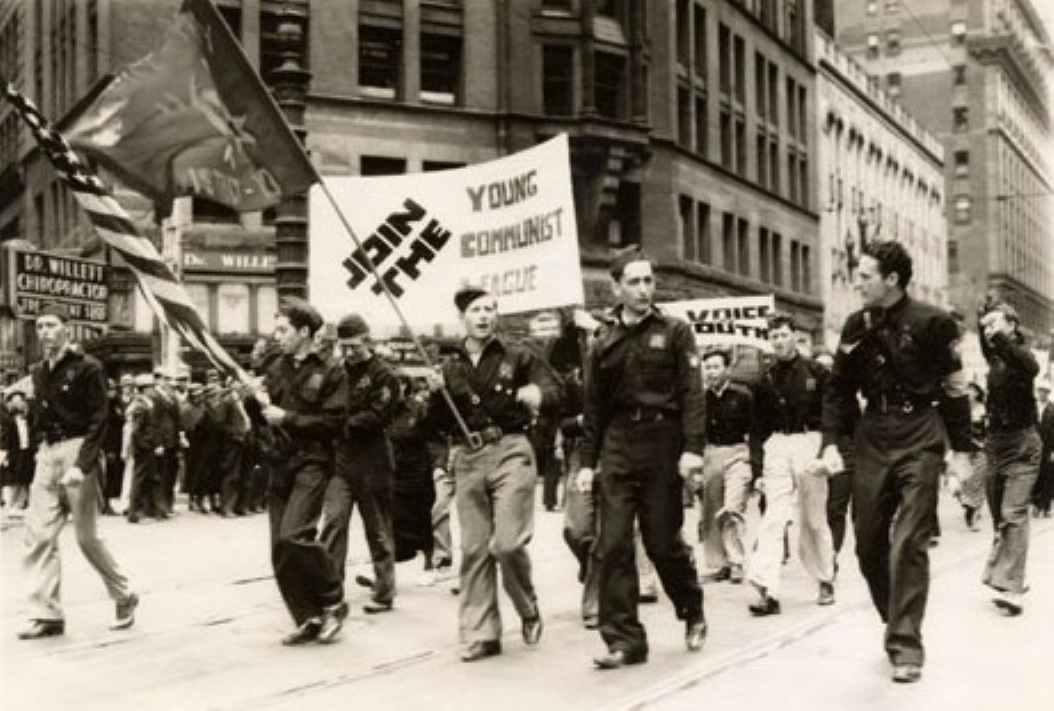
1933’s Open Letter is promoted by the Y.C.L.’s long-time leader Gil Green.
‘The Open Letter and Tasks of the Young Communist League’ by Gil Green from The Communist. Vol. 12 No. 8. August, 1933.
THE Open Letter adopted by the Extraordinary Party Conference and addressed to every Party member has a special significance for the Young Communist League—the organization which at all times acts as the closest co-worker to the Communist Party in the struggle for the majority of the working class. In the light of this letter it is necessary to analyze the situation and tasks of the Young Communist League.
The Open Letter calls sharply to the attention of the whole Party the fact that “in spite of the radicalization of the masses of workers, the Party has not developed into a revolutionary mass Party of the proletariat,” but remains as yet isolated from the basic American proletariat.
This is many times more true of the Y.C.L. The League, which under normal conditions should be many times the size of the Party, has only 6,000 members as compared to 20,000 in the Party. The Y.C.L. is far more isolated from the decisive masses, being exceptionally weak in the most important industrial districts and having only 25 shop nuclei compared to approximately 135 of the Party. The composition of the League is extremely poor, fully 35 per cent of our membership being composed of students and farming youth, barely 15-20 per cent are working and most of these in small shops, and the balance are unemployed. While the League, as a broader organization than the Party, can include in its ranks a larger percentage of non-proletarian masses, basically it must be composed of proletarian youth, a large percentage of whom are employed in industry.
But the above facts are not something new. Both the Party and League for a long time have known their basic weakness. The Open Letter says: “In many resolutions we already set ourselves the task of developing our Party into a proletarian mass Party. We did this with the greatest thoroughness over a year ago at the Fourteenth Plenum of the Central Committee. But all these resolutions have for the most part remained on paper.” The same is true of the decisions of our League Plenum held a year ago.
It is for this reason not enough to reiterate the basic tasks of our League, but to find the reasons for the failure to carry through these tasks since our last Plenum.
First, the leadership and the League as a whole failed to understand the most important factor from which flows our whole revolutionary perspective; namely, the growing radicalization among the young workers. We drew conclusions that the main process among the youth is that of “disillusionment,” of helplessness, of disappointment; instead of seeing that the most important characteristic is the growing activity of the youth, their growing radicalization and movement to the left.
Second, we began to draw certain theoretical justifications for our weaknesses in the shops. We concluded that the role of youth in industry was declining. In the resolution of the Sixteenth Plenum of the Party we stated: “The actual wages paid, therefore, supply no more incentive for the capitalists to prefer young workers to adults.” This is 100 per cent wrong.
While it is true that a majority of the youth today are unemployed, still the youth play a very important role in the industrial process. This is shown by the high percentage of youth involved in the present strike wave. Under capitalism there is always incentive to hire young workers, as the level of wages is never so low but that it cannot be reduced a little more by hiring younger workers who are forced to work at a faster pace for less wages.
Is it surprising then, that with the above two conceptions our League failed to see the development of the present strike wave and was thus entirely unprepared when it burst? Both of these only served to cover up the failure of our League to penetrate the basic sections of the youth by placing the responsibility on the objective conditions instead of upon the subjective factor—our Party and League. Such theories are only possible as a result of the fact that “in the Party (and League), particularly among the leading cadres, there is a deep going lack of political understanding of the necessity for strengthening our basis among the decisive sections of the American workers.” (Open Letter.)
We began to look for the transformation of our League into a mass organization not by pursuing the path of organizing and leading the economic struggles, but by finding some “easier” and “shorter” path to the masses of youth. Instead of emphasizing the economic struggle we emphasized educational and cultural activity, without realizing that the basis of all Communist education is the daily struggle. Instead of emphasizing the need for activizing every member of the League in the daily class struggle, we emphasized the need for “less discipline” in the League—the need for demanding less activity from each member.
The result of all the above is that our League actually revised the line of the Y.C.I. as expressed in its letter sent to our League more than a year ago and failed to carry out the good decisions made at our own Plenum.
But this is not all. It is necessary to find out why, even in some places where attempts were made to carry out the line, so little results were obtained. This leads us to the point emphasized by the recent Plenum of the Y.C.I., that only by a complete reconstruction of our system and methods of work is it possible to turn our League towards the decisive masses of youth.
At last year’s Plenum, we decided on a policy of concentration. Why? Because we realized that our weak League could not penetrate ail the masses of youth at the same time. Like every army conducting a serious war, we chose certain strategic points of the enemy for attack—for concentration. We realized that by capturing these strategic points we could move our army forward along the whole front.
But the policy of concentration was not carried through, because:
1. We have not yet learned to stay in one place until something is accomplished. We still run here and there, bowing to the spontaneity of the masses, to the events of everyday life. Let us give an example from the work of our National Committee. At our last Plenum we chose four districts for concentration. This meant to assign our best forces to work for a change in these districts. Two weeks after the Plenum, in discussing the election campaign, we decided to send two leading members of our National Buro on three-month speaking tours across the country. This is how in practice we carried out our own policy of concentration.
2. Because of our narrow approach towards concentration. We looked upon concentration as the property of a few leading forces, and not as a method of work for the entire League. We assigned one or two comrades for work at a large factory, and then believed we were concentrating.
Every unit and individual member must understand and apply the policy of concentration in their daily work. If in Chicago the League is concentrating on the Stockyards, this means that the membership on the South Side must know what is going on, must direct and control this work. Secondly, concentration must not be limited to national or district concentration points. Every section and unit must have its place of concentration, and every member must understand how his own individual work fits into this plan of concentration.
The carrying through of a line of concentration is intimately connected with another question of greatest importance—that of activizing every member of the League around concrete issues of struggle. Without this it will be impossible to make a fundamental change in the situation of our League.
The Open Letter says: “The center of gravity of Party work must be shifted to the development of the lower organizations, the factory nuclei, local organizations and street nuclei.” This certainly is not the case in the League today, because: “A characteristic feature of the work of the American League up until now has been the fact that the leadership in a bureaucratic manner replaces the activity of the lower units and does not organize their work on the basis of the development of broad self-initiative.” (Resolution of N.E.C. Plenum.) What is necessary?
1. To establish a broad collective leadership throughout the League. It is impossible to do away with the system of replacing the membership, before we first of all do away with the system of one or two-men leaderships. Today, it is the handful of full-time functionaries that not alone replace the membership, but also the leadership. It is they who try to do all the work with the result that the leadership can be nothing else but bureaucratic, a hindrance to the development of new proletarian forces.
2. It is necessary to institute the broadest inner democracy. The leadership must feel responsible to the membership for its work. Every political campaign, every political conclusion must be brought to the membership. The present situation in which the leadership merely looks upon the membership as technical machines which carry out instructions must be eradicated. There must be regular re-elections of leading bodies. Every member must feel from the first day he enters the League that this is his organization, that he is master. The question of inner democracy is of special importance in the Y.C.L., precisely because it is a youth organization.
3. Through the establishment of broad inner democracy, it is necessary to give every unit a political life of its own. Today, our units live on instructions from above. They do not react to the problems in their own shop or territory. Every unit must have its own concentration point, must know where to reach the most decisive sections of youth. Every unit buro must know its membership. The task of every comrade must be worked out so that it fits into the plan of the unit as a whole. We must know where every comrade works, and must help him in his work there. We must give every member a task out among the youth and must make him feel responsible for carrying it through. In this manner the work of the whole League will not be merely one campaign after another, but will be based on a conscious plan starting with every member and going all the way to the National Committee.
4. It is necessary to establish firm organizational control of all of our work, of the carrying through of all decisions. For every decision made someone must be made responsible for carrying it through. It must be understood that a correct line or good decisions if merely left on paper can accomplish nothing. Decisions that are not carried through are only obstacles in our path.
The most important question before the leadership is to struggle for a complete reconstruction of the system and methods of work of our League. The leadership must discuss and solve the daily problems of the units. Only by changing the situation down below can we move our entire League forward.
In line with the directives of the Open Letter the whole League must be orientated to the following immediate tasks:
1. The mobilization of the whole membership for concentration on the most important factories. The activization of every League member who works, in his own factory and trade union. In all industries and especially in the industries and factories of concentration, the organization of a struggle against the industrial codes and in particular against the discrimination af young workers in these codes.
2. The organization and preparation of strike struggles and the penetration of existing strikes whether organized spontaneously or under reformist leadership. Especially the penetration of the strike struggles in the mining industry. Simultaneously with the development of these strike struggles must come the building of the revolutionary trade unions, and youth sections. In every strike special demands must be put forth for the young workers, especially for Negro youth, and organs created for giving organized expression to these demands. As a means of formulating the demands of the youth and preparing strike struggles, special youth conferences are to be organized as soon as possible in mining, textile and needle and later in steel and marine.
3. The League must intensify its work in the reformist unions. Special attention must be paid to forming broad opposition movements among the A. F. of L. apprentices, especially in the printing trades. Work must be started in the reformist unions in mining, textile and shoe, where we must work for the creation of youth oppositions and youth sections under our leadership. Attention must be paid to the youth in the railroad industry.
4. Special care must be taken of every Y.C.L. shop nucleus. The District Buro in every district must be politically responsible to the National Committee for the existence and growth of shop nuclei. Leading comrades must be assigned to work with these nuclei as their most important tasks. District Buros must analyze and discuss the work of individual shop nuclei.
The decision of the Open Letter that: “Every Party factory nucleus must help to organize a nucleus of the Y.C.L.,” must be carried into life. Special discussions must be held in all Party nuclei on the importance of this task, and special forces assigned to conduct work among the youth in the shop. This slogan must however not be interpreted as solely a task of the Party. On the contrary, it is the League leadership which must be responsible for constantly raising this question with the Party, and for assigning League forces to work with Party nuclei. In this work also, the Party and League are to choose concentration shops where in a definite period of time Y.C.L. nuclei are to be established.
5. While the main point of concentration is work at the shop, our League must also intensify the struggle for social insurance which remains the most burning issue before the American working class, unemployed and employed. Of greatest importance is the further struggle against the reforestation camps.
***
The carrying through of the Open Letter by our League necessitates the closest cooperation and guidance from the Party. The Open Letter says:
“The Party is confronted with the task of drawing the young workers into the class struggle. This demands that an end be made of the underestimation of youth work, and of the necessity of putting up special youth demands. All Party organizations, especially the factory nuclei, as well as fractions in all trade unions and mass organizations, must organize youth sections and give active support to the Young Communist League.”
Today the Party comrades do not yet realize that the carrying through of the Open Letter is impossible without making a change in our approach towards the American young workers. The problem of penetrating the basic industries is to a great extent the problem of reaching the American-born workers from whom we are completely isolated today. Today our Party is still a Party of foreign-born workers. The problem of improving our work among the American youth is part of the key problem of rooting ourselves among the basic American masses. If this were understood by our fractions in the mining union, by our comrades in the key concentration districts, a little more attention would be paid to the problem of the young workers.
It is only under the political leadership of the Communist Party that the Y.C.L. can root itself among the decisive sections of the youth and in this way become a force for the transformation of our Party into the Mass Party of the American proletariat.
There are a number of journals with this name in the history of the movement. This The Communist was the main theoretical journal of the Communist Party from 1927 until 1944. Its origins lie with the folding of The Liberator, Soviet Russia Pictorial, and Labor Herald together into Workers Monthly as the new unified Communist Party’s official cultural and discussion magazine in November, 1924. Workers Monthly became The Communist in March, 1927 and was also published monthly. The Communist contains the most thorough archive of the Communist Party’s positions and thinking during its run. The New Masses became the main cultural vehicle for the CP and the Communist, though it began with with more vibrancy and discussion, became increasingly an organ of Comintern and CP program. Over its run the tagline went from “A Theoretical Magazine for the Discussion of Revolutionary Problems” to “A Magazine of the Theory and Practice of Marxism-Leninism” to “A Marxist Magazine Devoted to Advancement of Democratic Thought and Action.” The aesthetic of the journal also changed dramatically over its years. Editors included Earl Browder, Alex Bittelman, Max Bedacht, and Bertram D. Wolfe.
PDF of full issue: https://www.marxists.org/history/usa/pubs/communist/v12n08-aug-1933-communist.pdf

