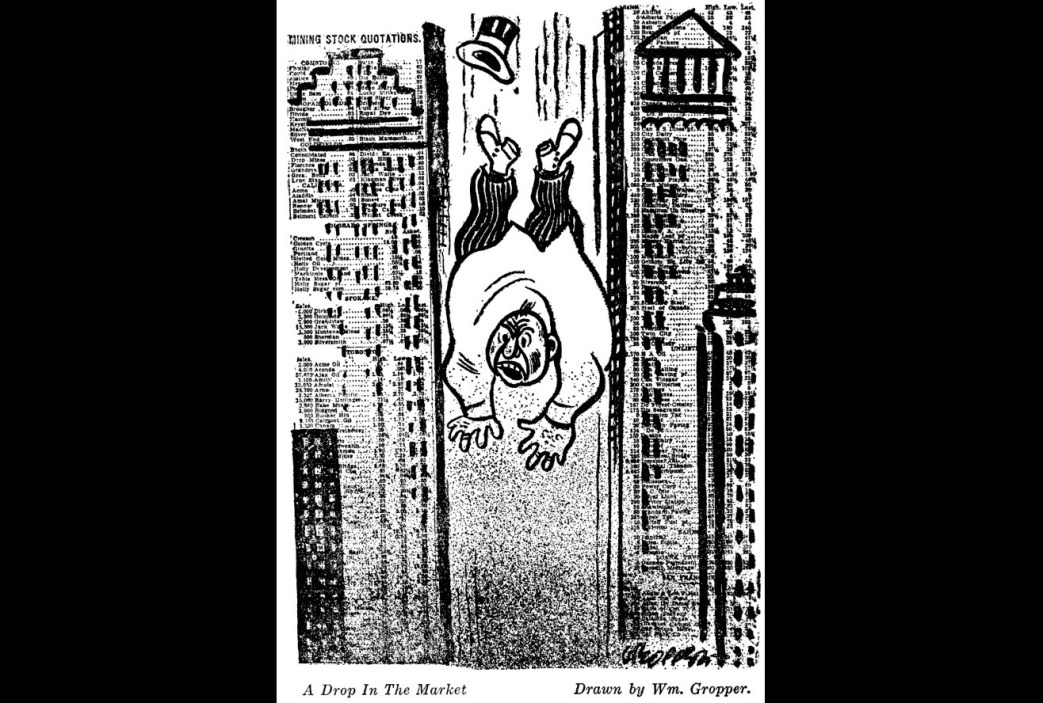
The October 1929 Wall Street Crash was a before-and-after moment for the 20th century and is here analyzed shortly after by Harrison George. It is always illuminating to read contemporary reactions and analyses of past, transformative events, as they were necessarily understood by history and contemporary conditions; while we live with, and largely understand, those events through their consequences. Harrison was a former leading I.W.W. activist and journalist, sent to Leavenworth after 1917’s mass anti-radical raids, became a founding member of the Communist Labor Party in 1919 while in prison. One of the last ‘politicals’ to be freed, and a fine writer, he was hired on his 1923 release as a staff journalist for the Daily Worker, eventually going on to edit the People’s Weekly World in the late 1930s. Much of his political work in the 1920s related to the Profintern for which he be a functionary for the Pan-Pacific Trade Union Secretariat, and edit its journal. In addition he was the R.I.L.U.-P.P.T.U.S.’s liaison to the Philippines, Australia, and the United States among other national responsibilities.
‘The Bursting of the Wall Street Bubble and Its Meaning to World Labor’ by Harrison George from The Pan-Pacific Monthly (San Francisco). No. 32. November, 1929.
IN October last there began a series of spectacular panics on the New York Stock Exchange which, during the course of some weeks became, in the words of a capitalist chronicler, “a settled reign of terror” that, taken in conjunction with its causes and effects, affects the entire fabric of world imperialism, including the world proletariat and its organizations. More immediately and directly it affects, of course, the working class of the United States.
Gone, and gone forever are the fairy tales of “eternal prosperity in America,” the advertisers of which have, since the last World War, inflicted this illusion upon countless millions of workers abroad to such a degree that even in the Soviet Union we heard such remarks as “the young, red-cheeked American imperialism” only a year ago, while in capitalist countries America was looked upon as a sort of paradise, where everyone hoped sometime to go were it not for immigration restrictions making America nearly as difficult to enter as paradise.
It is necessary to say at the beginning that what “paradise” existed in America, was a bourgeois paradise, in the splendors of which the American proletariat had little share. True, during the period of expansion of American imperialism just following the World War and ascending on the advantage it had against shell-shocked Europe, the standard of living of American workers on the average was shown by statistics to be somewhat better than those in other capitalist countries. But this average was always deceptive, always figured out on the basis of the organized workers (mostly the skilled), always inflated with the inclusion of managers and superintendents, and generally faked in such a way as to conceal the basic fact–the fact, cold-blooded and unmistakable, that at no time was the average real wage of the factory workers (mostly unskilled and unorganized) within even thirty per cent of touching the bottom minimum scale set by the government itself as the very least life could be sustained upon in health and animal necessity. We see for example, that while the government declared that some $2,300 was required yearly to sustain an average family, the average factory wage was reckoned by the week at $25 or–if the worker worked the whole year through at this rate, at $1,300. Naturally, millions have no steady work. Naturally, also, below even this profoundly deficient average, millions have always faced a life of bitter privation. Limitless hours at speeded toil for slow-starvation wages a hopeless struggle for existence, with women, youth and child labor growing, with disease and poverty ever present in the slums of the cities and the hovels of the country-side. “Prosperity” indeed!
But out of this game the American capitalists were wringing the sinews of war for world hegemony. Out of this rationalization enormous profits were accumulated, affording a credit power never before equaled with which to club the way of Wall Street through diplomatic obstacles toward domination of Latin America, to stretch envious hands out to seize the prize of China from the grasp of England and Japan, to fight on every continent to break into the market areas controlled particularly by Britain.
To the American bourgeoisie, flushed with profits, there appeared only one year ago to be no end of unobstructed extraction of surplus value from the rationalized exploitation of its workers. Stocks, usually “watered” in their issue to totals far in excess of the physical value of production equipment, and always subject to speculation by stock gamblers a betting based essentially on whether much or little profits can be wrung from the working class–began on Hoover’s election, a skyward leap in prices on the greatest of Monte Carlos, the stock exchange. And why not? Was not Hoover, the alleged wizard of commercial engineering, the oracle of rationalization at home and trade expansion abroad, enthroned in power at Washington not more than one year ago? The “Hoover boom” became the eighth wonder of the world.
But alas and alack! The sickness of world imperialism is beyond cure. Even those “red cheeks” of American imperialism turn out to have been but the customary fever-flush of tuberculosis. America may lead in rationalization, but it has no monopoly on it, and its example being copied in the other imperialist countries boded no good for American imperialism, though its advertisers foolishly boasted at the time of Hoover’s election that America in the role of godfather to Europe had “rescued and reestablished” European stabilization and everything would hereafter go on as before the world war.
Yet it was precisely this regaining of the pre-war level of production that was bringing about a sickness for which neither Hoover or any other Jesus Christ of capitalism has or can possibly discover a cure.
The fatal contradictions eating at the vitals of the whole imperialism system, grown fat and diseased on the lifeblood of the world toilers, is pursuing its course, and more and more, with every addition to stabilization, every addition to the world productive capacity, was drawing the structure of American capitalism into the downward sucking vortex of the general imperialist crisis.
The blow at American domination in China, by the onslaught of Britain and Japan through the revolts of Feng Yu-hsiang, covertly aided by Yen Hsi-Shan, joined in point of time by Chang Fa-kwei and the “reorganizationists” in the South, coming, as it did, as a shock to American ambitions that had reached out its own hand for the Chinese Eastern Railway and Manchuria, was a terrific set-back for American interests. At the same time, it must be remembered, that the revolt of the rival militarists, reactionary as they all are, found a certain advantage for attack on Nanking in the mass hatred of Nanking’s bloody despotism and servility to imperialism in attacking the Soviet Union. The conscious vanguard of course had no illusions in the rebels and fights them as well as Chiang Kai-shek, but the wider masses, too, saw that the Soviet Union, friend of the oppressed, was being attacked by Nanking, and had no stomach for supporting Nanking in such imperialist banditry.
On another front, also, in Latin America, the masses are registering anger and struggle against Yankee imperialism. It was no accident that the labor instrument of the American state department, the Pan-American Federation of Labor, was forced to postpone indefinitely its congress called for in January in Cuba, the “Yankee plantation” ruled by the murderous fascist Machado.
The Latin American Trade Union Confederation, exposing the role of the Pan-American Federation of Labor throughout every Latin American nation as the labor organ of the Monroe Doctrine, has given not only this instrument a terrific blow, but also the imperialism which wielded it.
Nor was it found that MacDonald was any less a vigorous defender of British interests than Baldwin when he visited the land of “prosperity,” welcomed with warships and kindly escorted about by U.S. cavalry. MacDonald rejected the proposal to abolish British naval bases within immediate striking distance of America in Halifax, Bermuda and Jamaica; the “labor” government refused to agree to Hoover’s demand for “freedom of the seas” in spite of all Hoover did to represent this demand as “feeding women and children of war-torn countries” by supposed philanthropical “food ships,” and for all the fuss and feathers raised about MacDonald’s mission to “reduce naval armaments,” the net results were but a feverish spurt on the part of both powers to rush the production of new warships and particularly new air and chemical war preparations.
The coming “five-power naval conference” then, which is being whittled down to three by France’s declaration, refusing to accept its decisions as binding without reviewal by the League of Nations, is not by any means a prelude to peace, but merely a diplomatic play on the part of both England and America, to assure that in the coming war the other will not have too much of an advantage. It is to be compared with two prize fighters meeting before entering the ring, to examine each other’s boxing gloves to see that the foe has not slipped some brass knuckles in the gloves meant to be used on the other’s face, to see that the weight and arm reach of the opponent is not giving him an “unfair” advantage. But while in prize fighting rules may be established, and may be even lived up to, in war the imperialist necessities of the rivals prevent any real establishment of rules, and rules, if made at all, are invariably broken.
Yet the farce is put out in the capitalist press, since the requirements of any capitalist nation preparing for war, demand that it fool its own population, who must be propagated with the idea that its particular government is doing everything possible to maintain peace, so that when it enters war the government may appear before the population as acting “in defense” and in spite of its “desire for peace.”
The unmistakable evidence that England would fight further American expansion into its markets, did its part in puncturing the bubble of American illusions. But another basic weakness was within America itself. American labor was beginning to react to the rationalization attack upon it, in spite of all that could be done by the social-fascists of the American Federation of Labor and the Socialist Party.
Strikes, particularly of unorganized factory workers, are becoming more frequent and determined in spirit. It was no accident that a wave of stubborn strike struggles began sweeping the newly industrialized South and the more intensely rationalized northern factory industry shortly before the crash on the Stock Exchange. Nor was it an accident that, once the old revolutionary opposition movement inside the A. F. of L. struck out on a program of independent leadership of the masses, that they tapped an hitherto unknown stream of mass fighting spirit at the Cleveland Convention of the Trade Union Unity League that surprised many of those who had entertained doubts previously on the new course to the left insisted on by the Red International of Labor Unions.
Not only were the American masses beginning to fight further rationalization pressure, but the unemployed army was growing, narrowing the internal market; while the agrarian crisis, instead of being relieved by the fake “remedies” palmed off on it by finance capital, deepened very markedly, still further limiting the boundary of the internal market. The booster propaganda of the auto industry and the radio industry, to the effect that the internal market could never be saturated, a propaganda that worked for a while on the basis of installment plan selling, began to have an empty sound.
Production was being curtailed, the steel mills slackened, and in spite of all the blowing of gilded trumpets, depression crept into every major industrial artery, until the inflated prices of stock, prices set by the stock gamblers’ hopes of future profits, broke down in a wild panic in which millions of petty bourgeois and labor aristocrats saw their “honest and hard-earned” savings swept away over night.
Many, indeed, of the petty bourgeoisie, were hard hit; if not in the first wild break, then in the second, as many were there who, assured by Hoover and all other sages of capitalism, that “the fundamentals of American business are essentially sound,” after the first panic, took such advice seriously and followed the admonition that “now while stocks are low, is just the time to buy”–with the result that their lifetime of petty bourgeois hoarding and penny saving was rewarded by total loss in the later crash, a phase which moved an ironic rhymster to contribute the following to the thoroughly big capitalist New York Times:
The grasshopper sang “Oh! Why be a slave?
Why work and worry and scrimp and save?
The life for me is to laugh and lark it,
Flying around on a rising market!”
The ant kept on with his humble chores.
Far away from the trading floors
He delved till his form was lean and lank,
And he stopped each week at the savings bank.
The market broke. The grasshopper crashed.
Then swift to Wall Street the wise ant dashed
And bought for a rise with all his power–
And lost his roll in the next half-hour!
Indeed, humor may carry us further, since a well-known journalist at Washington has declared that many of the A. F. of L. bureaucrats, seeing a chance after the first break to turn an honest penny, used the funds of their union treasuries to “buy stocks while they are low,” only to find the bottom had not been reached and that some hasty covering up in accounts was necessary.
So painful was the subject that aristocratic cafes put up signs asking patrons not to talk of stock quotations. Al Smith, the recent candidate for president, became entangled as a director in a shady bank transaction involving a suicide of a bank president. Employees in the Wall Street district tell of frequent incidents, barred from mention in the capitalist press, of frenzied speculators in the height of the panic, leaping to their death from the windows or skyscrapers in the financial district of New York.
The magic names of Morgan and of Rockefeller, splattered over feverish front pages, assuring one and all that it was purely a “psychological” depression, and that “now is the time to buy stocks,” failed to work. The “red-cheeked American imperialism” turned pale. The prices of stocks of Morgan’s own bank were cut nearly in two. Fifty billion dollars of what capitalists call “values,” locked in the deepest and thickest steel vaults mysteriously evaporated–disappeared! American capitalism was–and is–in a crisis.
Heroic stimulants are being applied. Hoover, to whom the bourgeoisie turned for assistance, called a series of conferences, designed to put the Humpty-Dumpty of Wall Street together again–at the expense of the working class. Industrialists gave public assurance that they would not cut wages (which they immediately started doing on a large scale) or throw more workers into the unemployed (which they at once did at increased tempo).
“Labor,” supposedly represented by the officials of the A. F. of L., pledged they would not start any demands for wage increases, and promised they would “help industry solve its problems”–which means that they would, with this backing of government and industry, still further fascistize its attack on the new revolutionary union movement of the T.U.U.L., and the announcement of Hoover was made that this “Conference of government-capital-labor” would be made permanent “to meet further emergency,” thus marking a long step and a sudden one to displacement of parliament, which finance capital was sharply attacking for “delaying needed tariff legislation.”
Special mention must be made of Henry Ford, the ace of bourgeois reformist demagogy. Coming out of the conference with Hoover, he remarked grandiosely that not only would he, the king of rationalization, not cut wages, but he would raise wages. He was pressed to tell how much, but evaded that question. “Wages will be raised. Ain’t that enough to know?” he said. But Henry always has a little joker in the deck he deals from. For on that same week, 30,000 Ford workers were discharged who were getting six dollars per day. Ten days later a part of them were re-hired as “new workers” at five dollars per day. When Ford gets around to giving them ten cents more a day he will be hailed by a world of simpletons as one who has solved the “wage problem” without a revolution.
The net results then are: The settling down of chronic depression in American economy; a strong fascist development supported by the A. F. of L. and in which new forms of social-fascism are developing from the labor bureaucracy and the Socialist Party; an intensified attack on the wage standards of the workers, with even greater rationalization than before; a fascist attempt to rob the workers of resistant power by attacking the revolutionary trade unions and suppressing the Communist Party; an attempt such as never before to force the surplus commodities of American industry on the world market, and to do so an intensified aggression against imperialist competitors and a new campaign to destroy the embodiment of proletarian hopes of a revolutionary solution–the Soviet Union.
The perspective for the proletariat then is one of great opportunities and developing struggle, struggles against new and fiercer attacks, of advancing counter-attack everywhere, against more and sharper colonial exploitation, against war and particularly for defense of the Soviet Union. It is a period of wars and revolution, and the proletariat of the Pacific accepts the challenge. The exploited and oppressed of colonial lands, together with the revolutionary workers of imperialist America have nothing to lose but their chains.
Close all gaps between the vanguard and the masses!
Sweep aside reformist obstacles to the independent leadership by the revolutionary unions of the broadest masses!
Away with waverers and confusionists! Clarity, decision, and persistent courage! These are the slogans of battle for the toilers of the Pacific! Under these we march to victory!
The Pan-Pacific Monthly was the official organ of the Pan-Pacific Trade Union Secretariat (PPTUS), a subdivision of the Red International of Labor Unions, or Profitern. Established first in China in May 1927, the PPTUS had to move its offices, and the production of the Monthly to San Francisco after the fall of the Shanghai Commune in 1927. Earl Browder was an early Secretary of tge PPTUS, having been in China during its establishment. Harrison George was the editor of the Monthly. Constituents of the PPTUC included the Australian Council of Trade Unions, the All-China Federation of Trade Unions, the Indonesian Labor Federation, the Japanese Trade Union Council, the National Minority Movement (UK Colonies), the Confédération Générale du Travail Unitaire (French Colonies), the Korean Workers and Peasants Federation, the Philippine Labor Congress, the National Confederation of Farm Laborers and Tenants of the Philippines, the All-Union Central Council of Trade Unions of the Soviet Union, and the Trade Union Educational League of the U.S. With only two international conferences, the second in 1929, the PPTUS never took off as a force capable of coordinating trade union activity in the Pacific Basis, as was its charge. However, despite its short run, the Monthly is an invaluable English-language resource on a crucial period in the Communist movement in the Pacific, the beginnings of the ‘Third Period.’
PDF of full issue: https://www.marxists.org/history/international/profintern/pan-pacific-monthly/n32-nov-1929-PPM.pdf

