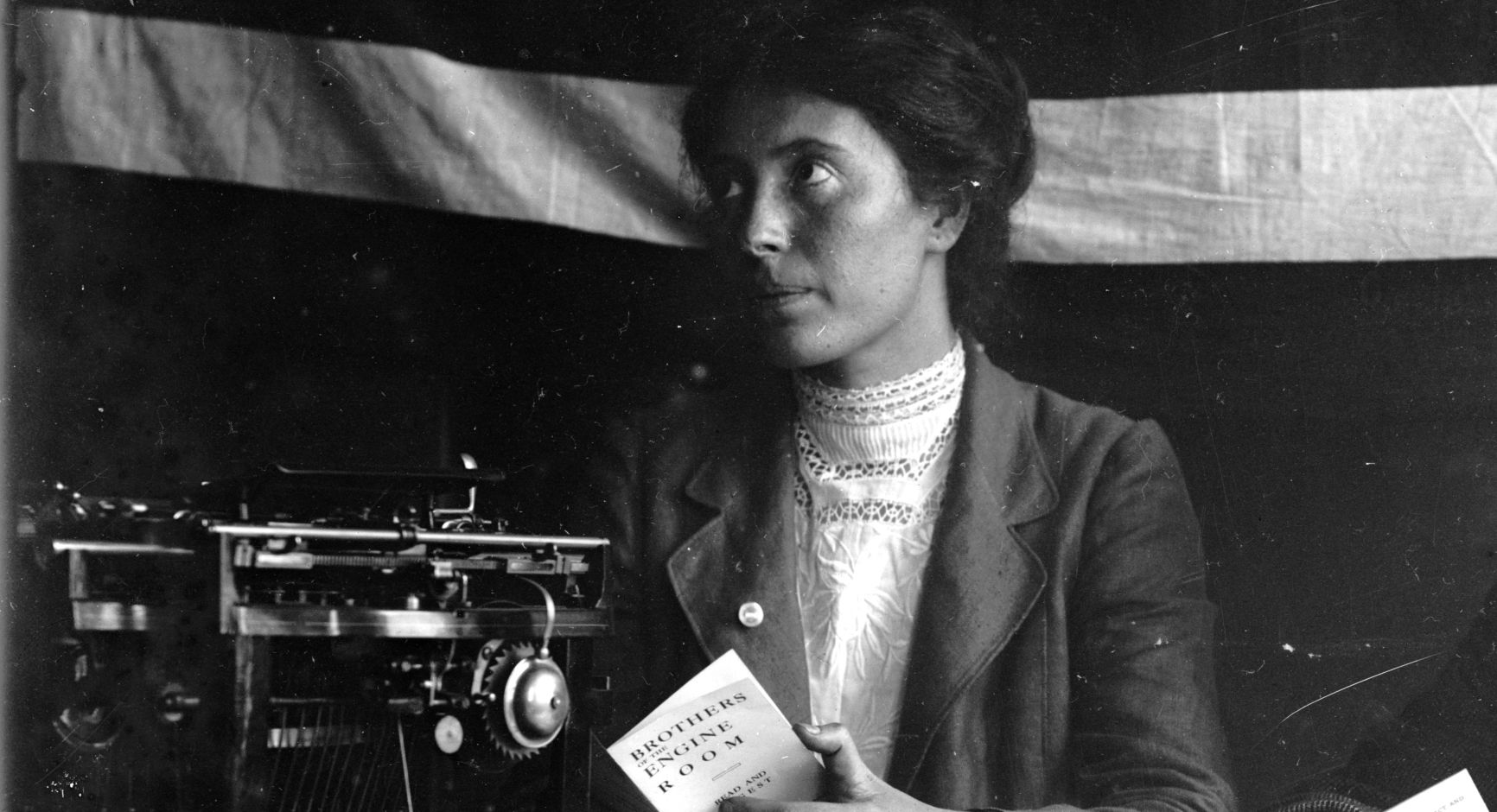
A wonderful article in which the working-class Socialist who married rich is asked by a liberal paper what she should do with ‘her’ money. Her priceless response was denied publication. Thankfully, the REVOLT stepped in and printed it. Born Rose Wieslander to a poor Jewish family in what is now Poland, she immigrated to the U.S. as a child. Landing in Cleveland, she found a job as a teen in a cigar factory, working there for over a decade. Responding to an appeal for Jewish workers to write in their experiences to the Yidishes Tageblatt, her talent as a writer soon brought her attention, and in 1903 she quit the cigar factory after being hired by the New York-based Jewish Daily News. An assignment to interview progressive Episcopalian millionaire J. Graham Phelps Stokes, a settlement house supporter, would result in their 1905 marriage, shortly after which they both joined the Socialist Party. Becoming something like celebrities for their ‘millionaire socialism’ and unusual union they were sources of gossip in both the Socialist and public worlds. An active fixture in the Party increasingly involved in birth control work, Stokes would follow her husband out of the Party in 1917 over support for the war. A decision she soon regretted, rejoining the Socialist Party in 1918 and adhering to its Left Wing and facing federal charges for her anti-war stance. In 1919 she became a founding member of the Communist Party. Divorcing Phelps, whose politics continued to revert to his class, she would remarry Party activist V.J. Jerome and would be among the Party’s most recognizable figures until her death in 1933 from breast cancer at age 53.
‘What a Millionaire Woman Could Best Do with Her Money’ by Rose Pastor Stokes from Revolt (San Francisco). Vol. 1 Nos. 6 & 7. June 3 & 10, 1911.
LIGHT! MORE LIGHT!
Basic Knowledge Means Basic Demands.
It was five years ago. The editor of the Magazine (a very popular, and ostensibly a “democratic” one), had sent a special emissary all the way out to my home in Stamford to request me (even to beg, if a request brought no results) to write an article for the Magazine on “What a Millionaire Woman Could Best Do With Her Money.”
“Her money!” I thought as I listened to the man who made the request. There was no need to beg, I cheerfully agreed to write the article. “But,” I added, “it will be ‘radical.”
“Very well; we’ll print it,” said the emissary.
“Pardon me,” I added carefully, “but I mean radical; not ‘liberal,’ nor just non-conformistic, nor just rebellious, nor even what you or your editor would call ‘Socialistic,’ but radical. I shall go to the ROOT of the question. Are you willing?”
“Certainly, Mrs. Stokes,” said the man. “You may write anything you like on the subject, and we’ll print it.”
That was assurance! So I wrote my article (on a broiling day in July, too), and sent it promptly to the Magazine.
Before many days, however, the bread I had cast upon the waters came back to me on the wave of a new emissary. Alas! they were “unable” to publish the article!
Unable? But why? What was the matter with it? Was it false? They could easily expose false statements! Was it too long? I could easily shorten it. Wasn’t it to the point? I could make it more so.
The new emissary did not know what was the matter with it; he only knew the editor could not use it.
I bade him good morning with a smile. We did not tell one another; but he knew that I knew the reason, and I knew that he knew.
About a month later I happened to meet in the home of a wealthy friend, one of the largest stockholders of that same magazine publishing company. Before the evening was over we were on very friendly terms. I told him what a tongue-tied magazine his was–told him the story of my article, and challenged him to publish the thing.
“You pride yourself upon your liberalism; your absence of bias; your ‘public’ spirit; your freedom from ‘class interest’; here’s a chance for you to prove it,” I said. “Of course, I warn you, it’s a radical article, but your editor ordered it and gave me a free hand. Dare you publish?”
He protested that he knew nothing of it, and would certainly bring the matter up at the next meeting of the Board of Directors.
Evidently he did, for soon the editor himself called and asked for the article. Oh, no! he was not afraid to print the truth! It was thought inadvisable to publish the thing because it was too long. If I would cut it down some and modify it a little, it would be published.”
“Very well, I’ll cut it down and modify it, too,” I promised. “I find it needs modifying. I haven’t said things quite so clearly as I might have said them, and I’ll try to clarify a little the things I’ve left rather vague for an uninformed public.”
So I modified, cut, and sent. The editor had been so apologetic and eager to make amends, that I was certain he would publish my article on the Millionaire Woman quite conspicuously. So what was my amused horror and mock surprise when the postman brought me my MS–just as good as new–back from the capitalistic junk shop. They really could not publish it–it was quite out of the question! It was too inflammatory. Their pocketbooks would not stand for it. It would disturb law and order!–the law of hate and the order of the club! They really couldn’t do it.
All because I questioned the legitimacy of those millions, the right of the woman to her unearned dividends.
Well, they are wise, some of them, and recognize their class interest clearly. Could but the oppressed, befuddled working class recognize its own interest as clearly;–the working class! fed upon the “news” of a press owned and controlled by the masters of its destiny!
I send you this story–with part of the original article enclosed, dear comrade-editor of REVOLT–that those who read and support this splendid paper may be roused to greater effort for its distribution among the capitalist-guided workers.
So long as the workers of the world continue reading what their masters choose to give them in the shape of newspapers and magazines, just so long will they be separated from the truth that will set them free.
Indeed, in my article, after it exposes the sources of the “Millionaire Woman’s” wealth, I suggest a free, ungagged, unmonopolized press as a “hobby” for her one that she herself or any group of interested persons shall be unable to control. In the present fierce struggle between the working class and the master class, it is clearly to the interest of the working class that the truth be told, and none but the militant, class-conscious fighters in the ranks of labor can tell, or are trying to tell, the rest of their class the whole miserable truth of the struggle.
Light! light! comrades, and more light! Without light, without the light of knowledge, the struggle is lost. Acquire (and spread) basic knowledge and you’ll make (and cause others of your class to make) basic demands.
Therefore, on with the work for this newspaper, REVOLT. Carry this torch of light into the dark places you all know. so well. No power on earth or above it can withstand the demands of an organized, conscious, brain-cleared humanity. And humanity (the great uncountable mass of men and women and little children that labor!) humanity cannot withstand the least wind that blows if it be neither brain-cleared, conscious or organized. And it cannot become these three without the WORD–the written, the spoken, the printed word.
We cannot all be speakers, but we can all be distributors of the printed word…Comrades, on with the mental revolution without which all other revolutions end in dust and ashes, in reaction and slavery.
Remember, the printed word–the power, incalculable, the power unconquerable of the printed word!
[Editor’s Note: The article by Comrade Rose Pastor Stokes, refused by the “progressive” magazine, will appear int the next issue of REVOLT.]
***
“TOO INFLAMMATORY!”
Popular Magazine Would Not Run This
WHAT COULD A MILLIONAIRE WOMAN BEST DO WITH HER MONEY?
Is plunder appropriated from a victim correctly regarded as belonging to the plunderer, or is it more properly the property of the victim, though in the possession of the other? Similarly, is wealth taken from the producers by monopoly or oppression, more properly to be regarded as the rightful property of those who take it, or of those from whom it is taken? In the case of our millionaire woman is the wealth which she possesses properly to be regarded as “hers”? Has it become “hers” through operation of moral law? or through violation of moral law by her or by some other or others for her?
Difficult problems arise here for our consideration. How and under what conditions did the wealth become possessed by her? How and under what conditions is large wealth usually acquired? Is it a reward willingly paid in compensation for great services rendered? Is it dug by its possessor from the earth? Does its possessor personally produce it? Or is it produced by others than its possessors, and if so, under what circumstances and conditions does ownership of it pass to the possessor from the producer?
Starvation wages in our coal mines and illegal rebating upon our railroads, have produced vast fortunes for the owners of the mines and roads. Child labor in our cotton mills has destroyed tens of thousands of innocent little souls and bodies and produced great wealth for the owners of the mills. The labor of men and women, ten, twelve, fourteen and more hours a day in our sweat shops and tenement homes have produced victims of tuberculosis by the tens of thousands; have eliminated wage earners from families dependent upon them, have caused terrible destitution, and have built up fortunes for many wholesale clothiers. Inhuman conditions of life and labor in the stock yards of Chicago and elsewhere, and ruthless monopolization and adulteration of food products have built up enormous fortunes for many of our packers and dealers in the people’s food.
Monopolization of sources of supply of commodities essential to human life, such as fuel and light and ice, and the enormous increases which have been made by the monopolists in the prices of these commodities in recent years, have curtailed proportionately the ability of the people to procure with their limited means the supplies which they require for health. Monopolization of public streets by so-called public-service corporations operating with or without legal franchise, but in any event compelling the people to pay for services rendered sums vastly disproportionate to the cost of the service, have lessened proportionately the ability of the people to lay aside of their earnings to meet the emergencies of sickness and distress.
Gas, which is shown by a competent legislative- committee in New York State to cost but about 40 cents per thousand feet to produce and distribute, is withheld from the people by owners of large wealth who insist that the poor shall pay more than twice what the service is shown to be reasonably worth, or get along without using gas for their fuel or light. Similarly, prices of coal and oil and other essentials to well-being are maintained by private greed at figures which render it impossible for the poor to secure enough for warmth or life. It is notorious that rentals in the tenement districts are enormously higher than in most residential portions of our large cities. The owners of the tenements know that the exigencies of the poor compel them under present conditions to live close to their fields of work, and the owners profiting by the compelling need of the poorer people “charge all that the traffic will bear,” and receive from tenement investments dividends commonly amounting to from 20 to 30 per cent per annum.
Every extortion thus practiced lessens the ability of the laborer to procure the things that are needful to the health and well-being of his family.
In former days the barons and feudal lords monopolized points of vantage commanding rivers and roads and commerce, and levied forced tribute on all who passed their way. Today the holders of bonds and stocks and special privileges of many kinds levy similar forced tribute upon the people, though commonly rendering little or no service in exchange. The workers of today, as were the workers of then, are obliged to produce far more than they require for their own maintenance. They must produce enough for the support of the privileged and idle and luxurious, in addition to producing enough for the maintenance of their own families, or else lose their jobs and starve. The machinery of production in this age of mechanical invention is almost wholly in the possession and control of others than those who use it, and access to the machinery is denied to the workers unless they will produce enough not merely for their own maintenance but for the maintenance of the owners as well; and this is true regardless of whether or not the owners produced the machinery or in any way render service.
There are in our community two main economic classes: those whose poverty compels them to produce more than they require for their own maintenance, and those whose wealth or strategic position enables them to control and consume more than they produce and more than they render proportionate service in exchange for. Most of the workers have to bear a vast burden placed upon them by fellow men. The poorer and more helpless they are, the more they must contribute to the support and maintenance of others. The wealth consumed by non-producers has always been produced by others, and has usually been appropriated from those others under artificially induced circumstances that made effectual resistance impossible. Under such circumstances as are usually availed of to promote the accumulation of wealth in private hands, and in the case of a woman, who has rendered no other service in the community than that which any good woman renders her husband and family and friends, is it as a rule true that the wealth should be regarded as wholly and properly hers?
It would be impossible for a woman who has acquired more wealth than she or her husband has produced by service of any kind, to return the excess to its producers individually. She would be unable to find them,–industry has become so complex and so many individuals cooperate in production. Such excess wealth could, however, be expended with enormous good, in the promotion of a better and wider understanding of human relations; to the end especially that through wider knowledge of the terrible effects of injustice, may come greater abhorrence of evil and more determined insistence upon justice and equity and right. For obviously there is a direct relation between human welfare and human justice, and human welfare can advance only in proportion as justice prevails in the relations of men with one another. Injustice always involves injury to some one; and in proportion as injustice is done, welfare is lessened.
Revolt ‘The Voice Of The Militant Worker’ was a short-lived revolutionary weekly newspaper published by Left Wingers in the Socialist Party in 1911 and 1912 and closely associated with Tom Mooney. The legendary activists and political prisoner Thomas J. Mooney had recently left the I.W.W. and settled in the Bay. He would join with the SP Left in the Bay Area, like Austin Lewis, William McDevitt, Nathan Greist, and Cloudseley Johns to produce The Revolt. The paper ran around 1500 copies weekly, but financial problems ended its run after one year. Mooney was also embroiled in constant legal battles for his role in the Pacific Gas and Electric Strike of the time. The paper epitomizes the revolutionary Left of the SP before World War One with its mix of Marxist orthodoxy, industrial unionism, and counter-cultural attitude. To that it adds some of the best writers in the movement; it deserved a much longer run.
PDF of issue: https://www.marxists.org/history/usa/pubs/revolt/v1n07-jun-10-1911-Revolt.pdf
PDF of full issue: https://www.marxists.org/history/usa/pubs/revolt/v1n07-jun-10-1911-Revolt.pdf

