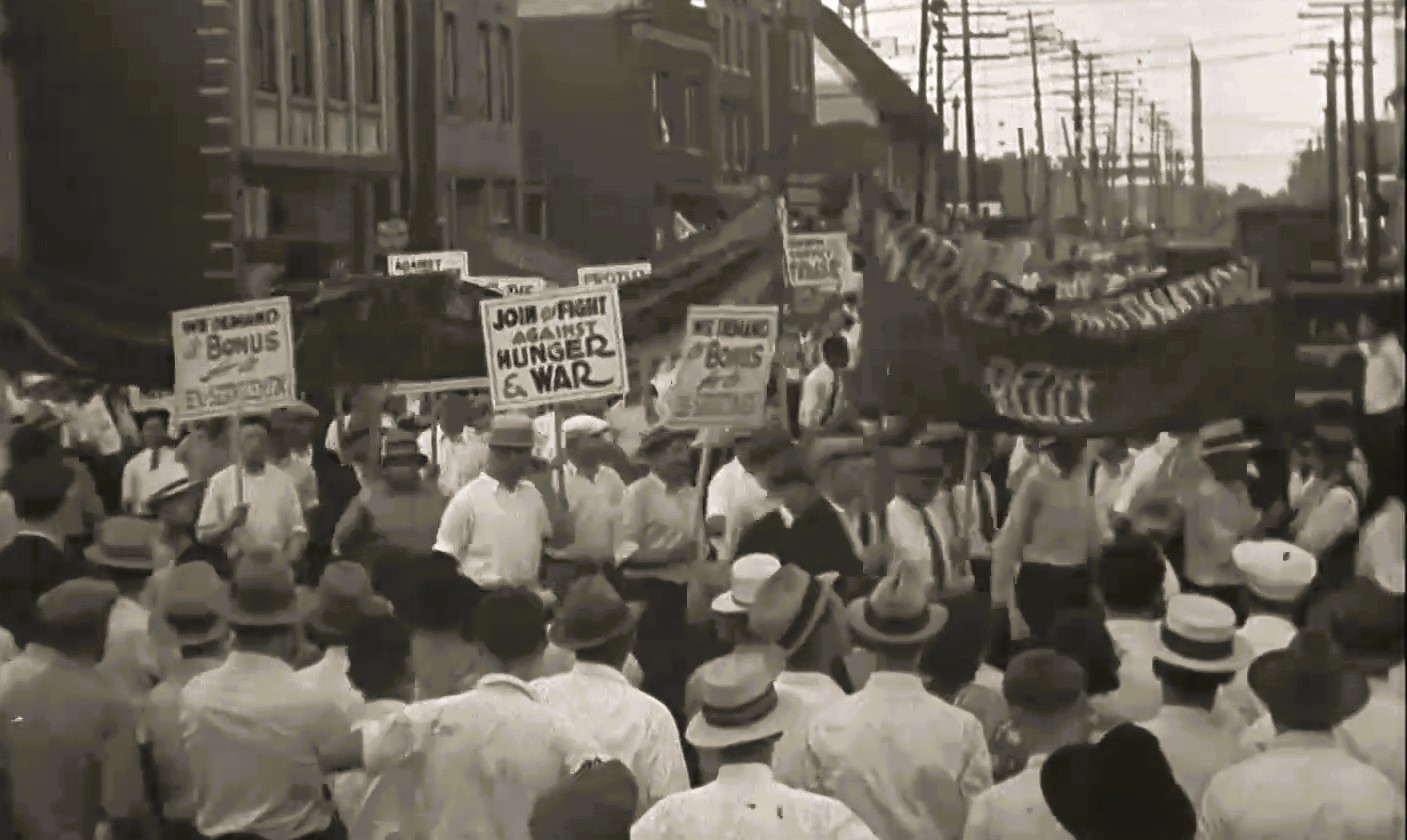
An Open Letter issued by the C.P. was as significant a direction to its members and secondary leaders as any document. They were meant to be studied, discussed, implemented, and reported on. Here, the Detroit District responds formally to 1933’s ‘Open Letter,’ which saw the Communist Party make its first steps away from the politics of the Third Period in the immediate aftermath of the disastrous coming to power of German fascism. It was clear that Communists had not won the leadership of the class through their own specific organization, and it was therefore necessary to shift again to working within existing organizations, including reformist ones.
‘Resolution on the Application of the Open Letter in the Detroit District’ from Party Organizer (C.P.U.S.A. Internal Bulletin). Vol. 6 No. 8-9. August-September, 1933.
Adopted by Section One Conference
The Section Conference after a thorough discussion of the Open Letter declares its acceptance of it, and pledges itself to carry out its provisions in Section One. The main points of the Open Letter as they apply to our section are as follows:
1) Raising the political level of the membership.
2) Shop work and building up the revolutionary unions.
3) Negro work and the struggle against discrimination and white chauvinism.
4) Working out a concrete plan for two concentration tasks: a) Concentration on plant; b) concentration in the Black Belt.
5) Strick check-up to see that all plans and decisions are carried into effect.
6) Struggle against sectarian practices; against social-fascists and white chauvinist tendencies.
7) Against financial irresponsibility.
Two Concentration Tasks
1. The concentration task of first importance to our entire section is the organization of the L.S.N.R. in the heart of the black belt. All of our section forces, but particularly units 8 and 9, with the cooperation of the District Negro Committee and some forces from the downtown sub-section must concentrate on building the L.S.N.R. and leading the Negro masses into struggle against race discrimination, hunger and mass misery. In the course of this struggle we must root out every vestige of the bourgeois poison of white chauvinism, both in the Party ranks and in the ranks of the mass organizations, including the language organizations, close to us and among the working class in general.
2. Our second concentration task is the organization of the plant workers into the Auto Workers Union. While this is also the task of the entire section, units 6 and 7 and one of the units shall concentrate on this task under the leadership of a comrade from the section and one from the district.
All the regular work of the concentration units must be so conducted that it will aid the concentration task. Leaflet distribution, Daily Worker and Michigan Worker sales, unit patties, lectures, mass meetings, canvassing for literature sales or signatures must be so conducted that it will aid in the concentration, and unit buros must carefully work out all activities with this aim in mind.
These two concentrations are not the property of only the units mentioned above, but must be carried on with the assistance of the entire section including mass organizations.
In carrying out these two concentration tasks, the work of recruiting new members, of building the Y.C.L. and the Young Pioneers, the improvement of our Party press work, the election campaign and all other Party campaigns must not be regarded as separate tasks taking the place of our main concentration but must be conducted in such a way that they will add to and strengthen our two major concentration tasks. In line with the criticism of the Open Letter we must learn to overcome our careless and bureaucratic organization methods in order that after every struggle we shall be able to realize the proper organizational results. The Party Organizer is one of the best guides in overcoming this and the comrades should study it more closely than ever before.
Hold Section Conference to Review Tasks
The Section Committee shall work out a concrete plan of action for these two concentration tasks, setting definite aims to be accomplished within six weeks. After six weeks a Section Functionaries’ Conference shall be called to check up on how far the plan has been accomplished. During the six-week period, the buros of the cooperating units in the concentration points shall meet jointly. The plan need not be accepted in every detail by the units as presented but the units have the right to work out their own plan.
The Section Committee and its members will have to supervise the activities of the units and fractions more closely. The minutes of the previous meeting must be read, a strict check-up must be made at every section meeting. Leading comrades must be held strictly responsible for failure to fulfill decisions and assignments. Units and fractions also should keep minutes which should be read at the following meeting and then turned over to the Section Org Department.
Members of the Section Committee must meet with the unit buros and help them to prepare their work in such a way that only 3 or 4 points will come on the agenda of the units, in this way assuring sufficient time for a proper discussion on all points.
In Section Committees, units and fractions, a strict financial check-up must be made regularly by the Section Finance and Org Committee.
Unemployed Work
In all sub-sections, the Unemployed Councils are completely out of existence. Definite steps must immediately be taken to establish at least one Unemployed Council in each sub-section. Every unit, sub-section and the Section must elect an unemployment work director who must meet Monday afternoon with the Central Unemployed Council and secure their help in reestablishing our unemployed work.
The concentration units in canvassing for contacts in the plant concentration streets must not fail to build Unemployed Block Committees, when unemployed cases come to their attention or when they have a sufficient group of unemployed workers to make the establishment of a block committee possible. The other units must immediately select a certain number of streets of their territory as their concentration territory and work for the establishment of block committees in these streets.
The units in the Black Belt must connect their unemployed struggles with the building of the L.S.N.R.
International Labor Defense
The section must build a functioning fraction in the I.L.D. branches and direct the work in such a way that the I.L.D. branches participate in our concentration tasks along the line of defense work and winning contacts.
Fraction Work
Fraction members in mass organizations shall be organizationally controlled by the unit. The unit buros shall decide what unit assignments a fraction member can take in addition to his fraction work. Fraction members shall receive collection lists, tickets, leaflet distribution and other tasks from the units, except in special cases upon which the unit buro must decide.
Party fractions must be established in all mass organizations, or strengthened where they already exist, and the Section Committee must give close attention to the work of these fractions.
The Section Committee must see to it that the fractions properly bring all Party campaigns into the mass organizations, particularly unemployed and shop work. An educational campaign on the National Industrial Recovery Act should immediately be organized in all mass organizations and connected up with our shop, union and unemployed work.
The fractions, and particularly fraction committees must be cautioned not to work in such a way as to stifle the leadership of the regularly elected executive bodies of the mass organizations.
Daily Worker and Michigan Worker
In order to improve the exceptionally poor work of our section in the distribution of our Party press, the following steps must be taken:
1. Systematic check-up on all comrades selling the Daily Worker and Michigan Worker, and securing of prompt payment which in turn must be promptly turned over to the District Daily Worker office. Lack of promptness in financial matters inevitably leads to confusion which finally results in the loss of large sums of money. This is the way in which most of the large bills have been accumulated, and this is why our Party press is always in a state of financial crisis.
2. Our section must see to it that factory sales are established at least at and shops.
3. Every unit should establish a route in its concentration streets, and work hard to get readers in a few streets rather than trying to cover ten blocks to get ten readers.
4. In every unit a unit workers’ correspondent shall be elected whose duty will be to write all publicity about the struggle, conditions of the workers or the activities of our organizations to the Party press. These unit workers’ correspondents to be called to a conference once a month together with the Daily Worker and Michigan Worker staff.
5. Section Daily Worker Committee must be elected to arrange ways and means for regular financial assistance to our press.
All work for the building of our press must be carried on ia such a way as to further our concentration tasks.
Literature
The Section Agit-Prop Committee must establish a literature fund and develop the mass sale of literature in our section in such a way that it will be connected up with the section concentration tasks.
The section pledges itself to organize a full time functionaries’ school in the immediate future and calls upon every unit to organize discussion groups including even close sympathizers where a program of discussion on important points can be taken up in the light of the Open Letter.
Our section pledges itself to participate in the District Concentration on the—plant, to help in the sale of—and to connect up our propaganda and organization work with this central District Concentration.
We pledge ourselves to turn all—contacts into the Organization Department and to assist in the establishment of—shop groups and shop nuclei.
The Party Organizer was the internal bulletin of the Communist Party published by its Central Committee beginning in 1927. First published irregularly, than bi-monthly, and then monthly, the Organizer was primarily meant for the Party’s unit, district, and shop organizers. The Organizer offers a much different view of the CP than the Daily Worker, including a much higher proportion of women writers than almost any other CP publication. Its pages are often full of the mundane problems of Party organizing, complaints about resources, debates over policy and personalities, as well as official numbers and information on Party campaigns, locals, organizations, and periodicals making the Party Organizer an important resource for the study and understanding of the Party in its most important years.
PDF of full issue: https://www.marxists.org/history/usa/pubs/party-organizer/v06n08-09-aug-sep-1933-Party%20Organizer.pdf

