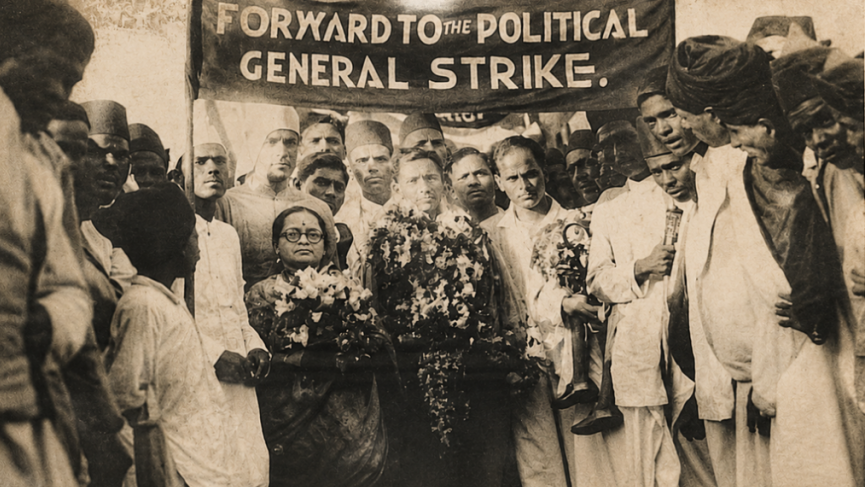
The extensive discussion at the Sixth World Congress on imperialism saw Sikander Sur (Shaukat Usmani) report on India with delegates Narayan (Saumyendranath Tagore), Raza (Mohammed Shafiq Siddiqi), and G.A.K. Luhani intervening in the discussion with Sur responding.
‘India at the Sixth World Congress Discussion on Imperialism’ from International Press Correspondence. Vol. 8 Nos. 72, 74 & 76. October 17, 25 & 30. 1928.
The Development in India.
Co-Report of Comrade SIKANDER SUR (India): Comrades, the theory of decolonisation is very harmful to the colonial movement and especially to the Indian revolutionary movement. This theory can be promulgated only by those who are sitting far away and have lost all contact with India. If we consider the social composition of India, it is easy to understand that this decolonisation theory falls to the ground. We have in India, landed aristocracy and feudal remnants, a numerically small but good developed big bourgeoisie, Urban petty bourgeoisie intelligentsia the so-called middle class; vast masses of peasantry; and an industrial proletariat that numbers with families, 12 millions.
Comrades, in spite of the development of modern means of production in India, the backwardness of the country is marked by the fact that the middle classes are united with the landowning class in a bloc. The British imperialists, taking advantage of the situation, make a united front with the landed aristocracy subordinating the bourgeoisie, against the bourgeoisie’s interests. British imperialism is developing the reactionary forces and not the forces of the bourgeoisie, and therefore the decolonisation theory falls to the ground.
The industrial development of India dates back as far as 1850, but only during the war a more systematic industrialisation took place. The textile industry is the main industry of India, which employs about one million hands. The textile industry is mainly in the hands of the Indian capitalists. During the war and the years immediately following the war, when the import from Manchester and Lancashire was cut down, huge sums were accumulated in the hands of the Indian capitalists as a result of enormous profits running as high as 600%. In spite of all this the industry developed at a much lower rate than in China and Japan. This factor indicates a drawback in the industrial development of India and speaks against decolonisation.
During the period from 1913 to 1927 the Indian textile industry developed on a large scale. As far back as 1927 India supplied nearly three-fourths of the internal market, while the import from Lancashire had decreased by 60% in the same period. This indicates a rivalry between British and Indian capital, and is not decolonisation. The Indian textile goods meanwhile found access to the markets of Persia, Mesopotamia and Africa, and this was a definite check to the British capitalist policy. The imperialist interests and textile producers from Manchester entered into an agreement with the Indian textile producers, and limited the importation of Indian goods to undeveloped countries. As compensation, the imperialists granted a tariff protection to the Bombay industry against Japan, which resulted in a reorganisation of the Indian textile industry. In spite of all this the industry has been running at a loss for the last three or four years.
The iron and steel industry developed seven times over between 1914 and 1927. India had not only freed itself from the import of pig iron, etc., but was actually exporting it to the U.S.A., Japan and England. When by the 1919 political Reforms a favourable fiscal policy was introduced, the bulk of the Indian capital was invested in this heavy industry, but as Indian capital could not be got to an adequate extent, foreign capital was attracted, and as this happened at a period when Britain had no surplus capital to invest in India, American capital flowed in to run these enterprises. Thus Indo-American capital relations threaten the British imperialist monopoly over India.
Another problem for British imperialism was, how to regain the Indian market when normally, British production could not compete with the better organised German and American industries These factors led to the tightening of the British grip upon India. The sham, industrial concessions granted in 1919 were withdrawn in 1925 when the Balfour reports indicated that the most dangerous development affecting the British, economic interests in India was the development of the iron industry in that country. Since then British imperialism has which it got reference and a new Exchange Policy, by which it got 12% protection over Indian prices, and a brake has actually been put on Indian heavy industry. The iron and steel industry is now reduced to a bare war minimum and is under the strict control of British imperialism. This forcible destruction of the iron industry has thrown a large number of skilled and qualified workers into the ranks of the unemployed. In Bombay and other industrial centres, this accounts for the breaking up of Indian industries and ultimately for the strike wave.
It would be un-Marxian to say that there is no industrial development in India, but those industries are being developed which are profitable to Britain rather than to India. These industries are the hydro-electric and aviation industries, which constitute a market for the British-produced machinery and materials necessary for aviation and hydro-electric works.
Further, British imperialism wants to reconstruct agrarian economy, but only for its own interests and that of course is harmful to Indian interests. For instance, India and Canada are the wheat exporting centres, whilst Africa and India are cotton producing centres. Both these groups are at logger heads. Canada cannot stand the competition of the Indian wheat, and Africa cannot stand the competition of Indian cotton. These groups are now demanding concessions from British imperialism and as a result we find that large parts of the agricultural areas in India are being transformed into fruit producing areas and a systematic reduction in wheat and cotton production takes place. Comrades, this has proved to be extremely injurious to the Indian peasantry as well as to the small traders and petty bourgeoisie who work in these trades.”
The petty Bourgeois whom we find organised in the radical groups were striving to utilise the Bardoli peasants for their own ends. But as soon as British imperialism gives them some concessions, the movement ceases. In India. there are at present two waves-revolutionary and quasi-revolutionary movements. As a matter of fact the national quasi-revolutionary movement is not a real movement because as soon as British imperialism comes to terms with them they readily make a compromise and betray the movement. The other one is the movement of the working class. From time to time the national bourgeoisie are adopting a revolutionary attitude towards British imperialism and are proposing a bloc with us, but we cannot rely on their support during the intensified struggle. The organisation of this class is the Republican Party which was formed during the last Congress Session at Madras. This party advocates the complete independency of India by non-violent methods. In this century of machinery and iron, neither India nor any other country can be freed by non-violent or non-aggressive means. So long as this Party facilitates our way to the masses and offers us the chance of developing our revolutionary movement, we can utilise it but it would be harmful to think that these people can be utilised to a great extent for our cause. This is impossible.
Comrades, the policy of British imperialism is closer union with the landed interests. In 1919 a reform system was introduced and the capitalist class was granted some concessions for industries. In this way, British imperialism was getting the support of the bourgeoisie in the struggle against the revolutionary movement inside the country as well as in some political crises in which British imperialism may be involved with some foreign power.
The Indian proletarian movement which has developed recently has absolutely no similarity with that of 1920-22. In the period of 1920-22 the proper leadership was lacking, and besides, the masses did not yet understand the significance of the revolutionary movement. But now, under the iron heel of British imperialism and as a result of the treachery of the leadership, they have come to understand class solidarity.
The Indian working class now realises that unless it sets up a united front it cannot successfully fight against the two powerful enemies, viz. British imperialism and the native bourgeoisie.
The new strike wave of 1928 has done much in awakening the latent consciousness of the working class. The workers organise meetings and emphasise the necessity of continuing the strike to a victorious end. It is the beginning of a new era full of revolutionary hopes for the Indian workers’ movement.
The visit of the Simon Commission in India gave an impetus to the Indian bourgeois movement, but this movement can in no way be a real revolutionary movement. All their protests. were of a peaceful character and had no other aim than to force British Imperialism to give some concessions to the Indian bourgeoisie for the development of the Indian industries. The working class which understood the significance of the Simon Commission adopted other methods. They arranged demonstrations, not only against the Simon Commission, but also against the imperialist policy of the British and the Indian bourgeoisie; while at the same time they were attacking the pacifist Congressmen.
In the strikes in Calcutta, the workers were not only standing up against British imperialism, but even against the Swarajist leaders to whom they refused to listen. The only difficulties in the Indian movement are: first of all, the lack of leadership. British imperialism, whenever it sees that there are some revolutionary leaders of the working class developing, seizes them and throws them into prison. British imperialism is trying by terrorism to nip in the bud the rising revolutionary tide. British imperialism is also bringing pressure to bear upon the working class by means of Indian national reformists who declare that in every struggle against imperialism, or in struggles against capitalism they will try to come to terms. The Indian national reformists repeatedly interfere with the workers’ movement and use all means to put a brake to it. They advise the workers to use peaceful means and that they should not demonstrate in such a way that may lead to the rise of class antagonism. But comrades, in this fight, and in all these recent strikes and developments it is quite evident that the movement is greater than British imperialism, or its lackey’s in the shape of the Indian bourgeoisie and the reformists can crush.
The necessity at present is to form a strong Communist Party in India. There exist already many small groups which should be welded into a well disciplined single party.
In conclusion, I will say that there is a great deal of misunderstanding about the situation in India. Comrades who have been here for about ten years cannot properly deal with the situation. They therefore grope in darkness and formulate such absurd theories as ‘decolonisation’.
***
Comrade NARAYAN (India): Comrades, one of the most fundamental differences between the opportunistic attitude of the Amsterdam International to the colonial policy and the revolutionary attitude of the Third International has been very well defined at the Second Congress of the Communist International by Comrade Lenin in his theses on the colonial countries. Since that time the Communist International is following a definite revolutionary attitude towards the colonies.
From the Second Congress to the Sixth Congress, very fundamental developments have taken place in the colonial movements. On behalf of the Indian delegation I welcome the theses on the revolutionary movement in the colonies and semi- colonies and especially because of the very great stress that has been laid on the Indian question. But there are some contradictions in the theses, which I want to point out.
At the 6th page of the theses, we find such a statement: “The real industrialisation of the colonial countries, especially the building up of efficient machine industries which might make for the independent development of the productive forces of the country, are not fostered by imperialist monopoly, but are retarded. This is its basic function in colonial subjugation. The colonial country is forced to sacrifice the interests of its independent development…and to serve as the economic market for capitalism in order to strengthen the economic and political power of the bourgeoisie of the imperialist country, in order to perpetuate monopoly in the colony and to increase the expansion power of the respective imperialists as against the rest of the world.”
Comrades, I consider that this statement does not give a true picture of the development of the dynamic growth of capitalism, of industrialism in India. Up to the war the policy of British imperialism in India was the policy of the classical form of imperialistic exploitation. It consisted in keeping India as a source of raw material and a market for the industrial products of British industries. There was a deliberate policy of keeping India a backward country, and not to allow it to develop its industries. High tariffs, high duties and embargoes on machinery were imposed by the British imperialists in order to prevent the industrialisation of India.
At that period British capital in India was solely used for railways, for irrigation work, for harbours, that is, for the sole purpose of the expansion of the market. British imperialism does not follow the same old method of exploitation in India today. There were fundamental objective conditions which led to the change of the policy of British imperialism towards India.
The reasons for this change are: first, the conditions during and after the war. It was necessary that in India war material should be manufactured to be supplied to Mesopotamia and other Eastern bases of war. England could not effectively supply war materials unless industries, especially war industries, were developed in India. This led to the setting up of the Industrial Commission in 1916 which marked a turn in the policy of British imperialism in India.
The second cause was that Japan and America seriously. threatened British monopoly of the Indian market. England was unable, without developing India industrially, to cope with this situation. This led to the virtual abandonment of the traditional policy of free trade and the recognition of differential protectionalism in India which we find, for instance, in the Bombay industries. This clearly shows that for the stabilisation of British industries during this period of decay it was absolutely necessary that India should be industrialised.
The industrialisation of India creates a market for British engineering and metallurgical industries. Cheap Indian labour could be more effectively exploited in order to achieve this stabilisation of British industry.
The taxation commission was set up. The sole purpose was to adjust the burden of taxation in order to expand the internal. market. The scheme for modernisation of agriculture was formulated for the purpose of raising the purchasing power of the peasantry.
The third important cause which led to this policy was that India could not be made a military base of British imperialism in the East unless the support of the national bourgeoisie was bought over, and the national bourgeoisie could not be bought over unless some concessions were given to it.
What is the political expression of this policy? It means that in order to industrialise India, it is necessary to extend the internal market, to make certain agrarian reforms which it is impossible for British imperialism to achieve in India owing to the very complicated land tenure system in India.
This industrialisation leads to pauperisation of the peasantry which involves the possibility of an agrarian revolution; industrialisation gives rise to the development of the proletariat which brings with it the possibility of Socialist revolution; industrialisation causes a change in the attitude of the national bourgeoisie all these are the political causes which give rise to the change of England’s economic policy towards India.
Unless we see this process dialectically, we lose all perspective and we come to certain wrong conclusions on the role of the native bourgeoisie in India and we shall arrive at the same wrong conclusions as the author of the theses.
So long as imperialism was obstructing the capitalist development in India, the Indian bourgeoisie was a driving force. The change of policy has already led to a corresponding change in the attitude of the Indian bourgeoisie towards British imperialism. We find that to the same degree as the hindrance in the way of the capitalist development of India has been removed by British imperialism, the bourgeoisie is sliding more and more towards co-operation and one group after the other is capitulating to imperialism. The Indian bourgeoisie never in its history adopted a revolutionary attitude towards British imperialism. It never went beyond constitutional agitation; and when the critical moment arrived, they have betrayed the movement. Anybody conversant with the Indian National movement knows that the Indian bourgeoisie is connected with feudalism, it cannot raise the masses, it cannot bring in any agrarian reforms without cutting its own ground and it would never do it.
Now let us see how this role of the bourgeoisie has been formulated in the theses. We see on page 17, paragraph 19, that “as an independent class rule, a future of ‘free’ and independent capitalist development, a hegemony over an independent people this will never be given voluntarily to the national bourgeoisie by imperialism. But this is precisely the class aim of this bourgeoisie, their future as an independent class, as a ruling representative of an independent nation. In this point the conflict of interests between the national bourgeoisie of the colonial country and the imperialists is objectively of a principle character, it is unbridgeable, it demands capitulation from one side or the other.”
Too much stress on the nature and intensity of the conflict between the national bourgeoisie of the colonial country and the imperialist bourgeoisie has led to certain inaccurate conclusions. Let us see: on page 21, paragraph 23:
“In the first preparatory period of the revolutionary movement of these countries, when the organisation of the proletariat and the influence of the Communist Party is still weak, but that of the bourgeois parties on the other hand is much stronger, when the latter occupy the leading posi- tion in the national movement because in the interests of the demands of the national bourgeoisie for power they still temporarily demonstrate their opposition (no matter how vacillating and reformist) against the ruling imperialist- feudal power bloc, and when the masses of the population follow along behind them, in this stage (as at present e.g. in India and Egypt), it would be an ultra-Left mistake to start the Communist Party agitation by simply identifying the national-reformists (Swarajists, Wafdists and others)
with the ruling counter-revolutionary bloc of imperialists and feudal lords”,
…and a little lower…
“It is not true that the Swarajists, Wafdists and others have already exposed themselves in the eyes of the toiling masses as allies of imperialism, as counter-revolutionary traitors to the national movement”.
A few lines later on:
“The Swarajists, Waidists, etc., have not yet betrayed the national liberation struggle in the decisive manner in which e.g. the Kuomintang did in China.”
The conclusions are that the Communist Party in India. should keep quiet and not criticise the vacillation of the reformist bourgeoisie because it has yet to play a certain revolutionary role. It is here said that “they have not betrayed the national liberation movement in a decisive manner.” This is far from being true. The Bardoli decision was a definite betrayal of the Indian masses by the nationalists in 1922 when the great mass upheavals took place and there was the greatest possibility of an agrarian revolution breaking out in India. The bourgeoisie decisively betrayed the movement under the leadership of Ghandi, out of pure and simple class interest. It was the menace of the agrarian revolution which forced the national bourgeoisie to betray the movement. Perhaps not in the same. manner as the treacherous counter-revolutionary bourgeoisie which in China shed the blood of millions of proletarians and peasants, but it was also the Indian bourgeoisie which deceived. the national liberation movement of the masses at this particular period.
At the end of the paragraph we find:
“The Indian Communists’ agitation in this stage should not concentrate the sharpest fight against the bourgeoisie, but should turn it against the present immediate chief foe, the ruling imperialist feudal bloc.”
I consider that also this statement does not give a realistic appreciation of the situation in India and of the growing counter-revolutionary attitude of the bourgeoisie towards the national revolutionary movement in India. This is a tactical blunder of the worst type.
Now I come to another question which is in the last paragraph of the theses page 37, paragraph 32. Here in describing the activities of the Workers’ and Peasant Parties and drawing the conclusions, we read:
“The special Workers’ and Peasant Parties, no matter how revolutionary they may be, can all too easily be transformed into ordinary petty bourgeois Parties. Therefore the organising of such Parties is inadvisable just as the Communist Party cannot build itself upon a foundation of an amalgamation upon two classes, so it is just as wrong to organise other Parties on this foundation, which is typical for petty bourgeois members.”
It seems to me that some of the comrades are scared with the nightmare which is the result of their own irrational fantasy that the Workers’ and Peasant Party is a substitute of the Communist Party. Nobody has ever put forward that the Workers’ and Peasant Party would be a substitute for the Communist Party.
The petty bourgeois elements in the country who have been proletarianised are sometimes more proletarian than the proletariat themselves. The petty bourgeois intelligentsia, the urban petty bourgeoisie, have to play a role in the revolutionary movement in the colonies. What should be the organisational expression of the anti-imperialist front of the petty bourgeois elements? Can we afford to swamp the Communist Party with such petty bourgeois elements? We cannot. On the other hand, the Communist Party of India should utilise the revolutionary energies of the petty bourgeoisie. I think it is clear that this anti-imperialist front can only take the organisational form of a Workers’ and Peasant Party composed of the urban intelligentsia and the petty bourgeois elements, under the leadership. of the proletariat. On this point we ought to call to mind what Comrade Stalin said in his speech before the Eastern University in May 1925, dealing specially with India.
These Workers and Peasants Parties which started in India in 1925 have been carrying on a definite line of action. This Party organised 30,000 workers in Bombay in demonstrations against the Simon Commission under such slogans as “Down with Imperialism”, “Absolute independence of India” and other such revolutionary slogans. Strike movements today are being led by the Workers’ and Peasant Party. The strike in Lilloah was led by the Workers’ and Peasants’ Party under the control of the Communist Party of India. We have been able to take over some trade unions from the reformist leadership, to organise peasant unions; now we are told to liquidate all these Workers’ and Peasant Parties. This is pure and simple professorial dogmatism against which Lenin warned us so many times.
But if you look at the situation in India itself, which are the channels through which the Communists are making their influence felt among the masses? I think it is quite clear that, under the leadership of the Communist Party of India, the workers’ and peasants’ parties are a valuable help for the propagation of Communist ideas in India. There has been no other revolutionary orientation in the Indian Nationalist movement before the workers and peasants party appeared in the field. And today all the Left elements in the country are orientating towards these organisations, and a certain crystallisation of the Left forces has been taking place through these workers’ and peasants’ parties.
And therefore I think that this formulation is absolutely wrong, both in principle and tactically.
In the same clause it is said that this by no means excludes the organisation of the fighting bloc of the workers and peasant masses, which is necessary for the conquest of power in the bourgeois democratic revolution at the time of the uprising in the form of elected Soviets and in loose organisational forms. Loose organisational forms are admitted, and such organisations can be formed between the peasants and workers. But when the concrete party comes in the field as a Left party which gives an orientation to the whole nationalist revolutionary movement in India, it is to be liquidated. I do not understand the logic of this whole argument, and I consider it is a very weak and unrealistic attitude towards the Workers’ and Peasants’ Party.
***
Comrade RAZA (India): Comrades, the colonial world today cannot be classed as isolated from the rest of the world. These countries are drawn into closer touch with the rest of the civilised world thanks to the international character of capitalism.
Owing to their world-wide inter-relations and economic inter-dependence, all that could have been termed strictly as national some years back is today international. When discussing the international movements, we have to make this Universal Law of Independence our main starting point and lack of the spirit of this law is, unfortunately, a shortcoming of the theses.
The colonies cannot be an exception to this universal economic law. It is true that the economic development of the colonies is extremely slow and it has viciously been retarded by foreign domination. But still they are drawn into the present world economic system as an integral part of the international capitalist world, through its imperialist policy. The imperialists, while practically putting an end to the feudal system in the colonies, have been purposely supporting the few feudal remnants and the landed aristocracy, they have created a class of the native bourgeoisie, as without it was impossible to hold. sway over these colonies. But the native bourgeoisie have to be put under permanent control so that they should not grow into a rival power to the foreign intruder; hence the support of the feudal remnants and vice versa, such is the characteristic feature of imperialist colonial policy of “divide and rule”. Nevertheless”, the foreign exploiter has to surrender, and in fact, has done, a minor portion of the profits to the native exploiter for the joint exploitation of the colony.
The capitalist system demands state power, without which it cannot coerce the working masses, cannot guard its trade and trade routes, cannot capture fresh markets, etc., etc., and hence the evolution of imperialist forces as the vanguard of capital. Imperialism is the tool of oppression in the hands of the capitalists. Imperialism demands ever more fresh colonies, exploitation and subjugation of new peoples. Imperialism has to introduce the capitalist order of society among the colonial peoples. Simultaneously with this, the colonial policy of the imperialists has given rise to enormous social contradictions in the colonies; the rise of the working class, the pauperisation of the peasantry. These are the two main factors which today stand face to face against the imperialist forces. But this is not only true of India and the other colonies, but is true today all the world over. The unification of all these forces in the colonies, along the lines adopted for the rest of the capitalist world is the task before the Communist International. Imperialism is the creator and chief-in-command of the capitalists; Communism is the creator and the advance-guard of the toiling masses. All the rest of the political parties fall into either of the two main categories.
Communism, as the diametrically opposite force to imperialism, has to adopt just the opposite tactics as the latter in the colonies, Communism has to utilise all mass forces. which imperialism has created. Communism has to challenge the very order which imperialism stands for in the colonies. Communism cannot aim at bourgeois revolutions,
The Communist International, as the standard bearer of Communism, has to rely on the industrial proletariat for carrying out its revolutionary programme in the colonies, and to co-ordinate this struggle with the revolutionary struggle of the world proletariat. Imperialism owes its very life to the capture and exploitation of the colonies. The C.I. must capture the colonial revolutionary forces, the proletariat and the peasantry, the very germs created by the imperialist colonial policy and which will eventually destroy it.
The history of the Indian Nationalist movement is a history of the treacherous betrayal of the toiling masses by the national bourgeois leaders. Not only that. Those treacherous leaders took a definite stand against the masses, when the latter took to armed uprising on any occasion. Because they are class conscious. There may exist antagonism between the foreign. and the native bourgeoisie, but this is a phenomenon all the world over. But it does not mean that the C.I. bases all its revolutionary programme on this antagonism alone. No, it must base its programme on the dynamic forces of revolution, that is, the proletarian movement in all the countries, it is quite a different thing for the Communist International, for tactical reasons, to utilise hose antagonisms for revolutionary purposes. But even this is problematic, owing to the fact that the capitalists are more cunning and politically conscious than we are.
Economic antagonism exists between a section of the native bourgeoisie and the foreign bourgeoisie; the former stands for an exclusive right of exploitation, but this is not the driving force of the revolution. The driving forces of the revolutionary movement are, as in every other capitalist country, the millions of homeless industrial proletariat, and also the pauperised peasantry, created by the capitalist exploitation in different colonies; and it is these rising forces that badly need the attention of the Communist International. Needless to say, we cannot depend, or rather, we must not attach any considerable importance to the so-called nationalist movements in the colonies, as the history of this movement is the history of servile capitulation before the imperialist forces on the one hand, and on the other, the treacherous betrayal of the masses by the so-called nationalist leaders just at the moment when an honest sincere lead was needed.
With reference to paragraph 8, in which the theses mention the decolonisation theory, Comrade Kuusinen is quite right in his condemnation of this false theory. No imperialist power whatsoever will ever agree to decolonise until and unless its very existence is threatened. Especially in India it is a life and death problem for British imperialism.
A few remarks about the industrialisation of India. The creation of the native bourgeoisie is a historical necessity for the British bourgeoisie, but at the same time, by such an action, the British bourgeoisie willfully creates a competitor and a rival. And it is here that the imperialist colonial policy asserts itself. India must be industrialised, but: 1. under the chief control of British capital; 2. Indian capital has to assume a junior partnership; and 3. the Indian industries have to play a secondary role so as never to be independent of the home industries, but, besides this, to be permanent consumers of the home manufacturers; 4. to help in the competition against Japan and the U.S.A., etc., and 5. to help in the production of war material.
This is, in short, the gist of the real imperialist policy of the British bourgeoisie with regard to the industrialisation of India. There is a group of comrades who really think that the industrialisation of India is developing quite independently, and that that is the real policy of the British bourgeoisie. Such an idea is absolutely erroneous and misleading. As long as the British rule in India, there can be no free development of the natural resources of India, much less of industry. Then again, a section of the theoreticians think that there has been no industrialisation whatsoever in India. Such an idea is just as wrong as the first one. If there has been no industrialisation, how will you account for the huge army of the industrial proletariat and the strikes in practically all the industrial centres of India. Whatever motive may be attributed to industrialisation, it has been developing; though it is quite correct to say that it has been retarded, and that it will never receive any independent headlong stimulus at the hands of the imperialists. Comrade Page Arnot should not have been so optimistic and enthusiastic about the industrialisation of India. Speaking the other day on the colonial theses, he went so far as to defend British imperialism in India, instead of ruthlessly condemning it.
Well, now, the so-called industrialisation of India has brought forth an army of factory proletariat the vanguard of the Indian revolution. But it is obviously relatively weak to be capable of fulfilling its historic mission quite independently. The peasantry, comprising the greater part of the Indian population, the most down trodden, the landless and the homeless whose blood is sucked by the government, the landlord and the usurer jointly, is adopting a revolutionary movement.
The present economic analysis of the situation brings forth to the light that the vanguard and the rearguard the factory proletariat and the peasantry must co-operate to fulfil the tremendous task of the liberation of India from imperialist domination. It is quite clear and certain that in the struggle the factory proletariat, being better organised in the urban centres, will take the lead. The situation today, therefore, demands the organisation and centralisation of a strong class- conscious political party with a Marxist-Leninist programme and slogans; in other words, the Communist Party of India, to lead the revolutionary masses to its final and successful goal.
Some comrades may suggest that the Workers and Peasants Parties existing in the various provinces of the country are nothing less than a proletarian party, as suggested by me. Permit me to clear the situation. In the first place, these workers and Peasant Parties are not Communist groups. Secondly, their programme is an elastic one so as to include all those who are interested in the welfare of labour. And thirdly, they have no peasantry affiliated to them. They are, so to speak, mere union of workers.
At the same time we must criticise the policy of the Comintern in conducting the organisation of the Workers and Peasant Parties while altogether ignoring the organisation of the Communist Party of India. This is just as absurd as to put the cart before the horse. This policy must be revised,
In conclusion I request that all these points should be clearly dealt with in the theses and a definite line of action should be drafted for the future work in India.
***
Declaration of Comrade LUHANI (India): I consider it necessary to declare that I have nothing whatever to do with the so-called “decolonisation of India theory which Comrade Kuusinen described in his speech introducing the draft theses on the Revolutionary movement in the colonies and semi-colonies. What he, and some other comrades taking part in the discussion, said in this connection is a complete travesty and misrepresentation of what some of us wan- ted to convey in the provisional use of the term “de-colonisation”. I emphasise that our use of the term was provisional; we always put the term in quotation marks. I repudiate entirely the interpretation which Comrade Kuusinen has given to our use of the term.
In order to dissipate the confusion which has been created with regard to the genesis of this point of view, I think a certain mise en point is called for. About a year ago at a meeting of the Political Secretariat of the E.C.C.I., an Indian comrade made a report on the situation in India. In the report no mention was made either of the colonisation or de-colonisation of India. As a result of the discussion of the report, a special commission was, however, appointed to study, among other aspects of the Indian situation, the question of decolonisation. The terms “decolonisation” was included in what I may call the terms of reference of the commission. So far as I am aware, it was the first occasion of the use of the term “decolonisation” with reference to India.
The special commission occupied itself with the questions as formulated. Materials were submitted to the commission embodying a certain point of view. There were several discussions held and I remember no serious divergence of opinion inside the commission, and, if I am not mistaken the point of view was accepted as general groundwork. The materials of the commission, either in a manuscript of printed form, have been available for the last nine months. They contain the subject matter of the greater part of the present discussion on India I have not the possibility here of raising the question whether the point of view is right or wrong, or whether it is Right or Left, and of formulating my response to the somewhat one- sided discussion. However, I want you to take note of the fact that the point of view has been presented to you, not in its original, but in its travestied form. Thus, our own formulation of the point of view in question is not before you. I must register my energetic protest against this method of controversy as, to put it mildly, unfair both to the delegates of the Congress and those whose point of view is being criticised.
***
Concluding Speech by Comrade Sikandar Sur (India): Comrades, Cent per cent. of the speeches of the advocates of the theory of decolonisation were of an academic nature. They had no bearing whatsoever on the existing circumstances in India. The theoretical basis for the majority of the British Delegation in advocating this theory is that imperialism means the export of capital to the colonies and to India. And that the export of capital means development of industries, that is, industrialisation, and finally culminating in the development of India as an independent economic unit depending on imperialism mainly for its financial resources.
Comrades, the development of capitalism brings into existence a native capitalist class. Now, the interests of this newborn class collide with those of the metropolis.
This theory of decolonisation seems to me to be a mechanical application and distortion of Marxian theory in the colonial countries. The comrades who advocate it seem to neglect the actual state of affairs and jump headlong into a wide ocean of metaphysics. We are here not to discuss metaphysics but we are here to analyse the actual state of affairs in the colonial countries. It is not so automatic as Comrade Page Arnot, the glorious theoretician of the British delegation who pretends to be an authority on colonial and Indian questions, asks us to believe. Let us peep a little deeper.
The chief imperialist interest in India is its monopolist character and the preservation of this position in India at all costs.
The second interest is the trade. India is the biggest single market of Britain. India is also the biggest field for services of the youths of the British governing class. This is evident by many commissions that had been appointed and by the many Britishers found serving in the I.C.S. (Indian Civil Service). India is also the biggest reservoir of raw materials. Then it is the investment field of British export capital. And last but not least there comes the tribute from India in the shape of Home charges for pensions of retired service men and certain military expenses. This tribute amounts to 40 million pounds sterling a year. Britain will not lose its grip on India as easily as some of the comrades indicate!
England needs agricultural products. To get these raw materials and products also for military strategic purposes it is necessary to develop the railways there which ultimately means the investment of capital exported from England. In the capitalist countries, corollary to the development of the railways is the development of the key industries. But, here in India, the building of railways and the extension of rail lines is made for strategic purposes and for the export of iron and finished goods from England into India. Hence this means the widening of the market for England; it does not mean the industrialisation of India,
So you see this capitalist development and investment of capital from England is not industrialisation in the sense that India could develop into an independent economic unit, but that it is the tightening of the grip and strengthening of the imperialist monopoly over India.
So far as this analysis is concerned, the theses is correct.
Comrade Page Arnot was all along trying to seek shelter under the cloak of his phraseology, but we find he was actually and insistently supporting the decolonisation theory.
Comrades, besides the agricultural products, British imperialism needs industrial raw materials as iron ore, petroleum, etc. India is developing very big petroleum wells at present. But all this is not in the hands of Indian capitalists. It is done exclusively by means of British capital, British management and British clerical and technical staff, Plantations also are being carried on under direct supervision of imperialist agents. The petroleum industry and plantations are expanding and naturally need subsidies, but the direct Indian share is scanty. Here is one of the main reservoirs where British capital flows in, but this form of industrial development does not industrialise the country to her own interest.
So it is clear that the export of capital and its investment is not synonymous with the development of India as an independent economic unit. It is not industrialisation. The industrialisation theory therefore falls to the ground,
We also see a developing coal mining industry. Comrade Remmele cited figures relating to coal consumption showing how the country is not being industrialised. When the consumption of coal per head is stationary, how could one say that the country is being industrialised? Comrade Page Arnot, to contradict this statement, brought forward no other facts than a morsel of ‘cow dung theory. Let Comrade Arnot throw his cow dung on Buckingham Palace, but let him not entertain the delegates with it.
I will say in conclusion that the protagonists of industrialisation are confusing investment with industrialisation. Investment is not the same as industrialisation of a country. The general capitalist development in India has brought into existence the native bourgeois class. Indian capitalist investment, but not industrialisation, which dates from the middle of the last century has considerably increased during recent years. The war situation promoted this trend of development in the key industries. But when Britain was no longer interested in having her factories turned into war factories and when she once more began peacetime productions, then the break up of Indian industries commenced. Since the war, India has been. striving to become economically independent, and the slogans of the Indian bourgeoisie are: development of key industries, development of export capital, and political independence.
This trend and these slogans directly challenge the monopolist position of imperialism in India. The imperialist slogan is, unity with the landlords and feudal elements, split between
the upper and lower bourgeoisie, a definite check to the development of key industries and a brake to the political aspirations of the bourgeoisie.
This is the driving forces of the bourgeois opposition and of the outburst of protest against the Simon Commission.
But comrades, let us have no false illusions regarding the bourgeoisie. They are not revolutionaries, but decidedly counter-revolutionary because they betray even the political independence movement. They betray the revolution at every footstep by compromising with imperialism.
Comrades, to think the Indian bourgeoisie have not yet. betrayed the national liberation struggle in the same way as the Kuomintang has done in China is not correct. In 1918, when the working class resorted to street barricades fighting and when, in the beginning of 1922, the fury of the masses released with vengeance on the agencies of British imperialism, when the Police Station at Chauri Charra was set on fire, the national bourgeoisie relapsed. Gandhi played a definite role as agent of imperialism. There after came the Bardoli resolution which liquidated this movement.
Let us not overestimate the role of the bourgeoisie. I am not a theoretician but I am speaking from experience. The development of Kuomintang is a warning example for us. It is the duty of the Communists not to let the power fall into the hands of the Nationalists, however radical they may. be. To base our policy on the oppositional attitude of the bourgeoisie against imperialism is to put ourselves on the wrong track. At the time of a political crisis or during a war, when England will be involved in this war with some other powers, there will be a decided split in the bourgeois camp. The upper layer will side with the governing class, while the lower strata, might struggle to seize the reins of the Government, utilising the workers, and peasantry, as cannon-fodder. We must be prepared for this most critical period in the history of the working-class movement in India. It may be that the seizure of power by the bourgeoisie will deliver a blow to British imperialism; it may be that they will be friendly towards the Soviet Union for a time, but they will prove a definite brake to the Indian proletarian revolution. For that day we must be prepared. We must have our own machinery and, while using the radical bourgeoisie so far as they facilitate our work, we must see that the actual power does not fall into their hands. and thus prevent a repetition of what we have experienced.
No one denies that the lower strata of the bourgeoisie have got influence over the masses. To wrest the masses from the influence of this strata is our main task. We can do this by discrediting and exposing them. At every demonstration which these bourgeois organise against imperialism we should bring forward more radical demands. Here we should work out the programme for the proletarian revolution. The bourgeoisie would then automatically be unmasked.
In this respect the theses need changes which will be proposed in the form of amendments.
As to the existence of workers and peasants parties, I agree with the thesis where it says:
“Special workers and peasants parties no matter how revolutionary they be, can all too easily be transformed into ordinary bourgeois parties; therefore the organising of these parties is inadvisable.”
The workers and peasants parties exist owing to the wrong tactics and instructions of the Comintern. The last report of the Annual Conference of Bengal Peasants and Workers Parties shows that the party is falling into the hands of philanthropic petty bourgeoisie. Our comrades do not hold any office there.
Comrade Shubin is absolutely wrong when he talks of the inadvisability of forming a Communist Party on account of objective difficulties. But should we surrender to obstacles or should we overcome them?
The organisation of a strong Communist Party in India is an urgent necessity so that when the long-anticipated political crisis overtakes Britain the political power does not pass into the hands of the petty bourgeoisie.
I come once more to the topic of industrialisation. The belief in the industrialisation policy of imperialism is synonymous with the belief that imperialism has a progressive character. While we, Marxists, say, that imperialism is the last stage of capitalist development and it is in its decaying stage. MacDonald and the II. International cry themselves hoarse to prove the progressive character of imperialism on account of the industrialisation of colonial countries. And this is the theory which these people put forward in support of colonial domination. It is strange to see so many comrades putting on these garments of MacDonald and Co. by supporting this theory of industrialisation and decolonisation of India.
Comrade Arnot surpassed all when he brought quotations that in such and such a report, imperialism has promised the industrialisation of India. In support of his absurd assertion he vehemently asked: Do these governments tell lies? Yes, comrades, the imperialist governments tell lies thousands of times more than we can dream of. In conclusion I would say that these arguments of Comrade Arnot and of other comrades are nothing more than a open defence of imperialism!
International Press Correspondence, widely known as”Inprecorr” was published by the Executive Committee of the Communist International (ECCI) regularly in German and English, occasionally in many other languages, beginning in 1921 and lasting in English until 1938. Inprecorr’s role was to supply translated articles to the English-speaking press of the International from the Comintern’s different sections, as well as news and statements from the ECCI. Many ‘Daily Worker’ and ‘Communist’ articles originated in Inprecorr, and it also published articles by American comrades for use in other countries. It was published at least weekly, and often thrice weekly. Inprecorr is an invaluable English-language source on the history of the Communist International and its sections.
PDF of full issue: https://www.marxists.org/history/international/comintern/inprecor/1928/v08n72-oct-17-1928-inprecor-op.pdf
PDF of full issue 2: https://www.marxists.org/history/international/comintern/inprecor/1928/v08n74-oct-25-1928-inprecor-op.pdf
PDF of full issue 3: https://www.marxists.org/history/international/comintern/inprecor/1928/v08n77-nov-02-1928-Inprecor-op.pdf

