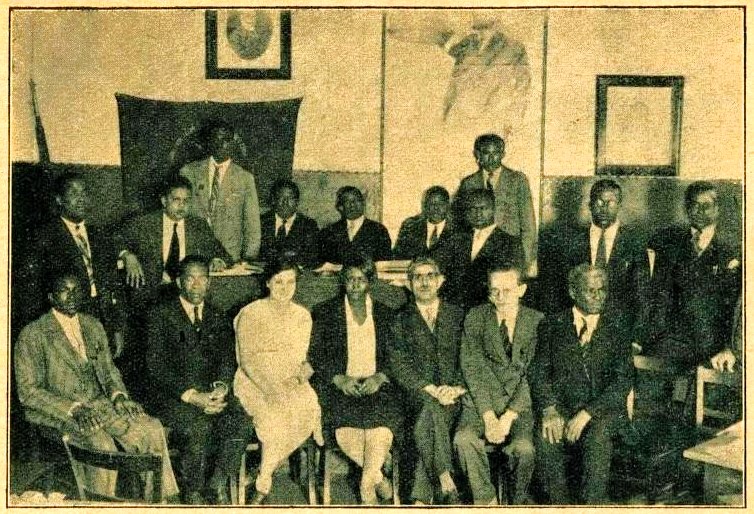
James W. Ford on the background to a milestone in international Black Communist organizing, the First International Conference of Negro Workers sponsored by R.I.L.U.’s International Trade Union Committee of Negro Workers held during July, 1930. Writing in the run-up to the historic gathering, Ford calls it the ‘London Conference’ when in the final weeks difficulties with the Empire’s police necessitated a change in venue, to Hamburg.
‘The London Conference of Negro Workers’ by James W. Ford from The Daily Worker. Vol. 6 No. 366. May 9, 1930.
(Chairman, Provisional International Trade Union Committee of Negro Workers.)
THE Trade Union and political organizations of white workers that arose scores of years ago have always suspected the Negro workers, betrayed them, Jim-Crowed them, and looked upon them as step-children in the proletarian family. They take the position that Negro workers are made by god as slaves to be inhumanly exploited by the capitalist bosses. In this respect these reactionary trade union and political organizations of the white workers have been no different from the capitalist bosses themselves and have assisted in the exploitation of the Negro toilers in one form or another.
A. F. of L. Betrays Negro Workers.
It is a well known fact to all Negro workers that the American Federation of Laber has long been a tool of the capitalist bosses to Jim-Crow, segregate, brow-beat and prevent the organization of the Negro workers.
Let us consider one case. The race riots in Chicago in 1919 were organized by the capitalist bosses, in an effort to enforce an unofficial segregation of Negro workers, who were being drawn into the industries from the South, and to prevent their organization.
The official bureaucrats of the A.F.L. craft unions affiliated to the Stock Yards Labor Council in Chicago, by their discrimination against the Negro workers furnished the basis for agitation amongst Negroes against all unions of the white workers. This is a well known fact that has been disclosed by special investigation.
Gompers, head of the A.F.L. for many years, was for these many years an arch enemy of the Negro workers and an agent of the capitalist bosses. This history of betrayal of Negro workers by the A.F.L. lays like a slave whip upon their backs.
The reformist reactionary organizations of the Amsterdam International and the socialist parties of the Second International are no different regarding the Negro toilers in Africa and the West Indies. Their methods are more subtle and deceitful and at the same time, just as brutal.
The Belgium socialists founded a cotton company in the Congo and carry on a more ruthless exploitation of the natives than d Leopold himself. M. Mathieu, a socialist member of the Belgium Parliament, is at the same time manager and director of an exploiting company, which is supported by a socialist bank and operates in the Belgium Congo. The socialist members of the French Chamber of Deputies sanction the ruthless murdering of native workers in Central Africa as “The civilizing influence of French Colonia Policy in Africa.”
The British “Labor” Government under the control of Ramsay MacDonald, a socialist, shoots down native women and workers in West and East Africa and carries out the policies of the exploitation of the natives the same as the capitalist parties and for the capitalist class.
Exploitation Supported by Reformist Organizations.
Thus the exploitation of the Negro toilers in the various parts of the world is carried on by the socialists equally as by the capitalists themselves. The reactionary trade union organizations such as the Amsterdam International is a cloak for forced labor in Africa. The reformist and the reactionary organizations of the white workers are imbued with the same spirit as the imperialists themselves. The theory of higher and lower, inferior and superior races determines the policy of the socialists and the reactionary fascist trade unions, like the A.F.L. and the Amsterdam International.
At the same time the Negro toilers have been separated and isolated from each other and isolated from the honest proletarian movements of the white workers. They have had very little opportunity to take stock of this situation together. We in America have been isolated from our brothers in Africa and the West Indies and they from us, while at the same time the capitalists ride upon our backs.
Plans Made at Anti-Imperialist Congress.
But the second World Congress of the League Against Imperialism held at Frankfort, Germany, in July of 1929, gave the representatives of the Negro toilers the opportunity to get together and to discuss their problems from a working-class point of view.
Delegation of Negro Masses.
In this connection it’s interesting to note the composition of the Negro delegation at this congress: Mary Burroughs, American Negro Labor Congress (USA): James W. Ford, International Trade Union Committee of Negro Workers of the RILU. (USA): Johnstone Kenyatta, Kikuyu Central Association of Kenya, East Africa: Garan Kouyate, League for the Defense of the African Race, West Africa: DeKeersmaecker (white), of the Congo Colonial Commission of Belgium; Andrews (white). Trade Union Congress of South Africa; Henry Rosemond, Haitian Patriotic Union, Haiti: William Pickens, National Association for the Advancement of Colored People (USA): William Paterson, American Negro Labor Congress (USA); and M. Ali (Algerian), Paris, France.
Fraternal Representatives of Other Races.
A few of the representatives from the U.S.A. took the initiative in calling a small trade union conference of these delegates, to discuss the problems of the Negro toilers in the various parts of the world. In addition to the Negro delegates, fraternal representatives of other races and organizations in attendance at the Congress were invited to our meeting. These were L. Li of the All-China Federation of Labor; Sen Gupta of the Indian National Congress; M. Burns of the Transport Workers’ Union of England: Saklatavala of the Indian Welfare Association of England; J. Ballam of the Trade Union Unity League of the U.S.A. and a representative of the C.T.G.U. of France.
Preliminary Trade Union Conferences.
We had planned to hold only one meeting but the first day’s discussion was so exhaustive and interesting that a second meeting was held. On the first day Saklatvala spoke on the wage conditions amongst the Indian and African workers in South and East African. He told of how the imperialists try to use Indian workers against African workers and African workers against Indian workers, and advised a closer relation between the Indian and African worker of East Africa, with the Indian workers’ movement in India, He also spoke of the role of the socialist parties as one of oppression of the natives in the colonies. Mary Burroughs spoke of the conditions of Negro workers in America and the role of the American Federation of Labor,
Reports of Delegates.
Most interesting was the report of Johnstone Kenyatta of East Africa on conditions in East Africa. He told of how the native workers have had their land taken from them, how they are denied any educational advantages, how the white colonists use young native girls as concubines, how the British shot down 20 defenseless natives who were making a plea for the release of one of their leaders who had been exiled. He said that there are many R.R. workers in East Africa, but that the problems of the natives was essentially a land problem.
Other speakers told of conditions of Negroes in the Belgium Congo, West Africa, Haiti and the United States. J. Ballam of the Trade Union Unity League told of the program of organization outlined by the TUUL for organizing Negro workers in the United States.
Rebukes Lynchings in U.S.A.
On the second day, J.W. Ford, chairman, outlined a program of trade union organization for Negro workers and suggested the calling of an International Conference of Negro workers; he also spoke of the war danger and Negro tollers. This suggestion was received with great enthusiasm by the delegates and a long discussion took place. Sakalatvala suggested that since a great number of Negro worker toilers are under the British Empire such a conference should be called in London, England. This suggestion was well received by all the delegates. Comrade All of France, however, put in a plea for Paris. But we were reminded that the French authorities had already prevented the holding of the League Congress at Paris.
Many points of aid and suggestion were brought to us from our fraternal representatives of China and the white movements of Europe. At our second meeting Sen Katayama, an old Japanese trade union veteran, and at one time a resident of America, attended our meeting and spoke about lynchings America.
Election of Provisional Committee
The conference then decided to elect a Provisional International Trade Union Committee of Negro workers with J.W. Ford as chairman and gave him instructions to proceed with the convening of an International Conference of Negro workers in London, England, on July 1st, 1930.
Thus the organizational plans for the convening of this historic conference were made on July 26th, 1929, at Frankfort, Germany. The plans for this conference are now under full swing. The Negro toilers have many problems to discuss at this conference and an historic task to perform.
1. Report of the International Trade Union Committee of Negro Workers.
2. The economic struggles and tasks of the working Negroes.
3. The struggle against forced labor and poll tax.
4. The danger of war and working Negroes. These and other points will be the main points of discussion at the conference.
The Provisional International Trade Union Committee will in the next few weeks conduct a series of nation-wide mass meetings amongst the Negro toilers for the nomination and election of Negro delegates to the London Conference of Negro workers.
The Daily Worker began in 1924 and was published in New York City by the Communist Party US and its predecessor organizations. Among the most long-lasting and important left publications in US history, it had a circulation of 35,000 at its peak. The Daily Worker came from The Ohio Socialist, published by the Left Wing-dominated Socialist Party of Ohio in Cleveland from 1917 to November 1919, when it became became The Toiler, paper of the Communist Labor Party. In December 1921 the above-ground Workers Party of America merged the Toiler with the paper Workers Council to found The Worker, which became The Daily Worker beginning January 13, 1924.
PDF of full issue: https://www.marxists.org/history/usa/pubs/dailyworker/1930/v06-n366-NY-may-09-1930-DW-LOC.pdf
 Revolution's Newsstand