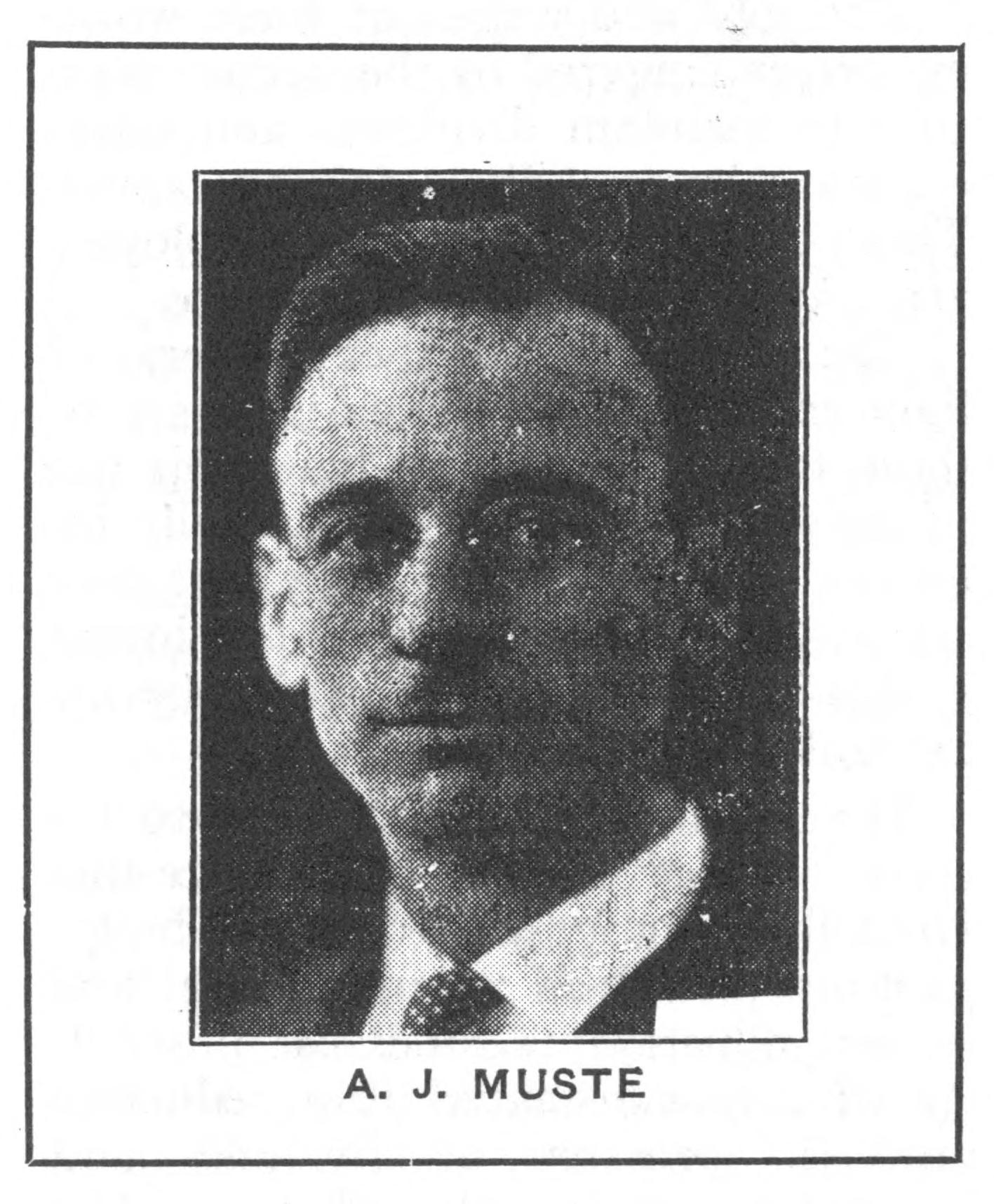
The violent divisions, a death sentence in the face of a rising fascism, in the workers’ movement and ways of overcoming them became the main topic of conversation among the Left of all traditions for a period in the early 1930s. Here, in the final issue of Labor Age, A.J. Muste offers his possible solution to the crisis as it was in the United States.
‘The Need for a United Labor Party’ by A.J. Muste from Labor Age. Vol. 22 No. 1. February-March, 1933.
AN official of a building trades A union, brought up in the tradition of the British I.L.P. and so not exactly typical of the American building trades official, was recently speaking to a labor group about the need of a labor party in the U.S. He said that for months he had tried the experiment with all kinds of working-class audiences, in union halls, at street-corner meetings under Socialist, Communist or even old party auspices, of mingling with the crowd and quietly asking large numbers of individuals their opinions in regard to a labor party. Invariably he found the same reaction from the workers. It might be expressed thus: “Why can’t we have a single united party of labor and the farmers? Labor ought to vote the way it strikes; the old parties are boss parties; we must have our own political party just as we have our own unions. But it is no use if labor won’t stand together. We can’t get anywhere with all the small political parties in the field today.”
There is every reason to believe that that reaction is typical of the feeling among the more intelligent workers throughout the country. Among the leaders and members of existing political parties and groups and among the intellectuals one finds, however, a good deal of opposition to or doubt about the idea. In part this is due to the natural feeling of each party that it is as near perfection as one can hope to find, and that if everybody would just join it, labor would have its party and a smashing big one. Some of the doubts are, however, of a more fundamental nature, and we need to make clear the historical necessity of a united mass labor party in the U.S.
Divided Labor—Prey of Fascism
If anything has been made clear by the war and post-war history of labor, it is that a divided labor movement is no match for reactionary forces which at the critical moment assume a Fascist form.
What happens in countries like Italy and Germany, for example, when the labor movement is split up, when the militants and revolutionists break away from the main masses in the unions, on the political field, in the cooperatives, and form separate organizations? The answer is Fascism. In a period of disturbance, Fascism, which is also militant, which repudiates the sham of “democracy,” which rejects many elements in the present set-up (repudiates the reparations in Germany, for example, and promises to overthrow the rule of the international bankers) has certain advantages over the labor movement, certainly over a divided labor movement.
In the first place, farmers in these more advanced countries are not in the habit of working with the labor movement; they have a more individualistic point of view. When they are in distress and feel that there must be a change, they do not naturally turn to labor leadership. Fascism is likely to appeal to them. In the second place, Fascism can usually count on the support of the church, which will probably fight for “democracy” up to a certain point as the Centrists are doing in Germany today, and as the Popular Party under the lead of Dom Sturzo did in Italy some years ago. But when it comes to a show-down the church will throw its support to Fascism rather than Labor. There are even certain elements among the workers, those, for example, under the domination of reactionary elements in the churches, who, if the labor movement is divided, are likely to take that as an excuse for going Fascist.
Many white-collar workers, clerical, technical, and professional, are likely to feel that joining labor is joining an “inferior” group, and they, therefore, form an easy prey to an ultra-nationalistic Fascism.
In the next place, capitalists in a showdown will also choose Fascism rather than Communism, which means that Fascism can count on access to the money-bags. Finally, capitalist foreign powers will, as has been abundantly demonstrated, look with a mild eye sometimes on a Fascist regime, but they will maintain an attitude of implacable hostility toward the effort of any people to build a genuine workers’ republic.
A Force Against Reaction
Against such mighty forces as these a united labor movement may be able to make a stand. If labor were united, for example, the farmers would be much more likely to be attracted to what would then be a very powerful organization, in a position to be of great service to them. When labor is divided, the church can widen the breach by disowning the left-wing elements as irreligious. Reactionary elements in the church are much less likely to be successful in this effort if labor stands together. It is very difficult to raise the religious issue against a united working class.
Except in a united mass labor party (under whatever name) it is not likely that Socialists and Communists can be gotten together. “Socialism” or social-democracy is one labor philosophy, Communism is another. There is a tremendous difference between them. These groups cannot unite on the basis of a common philosophy. If, however, we are to have a separate Socialist and a separate Communist movement in the U.S. both will probably remain weak and ineffective. The S.P. under these circumstances will be constantly drained of its most militant elements, it will lean on the less revolutionary element among the intellectuals, and it will not be able to appear before the workers as the one political voice of labor.
The Communist Party, on the other hand, will not be able to speak as the one voice of labor either. It will often have to be a divisive force. Political differences will split the unions. Socialists will see to it that certain sections of the working-class will be alienated from the Communists. It is altogether unlikely that Communists under these circumstances could build up an effective revolutionary movement, but they cannot be merely ignored. They would certainly torment the Socialists as much as the Socialists could torment them.
If there were a mass organization of labor and the farmers which had a sound class basis and which would therefore be sounder and more trustworthy, even while its program and philosophy were of an elementary character, then a propaganda society composed mainly of intellectuals, both Socialists and Communists might work inside it. Where else, except in the unions and other economic organizations, would they find so favorable a soil for educational seed? In any event we see no other way in which Socialists and Communists might be brought together.
There are a very considerable number of militants and revolutionists in the U.S. today who cannot work at all, or at least not with any degree of satisfaction, in either S.P. or C.P. These also would enthusiastically work in mass labor party with elements from which they differ, believing that such a party is a historical necessity in the present stage of American working-class development.
Probably there would be a re-grouping of revolutionary elements within the mass labor party which would result in a much more effective revolutionary movement, one much closer to the American soil than we now have.
Bring Farmers and Unions Together
Many other considerations point to the necessity of existing parties and groups turning their backs on sectarian tendencies and uniting to sponsor a labor party. Industrial workers must be the base and spear-head of a working-class party in an industrial civilization, but the allegiance of certain sections of the farmers is needed. They will go Fascist eventually if they are not tied to labor. But is there the slightest sign that any large sections of farmers are turning to either the S.P. or C.P.? Does any careful observer doubt that it would be much easter to swing them into a united labor party with the unions, the cooperatives, etc., than into the S.P. or C.P.?
What of the unions? Let the relations between the S.P. and C.P. remain as they are, and the unions will be the battle-ground of contending political groups, instead of the economic base for working-class political power. There is no sign that the unions any more than the farmers are moving into either of the above parties. There is no such connection between them and the unions as has obtained in Europe. To the unions in the United States they are “outsiders.” If the railroad unions, for example, go in for independent political action, it will not be because they are won over by the arguments of Socialists or Communists, but because necessity compels them to break with the old parties. They will then in all probability do just what they started to do in 1919-24, viz., back a labor or farmer-labor party. As soon as a few big unions do that they will have overnight a more substantial political force than the S.P. or the C.P. and these latter will have to join in or simply be isolated from the living forces in the situation.
There are large numbers of workers in the churches, both Catholic and Protestant, whom it will be exceedingly difficult to get into either the S.P. or the C.P., but they might be gotten into a farmer and labor party. If they remain politically aloof from other workers, the labor movement will be terribly weakened. We may even see ecclesiastically-dominated unions formed as in Europe.
Whether we look to years of comparatively gradual growth of the labor movement or to swift developments in a revolutionary situation, American workers must be weaned away from their individualistic, pro-capitalist, nonlabor (in many cases anti-labor) bias. Now such transitions are not effected by one individual after another coming to espouse as a result of “education” and logical processes a different philosophy. They come because masses under pressure shift their allegiance to new organizations and movements which give them the slogans and theories they need in the new situation. That means that the next big step, in addition to getting workers and farmers into economic organizations, is to get them to quit voting the Republican or Democratic ticket.
Peanut Whistles Against a Hurricane
But if that is to happen something will have to touch the imagination of the plain, everyday “worker on the street”—the worker in Oshkosh, Tacoma, Pittsburgh, Birmingham, Hartford, Toledo—not only in Union Square, New York. If the babe! of voices which now comes to the worker from the radical camp could be silenced, if one clear united voice could sound out from that babel, calling on all workers and farmers to stand together in a great fighting labor party, such a call for unity of labor in this world crisis, unity against reactionary forces which threaten to sweep away the labor movement in every industrial country, might touch the imagination of the now bewildered masses and get a vast response. Nothing else will. The separate voices of Socialists, Stalinites, Trotskyists, Lovestoneites and the rest are peanut-whistles against a hurricane. The American masses know it and will not respond.
A word of caution must here be inserted. If existing political parties and groups persist in following a sectarian course, it is possible that some “labor party” movement will nevertheless get under way, as various elements in the population despair of getting anything from the old parties. There are states for example, where conservative trade union bodies are thinking seriously of sponsoring “a labor party.” There are instances where groups under strong ecclesiastical influence are apparently thinking “labor party.” It is not at all impossible that elements which are primarily liberal will try to form a “third party,” unless Roosevelt works miracles, and that such a party would have at least a temporary attraction for sections of farmers and workers.
If such movements get under way and the radical elements are outside them, the scene will be still further confused. Potential recruits for a genuine labor party will be diverted into other groups. Such parties, devoid of radical elements, will be dominated by the right wing. The place of radicals is inside genuine mass movements to keep them sound and out of the control of confused and non-radical elements.
“Yes, but unions and labor parties,” the left-winger answers, “get in the habit of compromising, of trying to get results by parliamentary methods, electing candidates to office under the capitalist system. Then, when the need for drastic action, for taking some actual step toward the establishment of a working-class regime comes, they draw back. They fail. The only thing we can rely on is a disciplined revolutionary party. And such a force can keep itself truly revolutionary only if it keeps itself separate politically and builds up its own unions, cooperatives and cultural organizations.” This may be true. If those who advance this argument, however, are realistic, if they face the facts, they must confess that in making this argument they pass sentence of death on the labor movement in all such countries as the United States, Great Britain, France and Germany. If it is ever safe to prophesy, it is safe to predict that a divided labor movement in such countries means the triumph of Fascism.
Is It Purity or Death?
Must we then resign ourselves to complete despair on the ground that if a divided labor movement will be an easy prey for Fascism, a united labor movement will be too slow, too cautious, too lacking in militancy and vision, to take power and to build a new social order in which there will be bread, security, and peace for all the workers, and no place whatever for any shirkers?
We do not believe that the truth of this last proposition has yet been proved. Of course, a movement including all elements in the working class will not want at first to proceed as rapidly as the most extreme elements, if left to themselves, would wish to do. On the other hand, to suppose that a handful of red-hot revolutionists, off in their own sectarian unions, who in addition to opposition from all the capitalist elements, have also to face determined opposition from many workers, can accomplish a great social change in a country like the United States, is the most dangerous kind of day-dreaming. As leftwingers, in the past at any rate, have often pointed out, if the militant elements among the workers go off in a corner by themselves, the result is to leave the masses in the hands of reactionaries. When the militants organize by themselves, the other organizations will move further to the right than they otherwise would, because they feel they have to fight the lefts and be as different from them as possible. If a really revolutionary crisis arises and the militant elements are in touch with the mass of labor and have the confidence of the workers, because they have led them intelligently in their daily struggles, we have some hope.
Militants who argue, as some of them do, that you cannot build industrial unions in this country, cannot get the workers into a labor party, but that those workers who are not advanced enough to fight for organizations to deal with the problems right under their noses in the shop, and to quit voting the Republican or the Democratic ticket, will follow a handful of revolutionists to the barricades if a crisis arises, are either hopeless, or idiotic or are provocateurs deliberately working on behalf of capitalists to keep the labor movement as weak as possible and to insure the triumph of Fascism.
Our Place Is in Organizations of the Masses
On the other hand, we are convinced that without a powerful, intelligent, revolutionary left-wing which carefully studies the lessons taught by the course of labor parties in other countries we too shall end, in spite of all the votes we roll up in elections, as slaves to Fascism. A labor party may be but a passing phase in our development. So long as it is in the picture, radicals should be in it, not isolated from it.
We say to workers of all shades of opinion—red, pink, yellow, green or what not—workers who have been kicked out on the street, who are working at starvation wages if they have jobs at all; who were good Americans and bought little homes only to have them taken away; who have no security left, who are suffering in the very midst of abundance because they have turned out goods so efficiently ; industrial workers, agricultural, clerical, technical, professional—we say, the time has come to build a united fighting party for all who toil, in which no exploiters of labor will have any part, which will set about to organize industry, in such a way as to make America a land of abundance and joy.
Already workers in a number of places and in different industries have taken steps toward the building of such a party. What are the chances in your city? Have you brought the subject up in your union, workers’ education class, cooperative society or political group? Write to us if you are interested in the subject and want to be put in touch with others who are also interested.
There is no hope in the old parties of the elephant and the jackass. Divided on the political field we are helpless. United, the American masses have the intelligence, the vision, the power to build a world according to their heart’s desire.
Labor Age was a left-labor monthly magazine with origins in Socialist Review, journal of the Intercollegiate Socialist Society. Published by the Labor Publication Society from 1921-1933 aligned with the League for Industrial Democracy of left-wing trade unionists across industries. During 1929-33 the magazine was affiliated with the Conference for Progressive Labor Action (CPLA) led by A. J. Muste. James Maurer, Harry W. Laidler, and Louis Budenz were also writers. The orientation of the magazine was industrial unionism, planning, nationalization, and was illustrated with photos and cartoons. With its stress on worker education, social unionism and rank and file activism, it is one of the essential journals of the radical US labor socialist movement of its time.
PDF of full issue: https://www.marxists.org/history/usa/pubs/laborage/v22n01-feb-mar-1933-labor-age.pdf

