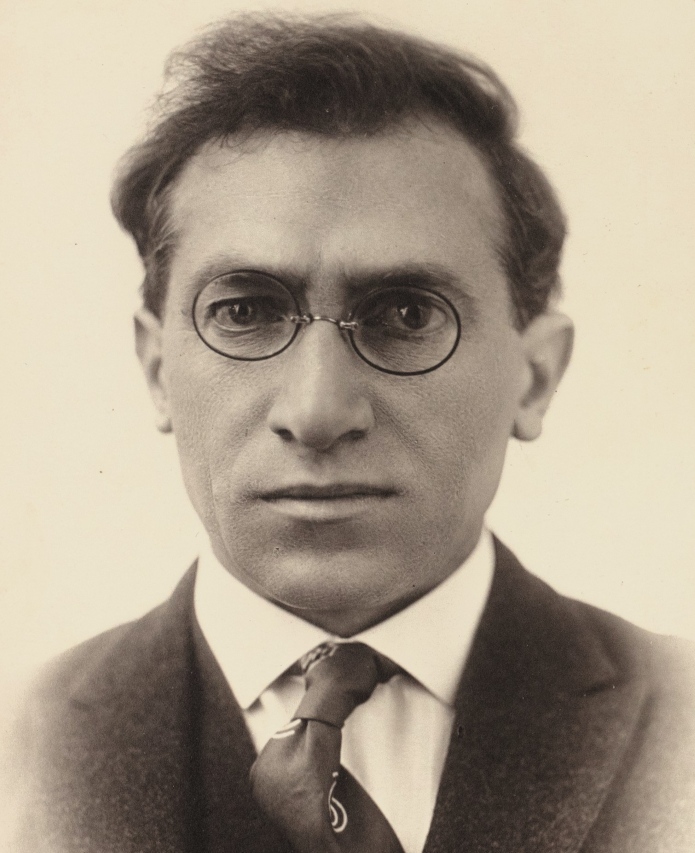
Olgin, attending the Comintern’s Fifth World Congress with an essay on the Profintern, the Red International of Labor Unions to which the Trade Union Educational League was the U.S. affiliate.
‘Revolutionary Unionism vs. Weak-Kneed Reformism’ by Moissaye J. Olgin from The Daily Worker Magazine. Vol. 2 No. 140. August 30, 1924.
A few remarks on the Congress of the Red International of Labor Union (Profintern.)
THE “respectable” Philistines, bourgeois by social position and bourgeois by the grace of social reformism, calls us Communists, Utopians, dreamers. This is what ‘the Russian Philistines called the Russian revolutionaries twenty years ago here, in this estate of the tzars, in this “holy” Moscow where most of the graves of the one-time “respectable” and “practical realists’ (graves, physical and political) are now rotting away in ignominious oblivion. When you travel the width of U.S.S.R. Union of Soviet Socialist Republics (It’s about time we knew what these initials mean) and observe the new forms of free proletarian life sprouting on virgin revolutionary soil, you laugh derisively at those clever ones who deem to annihilate you by the bombshell dreamer. But if you were to spend two weeks at the Congress of the Profintern (Red International of Labor Unions—R.I.L.U.) with its detailed reports and masterly analysis of the world trade union movement, you would say that it is the “respectable” social reformists of the Amsterdam International who are this actual Utopians, whereas the movement represented here, in this Hall o’ Columns of the House of the Unions is a movement of shrewd and circumspect practiciens who study the social forces of post war society, understand the trend of history, know the nature of the approaching enormous conflicts, and prepare the working masses for the role allotted to them by the development and decay of capitalism—the inevitable and unavoidable struggle for power.
There, lazy acquiescence in imperialist machinations; in most cases, actual aid to the forces that are robbing the working class of its subsistence minimum and preparing a new horrifying world catastrophe; at best, a pious hope that oily “democracy” will turn a cure-all for the “evils” of society and lead us painlessly and suavely, into the haven of socialism.
Here, a pitiless search for the truth, a keen application of past experiences to the solution of complicated problems, a courageous facing of consequences, however difficult, a readiness to fight in a world where nothing can be gained without organized, consistent social warfare.
Who are the dreamers?
In certain respects the Profintern congress, less numerous and less sparkling than the great world congress of the Communist International, was even of a more fascinating nature than the latter. Here was a dealing with the everyday actualities of the workingmen’s life. Here was felt the breath of that incessant struggle which the industrial worker is compelled to lead for his daily bread, a struggle that is the daily bread of the working class. There were mostly men from the ranks of the labor unions, men who went thru the hell of shop work, strikes and lockouts for years and decades. Here the question of the united front of labor assumed a more vivid aspect than even in the field of political struggle.
And the enemy, the immediate enemy of the working class—the social traitors who are often more dangerous to the workers because not so easily recognized and not so readily guarded against, than the bourgeoisie itself—appeared here as something tangible, something that stands everywhere between the worker and his accession to power, it one may say so, here was felt more keenly the odor of the earth. A practical application of one of the principles formulated by the Comintern congress, the Profintern discussion were more absorbing in the same way as is every application of a general principle to the unending variety of circumstances in practical life.
Here, as at the Comintern Congress, the correspondent is painfully aware of the impossibility to give in an article an honest description of what requires a book for its presentation.
It will, perhaps, be best to enumerate the high lights of the congress.
An inquiry among many leading delegates, Including members of the presidium, seems to reveal a consensus of opinion that the following points were the most outstanding in the work of the congress:
1. The question of unity with the Amsterdam International;
2. The question of strike strategy;
3. The colonial problem.
Unity with the Amsterdam International would mean a combination of all the forces of the working class in one big organization. It would mean, not only bringing the Russian trade unions into line with the trade unions of western Europe, but it would mean a solidification of the industrial inter, nationals (transport workers, miners, etc.) which are affiliated with the Amsterdam International and which begin to play a role in the labor movement of the world. There is no need of dilating over the importance of bringing all working class forces together, over the enormous vistas which this would open before the world proletariat. There is, however, one little point which has to be considered in relation with such prospects, and that is, “What for should this unity be achieved? What is the use to be made of this consolidation of the world proletarian forces?” The gentlemen from Amsterdam, at their Vienna congress of this summer, made it clear that they would like to have the Russian unions join their International on the basis of its constitution and statutes, i.e. they would like to see the Russian unions as tame, as devoid of the class spirit, as willingly collaborating with the bourgeoisie and as inactive in the class struggle as those “respectable” union bureaucrats have made the organizations under their guidance. This is a prospect unacceptable to the Profintern, and there would have been no need of discussing the problem of unity with the reformists if not for the Amsterdam left wing. The Vienna congress manifested that there is no unity in Amsterdam itself. There is a left wing which, though timid and muddle-headed and far from a revolutionary standpoint (Edo Fimmen, the Dutch leader, some of the British trade unionists), begin to fret under the rule of pure and simple social reformism. The “rebellion” of these leaders, weak and toothless as it may be, is a reflection of deep fundamental changes taking place in the mood of the large masses of the working class. Outwardly all this enormous molecular process expressed itself in an invitation extended by the Amsterdam International to the Russian unions (but not to the Profintern as a whole) to join it on the basis of its program and statutes.
The Profintern Congress, of which the Russian unionists were an important part, had to take a stand. To go or not to go to Amsterdam? How far to go in concessions to the reformists? On what basis to agree to join Amsterdam? What shall be the fate of the Profintern if the Russian unions unite with the unions of the Amsterdam Internationals? What shall be the fate of the International Propaganda Committees (I.P.C.’s.) set up by the Profintern to work among the Industrial Internationalists? Will we not weaken instead of strengthening the world union movement? Shall the Profintern mark the first step without awaiting formal invitation from the adversary? What effect would all this have on the Communist movement of the various countries?
There was heat in the discussion.
There was passion. There was a feeling of historic responsibility which made many a heart throb with anxiety. There was a feverish scrutiny of all the circumstances. The nature of reformism as such, the nature of the left wing, the present galvanization of reformism which makes it appear to be passing thru a period of revival, the situation of the union movement in every country, the particular situation in Great Britain under the “labor” regime of MacDonald, the general trend of the class-struggle in the world, the prospects of the revolution—all this passed review before the mind of the delegates who faced, and were fully aware that they faced, a problem such as is seldom put before a body of revolutionaries. Those days when the question of unity of the world labor movement was before the Congress, may be considered the crucial days of this big and colorful gathering.
But the delegates assembled were Communists, and they were under the leadership and in close contact with the master minds of the Comintern. They had a few fundamental truths to be guided by, and they finally reached decisions which were accepted unanimously. The Profintern wants unity. It declares its readiness to establish unity. This is not a mere maneuver as some fear, and even a few friends, would like to interpret it. The Profintern knows that in a world where capitalism is becoming more organized and more concentrated every day, only an organized and concentrated labor movement can lead the class-struggle both on a national and international scale. The Profintern has no reverence for this or that form of existing organization. Contrary to the Amsterdamers, it does not emphasize the “dignity” of its organization. It will sacrifice this so-called dignity if the interests of the working class and the revolution require it. The Profintern will make the first move toward unity. But it understands unity as meaning a consolidation of the working class forces for the class-struggle against capitalism. It values unity only if it enhances the power of the proletariat and accelerates its revolutionary movement. It will not join under conditions which would prevent the evolutionary elements from conducting a vigorous class revolutionary propaganda among the working masses.
On the other hand, it believes in the revolutionary spirit of the masses. It knows that, however misled and befogged by reformed chieftains, the workers will rally under the revolutionary banner when approached by determined class revolutionary leaders. It is, therefore, not afraid to be in the minority. Moreover, the Congress, as a body of Communists, knew that it is the duty of Communists to seize every opportunity which would open for them an approach to the broad working masses. Unity with the Amsterdam International would offer a large field for revolutionary work among the masses. The Profintern, therefore, says to Amsterdam: let us come together; let us unite the world proletarian forces; but let us do it for the class struggle; we, the Red ones, will abide by majority decisions as far as action is concerned, but we demand the right of free criticism and free propaganda of our opinions; we are for proletarian democracy, and therefore let the world proletariat itself, in Congress assembled, decide upon the practical conditions for unity.
The steps taken by the Profintern and the Russian unions are known. The Russian unions answered the Amsterdam International with a proposal to call a conference of an equal number of representatives from each side to discuss the problem of their uniting with the Amsterdam International. The Profintern is going to write a letter (and by the time this reaches America the letter will prob ably have been sent) to Amsterdam with a proposal to discuss in a conference of an equal number of representatives the problem of calling an International Unity Congress on the basis of proportional representation. Thus the question of a united front in the union movement enters a new phase. When this letter is printed new developments will have taken place. One thing must be emphasized, and this was expressed at the Congress as resolutely and as unequivocally as possible. The Profintern, and the Russian unions, will never weaken their propaganda of revolutionary class-struggle. The steps towards unity on the part of the Profintern and the Russian unions are not a move to create a united front from above inasmuch as the unity campaign will be developed by the revolutionary trade unionists, the Profintern, the minorities within the reformist unions, and the red independent unions, among the broadest masses of the proletariat the world over, making them realize the necessity of unity and the revolutionary possibilities which it has to attain. The Profintern knows that once revolutionary unions are part of a general federation of unions, their influence will be much greater than when they stay out.
The question of the fate of the Profintern agitated many a comrade, especially of the German delegation.
The German comrades who now occupy the extremest ideological position in the Comintern, gave their consent to the program of the Profintern with no enthusiasm, knowing that among their own ranks there are elements which would like a secession from the German reformist unions. They are anxious to retard the unity movements of the Profintern though in principle they accept them.
The German comrades warned emphatically against any attempt to liquidate the Profintern. The position of the Profintern is this: If a World Unity Congress is called; if at that unity congress all unions of whatsoever trend are represented in proportion to their numerical strength; if that congress creates a new World International of labor unions thereby liquidating the old internationals including Amsterdam; if Amsterdam agrees to disband in consequence of such decision, then the Profintern will also cease to exist. Until then, however, even should the Russian unions enter the Amsterdam International (thereby, naturally, leaving the Profintern) the Profintern will remain on its post.
If the demand for a World Unity Congress was the new word of the Profintern Congress in the realm of tactics, the formulation of the strike strategy was its new word in the realm of the theory and practice of actual class-struggle. It was for the first time in history that the labor movement took up the question of strike strategy simultaneously as a theoretical and a practical problem; theoretical, in that it requires a careful study of all experiences and forces of the working class on the one hand and of capitalist society on the other; practical, in that it must be reduced to a net of clear and comprehensible rules for the guidance of the strike leaders in their battles against the employers. The Congress has only outlined the problem. It requires study. Material will be collected and further inquiries made. One thing, however, was evident from all the discussion: only a body of men, representing organizations that lead revolutionary struggles and know the inevitableness of a final revolutionary onrush of the working masses to overthrow capitalism, could take up the strike from such angle. Speaking generally, the problem is how to make the organization of the working class so perfect that every strike should turn into a revolutionary battle against the bourgeoisie, and every action—a new step towards the final goal—overthrow of capitalism and establishment of proletarian dictatorships. In this aspect the working class is an army of actual or potential fighters, the aim is the conquest of power, the strike strategy is the ways and means whereby the revolutionary army can storm the stronghold of the enemy. Nobody should fail to read the speech of Comrade Lozovsky on this problem—a speech showing what a strike ought to be and can be when leaders and masses are animated by a class revolutionary spirit.
We, Americans, will be able to contribute to this discussion the most valuable material to show what the strike strategy should not be.
From revolutionary strike strategy to the revolutionary prospects of the East, the distance is not far. Of course, the Amsterdam International is not interested in the working class of the East. Why should it if it is not Interested in the working class of the European countries. When such gentlemen as MacDonald and his henchmen deal with the colonial problem, it is only from the standpoint of keeping the colonial masses in subjugation. Meanwhile, the colonial and semi-colonial countries are charged with revolutionary electricity. Imperialism is crushing these large sections of the globe, and the spirit of rebellion is abroad. There is every prospect of revolutionary upheavals in the East, and the working class there may be one of the greatest factors in the not far distant future. The fact that the first international labor gathering of the East, the international transport workers’ conference at Canton, was organized by the Profintern, shows that the Profintern is aware of those revolutionary prospects. Moscow, Aug. 1.
The Daily Worker began in 1924 and was published in New York City by the Communist Party US and its predecessor organizations. Among the most long-lasting and important left publications in US history, it had a circulation of 35,000 at its peak. The Daily Worker came from The Ohio Socialist, published by the Left Wing-dominated Socialist Party of Ohio in Cleveland from 1917 to November 1919, when it became became The Toiler, paper of the Communist Labor Party. In December 1921 the above-ground Workers Party of America merged the Toiler with the paper Workers Council to found The Worker, which became The Daily Worker beginning January 13, 1924.
PDF of full issue: https://www.marxists.org/history/usa/pubs/dailyworker/1924/v02a-n140-supplement-aug-30-1924-DW-LOC.pdf

