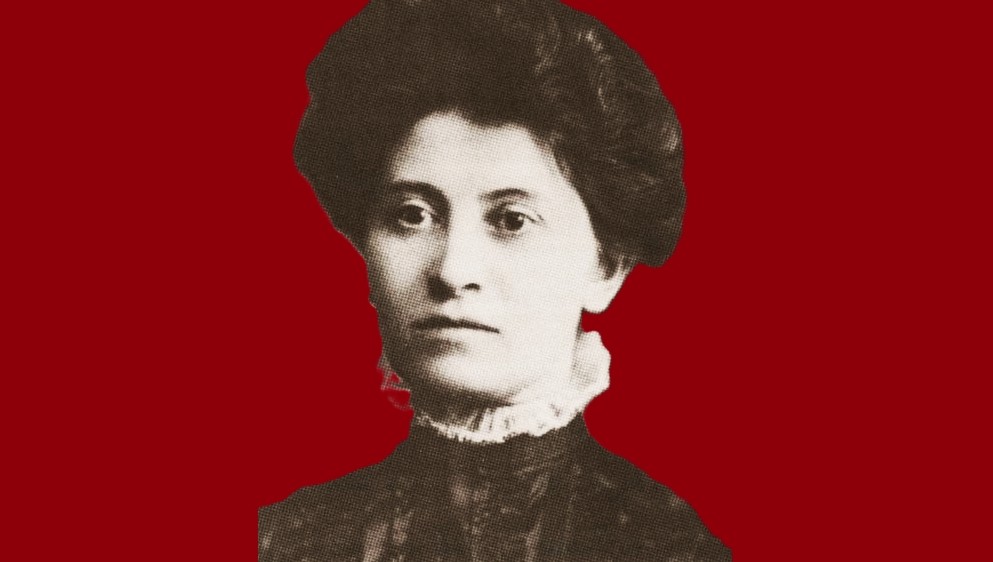
The ‘sanctity of the home’? The ‘honor of woman’? Under capitalism? Theresa Malkiel calls bullshit.
‘The Mother’ by Theresa S. Malkiel from Progressive Woman. Vol. 2 No. 22. March, 1909.
“Whose is the love that, gleaming through the world,
Wards off the poisonous arrow of its scorn?
Beneath whose looks does the reviving soul,
Riper in truth and virtues, daring grow?”
The words woman and mother are so linked together that one is almost synonymous of the other. The world over, and from time immemorial, it has been. proclaimed that the destiny of woman is motherhood. Without a protest, without a thought that it is not more her sole destiny to become a mother than it is man’s sole destiny to become a father has woman accepted her allotted task. She clung to it faithfully and tenaciously, until the economic developments of the world have begun to root her out of that sphere.
Heavy as that burden weighed upon woman, she might have borne it better had not man deprived her of everything else on account of it. Her sense of judgment, her interest in the outside world, her very liberty were sacrificed for it. Every move towards freedom was nipped in the bud.
“Back to the cradle!” was the universal cry. So long and so often has this cry been heard that woman herself came to accept it as nature’s law.
When woman’s rebellion became threatening this bitter pill was sugar-coated: “The hand that rocks the cradle rules the world.” “You and you alone are the educators of the future generation,” she is told today.
The contradiction in which men involve themselves through this utterance is obvious. They assign woman her sphere and entrust her with the great task of educating their children without granting her the right to educate herself. She is to make the children worthy members of society, good citizens, without having learned the needs of society herself. How can she know the requirements of a good citizen when she has no right to citizenship? How can slaves be expected to rear free men? In short, the mother is charged with duties which, under the present state of society, she is unable to fulfill.
Men, and the average woman alike, are horrified at the idea that woman is to leave her narrow sphere and go out into the world to learn and take an interest in everything that concerns life. Never thinking that just because she is a mother she has the double obligation of taking part in the world’s work.
It was often pointed out that great men usually had excellent mothers.
The qualities of the mother are therefore to be considered when we talk of the merits of the sons. And yet there seems to be a determination among the male half of society to limit the number of superior women as much as possible by curbing their very desire of elevation.
The influence of a mother often decides the whole trend of the child’s life. But under the present condition of society she has control and access to her child’s friendship only so long as that child is within the boundaries of the nursery; but no sooner does it go into the world where she cannot, and does not follow it, than her influence ceases. The child makes great strides forward, while she remains confined to, and interested in, the petty side of life only.
Before long she finds herself in the position that the child, instead of seeking her counsel, will retort, “Oh, what do you know about these things!” Her lips become sealed; she knows that, bitter as the words are, there is truth in them. The child, so much younger in years, is yet richer in knowledge and experience of the world’s work.
As a rule the father is too busy, the mother too ignorant to instruct it how to start out on the wide path of life and whatever it acquires, whether good or bad, it acquires of itself, you might say, blindfolded.
How much better would those acquisitions be if they could be accomplished under the intelligent guidance and tender care of a free mother.
The mother’s task, which in reality is the most difficult one, is usually undertaken without any preparation for it. Not a thought is given to the fact that she will have to deal with human beings, each of whom is born with certain characteristics, a certain individuality of its own; that it is not sufficient for a woman to bear children and attend to their physical needs while they are small; there is a much greater and more difficult task before her to shape their character, their future destiny.
In order to be able to teach, she herself must learn daily; she would know that in her enfranchisement is involved much more than the mere advantage of casting a ballot. The ballot is only one of the means of taking an interest in the broader side of life, of becoming humanized. She would realize that if she cooks, mends and washes for twelve hours a day she must also take some time for the spiritual needs of her children.
How often do we, advocates of these progressive ideas, meet with the reply: “Oh, bother going to a lecture, as if I have time for it.” Alas, poor mothers, you stunt your children’s minds for the sake of their bodies. Your own souls become dried and stagnant in the routine of everyday drudgery, while those who profess to be your slaves and are really your masters are willing to keep you there until eternity.
It is true, women, that your political freedom is not going to obliterate all your wrongs, but it will give you a chance to seek further relief. It will strengthen your limbs so that you may follow the male in his lofty climb to human freedom. It will enable you to raise a protest against the child slavery of today. At present, when your children are sacrificed upon the altar of greed, you remain helpless spectators.
Do you not realize the mockery of the words: “Honor to woman; to her it is given!” Is there honor in being a sham goddess, who has no judgment regarding the most commonplace things? You, the archangel of the human race, cannot decide for yourself what is right and wrong; those whom you are supposed to guard will do it for you. You, the educators of the future generations, have no word as to how its education shall be conducted.
Whether you are in the kitchen at the washtub, in a hut, or in a palace, think of it all, mothers, and with all the fire of a mother’s love protest against it. “She who would be free herself must strike the blow.” And strike you must, for the sake of the very babes you have borne under your heart. Only with your redemption will come theirs.
The Socialist Woman was a monthly magazine edited by Josephine Conger-Kaneko from 1907 with this aim: “The Socialist Woman exists for the sole purpose of bringing women into touch with the Socialist idea. We intend to make this paper a forum for the discussion of problems that lie closest to women’s lives, from the Socialist standpoint”. In 1908, Conger-Kaneko and her husband Japanese socialist Kiichi Kaneko moved to Girard, Kansas home of Appeal to Reason, which would print Socialist Woman. In 1909 it was renamed The Progressive Woman, and The Coming Nation in 1913. Its contributors included Socialist Party activist Kate Richards O’Hare, Alice Stone Blackwell, Eugene V. Debs, Ella Wheeler Wilcox, and others. A treat of the journal was the For Kiddies in Socialist Homes column by Elizabeth Vincent.The Progressive Woman lasted until 1916.
PDF of original issue: https://www.marxists.org/history/usa/pubs/socialist-woman/090300-progressivewoman-v2w22.pdf

