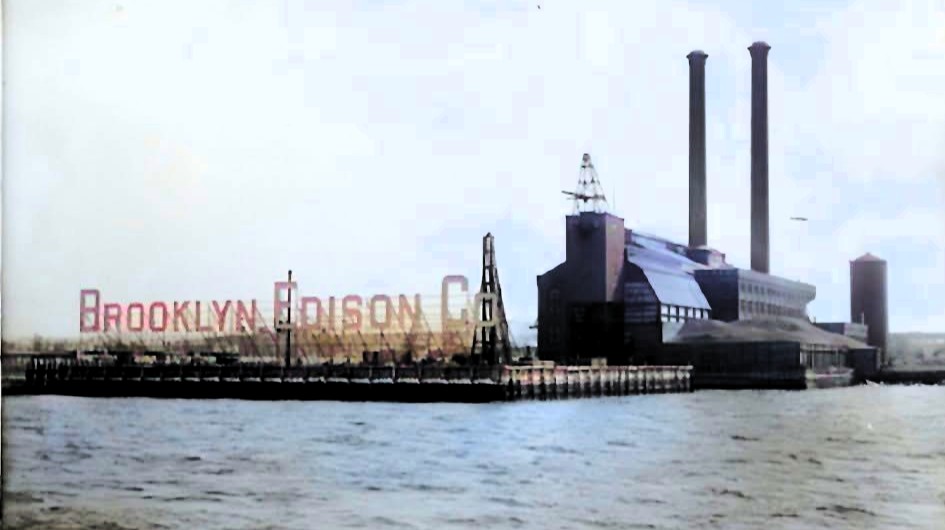
Utility companies acting like gangsters, preying on a captive market, pocketing every manner of public payout, all while charging too much for crap service, is as old as the first utility company. How Brooklyn Edison, an ancestor of today’s Con Edison, could lay off thousands while still paying record dividends during the Great Depression is investigated below.
‘Brooklyn Edison’ by Jerome Count from Labor Age. Vol. 21 No. 11. November, 1932.
A Study in Wages, Profits and the Consumer
THE shocking news of October, 1932, that the Brooklyn Edison Company had discharged 2800 employees, was followed in November by a reassurance to the financial world that dividend payments would be made at the same exorbitant 8 per cent rate that has prevailed for 30 years.
Official reports, published in the New York Times of November 2, 1932, disclose that Brooklyn Edison business for the last twelve months had actually exceeded that of the previous twelve-month period. Net earnings and income for the last three-month period had increased over the same period of 1931. Dividends for 1932 will reach $10,000,000—a new “high” for Brooklyn Edison, $1,200,000 more than was paid in 1931 and $2,800,000 more than was paid for dividends in 1928, 1929 and 1930.
The October lay-off tragedy and the November profit news presented a glaring contrast that invites investigation of the Brooklyn Edison dividend structure.
Brooklyn Edison began paying 8 per cent dividends 30 years ago and has had a consistent record ever since. Wage earners struggle with poverty, millions of unemployed face starvation, vast industries suffer deficits, railroads suspend dividends, private corporations pay dividends out of rapidly dwindling surpluses, but Brooklyn Edison stockholders are exempt from economic calamity. Eight per cent is Brooklyn Edison’s “iron law of dividends!”
Taxation Without Representation
Every one of Brooklyn Edison’s 829,000 meters represents an average “dividend tax” of $10 a year. More than 2,000,000 citizens in the princely domain of Brooklyn Edison pay $4.00 per head for Edison dividends. “Taxation without representation” is no idle phrase here. An average family of four persons now pays $16 each year for Edison dividends—equal to the present income tax of the United States Government on the same family having an income of at least $3,700 per annum. There are dividends of 20 cents in every dollar spent for electricity by the people of Brooklyn. Forty million dollars has been contributed by Brooklyn consumers for Edison dividends in the past five years alone, of which 55 per cent was paid in two-and-a-half years of the most stringent economic distress throughout the nation.
Profits available for Brooklyn Edison dividends, during the depression, have equalled 25 per cent of the gross sales. Thirteen million four hundred thousand dollars was available for dividends in 1931 out of gross sales of $48,000,000. Again in 1930, $13,700,000 was available for dividends out of $46,000,000 in sales. It is a curious and tragic phenomenon that Brooklyn Edison can maintain peak profits when the world is in the depths of economic chaos. Reasons can be found in unscrupulous rates and a vicious labor policy.
Beginning in 1921 Brooklyn Edison stock was increased from $19,000,000 capitalization to $125,000,000 ten years later. Dividends, therefore, are now paid at the same 8 per cent rate on six hundred per cent more stock than ten years ago. Electric consumption, however, only increased 10 to 15 per cent every year. It is apparent that this private monopoly operates under a system that requires a 60 per cent annual increase in dividends in order to supply 10 or 15 per cent more electricity per year. Whether this disparity can be put down to incompetent management, the inherent injustice of the system that sanctions it, or the deliberate schemes of dividend-hungry stockholders, makes scant difference to the consumer. He pays the dividends with a well-founded suspicion that all three causes contribute their burden to his monthly electric bill.
250 Per Cent Surplus in 5 Years
While paying exorbitant dividends for three decades, Brooklyn Edison has not neglected its future. Twenty million dollars in accumulated reserves are stored up, lest the next thirty years fail to measure up to the past! 1931 added $4,000,000 to the total Brooklyn Edison surplus of $30,500,000. The surplus was increased 250 per cent in the past five years alone.
The consumer has little recourse against this staggering load. The regulation of public utilities has proved a consummate failure. The files of the Public Service Commission overflow with Edison scandal sufficient to convict the Commission of gross neglect in permitting rates to remain at their present level.
A decade ago, public clamour brought the issue to the Public Service Commission. Mayor John F. Hylan petitioned the Commission in 1923, charging that Edison rates were excessive, exorbitant and unlawful. Hearings continue for six long years and the case was finally closed. The public waited, the petitioner became ex-Mayor Hylan, administration after administration passed through City Hall. Hundreds of thousands of dollars had been spent in the proceeding. But the public waited in vain for a decision of the Public Service Commission.
Finally, in the following year, while still awaiting the Commission’s momentous decision after seven years of consideration, the public was startled by an offer of $6,000,000 in reduced rates, volunteered by Mr. Sloan, President of the Edison system. But for the small needy consumer, there was to be no relief. In fact the proposed reduction was expressly conditioned upon an increase in the rates of the small consumer. Hearings were had anew, in which the Public Service Commission refused to receive any testimony showing that the Edison system carried $100,000,000 in fictitious capitalization—that would involve an expensive rate proceeding, said the Commission with seven years’ consideration behind it. And with a fanfare of legal sanctity and the approving stamp of “Utility Regulation,” the small consumer, being more than 50 per cent of all consumers, found his electric bill substantially increased.
The Public Service Commission has been literally besieged with public complaints against excessive electric rates, and it is now proposed by the Greater New York Consumers’ League to join all complaints in one final assault on the Edison system. Fifteen years of struggle has failed to move this gigantic monopoly in the direction of reasonable rates.
How Do Edison Workers Share?
The consumer shares this oppressive load with Edison employees. While dividends have been secure and excessive for thirty years, Brooklyn Edison workers have labored under the threat of insecurity and the curse of underpayment. Although total dividend payments increased at the rate of 60 per cent each year since 1921, the average wage remained constant and the total wages paid (by reason of increase in force but not in the average wage) increased only 15 per cent annually up to the end of 1930. Brooklyn Edison stockholders reaped the benefits of a decade’s increase in industry at a ratio of four parts to every one apportioned to its employees.
Came the depression and 1931. Brooklyn Edison dividends increased from $7,200,000 to $8,800,000 but wages decreased by $1,126,000, With the year 1932, dividends again increased, this time from $8,800,000 to $10,000,000. It is estimated that wages decreased by $4,575,000 under the 1930 level. An analysis of the average stockholder’s booty and the wages of the average worker in a typical year (1926) before the Consolidated Gas Co. assumed control of Brooklyn Edison, brings the relation of profits to wages into sharp relief. Eight thousand six hundred and sixty-six employees devoting their entire year’s labor to the production and distribution of electricity to more than 2,000,000 people, received an average wage of $1,500 per annum. Five hundred dollars (or one-third of the average wage) was paid to 11,343 average stockholders enjoying the privileges of absentee ownership. Total dividends paid were equal to 48 per cent of the total amount paid to wage earners. The elimination of dividends would raise a miserable wage level (less than $30 a week in the boom year 1926) to $2,000 per year.
Many men sacrificed Union wages in boom years in exchange for meagre Edison wages and for the hope of security when Union men might suffer the sins of depression. Thirteen thousand nine hundred and forty eight Brooklyn Edison workers believed in that salvation in the beginning of 1931. Five thousand of them have been completely disillusioned. Two thousand of them have been out of Brooklyn Edison employ for two years and 3,000 more learned their lesson in 1932. It is estimated that these 5,000 men could have remained in the employ of the Brooklyn Edison Company at a wage cost of $6,000,000. During the same period while this cost would have been borne, Brooklyn Edison Company had $25,000,000 available for dividends ($18,800,000 actually paid) and $22,000,000 in accumulated reserves.
The Pious Mr. Parker
“Alas,” says pious Mr. Parker, President of Brooklyn Edison, “Alas, but construction work on which these men were engaged has been completed, and when a house is built, it can’t be built again.” “But, Mr. Parker,” the Public Committee on Power Utilities and Labor, answers, “what about the 36,500,000 feet of overhead wire which the Legislature found to be a public menace forty years ago? And why not complete the change-over from ‘D.C.’ to ‘A.C.’ current, Mr. Parker?” “Oh,” answers Mr. Parker, “we are way ahead of schedule.” “Need you be told,” suggests the Committee, “as Chairman of Brooklyn’s Emergency Relief Drive, that 5,000 of your men and their families are ‘ahead of schedule’ in distress and starvations?”
A Committee of Citizens, who recently visited Mr. Parker to obtain his assurances of continued work for Brooklyn Edison employees, was greeted with an air of sanctimonious respect for the rights of labor. Mr. Parker impressed his callers with his pious reverence for nothing less than “home, school and society.” He declared it his sacred responsibility to keep Edison men employed. He insisted that the common dictates of conscience demanded this of him. Soon after, he discharged 2,800 men while 36,500,000 feet of wire remain overhead, and a regular quarterly dividend of $2,500,000 was promptly declared. Mr. Parker, no doubt, was motivated by the same pious sentiment when he accepted the Chairmanship of the Emergency Relief Drive. “Stripping Peter after robbing Paul” is an axiom of Parker ethics.
The Brooklyn Edison Company has resisted every effort of the Brotherhood of Edison Employees to organize its workers. In the reign of Matthew Sloan, these efforts met with organized violence, suppression and the insidious threat of espionage. Although the Brooklyn Edison Company denied all connection with these violent assaults, they ceased immediately upon the resignation of Matthew S. Sloan.
With the ascent of Mr. Parker, open violence disappeared, until November 2, 1932, when a dozen persons peacefully picketing Edison offices, were forcibly dispersed by 100 policemen including a riot squad with rifles in hand, a dozen mounted police, and assorted police inspectors and lieutenants. The threat of discharge for membership in the Brotherhood of Edison Employees has not been removed by Mr. Parker.
The pressing need of organized protection of Edison employees is strikingly emphasized by recent events in Brooklyn Edison finance. Consumption increases, excessive rates and maximum dividend booty continue, capitalization: increases, reserves and surplus pile up—but employment is cut 40 per cent!
Labor Age was a left-labor monthly magazine with origins in Socialist Review, journal of the Intercollegiate Socialist Society. Published by the Labor Publication Society from 1921-1933 aligned with the League for Industrial Democracy of left-wing trade unionists across industries. During 1929-33 the magazine was affiliated with the Conference for Progressive Labor Action (CPLA) led by A. J. Muste. James Maurer, Harry W. Laidler, and Louis Budenz were also writers. The orientation of the magazine was industrial unionism, planning, nationalization, and was illustrated with photos and cartoons. With its stress on worker education, social unionism and rank and file activism, it is one of the essential journals of the radical US labor socialist movement of its time.
PDF of full issue: https://www.marxists.org/history/usa/pubs/laborage/v21n11-nov-1932-labor-age.pdf

