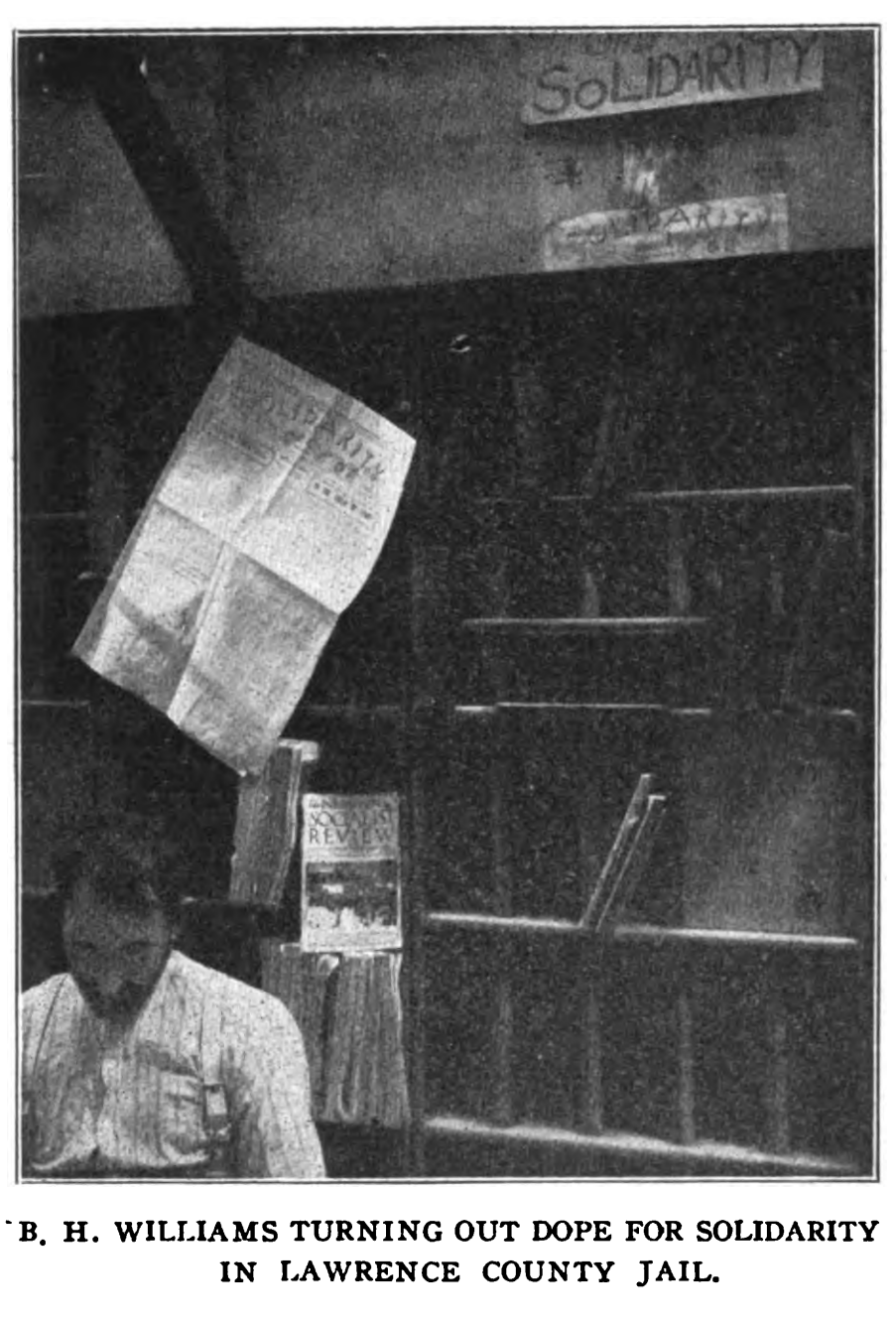
A major speech from a central figure of the I.W.W. gives insights into the development of a whole layer of activists’ thinking. A veteran member of the S.L.P. who became a leading member of the I.W.W., editing its newspapers for years and serving on its General Executive Board, B.H. Williams illuminates the trajectory of a generation of militants like himself as they parted ways with the S.L.P. and S.P. to focus energies on the building of the Industrial Workers of the World.
‘Industrial Unionism and Politics’ by B.H. Williams from Industrial Union Bulletin. Vol. 2 No. 3 March 14, 1908.
Address Delivered Before the Socialist Labor Party, at McMahon’s Hall, New York City, March 2, 1908
Comrades and Fellow Workers:
In speaking tonight under the auspices of the Socialist Labor party I shall assume that I am addressing men and women who have been connected for some years with the labor movement in America. Many of those present here have been in that movement either as students or as active workers, or as both, much longer than I have. While I was reading “The People” and studying the literature of the S.L.P. in a rural community of the middle west, many of you were wrestling with the practical problems of the movement here in New York. Nevertheless, I shall presume to address you tonight upon certain aspects of the labor movement which I find are none too clearly grasped by many S.L.P. men.
I remember in 1898, when I first became a regular reader of “The People,” it was some months before I at all grasped the significance of what at first seemed to me a dual organization dividing the energies of the Socialist movement, viz., the Socialist Trade and Labor Alliance. But long before the split of ’99 in the S.L.P. I perceived the necessity of the economic organization; and though due to my surroundings, perhaps, I sometimes had doubts, the conception never left me, and became stronger from the moment I became an active worker in the movement.
Again, when the I.W.W. was formed and about the same time I went on the road as an organizer for the S.L.P., I right away perceived that the emphasis in our agitation should be placed in a different direction than formerly. I saw that the rank and file of the workers who appeared at our street and hall meetings did not seem to be greatly interested in our presentation of the difference between the two Socialist parties in the usual way, which with most S.L.P. speakers, besides including a destructive argument against craft unionism, consisted mainly of a recitation of specific acts of political compromise by the Socialist party, beginning the “armory usually with Carey, builder” and including among others the quadruple candidacy of Morris Eichmann, of West Hoboken, N.J. In other words, to be plain, I concluded the workers wanted to know how they might become united to overthrow the capitalist system. Hence the line of agitation I adopted was to emphasize the constructive program of the I.W.W., to contrast the form of Industrial Unionism with that of craft unionism, and as much as possible draw the workers attention away from the pure and simple political notion of merely voting (as they thought) for the Co-operative Commonwealth. And as I proceeded along this line and gained more experience and a wider outlook, I saw that just in proportion as we kept I.W.W. agitation free from the entanglements of the bitter fights between the two Socialist parties–in other words, just in proportion as we adhered strictly to the non-affiliation clause in the preamble, just in that proportion did we gain a hearing and response from the workers. But the wisdom of the non-affiliation clause of the I.W.W. preamble has since dawned upon me to a fuller extent. While in southern California two years ago my attention was called to an incident connected with a lecture by a Socialist party speaker named Lewis. In referring to the idea that the political movement of labor is the reflex or shadow of the economic movement, Lewis asked the question of his audience, “If that is so, then I want to ask, is the Socialist party the political shadow of the I.W.W.?” The response from the S.L.P. men present was a thundering unanimous “No.” “Well,” said Lewis, “is the Socialist Labor party the political shadow of the I.W.W.?” The S.L.P. men inadvertently answered “Yes.” “How can that be?” asked the speaker. “How can a body cast a shadow before the body itself exists?” The answer never came. A comrade who reported the incident to me said the S.L.P. men were tricked, and he added that the answer should have been, “No, the S.L.P. is not the political reflex of the I.W.W., but we hope it may become such in time.” And so many of us thought, and we repeated the phrase. “The political must justify itself to the economic,” while really we were trying to mold the economic to the political–to cast the I.W.W. in the mold of the S.L.P. That practice still obtains to a great extent among S.L.P. men. They still couple the I.W.W. and the S.L.P. together in their propaganda. They still hug the delusion to their breasts that the S.L.P. may some time be recognized by the I.W.W. as the latter’s political reflex. But the hope, I say, is vain, and for this reason”: “Only the trade union can set on foot the true political party of the working class.”
This declaration of Marx’ I shall modify to read:
“Only the economic organization of the working class can set on foot the true political reflex of working class interests.”
I hope you will bear in mind the modification, as it will appear important before I get through with my argument. Let us first of all take a rapid glance at the structure of that working class economic organization that is to reflect the true political movement of labor. The structure of the industrial union conforms closely to the organized form of modern capitalist industry. Modern capitalist industry is more and more grouping the workers into co-operative entities on the basis of industries, in which the old-time crafts, besides having been modified by the introduction and perfection of machinery, have at the same time become parts of a greater whole–links in the chain of single industries, which in turn have become larger links in the chain that binds together the entire industrial system. An illustration will help to make my meaning clear:
Take the trade of carpenter for example: Formerly a carpenter was an all-around builder who could complete a wooden structure from the foundation to the chimney, inside and outside. Today on a modern building the carpenter is a specialist. He has become a framer, a floor maker, a finisher, or something else. Besides having become specialized, the carpenter’s trade has also ceased to be independent, and has become merely a link in the chain of other trades that bind together all the various workers in the building industry. Carpenters, stone masons, bricklayers, plasterers, lathers, plumbers, electricians, structural iron workers, concrete workers, and others, all co-operate in the production of buildings, and oftentimes in the production of a single building, industrial unionism organizes these different trade or craft divisions of the building industry as branches of one industrial union. On the mathematical axiom that the whole is greater than any of its parts, the branches are subordinate to the industrial union–the whole, of which they are parts. Through the functioning of the industrial union, the bricklayer, for example, supports the carpenter, or the plumber, or whatever craft is directly affected by an industrial disturbance, and in turn the bricklayer is supported in his struggles by each and by all of the divisions of the building industry. Unity of action of all the workers in the industry results necessarily from the functioning of the industrial union.
Thus, in a given locality all the workers of the building industry form a local industrial union of building workers. These in turn are united with the workers in all other industries of the same locality through the industrial district council, made up of delegates from all the various local industrial unions. By the functioning of the industrial district council the workers of the entire locality are bound together for united action against their employers.
On the national field again, the next link in the chain of industrial solidarity is the National Industrial Union, which unites all local unions of a given industry into one national body. For example, in the textile industry all local industrial unions of weavers—whether locals of silk, cotton, wool or linen weavers–form a National Industrial Union of weavers, embracing in its plan of organization all the weavers of the nation. The local unions are, of course, subordinate to the National Industrial Union. The functioning of the National Industrial Union means national unity of action on the industrial field of all workers in a given industry.
Again, on a larger scale, two or more National Industrial Unions–e.g., the National Industrial Union of Weavers and the closely allied National Industrial Union of Clothing Workers–form a department, in this case the Department of the Textile Industries. The functioning of the department means the broader national unity of allied groups of industries.
Finally, the General Administration, functioning through the General Executive Board, the General Convention and the General Referendum, binds all the subordinate parts together, and completes the links in the chain of industrial solidarity. That is a national division of the industrial union movement. Each national division in turn forms a link in the chain of the New International, that is to unite the workers of the world for their emancipation.
This, briefly speaking, is the plan of organization as comprehended by the I.W.W. up to the present time. I have simply presented it to you in skeleton form without unnecessary details. You may realize, even from my imperfect presentation, what the carrying out of the I.W.W. plan would mean to the working class. You may realize that such an organization in its development will afford a powerful means of aggression and defense against the employing class, and in its perfected form such an organization means the overthrow of capitalism and the inauguration of a new state of society–an Industrial Democracy, in which there shall be no longer employer and employe, but workers only, and in which each worker shall have a share in the ownership and a voice in the control of industry.
Meanwhile the economic organization of the working class–the I.W.W.–is in process of formation only, and on account of that fact the era of the theorists is not yet past. And among the theoretical problems that have raged most fiercely in I.W.W. councils the past three years, none has received more attention than the probable relation of the economic movement to the political movement of labor. I shall not presume to settle the question here tonight, but to give my opinion only.
Coming back to the quotation from Marx, which I modified to read, “Only the Economic Organization of the Working Class can set on foot the true Political Reflex of Working Class Interests,” we must admit if we accept this declaration that the true political movement has not yet evolved. The economic organization has not yet set it on foot. But a great many of you may dispute the declaration of Marx as modified by me. I have heard is disputed from the S.L.P. platform here in New York within the past two weeks. Some of you may hold that no political movement is possible–that unity on the industrial field includes everything. Others may insist that political unity is summed up in a so-called political party, separate and distinct from the industrial or economic organization. My position is this: The working class movement includes political action, and that political action is an inevitable consequence of the functioning of industrial unionism.
Let us see how it is today with capitalist politics: Capitalist society is organized on the basis of territorial and property relations. The more significant side of capitalist society is the side of property relations. Territorial relations cut some figure, but their influence becomes less and less as capitalism develops. The fact that the Morgans, Rockefellers, Goulds and a few thousand others who compose the capitalist class hold in possession the bulk of the nation’s property in the form of land and tools of production, gives them control of the economic power of the nation. But the capitalist class, like all ruling classes, is a decided minority of the people. Hence the necessity on the part of the capitalist class to make use of a complicated machinery of repressive government with police powers, to hold in subjection the working class, and to protect the capitalist’s economic power, which resides in his ownership of the land and means of production. But the capitalist class cannot manufacture political machinery out of whole cloth. The ruling class finds itself up against certain political forms and institutions that have come down from the past. America has passed through several varying stages of economic development, from the era of equal opportunities with its small hand tools, through middle class supremacy, to the present reign of the ultra-capitalists in trustified industry. Political and other institutions of each period have left their impress more or less upon those of the succeeding period. “The load of tradition,” to quote Marx, “weighs like an alp upon the brain of the living.” Hence the capitalist is compelled to modify and adapt to his purposes the political, judicial and other institutions that have come down from the past. This task is extremely difficult, and becomes more difficult as the middle class decays and as the distance becomes greater between the workers and their employers. Threatened with reaction on the one hand and with revolution on the other, the ruling class realizes the tremendous importance of political action and the tremendous significance of certain political institutions to protect its economic power. A “subsidized” press, a “venal” pulpit, a subservient public school system, a repressive government with legislative, judicial and executive functions, an antiquated form of craft unionism controlled by leaders who hobnob with capitalists in the Civic Federation–these are parts of that complicated political machinery which the employing class has adapted to its own purposes and which it uses with great efficiency to maintain its hold upon the economic power.
But let us draw no hasty conclusions: The capitalist class does not hold the working class in subjection through political action alone. Rather does the capitalist class control the working class and its own political institutions by and through the capitalists’ economic organization. Whether or not we believe “the king can do no wrong,” the king is not Teddy the “Trust Buster,” but rather the heads of those very trusts which Teddy professes a desire to curb or break up. A small coterie of financiers in Wall Street pull the political wires at their command, and the middle class and working class of the nation vote at their dictation, while the “radical” jumping-jack at Washington tumbles off his pedestal into the ash barrel of the “has beens.” Capitalist political action is a reflex of capitalist economic organization. And just as the capitalist class controls and directs its political reflex through its economic organization, so must the working class, while seeking to gain economic power through Industrial Unionism, control and direct the working class political action through industrial unionism. But let me remind you of certain differences between the two, together with certain eliminations from working class political action that are indispensable in the political action of the capitalist class.
As said before, the ruling class is a minority class. Its economic supremacy depends upon its subjugation of the majority. To that end the capitalist class has need of the complex machinery of repressive government, which the capitalist must control in his own interests. On the other hand, the working class is a majority class. It does not seek to subjugate the capitalist class, but to abolish it. Accordingly, the working class could not use the present governmental machinery if it got possession of it. For the emancipation of the working class, a properly constructed in disciplined economic organization aiming at Industrial Democracy is indispensable.
Again, the working class has no property–“It has nothing to lose but its chains.” Nevertheless, just because the working class has nothing but its labor power–just because the capitalist, through his control of the means of life, may starve or intimidate the workers into submission–on that account we find the unorganized and disorganized working class displaying a lamentable lack of revolutionary backbone. Nothing but the discipline of Industrial Unionism can supply that revolutionary stamina to the workers. Merely going behind a curtain and expressing a wish on a piece of paper, while trusting to politicians or “intellectuals” to carry out the wish, could result in anything but disaster if successful on a national scale.” Again, the want of property among the workers–their precarious economic position–makes them a prey to the allurements of reforms, of so-called “immediate demands” in political party platforms. The I.W.W. makes clear to the workers that an immediate improvement of their condition is possible only through Industrial Unionism. Thus the I.W.W. saves the working class from the pitfalls of reactionary reform movements and from the allurements of capitalist political issues.
Again, in the legislative, judicial and executive councils of the political state the capitalist has need of an army of lawyers, professional politicians and others to make, interpret and execute capitalist laws against the working class. On the other hand, the legislative, executive and judicial functions of the working class movement are embodied in the administrative functions of the economic organization–the Industrial Union. The laws relating to labor’s interests must be made in the shops through the industrial organizations. Such laws will refer to wage schedules, understandings with the employers regarding hours of labor, protection of machinery, etc. Only actual wage workers may make and administer such laws, and “only actual wage workers may be members of the I.W.W.” Hence, the local, national and international administrations of the I.W.W. will be free from the machinations of lawyers, politicians and scheming “intellectuals” with bourgeois instincts. The “horny-handed son of toil” will learn to rely upon himself and look to members of his own class to lead and direct his own movement. “The emancipation of the working class must be the class-conscious act of the working class itself.” To that end the I.W.W. will develop the methods and the men.
In what, then, will consist the specific political action of the labor movement? I have mentioned a political institution, the capitalist press. It is obvious that we, too, must have a press; and we have already made a start in that direction. But it must be equally obvious from my previous argument that the press of the labor movement must be under the control of the economic organization. A full realization of that S.L.P. ideal of a party press–“owned by workingmen, edited by workingmen and supported by workingmen”–will be possible only when the I.W.W. has established its own press on a scale befitting the economic movement.
I have mentioned the pulpit. We perhaps shall not need that, and may substitute therefor the lecture platform or the lecture bureau. The tremendous possibilities of the lecture platform for promoting the education of the working class, for recruiting industrial unionists, and even for disarming the opposition of the middle and professional classes, need not be dwelt upon by me. Here again it must be obvious that this political institution–the lecture bureau–must be guarded and controlled through the economic organization which reflects it. I need not add that workingmen for the most part will occupy the platform for the I.W.W.
I have mentioned the public school, which today is supported by and controlled in the interests of the capitalist. I shall not say we contemplate setting up such an institution as the one we have today. That institution–the public school–will doubtless be carried over into the Co-operative Commonwealth and be readapted to the purposes of the new state of society. Nevertheless, we do contemplate reaching and educating the child of the worker; and to this end the I.W.W. will set up and control the necessary political institution or institutions. Here, I think, some of the significance of the working woman’s movement will be apparent.
I have mentioned the government proper, and here we have arrived at what is ordinarily regarded as political action. Will the I.W.W. set up a political party in the ordinary sense, and contest with the capitalist the seats of government–legislative, executive and judicial? I think not. But if so, I only to a limited extent, as exceptional opportunities or situations present themselves. The I.W.W. may, from time to time, seize hold of a municipal government here and there, for the purpose of protecting its economic organization. But in the matter of influencing the actions of the capitalist committee known as the government, I am inclined to think that the political influence of the I.W.W. will be indirect rather than direct, and none the less powerful because indirect. Today we have judges’ injunctions against workingmen on strike. Today we have judges’ decisions against so-called labor laws, as for instance the recent U.S. Supreme Court decision declaring an Employer’s Liability Law unconstitutional. Today we have court decisions legalizing the kidnaping of labor leaders, as in the celebrated case of Moyer, Haywood and Pettibone, the kidnaped officials of the Western Federation of Miners. Today we see workingmen railroaded to prison after farcical trials, as were Preston and Smith at Goldfield, Nev. Today we see the militia and the federal troops called out with increasing frequency to break strikes. Nothing but a powerful I.W.W., functioning on a national scale and reflecting itself on the political field through its press and system of agitation, can hold in check the capitalists’ committee of repression known as the government. In proportion as the political and economic power of the working class increases through the I.W.W., the political as well as the economic power of the capitalist class wanes–until finally the government of future society, Industrial Democracy, replaces the present political autocracy, the government of capitalism. That is the significance of a “peaceful solution of the labor question.” For the I.W.W. to set up a political party in the ordinary sense would mean confusion and retardation for the movement, to say nothing of the corruption that must surely follow the advent of the adventurous labor politician.
From the foregoing it may now perhaps be clear to you what I mean by the declaration, “Only the economic organization of the working class can set on foot the true political reflex of working class interests.” Also it may be clear to you that the seeming contradiction in the I.W.W. preamble which declares for working class unity on the political field, and at the same time declares against affiliation with any political party, is really no contradiction. However, I wish to add that the non-affiliation clause in the preamble in time may become unnecessary and may be dropped. At present it acts as a buttress against attempted control of the I.W.W. by either of the two Socialist parties. But anyway, as the I.W.W. develops, its political reflex must at the same time develop. Political unity and industrial unity are simultaneous processes. Both the economic organization and its political reflex act together and continuously as powerful levers to recruit, discipline and advance the forces of labor toward labor’s emancipation. With the completion of the work of both the I.W.W. and its political reflex, the age-long struggle of classes will have ceased. An Industrial Democracy will have taken the place of the present society based upon class rule, and for the first time in the history of civilization we shall have a government of, by and for the people.
So much for the purely theoretical side of working class political action, as it appears to me at present. Perhaps I should stop at this point, inadequate as my presentation of the subject has been. But I consider it my duty, while speaking to members of the S.L.P., to add a few suggestions as to the attitude of the two propaganda organizations called the Socialist parties in the present situation in the American labor movement. I realize the difficulty that faces men who have been thinking and fighting along certain lines for years; who have been holding fast to certain principles and tactics which they have regarded as fundamental, and in the practical application of which they have acquired a certain well-defined attitude of mind–I realize the difficulty that confronts such men when called upon to adjust themselves to new occasions and to new duties. I well remember how many of us looked askance at the new Industrial Union movement following the manifesto of January, 1905. I also remember, when I arrived in San Fran- cisco in the fall of the same year, a lady comrade remarked to me that she did not like to see S.L.P. organizers coming around “and doing most of their talking for the I.W.W.,” and she added, in a half-jocular, half-serious manner, that “this I.W.W. will kill the S.L.P. anyway, if we don’t look out.” It never occurred to the comrade in question that the S.L.P. influence in certain directions might operate to the detriment of the I.W.W. With the comrade in question the S.L.P. was of supreme consideration; the I.W.W. was of secondary importance. That attitude of mind was natural at the time and in the circumstances. I remember again, a year later, I received a letter from a comrade and member of the S.L.P., who among other things deplored the fact that “this big baby of ours” (meaning the I.W.W.) “did not seem inclined to recognize its parent” (viz., the S.L.P.). That attitude of mind of regarding the I.W.W. as mainly a product of S.L.P. teaching and experience, and therefore requiring to be under the especial tutelage and supervision of the S.L.P., was a very common attitude of mind two years ago, and is by no means uncommon today among the S.L.P. membership. The thought that S.L.P. men might “learn a new language,” as Marx expresses it, and having acquired the new tongue, “learn to move in it without recollection of the old,” and not keep “translating the new language back into the mother tongue,” that thought seems hard to grasp by many even who have been most active in the past and who have contributed much to the growth of revolutionary thought in America. And I.W.W. back into terms of the S.L.P. and thereby, though doubtless without intention, you inject confusion into the minds of the workers. A recent experience will illustrate the point further. At an I.W.W. mass meeting in Brooklyn several weeks ago, after I had spoken for an hour, and in my own way had explained as best I could the fundamental principles and aims of the industrial movement, without referring to any political party, a comrade of the S.L.P. took the floor and reminded the audience that there were two Socialist political parties in the field, and that especially they (the workers present) must not forget the S.L.P. and its literature, etc. I felt it my duty in the circumstances to take the comrade to task for injecting confusing elements into an I.W.W. discussion. I insisted that we were there to teach Industrial Unionism and to recruit members for the I.W.W. exclusively; that there were wage workers present who possibly didn’t care a fig whether there was an S.L.P. in existence or not; and that while we would not attempt to dictate to the Socialist parties what they should say or do at their meetings, the I.W.W. would insist upon controlling itself and its own meetings without dictation or interference from outside organizations or individuals.
And so, with all due regard for past services, we say to all those who cannot adjust themselves to the I.W.W. position, “Hands off!” whether such individuals belong to one or the other of the two Socialist parties. To the parties as a whole, we have already said the same thing in our non-affiliation clause.
Finally, comrades, I am aware that history shows us that men and movements, when they have arrived at certain stages in their development (usually at the later stages), maneuvre themselves oftentimes into false or reactionary postures, because they fail to adjust themselves to new conditions or fail to recognize the fruition of their labors in new forms. In the history of the anti-slavery movement in America we have an instance. At the opening of the Civil War we saw many of the old-time abolitionists, after having fought for thirty years on the principle of “no compromise.” and after having suffered internal disruptions and endured outside persecutions without “retreating a single inch”–we saw many of these abolitionists, when face to face with the fruition of their labors, opposing the war and the political organization in the north that was prosecuting it. Those sturdy anti-slavery men could not understand that the conflict between the states was the only means of realizing their ideal–the abolition of slavery.
I trust we may not have a parallel case in the American labor movement. And for that reason I have spoken plainly to you tonight. I hope you will take what I have said in the spirit in which it is given, and consider seriously the proposition I have discussed with you: “Only the Economic Organization of the Working Class can set on foot the true Political Reflex of Working Class Interests.”
Govern your conduct according to that understanding, and it need not be long until the working class shall have come together upon the political as well as upon the industrial field, to end forever the age-long nightmare of class rule.
The Industrial Union Bulletin, and the Industrial Worker were newspapers published by the Industrial Workers of the World (IWW) from 1907 until 1913. First printed in Joliet, Illinois, IUB incorporated The Voice of Labor, the newspaper of the American Labor Union which had joined the IWW, and another IWW affiliate, International Metal Worker.The Trautmann-DeLeon faction issued its weekly from March 1907. Soon after, De Leon would be expelled and Trautmann would continue IUB until March 1909. It was edited by A. S. Edwards. 1909, production moved to Spokane, Washington and became The Industrial Worker, “the voice of revolutionary industrial unionism.”
PDF of full issue: https://www.marxists.org/history/usa/pubs/industrialworker/iub/v2n03-mar-14-1908-iub.pdf

