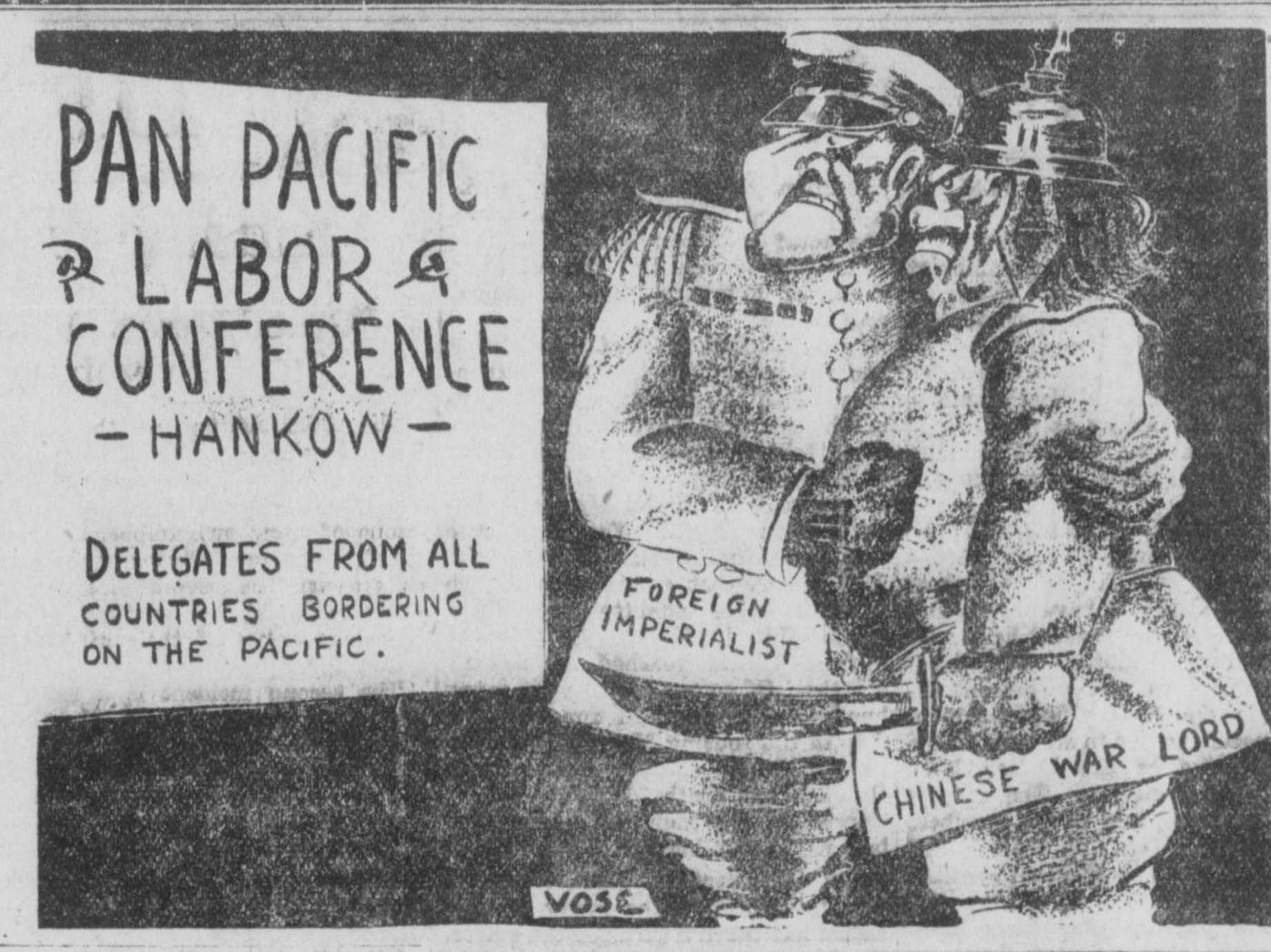
Browder, speaking here as its Secretary, on the second meeting of the Profintern’s Pan-Pacific Trade Union Secretariat held in Shanghai during early February, 1928.
‘Pan-Pacific Secretariat Meets’ by Earl Browder from Labor Unity. Vol. 2 No. 3. April, 1928.
(Executive Secretary Pan-Pacific Trade Union Secretariat. Editor Pan-Pacific Worker, former Editor “Labor Unity”)
CONSIDERING the difficult period, and the special obstacles existing in China at the moment, it must be registered as an achievement in itself that a meeting of the Pan-Pacific Trade Union Secretariat could be held February 3 to 6, in Shanghai. Furthermore, the meeting marked an extension of the scope of the P.P.T.U.S., as shown in the presence of the representatives of the Australasian Council of Trade Unions (500,000 members), and of the Congreso Obrero de Filipinas (81,000 members). In addition, representation of the Nippon Rodo Kuami Hyogikai and the Toitsu Domei (about 80,000 workers in Japan), the Far Eastern Section of the Russian Trade Unions, the T.U.E.L. of America and the Minority Movement of England, together with the heads of the All-China Labor Federation, made the Secretariat meeting the most representative trade union gathering ever held thus far in the East. It marked another step forward in the creation of an all-inclusive Pacific trade union movement.
Death Everywhere For Labor
Due to the white terror raging in China against the labor movement, it was difficult for the Chinese representatives to meet with the delegates from other countries. In the foreign concessions of Shanghai it is no safer than in the Chinese cities ruled by the counterrevolution, for the foreign police work in the closest co-operation with the militarists, arresting all active workers and turning them over to the native militarists for execution. Notwithstanding this menace to their lives, the Chinese trade unions sent to our sessions Sou Chao-Jen, chairman of the All-China Labor.
Two other reports were noteworthy, as bringing before the P.P.T.U.S. for the first time two important sections of our movement, namely, the report of the Australian and Filipino delegations. Jack Ryan, delegate of the Australasian Council of Trade Unions, made a report on the movement there, speaking directly on behalf of 500,000 organized workers. Hitherto the Australian movement has been rather isolated from the rest of the world; this Secretariat meeting was the first international gathering ever participated in by the Australian labor movement as a whole. The three Filipino delegates, from the Congreso Obrero de Filipinas, were also for the first time, bringing their movement into contact with the international labor movement. Although the Filipino trade unions have a history of 25 years, they are still undeveloped and uncentralized. The Congreso Obrero, the largest central body, is still comparatively quite small and weak, and a large part of its 81,000 affiliated members are only in mutualist associations. The Congreso Obrero showed in its report, however, that it fully realizes its great task of gathering together the Filipino working class for struggle, both for national independence and against the native exploiters.
1929 Conference In Australia
Latin-America and India still remain unrepresented in the P.P.T.U.S. Regarding the former, the meeting noted the projected formation of the Latin-American T.U. Secretariat, similar to the P.P.T.U.S., and which will include some of the countries which should also be members of our body. The P.P.T.U.S. welcomed the Latin American T.U.S. and pledged its co-operation to that body, which in its special field will have tasks similar to those of the P.P.T.U.S.
The meeting, carrying out the decision of the inaugural conference in Hankow last May, decided that a Pan-Pacific T.U. Congress must be called in 1929, deciding upon the month of March. On the motion of the Australian delegate, who reported to the meeting on this question, the Congress was called for Australia (Sydney or Melbourne as decided by the Australian T.U.S.) and items for the agenda of the Congress were invited from all affiliated organizations.
The principal resolution of the meeting was on the reports of the work of the Executive Bureau and reports from the countries. In addition to formulating the main tasks of the present period, the resolution gave concrete guidance on the specific problems of Japan, the Philippine Islands, Australia and China. In working out these resolutions every delegation took active part, and the whole was adopted unanimously.
Due to the extra-ordinary difficulties of the past period, the work of the Secretariat had been confined almost entirely to the publication of the Pan-Pacific Worker, in which was furnished all the available information about the developments in the labor movement in the Pacific. This work must be strengthened and extended. Not the least important resolution adopted was on this point, outlining the practical tasks of the Secretariat during the coming months, and strengthening its organization for these duties.
What must be our judgment on the accomplishments of the P.P.T.U.S. to the present time? First of all, we must say that, compared to the truly gigantic tasks before us, only the smallest beginnings have been made. It would be the greatest mistake to overestimate our own accomplishments, which consist largely in laying the foundation stones for the future work. But neither can we belittle the importance of just such beginnings as we have made; nor the wide fields of accomplishments that open before us, provided we work correctly; nor the fact that, although slowly, we are making steady progress toward gathering our forces together. The foundation and growth of the P.P.T.U.S., with all its weaknesses, still represents the most important positive development in world trade unionism during 1927.
What are the most serious weaknesses within the Pacific trade unions, which the P.P.T.U.S. must combat and help its sections to overcome?
First of all is the organizational vagueness and instability, the lack of centralization and established leadership, in the colonial and semi-colonial lands especially. This weakness is intensified by the White Terror which rages in China, Indonesia, and Korea. Notwithstanding all difficulties, the trade unions in these lands must, with assistance of the P.P.T.U.S., build up a reliable organizational apparatus, fitted for its special tasks and capable of mobilizing and leading the entire working class of each individual country.
Secondly, there is the tendency to provincialism, a lack of understanding of and in the labor movement of other countries, and to judge all questions from the strictly limited outlook of “our own” country. It must be frankly recognized that this weakness is seen more in the industrially-developed countries (Australia, Japan, America) than in the colonial lands, where imperialist pressure has forced the masses to take an interest in th whole world. Especially is this provincialism demonstrated by the complacent acceptance by large sections of the workers of the discriminatory legislation enacted by capitalist governments against the Asiatic masses, with the design of breeding racial antagonisms and preventing labor solidarity being masked by the hypocritical plea of “protection from the competition of cheap labor.” The breaking down of the narrow provincialism, resultant upon lack of international strike-breaking and that of racial prejudice and division which breeds the former. The full realization of international solidarity of labor will be a process of development, but we can make steps in that direction at once.
The largest problems of the Pacific trade union movement remain the same, namely, the struggle against war, and for the liberation of the oppressed peoples. These two struggles which are at the same time much broader than the trade union movement, are nevertheless of basic importance to the growth and development of trade unionism.
It is the fundamental achievement of the P.P.T.U.S. that it has laid down the correct lines on these fundamental questions, and already begun to proceed therefrom to the practical tasks of international review, criticism and guidance in the concrete application in life in the various countries. Without exaggerating our achievements, recognizing all our shortcomings and the large tasks still to be attacked (for example, India is still unconnected with the P.P.T.U.S.), we can now Press forward in our work after the February meeting of the Secretariat, confirmed in our belief in the progress of the Pan-Pacific Trade Union movement as an integral part of the movement for world unity of labor.
Most important of all reports presented to the meeting was that of the Chinese delegates. Since the former meeting of the P.P.T.U.S. in Hankow, in May 1927, the Chinese trade unions have been faced with an entirely changed situation; where formerly they participated in the Nationalist Government (in which Sou Chaojen was Minister of Labor) , they are now executed and exterminated by this same government, and have been driven into an illegal, underground existence. Notwithstanding the loss of more than 70,000 members, executed and imprisoned during 1927 (details are given in the Manifesto of the P.P.T.U.S. summarised in the International Labor Notes Section—Editor Labor Unity) the Chinese labor movement has not ceased struggling for a moment. In the strike movements of Shanghai, Hankow, the North, Canton, culminating in the great effort in the latter city during December to finally overthrow their oppressors, the Chinese trade unions have demonstrated the greatest heroism, fighting ability, and endurance, which has earned the admiration of the entire world. The P.P.T.U.S., as its first act, adopted an Appeal to the workers of the world on behalf of the Chinese workers.
Labor Unity was the monthly journal of the Trade Union Educational League (TUEL), which sought to radically transform existing unions, and from 1929, the Trade Union Unity League which sought to challenge them with new “red unions.” The Leagues were industrial union organizations of the Communist Party of the United States (CPUSA) and the American affiliate to the Red International of Labor Unions. The TUUL was wound up with the Third Period and the beginning of the Popular Front era in 1935.
PDF of full issue: https://www.marxists.org/history/usa/pubs/labor-unity/v2n03-w22-apr-1928-TUUL-labor-unity.pdf
 Revolution's Newsstand