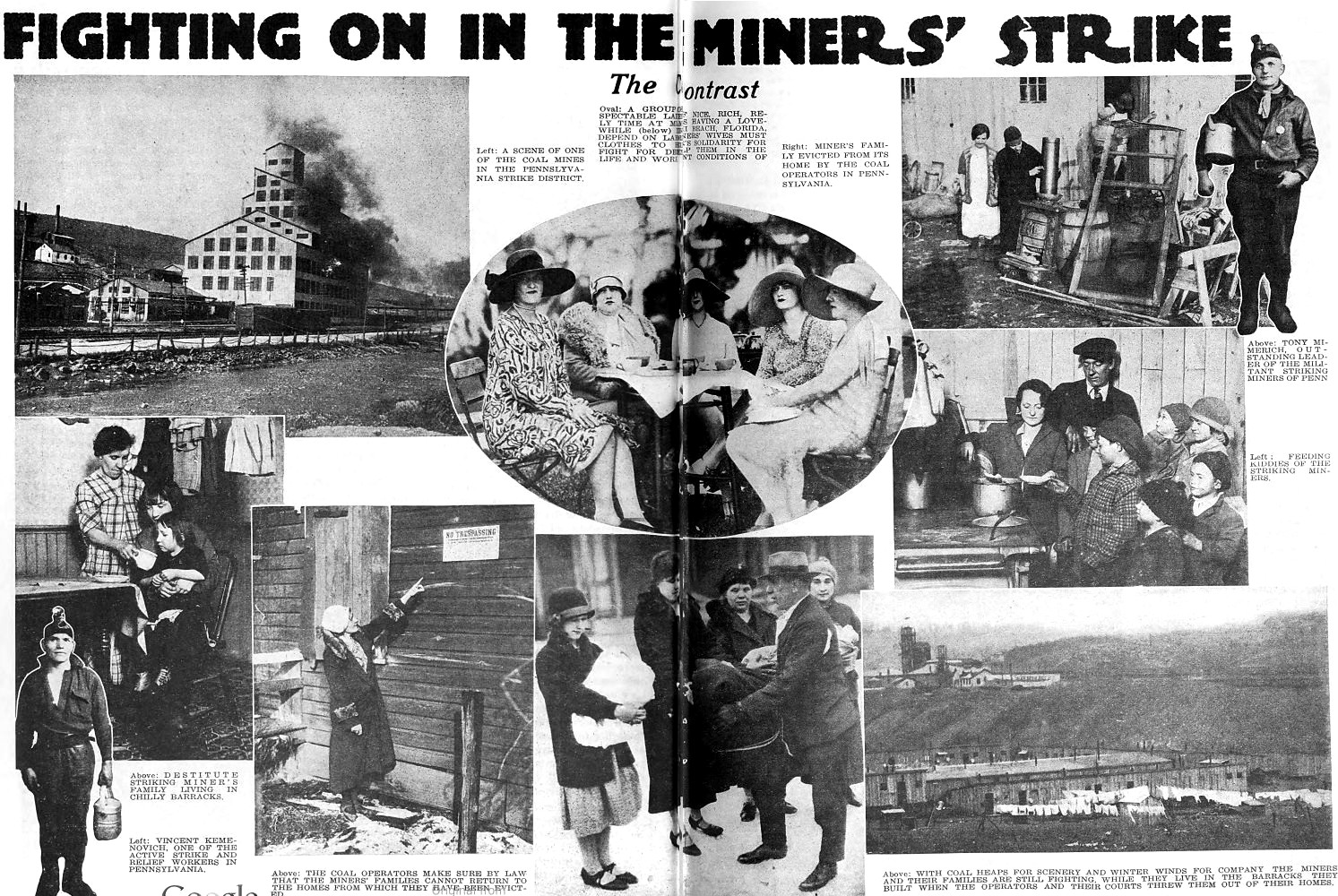
O’Flaherty on the reign of terror against insurgent miners in the Ohio-Pennsylvania bituminous belt as they fought both the bosses and the U.M.W.A. bureaucracy and the role of the I.L.D. in working class defense.
‘Pennsylvania Labor Under the Iron Heel’ by Thomas J. O’Flaherty from Labor Defender. Vol. 3 Nos. 3, 4 & 5. March, April & May, 1928.
In the Shadow of the Cossacks
AS these lines are being written within a stone’s throw of Andrew Mellon’s bank in Pittsburgh, editions of the afternoon papers are on the street with the news that a small army of state troopers has concentrated in the mining town of California, armed to the teeth and supplied with extra rations of food and ammunition for the expected struggle with the union miners who are picketing the scab pit of the Pittsburgh Coal Company, dominated by Andrew Mellon, secretary of the United States treasury.
All signs indicate a new reign of terror against the striking miners of this cossack-ruled state, who are chafing under the policy of inaction laid down for them by reactionary union leaders and are now beginning to realize that mass picketing is one of the most effective weapons at their command to prevent the operators from manning their scab pits with imported strike-breakers.
Thousands of coal and iron police, or “yellow dogs” as they are called by the miners, and state troopers shoot, club and arrest the miners of this state with practical impunity. Pennsylvania is ruled by coal and steel and the millions of industrial workers in this industrial barony are left at the mercy of their masters, and their servants in the Republican and Democratic parties, their only protection being what is left of the trade unions, bruised by the attacks of the capitalists and devitalized by the treachery of reactionary labor leaders.
As the crisis in the miners strike approaches its climax, with a fake senate investigation looming–unwelcome to the operators nevertheless–the coal companies are putting fresh energy behind the attempt to crush the workers’ resistance in the eleventh month of the struggle.
Roaming bands of human vermin combed from the alleys of slumdom are shooting up schoolhouses and barracks under the orders of the coal operators and with the connivance of the coal operators’ governor in the executive mansion at Harrisburg. The union miners are always guilty until they are proven innocent, in the eyes of the state governor and the injunction judiciary. “Civil liberties” is a myth in Pennsylvania. The constitutions of state and nation mean nothing here. The jails yawn before all those who actively engage in the struggle on the side of the striking coal diggers and their destitute families.
With their savings long since vanished, with hunger skulking at their barrack doors, depending to a great degree on the Pennsylvania-Ohio Miners Relief Committee for food and clothing, the militant union coal diggers are looking to the International Labor Defense for protection against the illegal assaults of the state troopers, “yellow dogs” and hired non-commissioned gunmen. Only a powerful mass defense organization, able to rouse the working class of the country and of the world in behalf of the persecuted workers and in a position to engage the best legal talent for their defense in the capitalist courts stands between those shock troops of the labor movement and the unhindered vengeance of the coal barons. How little regard those industrial lords have for the constitutional “rights” of the workers can be adequately proven by the raid on a Cheswick picnic, on August 22, 1927 where between one and two thousand miners with their women and children gathered to protest against the execution of Sacco and Vanzetti.
Here in the heart of the Allegheny Valley, the miners had been on strike since April 1st. They knew that their brothers Sacco and Vanzetti, who were murdered a few hours after the time set for the meeting were victims of the blood lust of the Massachusetts ruling class. According to law the miners had a perfect right to hold a meeting. Furthermore it was held in a private park.
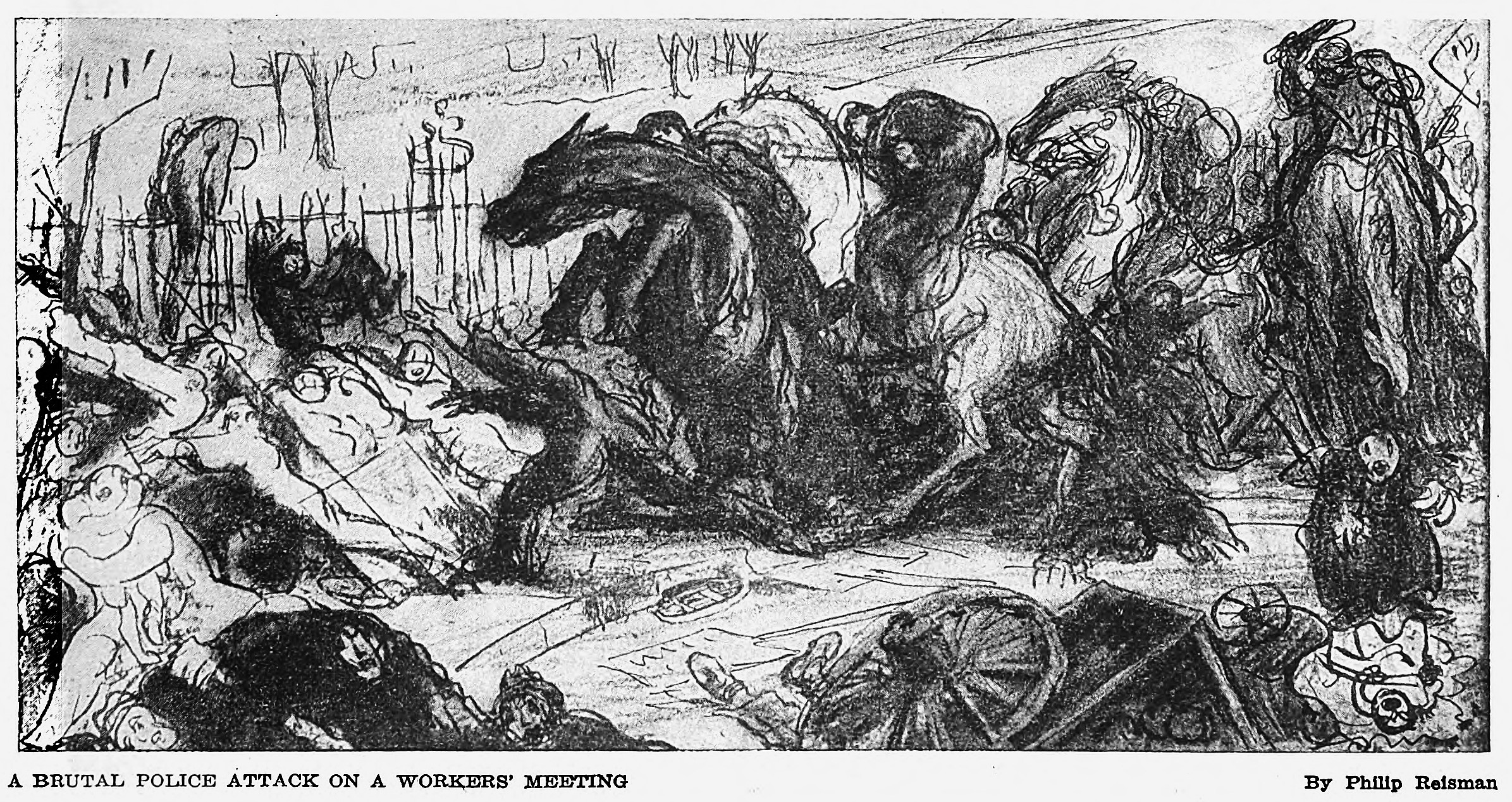
But no sooner had the chairman mounted the platform to call the meeting to order than state troopers on horse, foot, and in machines stormed the peaceful picnic grounds and began throwing tear-gas bombs into the crowds. Women and children went down in the stampede, some trampled under the hoofs of the horses others sinking under the blows of cossack clubs.
Drunk with power and some, it is said, with moonshine, confident that they had the state behind them, the troopers galloped thru the streets of Cheswick, striking at anybody who crossed their path. Men, women and children looked alike to them.
Here is an eyewitness describing what she saw:
“Now, just a couple of minutes after that happened seven state troopers care to my front porch. As they approached I got up off my chair and was about to ask what the trouble was when one of them spoke up and said, “Why don’t you move?” I said ‘Why should I move?’ Then he struck me across the hips with his club.”
The lady thus outraged is over 60 years old and the mother of 15 children.
Another woman about to become a mother was knocked unconscious by a blow from a trooper’s club and is still an invalid as a result of the experience. Space does not permit a complete account of this and other outrages on the workers of Western Pennsylvania which will soon be published in pamphlet form by the International Labor Defense.
What might amaze a reader who lives in a civilized country, should there be any, outside of the Soviet Union, is the fact that the perpetrators of the brutal raid went free whereas twenty-five of the victims were arrested and several of them are still out on bail awaiting trial.
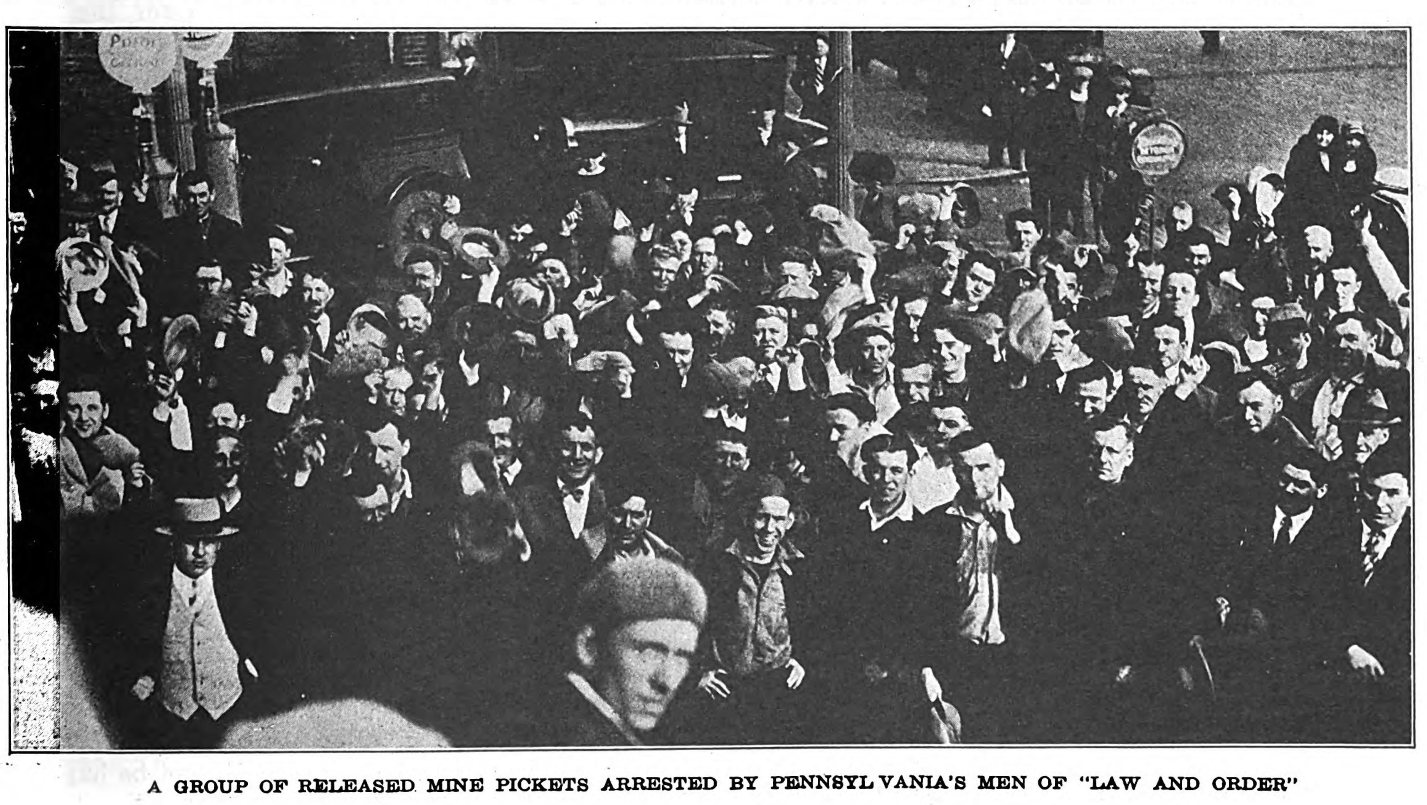
With the Cheswick raid fresh in their memory and the struggle between the operators and themselves growing in intensity and bitterness the striking miners and their dependents are looking more and more to the International Labor Defense for legal aid.
***
Pennsylvania Labor Under the Iron Heel
IN this kingdom of steel and coal ruled by the Mellon money dynasty the constitution of the United States and particularly that part of it which declares that the right of free speech free press and free assemblage shall be inalienable is as dead as King Tutankamen, and the thousands of coal miners now striking to maintain the standards of living wrung from the coal barons after many years of struggle are at the mercy of state troopers, deputy sheriffs and coal and iron policemen with no rights that the rulers of the state are bound to observe.
From Pittston in the east to Pittsburgh in the western part of the state the rule of the gun has superseded the rule of law. It is true that at best this capitalist-manufactured law gives little legal protection to the working class but whatever shelter it afforded them in time of industrial peace from the unhindered exercise of brute force employed by the capitalist class, they are now treated like outlaws, arrested, tortured, jailed and convicted at the whim of any local satrap of the masters of Pennsylvania.
With the bituminous coal strike in its twelfth month and almost half a million miners and their dependents, holding the line for unionism despite hunger and other privations, the operators have turned loose their suppressive forces in an effort to crush every opposition to their tyrannical rule and to smash the miners union.
The policy of submission urged on the workers by John L. Lewis and his reactionary machine in the miners union since the beginning of the strike has resulted in the operators being able to import thousands of strike-breakers into the scab mines. The coal barons felt that they had the back bone of the union broken when a new wave of militancy, organized and led by the “Save The Union Committee” under the leadership of such men as John Brophy, Pat Toohey, Anthony P. Minerich, Vincent Kamenovich and scores of others not so well known but equally courageous and progressive, brought the operators face to face with the fact that though the old leadership of the miners union had hauled down the flag of battle, the rank and file were able and determined to fight on to victory. This is the cause of the reign of lawlessness and persecution of the workers recently inaugurated by the government of the state of Pennsylvania under the leadership of the coal operators.
One of the first attempts to stem the rising tide of militancy on the part of the miners was made in the early part of February when Anthony P. Minerich, chairman of the Pennsylvania-Ohio Miners Relief Committee, was arrested in McDonald, Pa., while addressing a mass meeting of striking miners and charged with inciting to riot. The case was thrown out of court, the state troopers admitting that the “incitement” consisted of Minerich speaking in a loud voice. Minerich was arrested because he was an active strike-leader always out among the miners urging them to stand together, to picket the mines regardless of the strike-breaking injunctions. This was his crime. Rebecca Grecht of New York, a member of the millinery workers union, though young in years, a veteran in the class struggle, was arrested in Burgettstown on March 6 and held on a charge of sedition. The first charge placed against her was one of disorderly conduct, to be followed by “inciting to riot” and later on sedition.
John Brophy, chairman of the “Save the Union” Committee of the United Mine Workers of America and Pat Toohey, editor of the “Coal Digger” official organ of the Committee were arrested and Toohey beaten by State troopers while addressing a joint meeting of two local unions at Renton on March 6. The arrests were made when Toohey in his speech attacked the policy of sending marines to shoot down the people of Nicaragua in the interests of American imperialists. State trooper N.J. Onke, an ex-marine, assaulted the speaker, because he declared that he did not approve of Toohey’s views on the disgraceful invasion of Nicaragua.
Against this reign of persecution unleashed in the strike regions of Pennsylvania and Ohio, the workers must defend themselves to the limit of their ability. In the International Labor Defense they have a weapon which is always ready to aid to the limit of its financial resources. In this critical hour of the coal strike the I.L.D. will be called on to exhaust its ability to the utmost to help the miners defeat the efforts of the strike-breaking judges to keep them in jail and thus rob the masses of their leaders.
But Pennsylvania is not the only state where the constitution works one way, for the operators. In the coal mining regions of Ohio, the militant miners and their equally militant women folk are thrown into jail for exercising the right of picketing. In Ohio, Anthony P. Minerich, was arrested and convicted of a violation of a federal injunction against picketing and is now out on a bond of $2,000 pending an appeal of his case to a higher court. Several miners from around Steubenville have been convicted and jailed. Three women from Yorkville were arrested and jailed for leading a demonstration against a scab mine.
It is up to the members of the I.L.D. and all readers of the Labor Defender to support the striking miners in this struggle and help take the iron heel of the coal barons off the neck of labor in Pennsylvania and Ohio.
They have fought with courage and militancy, against the combined forces of the coal operators, and their gunmen, the government and its machinery, and their officials and their betrayals. They are making a fight for the whole working class.
***
Labor’s Shield at Pittsburgh
WHAT the Red Cross is to the fodder that pulls the triggers for capitalism in wartime, the International Labor Defense is to the militant section of the labor movement in the class struggle.
The surgeons of the Red Cross gather up the battered and battle-torn bodies of conscripts and sew them together for a fresh place in the trenches or the monotonous ease of hospital wheel chairs.
The Labor Defense stations itself on the industrial theatre of war and brings aid and comfort to those who fall into the legal clutches of the enemy. Everyday its services are requested and its aid needed more and more. From California in the far west to Pennsylvania in the East, prison cells are tenanted by fighting workers whose loyalty to their class and enthusiasm for the class struggle outweighed considerations that hold less militant spirits chained to the conventional hitching posts of home, family and a precarious position at the “Belt”.
Tom Mooney and Jim McNamara in San Quentin, Warren K. Billings in Folsom bridge the great distances between their places of confinement and the jail in the anthracite region of Pennsylvania, where Sam Bonita, Adam Moleski and Steve Mendola, face the penitentiary. The bridge is the International Labor Defense.
Defense was one of the big questions discussed at the great National Save the Union Conference that opened at Pittsburgh, Pa., on April 1st. The hundreds of miners who gathered there, tasted the bitterness of the oppressive machinery of the employers operated through their legally constituted government or their illegally improvised auxiliaries. Illegally improvised but legally winked at. Those miners had something to say about their comrades who now pine behind prison bars, physically divorced from the battle that means freedom or continued slavery for their class. Separated in body but not in spirit.
They talked about Dominick Venturato, a coal digger who is serving a life term in the penitentiary at London, Ohio. They talked of Henry Corbishley, Eddie Moleski, Steve Meanovitch and Ignatz Simich, victims of a frame-up between the Ziegler, Illinois operators and the renegade Frank Farrington’s henchmen in conjunction with the government apparatus of the odoriferous Len Small, governor of Illinois.
They did not forget the caged fighters outside the ranks of their own union–Mooney, Billings, MacNamara, the I.W.W. boys in Centralia and elsewhere.
The National Save The Miners Union Conference met to organize the forces of coal mine labor to win the titanic struggle they have waged for a year against the bosses for a decent standard of living, to rebuild their union, almost wrecked by the reactionary leadership of John L. Lewis and to organize the miners in the non-union fields into one powerful miners union.
This was the atmosphere in which the question of defense was discussed. In the International Labor Defense the American working-lass have an organization that acts as a protecting shield for them in their battle for a better living and final emancipation from the fetters of industrial slavery.
They have in the Labor Defender a voice that reaches out among the teeming millions of exploited workers calling on them to stand by their brothers and sisters who have been caught in the entanglements of capitalist lawlessness.
It is a major part of every class conscious worker’s duty to support those institutions to the limit of their resources in energy finances and mass power.
Labor Defender was published monthly from 1926 until 1937 by the International Labor Defense (ILD), a Workers Party of America, and later Communist Party-led, non-partisan defense organization founded by James Cannon and William Haywood while in Moscow, 1925 to support prisoners of the class war, victims of racism and imperialism, and the struggle against fascism. It included, poetry, letters from prisoners, and was heavily illustrated with photos, images, and cartoons. Labor Defender was the central organ of the Scottsboro and Sacco and Vanzetti defense campaigns. Editors included T. J. O’ Flaherty, Max Shactman, Karl Reeve, J. Louis Engdahl, William L. Patterson, Sasha Small, and Sender Garlin.
PDF of full issue: https://www.marxists.org/history/usa/pubs/labordefender/1928/mar-1928-LD.pdf
PDF of full issue 2: https://www.marxists.org/history/usa/pubs/labordefender/1928/apr-1928-LD.pdf
PDF of full issue 3: https://www.marxists.org/history/usa/pubs/labordefender/1928/may-1928-LD.pdf

