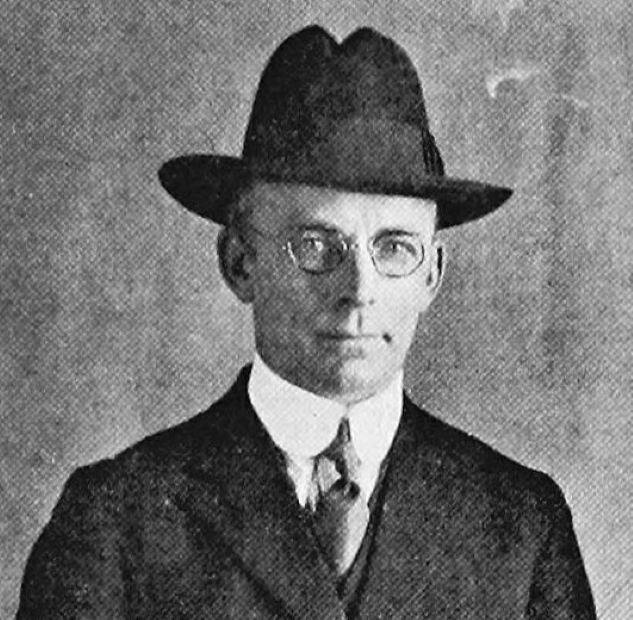
Of all those arrested on the charge of ‘Criminal Syndicalism’ during the August 22, 1922 raid at Bridgman, Michigan, delegates to an underground Communist Party Convention, just William Z. Foster and Charles E. Ruthenberg’s cases came to trial, with only Ruthenberg convicted. Clarissa Ware speaks to the reasons for the verdict, which would be upheld all the way to the Supreme Court and the sentence of which he was about to serve when he died in March, 1927.
‘The Conviction of Ruthenberg at St. Joseph’ by Clarissa S. Ware from The Worker. Vol. 6 No. 275. May 19, 1923.
At ten minutes of eight on Wednesday evening, May 2nd, after three and a half hours’ deliberation, the jury which for two and a half weeks had heard evidence through which the state of Michigan was endeavoring to convict C.E. Ruthenberg of “assembling with” the Communist Party of America, marched into the courtroom.
They came in single file, their heads hanging, shamefaced.
The clerk called the roll and directed the foreman to rise.
“Have you arrived at a verdict?” he inquired.
“We have,” answered foreman Thomas Smith, in a hardly audible tone.
“What is your verdict?”
“Guilty,” mumbled Smith, turning his head so that he would not face Ruthenberg. At the request of the prosecution they had “preserved the safety of the greatest nation on God’s green earth,” but they were not elated by their achievement.
According to the News Palladium, a local Michigan paper, commenting on the verdict, stated, “Ruthenberg’s philosophy and his previous jail experience has apparently made him impervious to sentiment. A slight shrug of the shoulders, the hint of a smile, mute expression of the though ‘it’s part of the game,’ and that was all.”
Why is it that this jury of eight farmers, a shoe merchant, who is treasurer of the Chamber of Commerce, a fruit buyer, a Standard Oil salesman, and a gas service station employee, who is a member of the American Legion, brought in a verdict of guilty, in contrast to the failure of the jury in the case of William Z. Foster to arrive at a verdict?
The answer to this question is not hard to find. The Ruthenberg jury had on it men with particularly strong prejudices against the things which the Communists stood for. Juror Rahn, the treasurer of the Chamber of Commerce, marched into the hotel dining room at St. Joseph’s with the members of the Rotary Club; the prosecution had succeeded in holding on to Juror Ward, member of the American Legion on the jury in spite of the efforts of the defense to disqualify him. As a whole the personalities on the jury were by their environment and their interests strongly prejudiced against the defense, while the three men who voted for acquittal on the first two ballots were of the neutral type.
So much as far as the jury is concerned. The character of the jury was not the only explanation nor even the most important factor in the verdict arrived at.
The prosecutors had learned form the Foster trial. They were not going to make the same mistakes. During the progress of the Ruthenberg trial, Assistant Attorney General O.L. Smith was seen in close conference with Bachman, the foreman of the Foster jury, who voted for conviction through all of the 38 ballots taken by the jury in that case.
Evidently Bachman posted Smith on the trial tactics which would succeed in arousing the prejudices of the jurors to the highest pitch. The results were evident throughout the trial.
In the Foster case, Ruthenberg was on the stand for a day for direct examination by Attorney Frank Walsh and under cross-examination for three days by Prosecutors Gore and Smith. Bachman probably told Smith that the explanation of Communist principles from the witness chair had much to do with removing from the minds of the jurors the misapprehensions and distortions which the prosecution was eager to cultivate.
As a result the prosecutors did all in their power to prevent Ruthenberg from talking to the jury from the witness chair. During the direct examination by Frank P. Walsh, Prosecutor Smith interrupted Ruthenberg on the average once a minute. While Ruthenberg was attempting to put the Communist principles in their historical settings Smith interrupted at every fifth or sixth sentence and Judge White cautioned Ruthenberg “be brief” and ruled out all illustrations of the principles he was stating.
When it came to the turn of the prosecution to cross-examination, they satisfied themselves with a few perfunctory questions. In the Foster case both Gore and Smith tried their hand at endeavoring through devious and involved questions to make Ruthenberg answer in such form as to give the jury the prosecution’s distortion of Communist principles. These questions, however, only served as an opportunity to state over and over again to the jury what Communism really was and what its methods and proposals were. They proved a boomerang for the prosecution. This mistake was not repeated in the Ruthenberg Trial. The prosecution did not dare a frank, bold avowal of Communist principles from the witness chair by the defendant because it would have made impossible the tactics through which they hoped to secure a conviction.
These new tactics were but the negative side of the plan of campaign. The positive side was of a more vicious character.
Ruthenberg was on trial because he “assembled with” the Communist Party of America. The main question at issue was whether the Communist Party advocated “crime, sabotage, violence, or other unlawful methods of terrorism as a means of achieving industrial or political reforms.” Under Judge White’s ruling it was unnecessary for the prosecution to prove that the Communist Party had advocated anything in the state of Michigan. It was sufficient, the judge argued, under his interpretation of the law, that the Communist Party elsewhere had violated principles which violated the law and that subsequently they had met in the state of Michigan.
This was the issue in the case. How then did the prosecution proceed to prove it?
One of the most convincing items of proof was to read from Bukharin’s Program of World Revolution a chapter devoted to the struggle of the Russian Communist Party against the Russian state church. It was through reading a Communist viewpoint on what science has to say about religion that the state of Michigan proved that Ruthenberg and the Communist Party had violated the criminal syndicalist law forbidding the advocacy of “crime, sabotage, violence, and other unlawful methods of terrorism.”
After finishing the Program of World Revolution on religion, Prosecutor Gore started with the chapter on religion from The ABC of Communism by Bukharin. By this time Judge White had become frightened. He told the prosecutors that they were going too far. The defense attorneys claimed that the prosecution had already gone too far; that no court which renders a verdict on the basis of the facts can uphold a verdict of “guilty” of criminal syndicalism secured by reading anti-religious literature to the jury.
The same tactics were followed in appeal to the patriotic prejudices of the jury. Ruthenberg had opposed the war. Ruthenberg had stood on the Public Square in Cleveland before 10,000 people and denounced the conscription law. He had served 10 months in prison for daring publicly to state his views during the war. “Slacker” shouted Prosecutor Smith to the jury.
The final appeal to the jury by Prosecutor Smith was made by tearing from their context in the literature of the Communist Party and the Communist International all reference to the party which force plays in the final forms of the class struggle and reading these to the jury.
To a jury not accustomed to careful distinction in the use of language these references to force, although always part of sentences in which the phrases “the idea,” “the final struggle,” “the ultimate form” were used to show that the reference to force was in its historical perspective and not in the sense of any immediate advocacy (particularly after the difficulties thrown in the way of Ruthenberg’s explanation of this language) were sufficient to create the impression of an advocacy in spite of Judge White’s distinction between “advocacy” and the statement of a historical fact.
Judge White came to the assistance of the prosecution in his charge to the jury. In the Foster case, the judge told the jury that the Communists had the right to advocate “The Communist Revolution,” “the Soviet Form of Government,” etc., in the state of Michigan or anywhere in the United States. In the Ruthenberg case he added the new instruction, at the request of the prosecution, “It is the contention of the prosecution that the advocacy of the Soviets includes the advocacy of force” because the Soviets, the prosecutors claimed, could not be established without the use of force. He told the jury that if it found from the evidence that this was true and the Communist Party advocated the Soviet form of government, it must bring in a verdict of guilty.
The conviction of Ruthenberg will be appealed. The highest court in the land will be called upon to pass upon the question whether the time has come when there can be such a unique “crime” as “assembling with,” when the organization “assembled with” admittedly had committed no act in the state prosecuting it which violated the law of the state. It will moreover be the contention of the defense attorneys that Ruthenberg was not convicted of criminal syndicalism because the Communist Party of America was proved to have advocated violence, but because Communists hold a certain viewpoint on the question of religion and for the equally relevant reason that Ruthenberg had fought the conscription law and the imperialist war.
Whether Ruthenberg will be permitted to remain out on bail while the case pends in the courts is to be decided by Judge White on June 4th, the date set for sentence.
The Daily Worker began in 1924 and was published in New York City by the Communist Party US and its predecessor organizations. Among the most long-lasting and important left publications in US history, it had a circulation of 35,000 at its peak. The Daily Worker came from The Ohio Socialist, published by the Left Wing-dominated Socialist Party of Ohio in Cleveland from 1917 to November 1919, when it became became The Toiler, paper of the Communist Labor Party. In December 1921 the above-ground Workers Party of America merged the Toiler with the paper Workers Council to found The Worker, which became The Daily Worker beginning January 13, 1924. National and City (New York and environs) editions exist.
PDF of full issue: https://www.marxists.org/history/usa/pubs/theworker/v04n275-may-19-1923-Worker.pdf
 Revolution's Newsstand