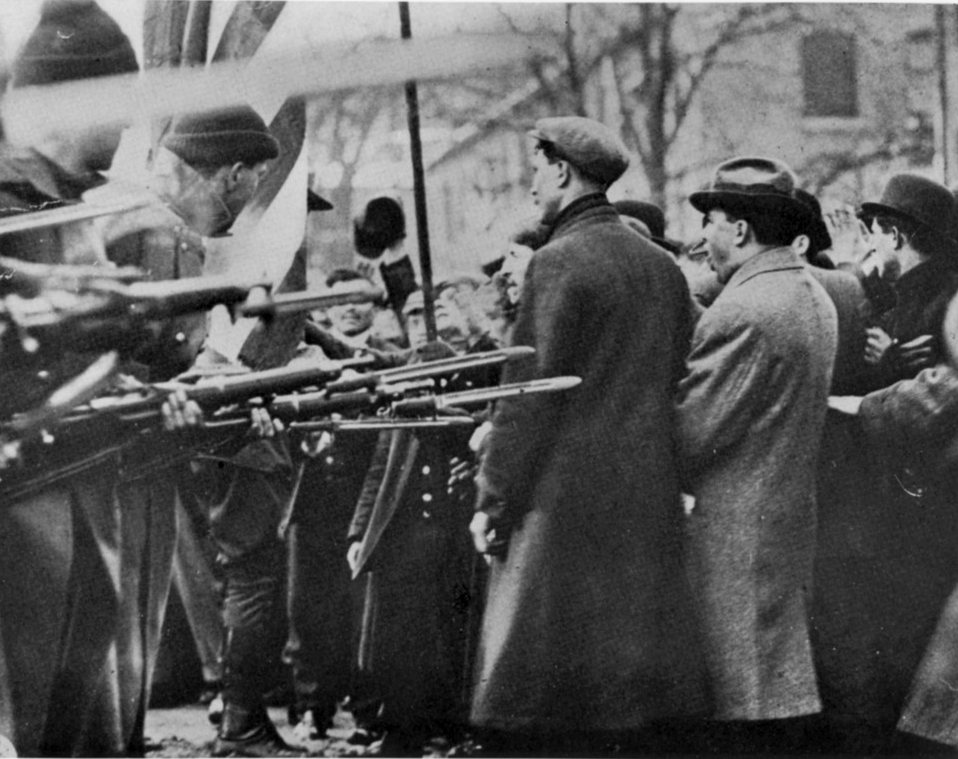
Flying the U.S. flag is no protection for Lawrence strikers, whose parade is bayoneted by state militia after they salute it.
‘Soldiers Club Lawrence Textile Strikers’ from the New York Call. Vol. 5 No. 18. January 19, 1912.
Crowd Is Finally Allowed to Pass Along Street
WORKERS BITTER
Resent Efforts of Business Men to Bar Them From City Hall.
LAWRENCE, Mass. Jan. 11. The first severe clash between the strikers and the authorities since Monday came at noon today when the militiamen on duty in the mill district endeavored to prevent a parade of strikers from passing up Canal street.
There were about 3,000 strikers in the parade, which had just passed through the tenement and business district and was headed for the mill section. A line composed of members of Battery, armed with clubs, had been thrown across Canal street, near the junction of Hampshire street, and nearly opposite the Pacific mills, and as the strikers approached this line they were ordered to go up Hampshire street, instead of proceeding along Canal street.
The strikers refused to obey the military authorities and tried to force their way through the line of soldiers. The militiamen drew their clubs and brutally belabored the strikers over the heads and shoulders, while the officers used the flat of their sabers with telling effect.
No one was seriously hurt in the conflict, although many were badly bruised and several children trampled. The crowd armed itself with bricks, stones, tin cans and pieces of ice, which they hurled at the militiamen. Several of the soldiers were struck with the missiles, but no one was badly hurt.
Crowd Gets Own Way.
After the crowd had been “quieted” the soldiers drew back and allowed the strikers to pass up Canal street into the mill district The crowd continued up Canal street, past the Atlantic, Lower Pacific and Washington mills, until it reached the Lawrence duck mill bridge.
Company K. of Lowell, under command of First Lieut. J.P. Davis, was on duty at the bridge and the strikers were ordered back. A man in the from rank of the strikers carried a large American flag, which he waved before Lieutenant Davis, saying: “This is the American flag. It can go any where.”
As the national colors were waved by the strikers Lieutenant Davis drew his men up in line and ordered them to salute the flag. As the soldiers saluted the colors those in the rear of the crowd of strikers began to press forward, and for a fraction of a moment it appeared as though the militiamen were being swept off their feet by the crowd.
Lieutenant Davis, however, quickly changed the order “Salute the flag” to “Charge bayonets,” and as the militiamen advanced upon the crowd the strikers fell back. After this occurrence the paraders began to desert the line and the parade broke up.
Says Bosses Are Bluffing.
At the meeting which preceded the trouble Joseph J. Ettor said that the mill men were bluffing, and pretending that men were returning to work. He said that contracts on hand would render a stoppage of work a serious matter for the mills. For the present, he said, he advised the men to abandon any attempts at picketing, and instead, to ascertain the names and addresses of the men who returned to work. They should then call at these addresses, he said, and warn the men that their names and addresses were known and would be printed, published and sent back to the home countries
A meeting of the Strike Committee was held at 308 Chestnut street this afternoon, and reports were received from the subcommittees of various nationalities. Complaints were made that steps were being taken to force men to work. A specific instance was cited in which it was charged that a man had been threatened with firearms until he went into an engine room at one of the mills and coaled up the fires.
There is an intensely bitter feeling among the strikers at the opposition of the business interests to the use of the City Hall by the strikers.
Additional strikes began today at the paper works of the Champion International Company and the United States Worsted Company.
Just as the paper mill was opening today the operatives assembled at the gates and declared that they had joined the textile strikers because of the operation of the fifty-four hour law. A number of textile strikers joined them.
An important development today was the striking of about 300 of the employes of the Arlington Mills, men who are members of unions affiliated with the United Textile Workers of America. Up to this time the textile workers have not taken any part in the big strike, which is under the auspices of the Industrial Workers of America.
John Golden, president of the former organization, was here yesterday, but said his organization had not sanctioned the strike.
Another development during the day was the arrival here of Immigration Inspector F.G.R. Gordon, of Haverhill, on orders from Washington to see that the laws with regard to “anarchists” and the importation of labor are observed.
In discussing his orders Inspector Gordon said:
“If I find any instances of people being imported here to work in the mills, it lies within the power of the government to deport those people immediately and the mill owners who brought them or caused them to he brought are subject to a fine of $1,000 in each individual case.”
It was also reported that Inspector Gordon would give his attention to the claim that a number of “anarchists” are in the city for the purpose of inflaming the strikers.
There has been no change for the better in the strike situation today. If anything, the outlook is worse than at any time since the trouble began. All efforts at having the strike settled by arbitration have ceased, as neither the mill owners or the disgruntled operatives will submit their differences to the State Board.
There was a conference this afternoon between Colonel Sweetzer, who commands the troops, and Ettor, the strike leader. What they talked about could not be learned from either man, but it is understood the militia officer made some sort of a proposition which may result in the establishment of temporary peace. He telephoned the result of the conference to Governor Foss, who, it was predicted by Ettor, would make a move in a short time which would result in concessions to the strikers.
The New York Call was the first English-language Socialist daily paper in New York City and the second in the US after the Chicago Daily Socialist. The paper was the center of the Socialist Party and under the influence of Morris Hillquit, Charles Ervin, Julius Gerber, and William Butscher. The paper was opposed to World War One, and, unsurprising given the era’s fluidity, ambivalent on the Russian Revolution even after the expulsion of the SP’s Left Wing. The paper is an invaluable resource for information on the city’s workers movement and history and one of the most important papers in the history of US socialism. The paper ran from 1908 until 1923.
PDF of full issue: https://www.marxists.org/history/usa/pubs/the-new-york-call/1912/120118-newyorkcall-v05n018.pdf

