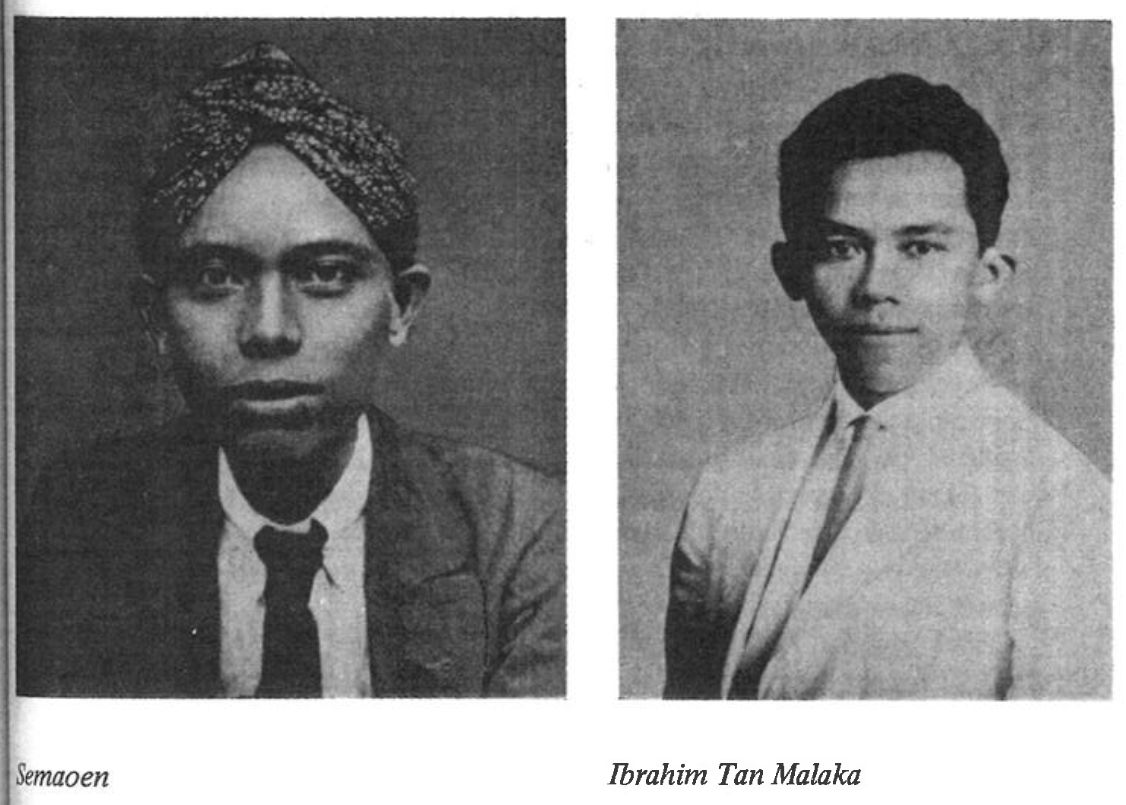
A Dutch wobbly mariner is deported from San Francisco to Indonesia where he works with the P.K.I. and its leader Semaoen only to be deported again, this time back to Holland, with Semanoen, Sneevliet, Bergsma, Malaka, and others. He tells his story below.
‘Dutch East indies’ by W.A. van Kordenoordt from Industrial Worker. Vol. 5, Number 79. December 8, 1923.
A much-deported man is W.A. van Kordenoordt. Flung from our hospitable shores. The lit in the Dutch East Indies. Java extended but a short-lived welcome and now, we hear from him at The Hague, Holland.
Van Kordenoordt was mate of a vessel that often touched at San Francisco. Whenever his boat swung through the Golden Gate this valiant rebel paid a visit to Tom Mooney. As Tom’s address appears to be fairly permanent in this land of freedom, the jail authorities came to know van Nordenoordt. First he was warned to keep away from Mooney and told to avoid all radical associations in San Francisco. Then one day he returned to his boat to find that his cabin had been ransacked and some of his belongings seized by the upholders of law and order. Next came his deportation to Java, accompanied with orders that he never again profane this refuge of the oppressed with his rebellious person.
In the Nederland Indies the P.K.I., Communist Party of India, as the only virile revolutionary group, enlisted the valuable services of van Kordenoordt. His activities doubled, redoubled and finally brought him so forcibly to the attention of the government, that is to say the combined financial and industrial interests, that he was unceremoniously thrust back onto the land of his birth. He writes from Gravenhage, which we know as The Hague, under a recent date, the following account being a compilation from several letters with only such changes as are necessary to make matters understandable and to prevent repetition.
***
Once more I am deported and live now in my native land of Holland. I am without work and get only a weekly allowance of 12 guilders from the authorities of the town. (A guilder is equal to about 40 cents in U.S. coin). Every man here who is without labor or a means of existence gets a small weekly compensation.
After the Javanese authorities deported me, they also sent to Holland my comrade Semaoen, the Javanese leader of the Party Kommunist India. This Semaoen is young, faithful and intellectual, the son of a Javanese nobility family. He was arrested and put into prison because the Dutch government–the capitalist rulers–feared a big strike of the railway men, and they felt that the strike would be won should it break out in the month of June–when the sugar plantations start with moulding the sugar cane. They knew that the putting of this loved leader in jail would force an immediate strike of the railway proletarians and an early strike would have much less chance to succeed. But they, the robbers, never thought that so many of the men would leave their engines and other posts as a protest against this Dutch iniquity in the Indies. Despite the guards of soldiers and the European strike breakers the mass of the strikers grew greater each day and sabotage occurred with more frequency. Sixty men were jailed without having any charges placed against them save that they belonged to the V S.T.P. (Vereeningvan le Spoor en Tramway Personeel), the Railway and Tramway Union. Many of the prisoners were given sentences ranging from one to six months in prison. The police authorities tried to provoke disturbances among the brown slaves and also tried to intimidate them into returning to work, but not one of the strikers broke ranks.
Two days after the outbreak of the strike, that is, after the arrest of Semaoen, a new law–Article 161–was promulgated. In substance it stated that any person who a forces or causes others to strike, or who gives out information, spoken or written, or o with books or papers, to strikers, or who i are on strike or who propose to go on strike, shall be punished with a maximum of five years imprisonment or a fine of 1,000 guilders. Two days later another article was added to the law by which penalties were provided for the assembly of more than three persons. Small wonder then that we were no longer able to keep in touch with the mass and to keep the men in touch with each other. Nothing more could be done, nevertheless the people showed a fine spirit of solidarity.
The strike was lost? No! The strike was won because the ruling mob got a lesson of the revolutionary sentiment of the brown slaves of the Nederland Indies.
Those who were deported are Sneevliet, Mrs. Sneevliet, Bransteder, Baars, Bergsma, Malakka, Dekker, van Kordenoordt and Semaoen.
Here in Holland, I am sorry to say, I find the workers demoralized and degenerated, without power to fight against misery and poverty, and without faith in the world revolution. All of us who have faith must lend a hand and give an example to these workers and a lesson to the international capitalists.
Comrades!
Do you know that the American capitalists have invested a vast amount of money in Nederland India?
Do you know that the Javanese people, after three centuries of slavery under the Dutch government, are now striving hard to gain their liberty?
Do you know that while the rich are squandering millions the poor natives are living in kampongs in poverty, and that every day many men, women and children die from hunger and fever along the roads? Do you know that striking has been made a crime and that men and women are hunted and deported just because they belong to the Kommunist Party of India?
Comrades! Show your solidarity and protest against these things.
Fellow workers of the I.W.W. do not lose your solidarity, your faith, your power. Teach the robbers in your country a lesson, because only when you get your liberty in America can the Asiatic people get theirs. Fight for your class, fight for all proletarians, fight for the freedom of the Asiatic peoples. (W.A. van Kordenoordt, Nieuwe Haven 322, The Hague, Holland).
The Industrial Union Bulletin, and the Industrial Worker were newspapers published by the Industrial Workers of the World (IWW) from 1907 until 1913. First printed in Joliet, Illinois, IUB incorporated The Voice of Labor, the newspaper of the American Labor Union which had joined the IWW, and another IWW affiliate, International Metal Worker.The Trautmann-DeLeon faction issued its weekly from March 1907. Soon after, De Leon would be expelled and Trautmann would continue IUB until March 1909. It was edited by A. S. Edwards. 1909, production moved to Spokane, Washington and became The Industrial Worker, “the voice of revolutionary industrial unionism.”
PDF full issue: https://washingtondigitalnewspapers.org/?a=d&d=IWW19231208

