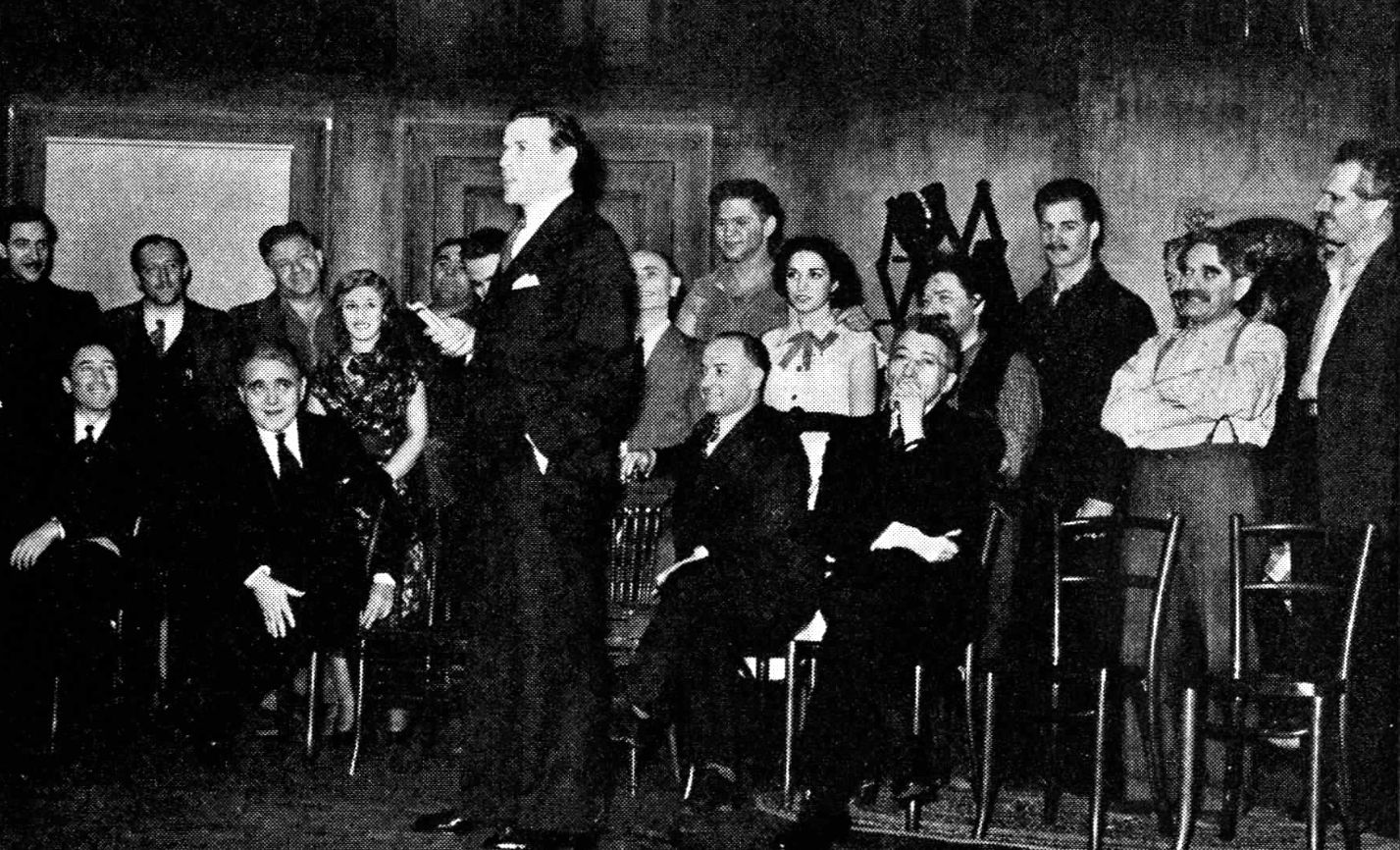
Theater as an organizing tool. The C.I.O.’s Steel Workers Organizing Committee puts to use the play Steel in its unionization drive.
‘Road Show–C.I.O. Style’ by Richard Pack from New Theatre and Film. Vol. 4 No. 2. April, 1937.
AROUND the alleys and cafes of Broadway where they like to wonder Is the Road Coming Back, there won’t be much interest in a certain road company which is going to tour this spring. But in Gary and Pittsburgh, in Detroit and Akron, where the talk is of John L. Lewis and C.I.O., it will be different. The men who make steel and rubber and autos are going to be excited about this show. For the first time, workers in the mass production industries will see their own struggles mirrored on the stage and for the first time the theatre will be used as an integral part of a drive for union organization. The sponsor of this unique tour is Labor Stage and the play–John Wexley’s Steel.
A leading organizer of the SWOC, Clinton S. Golden, furnished the incentive for the tour. “I have no idea what would be involved in getting this play presented by a company out on the road,” he told Labor Stage after seeing a performance of Steel, “But if it could be worked out, I think it would do an immense amount of good in our present organizing campaign.”
Other union leaders were also enthusiastic about the play. One hundred members of the Policy Committee of the United Mine Workers of America saw the play, while in town for the recent negotiations with the coal companies, and actually stopped the show they were so enthused that they began encouraging the hero in his fight with a company thug by yelling “Get ‘im!-Go to it boy!-Sock ‘im!”
Last month, a conference of unionists and theatre workers was called by Labor Stage and the New Theatre League to discuss a tour of Steel. Although no definite action was taken, tentative plans were drawn up. Patrick Fagan, head of the Pittsburgh Central Trades Council, and president of District 5 of the UMWA, came to the conference and pledged $1,000 for his district towards the expense of the tour.
When the Wexley play finally takes its part in the assault against the feudal rule of the big corporations, the boards of directors may find some consolation in the thought that Steel almost reached the screen, and in that medium might have achieved an even larger audience. The history of Steel is curious and significant. While working for Universal Films in 1930, Wexley wrote an original scenario called Steel, which was enthusiastically approved by Carl Laemmle, Jr., who was looking for another socially-conscious film to follow All Quiet On the Western Front. William Wyler was slated to direct Steel, and Lew Ayres, Slim Summerville, and the late Louis Wolheim were assigned to the cast.
“It was a simple story,” Wexley recalls, “It concerned a young itinerant worker, who while employed in a steel plant comes in contact with a number of characters…And of course, a girl–but not the boss’s daughter. The story described the burdensome conditions, low wages, long hours, and culminated in a strike conflict, during which scabs and strikebreakers were brought in…Looking back on the matter, I smile at my own innocent intrepidity of those years. You must understand that Laemmle, Jr., while production manager for the whole studio at that time, was only 21 years old, and an ambitious youngster, though very naive.”
However naive Laemmle, Jr., might have been, there were others who realized the implications of the script and visualized its repercussions. After a great amount of money and work had been expended on detailed preparations, the picture was suddenly shelved.
Wexley then re-worked the script for the stage, and in the fall of 1931 Richard Geist produced it in New York. It was the first labor play produced professionally in this country. The critics pounced on it as “propaganda” and the show closed within two weeks. Not long after, Steel was produced in a downtown hall for two performances under the auspices of the Workers’ School. Before a workers’ audience, the play was an overwhelming success. Both performances were sell-outs. More people saw the play in those two performances than in two weeks uptown!
The rejuvenation of Steel came about when Louis Schaffer, general manager of Labor Stage, began looking for a suitable script. He wanted a play for the C.I.O. whose drive had just started. Wexley’s play suited him, but it had to be brought up to date.
Wexley, who started out to revise Steel, ended up with what is really a new play. Before he wrote his new Steel, he put in six weeks of research, although in his youth he had once worked in a steel mill. Labor Stage furnished him with credentials, and he spent hours with organizers and with steel workers. He sat in union headquarters and watched workers come in to sign up; afterwards he walked home with them, asked them a multitude of questions why they joined up, conditions in the mill, etc. From one worker he even secured the minutes to a company union. meeting, which furnished the background for a particularly revealing scene in Steel.
At the present time, Steel is playing Friday evening, and Saturday afternoon and evening at the theatre of Labor Stage, instead of nightly as originally planned. A regular run had to be abandoned temporarily while the garment industry was in the midst of its rush season. Steel is performed by members of the International Ladies Garment Workers Union, who couldn’t manage eight performances a week, while working overtime in their shops.
When Steel goes on the road, this New York production will remain at Labor Stage. This month, conferences similar to that recently held in New York, will be called in Chicago and Pittsburgh to enlist the support of local unions and theatrical groups. Labor Stage will send out a director and seven or eight professional actors for the touring company, with the balance of the cast to be recruited from little theatres in Pittsburgh and Chicago. Steel will bring its dramatized message of industrial organization not only to steel workers, but to men and women in other industries in which the C.I.O. is active–rubber, coal, auto, oil.
Steel should prove a powerful ally of the C.I.O. The play will undoubtedly contribute to morale; it may even be the final clinching argument for unionization to many a worker who hesitates at signing. Labor–which in recent months has adopted such modern devices as the sound truck–has found another new technique.
And the social theatre has found a new audience, new meaning, and new strength. It has achieved that closer cooperation with the labor movement which it has so long sought. Sections of this country have seen no “shows” other than the moving pictures for years; Steel and plays like it will bring them the theatre at its best.
The New Theater continued Workers Theater. Workers Theater began in New York City in 1931 as the publication of The Workers Laboratory Theater collective, an agitprop group associated with Workers International Relief, becoming the League of Workers Theaters, section of the International Union of Revolutionary Theater of the Comintern. The rough production values of the first years were replaced by a color magazine as it became primarily associated with the New Theater. It contains a wealth of left cultural history and ideas. Published roughly monthly were Workers Theater from April 1931-July/Aug 1933, New Theater from Sept/Oct 1933-November 1937, New Theater and Film from April and March of 1937, (only two issues).
PDF of full issue: https://www.marxists.org/history/usa/pubs/workers-theatre/v4n02-apr-1937-New-Theatre-&-Film.pdf

