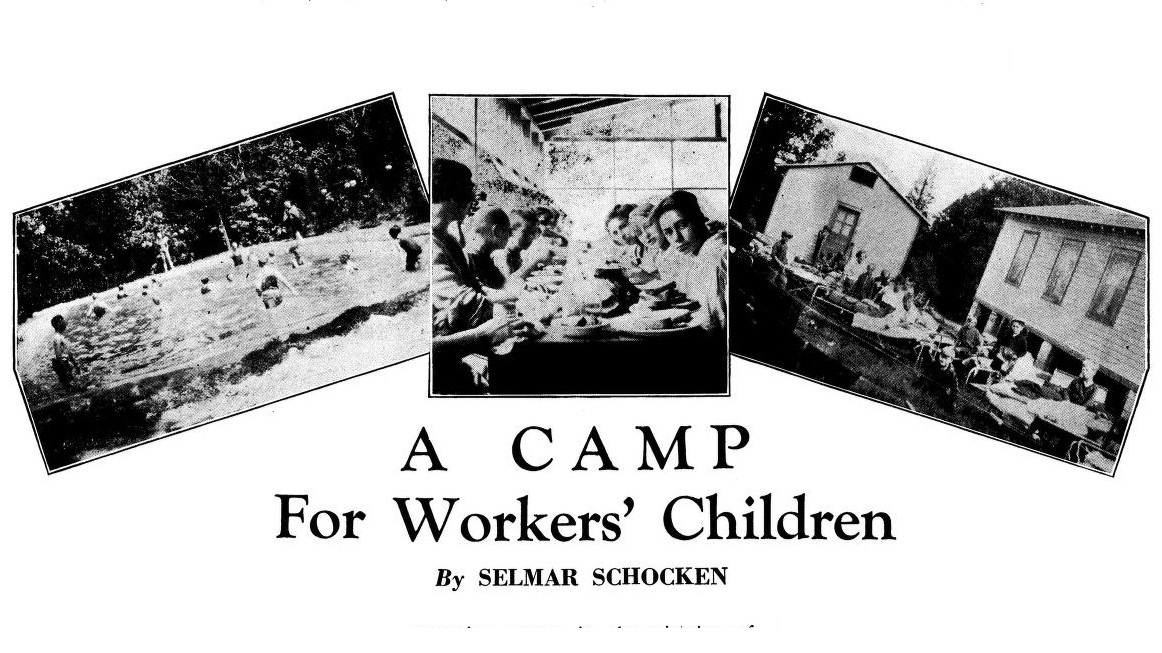
Inspired by Ferrer’s Modern School, the Conference for Progressive Labor Action ran a youth camp in rural New Jersey for years. Here, a veteran of the old Debsian Y.P.S.L. on the staff of the New Yorker Volkszeitung introduces the retreat.
‘A Camp for Workers’ Children’ by Selmar Shocken from Labor Age. Vol. 19 No. 7. July, 1930.
THE benefits derived from camp life by children is generally recognized. If anyone needs outdoor life in the few vacation weeks of the summer, it is the children of the working class families, living in crowded quarters with very little outdoor life. Only recently the health Commissioner of New York City spoke of the importance of picking a camp, and to the progressive thinking worker it is especially important that he find a camp for his child where the whole spirit is in line with progressive ideas.
In this article we will try to acquaint those New York workers who read LABOR AGE and who are attached to the whole movement of the Conference for Progressive Labor Action with a camp that is maintained by progressive workers for the children of progressive families.
The MODERN SUNDAY SCHOOL CAMP is maintained by the Modern Sunday Schools established in Manhattan, Queens and the Bronx. After teaching the industrial history of man, the history of government, evolution of mankind in general with special emphasis on the condition of the working class, to balance the winter program of the public schools, the Sunday Schools felt the need of taking care of their children in the summer. They bought a tract of land in the Ramapo Mountain region in Morris County, N.J., at Lincoln Park, eight miles from Paterson.
For the last five years this camp has served the children of the working class who were fortunate enough to get there. Constant improvements have made it one of the best and most attractive camps in the vicinity of New York. This camp is not a commercial undertaking and is run on a non-profit basis. The counselors are very carefully selected. Every one employed in the camp, especially those working in the kitchen and dining room must be examined and passed by the Union Health Center, in order to assure the children’s health. Every child must also pass a medical examination at the Union Health Center before it is accepted.
The camp is ideally located on a hill top with plenty of sunshine, surrounded by cool cedar woods. Although tents are romantic, dormitories are more practical, for even in camp provision must be made for wet days. The four roomy dormitories can comfortably house seventy children and their counsellors. The large social hall has a stage for dramatics, but the whole camp site in itself is a stage in a natural setting, beyond comparison with anything the city has to offer. The swimming pool, carved in the solid rock on the side of the hill, is a source of education, exercise, fun and health.
Every child should go to camp, if only for two weeks in the year. The birds and stars, trees and flowers should become his familiar friends. They should be a glowing reality in a child’s life. This knowledge of nature can only be gained by intimate contact. What a relief from the noisy city to stand under the open sky to rest the eye on distant mountain chains, to breathe the clear air, or sit in the quiet shade of the woods and rest one’s nerves.
The summer camp must help the child regain the lost energy of the winter months because his mental outlook and attitude toward life is so dependent on his well being and his experiences. The child must learn how to live and work and play with other children, to get a better perspective of life.
In the course of his normal development a child must become independent of his parents. To live for a period in a group of his contemporaries aids him to become adjusted to his own world. The path to our world must necessarily diverge from the maze of the boy scout camp which leads to militarism and the religious and charitable camps which lead to the fostering of the inferiority complex and superstition.
The desire to give the child of the worker a class conscious outlook on life, to enable him to think independently and have the courage of his convictions, first gave birth to the Modern Sunday School and then urged the creation of this camp. It is not enough for parents to teach children their ideals. They need companions who have the same ideals. This gives them opportunity for self-expression, strengthens their convictions and makes solidarity a reality.
Workers interested in progressive labor action will find this is an excellent camp for their children. The weekly charge is $9—members of the Modern Sunday Schools pay $7—for all children from six to sixteen years of age. Lincoln Park is less than an hour’s ride from Hoboken, on the Lackawanna and can be reached by bus and good auto roads from all points in Northern New Jersey.
Labor Age was a left-labor monthly magazine with origins in Socialist Review, journal of the Intercollegiate Socialist Society. Published by the Labor Publication Society from 1921-1933 aligned with the League for Industrial Democracy of left-wing trade unionists across industries. During 1929-33 the magazine was affiliated with the Conference for Progressive Labor Action (CPLA) led by A. J. Muste. James Maurer, Harry W. Laidler, and Louis Budenz were also writers. The orientation of the magazine was industrial unionism, planning, nationalization, and was illustrated with photos and cartoons. With its stress on worker education, social unionism and rank and file activism, it is one of the essential journals of the radical US labor socialist movement of its time.
PDF of full issue: https://archive.org/download/v19n07-jul-1930-labor-age_202103/v19n07-Jul-1930-Labor-Age_text.pdf

