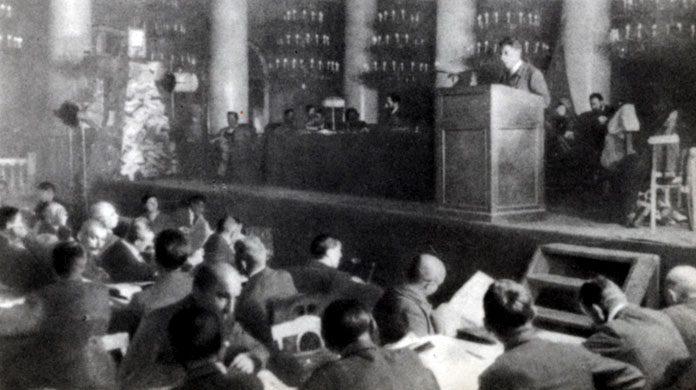
Much here as the leadership of the R.I.L.U. meets in an enlarged session to discuss the situation midway through that eventful year of 1923, which would see mass general strikes in German and Polish cities, complete with barricade fighting, just months after this. The resolutions passed are: On the R.I.L.U. Representation in the Separate Countries. Resolution of the Central Committee of the R.I.L.U. on the Differences in the Czecho-Slovakian Labor Union Movement. Motion on the Czecho-Slovakian Question. Resolution on Work in the Near and Far East. Resolution on the Tactics of the R.I.L.U. Partizans in Spain. Resolution on the American Labor Union Movement. Resolution on the Labor Unionist Press and Literature. Resolution on Work among the Youth. Resolution on Trade Union Work among Women. The Harbour Bureaus and Work among the Seamen. Resolution on the Report on the International Trade Unions. Resolution on the Report of the Executive Bureau. The Further Tasks of the Red International of Labor Unions. Resolution on Combatting Fascism. On Workers’ Migration. The Organizatory Structure of the Opposition. Resolution on the Present Position of the Russian Labor Unions. Resolution on the Motion of the Union of Mental and Manual Workers regarding the Dissolution of the Excluded Unions. Working Men and Women, join your Labor Unions! To the Revolutionary Workers of Japan.
‘Resolutions and Appeals of the Red International of Labor Unions’ from International Press Correspondence. Vol. 3 No. 65. October 6, 1923.
Of the Third Session of the Central Council Held in Moscow from June 25th to July 2nd 1923
Against the Sabotage of the International United Front of the Transport Workers.
***
On the R.I.L.U. Representation in the Separate Countries
Having taken into consideration the structure, powers and activities of the R.I.L.U. organization within the separate countries, the Central Committee charges the Central Bureau that it pay special attention to the further completion of said organisations to the widening of their spheres of activity. The constitution and the range of authorization must in each case be fixed by the Executive Bureau so as to prevent overlapping in propaganda, agitation, communication and information. The respective bureaus must direct their activities under the immediate control of and according to the directions of the Central Executive, and may only extend their frame of action providing the Executive thinks fit.
The Central Committee charges the Executive Bureau with working out a detailed instruction for the respective countries that will accurately sketch as far as possible the nature of their authorizations.
***
Resolution of the Central Committee of the R.I.L.U. on the Differences in the Czecho-Slovakian Labor Union Movement
The R.I.L.U. Central Committee in session on June 25th, 1923, on the basis of the results of the detailed discussions in the Czecho-Slovakian Commission resolved:
A) Textile Workers’ Sektion.
With the aim of solving the conflict between the I.A.V. in Prague and the Reichenberg textile section, a uniform all-labor-unionist textile workers’ section, is to be effected as follows:
1. The men and women employed in the textile industry who are organized in the I.A.V. of Prague and the Reichenberg textile section respectively, will be united in a uniform section of the textile workers of the I.A.V.
2. Contributions must be uniform throughout the section. Contributions collected by the local groups on the ground of monthly reckonings will be managed as a section’s account in the I.A.V. The section committee has the right of disposing of it under the I.A.V. Central Committee’s control.
3. The management of section affairs, in so far as they do not lie within the sphere of the I.A.V. Central, is a matter for the Committee appointed by the joint textile workers’ conference. Until then the two section committees at present existing will continue to manage affairs.
4. The section secretaries are appointed by the sections themselves. The district secretaries are appointed by the I.A.V. The Central is, however, bound to the recommendations of the numerically largest section of the district in question. As to the employment of other district secretaries, the next largest sections have the right of proposal.
5. Extraordinary conferences of the textile section must be called, if more than one half of the members voting request it. The cost of delegations must be defrayed by the section or its members.
6. Out of the Central funds or those of the Section, the LA.V. will pay all the strike and unemployment expenses of the Section; maternity benefits, agitational and administrative costs; the wages of Section employees; publications, libraries, trade journals and all other such items.
7. Economic struggles are to be conducted as follows: Minor work-struggles and strikes are to be led by the Section. When strikes arise of a nature greater than can be supported from the Section funds alone, then same must be previously announced to and ratified by the I.A.V. Central. It must be led according to its directions.
8. The Section Committee receives 10 hellers per section member for its free disposal anent extraordinary expenses. The expenses for the whole I.A.V. Union are divided among the sections proportionally to the number of members.
9. The local groups will keep 5 hellers per member for their special wants. The system of the Central groups is left integrate The Section Committee is authorised to enlarge itself. The Central does not touch the local group funds. The local groups are free to draw extra contributions from the local membership. Once a year, the local groups may retain 50 hellers per member. This fund will be used exclusively for educational work. The Section Committee must first, however, have sanctioned it after a full consideration of the Section’s financial capacity and funds. Local group officials are employed by the groups. Employment and dismissal are effected on hearing the members’ wishes and after having been in communication with the Section Committee. Officials are subject to the supervision of the Section Committee and to the control of the I.A.V. Board. They are paid out of the local extra contributions.
10. Until agreement has been arrived at with the C.P. of Czecho-Slovakia concerning the Red Labor Unionist, the German members will continue to receive that journal as before. If there is more than one member of a family organized in the I.A.V. they may, if desired, receive also the Woman Communist or the Alarm.
11. The I.A.V. will later pay those members of the Reichenberg Section who on the day of the amalgamation were entitled to unemployment benefit but who have not yet received same.
12. The regulation of the Statutes and Orders of the I.A.V. only apply to the Textile Section in so far as they are not altered by the afore-mentioned points.
13. On the basis of this agreement the amalgamation of both Textile Sections must be effected not later than the 10. Sept., 1923.
14. Concerning the late refusal of the Reichenberg Section to join the I.A.V., the Central Committee declares that same was not dictated by nationalist tendencies but was rather the outcome of following the principle of industrial organisation.
B) Farmworker’s Section.
In order to solve the trouble between the Slovakian Farm- workers and the Prague Farmworkers’ section of the I.A. V., the following principles have been fixed:
1. An extraordinary Congress of the Slovakian Farm Workers’ Union be called for the purpose of leading that organization within the Farm Workers’ Section of the I.A.V. Participation in managing the affairs of the Farm Workers’ Section of the I.A.V. to be determined according to the number of members.
2. The regulations governing contributions in the Farm Workers Section is in principle the same as in other sections of the I.A.V. The Central Committee observes that special circumstances among farm workers may require a different method of contribution. This, the Section will determine in conjunction with the I.A.V.
3. Uniform membership cards must be introduced for all Sections. There must also be issued monthly and free of charge, in Slovakian or Hungarian, for the use of the Slovakian farm workers a uniform central journal with trade supplements.
4. The I.A.V. Central must be composed of representatives from every Section. It is responsible for the organisation and management of all the Sections.
5. All employees must be acquainted with the locality wherein they work and must also understand the language. They must also be R.I.L.U. partizans.
6. Employees are remunerated on the basis of equal pay for equal work 7. These agreements must, at the latest, be in operation by 1st. Sept., 1923
Concerning the Czecho-Slovakian problem, the Central Committee in principle declares itself as follows:
The chief cause of the disharmony and its later development arose over the non-admission of the Slovakian delegate to the Farm Workers’ Congress in April this year. Although the Executive was formally right in refusing admission and representation to members who were more than three months financially in arrears, it was nevertheless a serious tactical mistake, severely damaging the Farm Workers’ Movement. The Executive ought to have considered the interests of revolutionary labor unionism paramount, and that these interests continually demand the strict unity of all the Czecho-Slovakian farm workers.
On the other hand, in founding an independent union of their own instead of endeavouring through the regular machinery (i.e. appealing to the I.A.V. and R.I.L.U.) to liquidate the trouble, the Czecho-Slovakian comrades committed a grave error. Such undisciplined proceedings threaten with disorganisation the entire revolutionary Labor Union Movement.
The Central Committee declares that the unity of the movement is a fundamental principle which must not be endangered by troubles of a personal character. Should the investigations of the Commission, which is composed of two representatives each of the I.A.V., the Farm Workers’ Section of the I.A.V., the C.P. of Czecho-Slovakia and the farm workers, show that the mutual charges existing cannot be maintained, then the Executive of the I.A.V. is requested to withdraw the organisatory measures directed against the party innocently accused.
The Central Council holds to the basis that will enable a joint collaboration to win over and build upon the mutual confidences of all Red Labor Unionists throughout Czecho-Slovakia. It appeals to every textile worker and farm worker in Czecho-Slovakia to join their respective I.A.V. Section and thus make of their Labor Union Movement a strong rampart in the Red International of Labor Unions.
***
Motion on the Czecho-Slovakian Question
Upon receiving the Czecho-Slovakian Commission’s report, the Central Council ratified the former’s decision concerning the establishment of necessary unity within the ranks of the revolutionary Czecho-Slovakian Labor Unions.
The Central Committee charges the Executive Bureau with the care of having the resolutions of the 2nd. Congress–wherein are embodied financial and organisational conditions which guarantee the efficiency and integrity of the industrial sections adhered to when carrying out measures decided upon.
It is of equal importance when fixing a uniform membership contribution for the section, that same does not exceed the maximum.
The experience and decisions of the R.I.L.U. have exposed obstacles blocking the path to solidarity. The Central Committee charges the Central Bureau to mobilize all the International’s authority in the removal of any and all hindrances opposed to the development of Revolutionary Labor Organisation in Czecho-Slovakia. 1. Russian Delegation. 2. French Delegation. 3. Spanish Delegation. 4. German Delegation. 5. Italian Delegation.
***
Resolution on the Work in the Far and Near East
1. Stated: That clause 7a of the resolution on colonial questions adopted by the 2. R.L.LU. Congress saying “the revolutionary national organisations and minorities of the nations possessing colonies (Great Britain, France, U.S.A., Japan, Holland, Italy, Belgium, etc.) must form special organs for keeping up the communications with the labor unions in the colonies”, has nowhere been carried out in practice.
The Central Committee binds our British, French, American and Dutch partizans to create the organisations in question within three months from now.
Said organs have the following concrete tasks:
a: to originate and develop in the press in labor union meetings and special gatherings of the rank and file an understanding and sympathetic interest in the fight taken for freedom under colonial and semi-colonial countries. Further they must try and rid the workers within the home countries of their imperialist opinions and to make them recognise their joint interests with the fighting proletariat of the colonies.
b: to conduct through the labor union press and also by the Party an agitation and propaganda among European workers and employees in the colonies which will serve to expose the defects of their capitalistic attitude and bring them over to the side of the indigenous proletariat.
c: to fight alongside the workers and employees irrespective of their nationality, sex, or colour for the principle: “Equal pay for equal work.”
2. The British partizans have, moreover, to conduct an explanatory, educational and organisational activity among the numerous Indian sailors (lascars) arriving at British ports on the ships of all nations. The commission sees therein an effective means of supporting the revolutionary labor union movement in India. The peril of English trade unionism penetrating and thriving in India makes these tasks imminently important and desirable.
3. Our French organisation is the largest in any country possessing big colonies, and it is upon it that the greatest part of the colonial question reclines. The work done in that direction by the C.G.T.U. can only be regarded as a weak and insufficient effort, Beside the system of “tourness” (i.e., propaganda tours) a systematic and permanent work among the indigenous working populace must be begun by European comrades living there. Not only the African colonies, but Indo-China must also be specially treated. The next step is to present a detailed report to the R.I.L.U. on the economic situation, trade organisation, and labor movement in all the Fresch colonies.
4. Similar demands rest upon the American partisans regarding the Philippine Islands–an important strategic point in the Pacific Ocean.
5. Our Dutch partisans are charged with maintaining a close and effective connection with the labor movement in Indonesia and especially with the revolutionary labor unions in Java.
6. Our Spanish partisans have to undertake the work of education and organisation among the working class of Tangier.
7. Material is to be collected on the big Portuguese colonies in Africa.
8. All our organisations in countries possessing colonies, as well as our partisans in the colonies themselves, must forward regularly to the R.I.L.U.’s address reports on the development of the labor movement, labor union organisations, and the nature of the work accomplished.
***
Resolution on the Tactics of the R.I.L.U. Partisans in Spain
In view of the fact that 29 labour unions have been excluded by the reformist officialdom from the General Union of Workers; that the majority of said organisations have remained autonomous; and that their ranks are being disrupted; that the Communist Party has failed to lead a systematic and energetic campaign for the readmission of those excluded according to the recommendation of the 2. R.I.L.U. Congress (i.e., that it is necessary to support the opposition committees of Revolutionary Syndicalists within the Anarcho-Syndicalist Labor Union Central–the National Confederation of Labor); further in view of the additional facts that in Spain there is a tendency towards the revolutionary elements quitting the General Union of Workers and joining the National Confederation of Labour, and another tending towards quitting the Anarcho-Syndicalist Labor Union Central should its next congress decide upon joining Berlin–the Central Committee decides: that all sections excluded from the General Union of Workers are immediately to join the National Confederation of Labor; that the minorities of all the said labor union centrals have at all costs to remain within same, so as to be in a position enabling them to continue their defence of the R.I.L.U.’s principles.
Should they, however, be excluded, an energetic campaign must immediately be entered upon to obtain their readmission. These organisations may join another labor union central only when every other measure undertaken for their restitution has failed.
***
Resolution on the American Labor Union Movement
1. The 3. Full Session of the Central Committee of the R.I.L.U. expresses its full satisfaction at the brilliant progress made in the United States and Canada by the Trade Union Educational League. The Session heartily endorses the work undertaken in winning for the League and all its slogans the sympathies of the organised American masses. The Session hopes that the tendencies displayed will now crystallise in definite organized form. As the spirit of the rank and file is at this moment very favourable, the Session declares this to be one of the League’s most urgent tasks.
2. The Full Session also accepts the good work the League has accomplished in the formation of group committees in the separate branches of industry. It recommends all these committees to take up connections with the R.I.L.U.’s international propaganda committees. The Session further accepts the special programs prepared for the vanguards in each branch of industry, as was the case in the miners’ campaign over the question of nationalization and workers control, etc.
***
Resolution on the Labor Unionist Press and Literature
The Central Committee instructs all organisations affiliated to the R.I.L.U. to formulate motions towards improving and completing the labor unionist press and literature. The Executive Bureau is charged with examining all practical propositions and to undertake the measures necessary.
***
Resolution on Work among the Youth
1. The economic crisis, still further intensified by the capitalist offensive, has very badly deteriorated the position of all juvenile proletarians without at all influencing the leaders of the Amsterdam International to undertake any effective measures on their behalf.
2. Young workers as a mass are mostly unorganised. The Amsterdamers do not regard them as equals. At the best they treat them as objects of reformist education. Like the Amsterdamers, the officials of the Pan-American Federation have not given sufficient attention to the young workers’ economic position, and have thus endangered the interests of the entire working class.
3. The R.I.L.U. has, on the other hand, through the medium of all its sections in the Red Labor Unions as well as through the activities of its red minorities in the Amsterdam and American Unions, declared the equal rights of the young workers, and has made every effort at securing their minimum demands for free physical and mental development. Thus it has strengthened the youths’ fighting efficiency.
4. In acknowledgement of the last circular note issued by the Executive Bureau and the demands therein, the Central Committee binds all Red Labor Unionists to fight against violations of the eight hour day and to work for the establishment of the six hour day; to fight against night and Sunday work and for compulsory professional training with the period of apprenticeship reduced to two years, etc. Further, all Red Labor Unionists must prepare an efficient labor control among youths by the respective trade unions and Shop Committees. The obstinate persevering fight which the revolutionary youth organisations are conducting–irrespective of Party or persuasion–must be extensively supported by all Red Labor Unions.
5. The Red Labor Unions must devote their chief attention to the amalgamation of young workers. In the oppositional blocks of the Amsterdam trade unions, all the oppositional young workers must be combined according to shops, industries, and nationality.
6. In view of the increasing importance of shop committees in the class struggle, of the lack of protection given the young workers by law and their miserable position in mining, textile, tailoring, commercial and tobacco trades, the Revolutionary Labor Unionists must admit the young comrades to the joint fight for securing shop committees.
7. In view of the unrestrained exploitation of young farm workers; of the right of paternal punishment still held by the employers against apprentices and by the farmers against young hands, and all the mediaeval traditions revived by fascism (as in Hungary) the struggle for the young workers’ collaboration as worthy equals must be taken up.
7a. An especially determined fight must be waged for the abolition of conditions of apprenticeship still extant in some countries which are remnants of the guild system. Two principles must primarily be championed, namely; freedom of movement and the full payment of young workers.
8. Where the young workers are prevented by law from voting shop stewards, a representative of the young workers must be admitted to the shop committee with an advisory voice.
9. In the struggle against the capitalist offensive and reactionary assaults, the young workers must take their place in the proletarian united front. When installing committees of action combining the Amsterdam Trade Union International and the Red Labor Unions, the young union members must be drawn into the fight against wage robbery, fascism and war.
***
Resolution on Trade Union Work among Women
1. The general economic and political position of working women in the industries and shops of most countries, is such as to make them the object of the worst possible forms of oppression and exploitation.
2. The treacherous policy of the Amsterdam unions which outwardly appear as protecting the interests of women workers, but are in reality continually abandoning them to the bourgeoisie, has resulted in the exclusion of great masses from the ranks of Trade Unionism.
3. We must not forget that the political immaturity and passivity still prevalent among women workers–chiefly owing to Increasing economic decay and misery–are being exploited by the forces of reaction and fascism, thus rendering the women an obstacle to the proletarian movement.
The revolutionary Labor Unions are urged to use all the means at their disposal to destroy and prevent the development of such danger.
4. The slogan of: “All workers into the labor unions!” must also include the women workers. One of the most important tasks is to gain the women workers for the labor unions, and to make them active, independent fighters in the unions and shops.
In view of the facts stated above (points 1, 2, and 3), the R.I.L.U. binds all Red Labor Unions and oppositional organisations to charge responsible comrades of both sexes in all local and central boards with gaining women workers for the labor unions, and to train them there towards revolutionary independence. That is the task for the time being. Special gatherings, conferences etc. of to men workers ought to be held wherever necessary.
The Harbour Bureaus and Work among the Seamen
Revolutionary propaganda among the seamen of the world, and their amalgamation within one organisation is one of the R.I.L.U.’s chief tasks. Consequently the instalment and development of harbour bureaus has proved exceedingly useful. For continuation and enlargement of that work, the Central Committee decides:
1. The Executive Bureau of the Profintern is charged with promoting the issue of a popular literature in all European and Oriental languages adapted to the circumstances and interests of seamen, and to furnish the international clubs by the help of the Propaganda Committee of Transport Workers with revolutionary journals and a popular literature dealing with the present events
2. For uniformly managing the verbal and written propaganda, the I.P.C.T.W will establish a number of directorates adapted to the special conditions of seamen on board ship and in the ports.
3. The I.P.C.T.W. is charged with giving its attention to the regulation of spontaneous movements and conflicts of the seamen on foreign ships in harbour, and to instruct accordingly the revolutionary seamen’s unions and harbour bureaus, so as to enable the latter at all times to adopt a strong attitude in defending the interests of the seamen against those of their employers and, the other hand, to quickly mediate quarrels arising among the sailors.
4. The Propaganda Committee of Transport Workers must collect material dealing with the sailors’ wage and work conditions and must forward same to the revolutionary seamen’s unions and harbour bureaus, thereby enabling them to fight for better conditions.
5. In reference to the decisions of the Berlin Conference, control commissions for supervising the transports of war material must be created in all large ports, and the revolutionary unions of seamen and harbour bureaus must therefore be given directions corresponding with the needs and conditions of the particular country in question.
6. The Revolutionary Transport Workers’ Unions, the revolutionary minorities and the harbour bureaus must devote their attention to insuring that the Berlin decisions on the organisation of the united front are being carried out. The Berlin decisions should form the centre of their propagandist activities.
7. One of the most important tasks for the revolutionary seamen and harbour bureaus is the struggle against fascism.
The fight must, however, be adapted to local conditions. It should be led and developed in close cooperation with other revolutionary workers’ organisations in the place or country concerned.
8. For reducing unemployment and the misery of unemployed seamen, unemployment committees must be installed in all harbours. Their duty is to ensure that sailors are employed only through the medium of employment offices. They must engage in a determined struggle against unorganised employment, blacklegging and scabbery. Furthermore it is essential that international funds be organised for mutual help purposes and for the allaying of unemployed seamen’s needs while in port.
9. The harbour bureaus will extend their activity to the railwaymen and local transport workers, if there is no other organ at the bureau’s centre that is working according to the directions of the propaganda committee of transport workers or of the revolutionary unions.
***
Resolution on the Report on the International Trade Unions
1. After exhaustively dealing with the problem of mutual relations between the revolutionary unions and the international trade unions, the 3. Session of the Profintern Central Committee observes that the tactics of the united front as defined by the 2. Congress have also proved successful in our dealings with the international trade union secretariats.
The new attitude which the trade union secretariats are assuming, especially towards the Russians unions, and which was clearly in evidence at the Transport Workers’ Conference in Berlin and in the Friedrichshafen gathering of metal workers is a consequence of the reformist policy of impracticability. It is an expression of the growth of rank and file sympathy for the slogans of consistent class struggle.
2. The chief task for the revolutionary unions and also for the International Propaganda Committees which they have created, is the further continuation of an active and spirited propaganda which has as its objects the increase of militancy and the awakening of a desire for greater unity among the existing international trade unions. They must, as at Berlin and Friedrichshafen, conclude analogous agreements in other trade groups.
3. The struggle for unity in the trade union international must not be confined to merely a fight for the admission of the Russian unions. Such unity of trade unions and trade union internationals can only be regarded as perfect, and the task of the international committees of propaganda considered as completed, when all trade unions have been admitted to their corresponding international federations.
After the realisation of that aim, the corresponding international committees of propaganda must be dissolved. The revolutionary elements of the international federations must, of course, keep up the connections and propagate their ideas even after the I.P.C.’s have been dissolved.”
4. The ideological influence of the revolutionary organisations affiliated to the R.I.L.U., and the experiences of the latter body, demonstrate clearly that the next step concerns the creation of mutual councils of action along with the International Trade Union Secretariats. The already great and ever increasing opposition within the reformist trade unions and the part played in rank and file actions point the way clearly. These Councils of Action will fight war and fascism and provide for other emergencies as they arise.
5. When entering the International Trade Union Federations, the revolutionary unions must set forth concrete programmes of action which aim at uniting the rank and file in preparation for the days of struggle.
All these programmes must contain the following basic demands:
a. Reorganisation of the trade union internationals according to the principle of industry and with due regard to professional differences.
b. The inclusion within the trade union internationals of the Labor Union Federations of the Orient and of the colonies. Should the reactionary leaders offer any opposition within the separate unions, the industrial internationals will appeal directly to the rank and file, calling upon them to effect the all-inclusive international amalgamation in spite of the reformist leaders.
c. Struggles on an international scale are if possible to be guided by the international industrial union. In cases of important national struggles, the union will furnish the necessary directions for the sections.
d. Determined struggle against all forms of direct and Indirect scabbery; the extensive use of the boycott.
e. The creation of an international solidarity fund for supporting strikes.
f. Attentive study of labor conditions and of the situation of the industrial group in question; of the movement and concentration of capital and the activity of employers’ organisations, etc.
g. Enlargement of information and the development of connections; the regular issue of bulletins and literature; and the organised transmission of international material to the national unions.
6. The industrial internationals must lead a determined struggle against war and fascism. Primarily the workers of the transport, metal, mining and chemical industries are called upon to supervise the activity of the controlling commissions, and to prevent transport of troops, fascists, and ammunition.
7. In the event of trade union secretariats remaining passive during large working class actions, the international committees of propaganda must of their own accord do all they can in winning international solidarity, and the active support of the militant workers.
8. For intensifying propaganda and agitation within the trade union internationals in favour of unity and revolutionary aims, the I.P.C.’s must double their connections with the revolutionary elements in the labor union movement. They must organise the exchange of material and experiences concerning the rank and file’s position in the particular industries under question. Further, there must be combined with the publication of the information bulletin a chronicle of international happening, same to be supplied to the labor unions.
***
Resolution on the Report of the Executive Bureau
After having received the report of the Executive Bureau of the Red International of Labor Unions and after discussing its activity during the period embraced by the said report, the 3rd. Session of the Central Committee resolves:
1. All measures undertaken by the Executive for the creation and development of a united front are approved of The Central Committee especially points out the successful conferences at Essen and Frankfort. These have provided an organisational basis for the development of the united front among the workers of every grade.
2. The Central Committee receives with approval the directions the Executives worked out for the international conferences of transport workers and of metal workers and which were adhered to by the representatives of the Russian unions in Berlin and Friedrichshafen. The Central Committee is of the opinion that the said conferences represent the beginning of a mutual approach by workers with distinct tendencies for undertaking joint actions against the bourgeoisie, and that an important stage has been reached in the struggle for world labor unity.
3. The Central Committee acknowledges all measures undertaken for combatting the exclusion of oppositional elements; for restoring unity; for systematically organizing the left wing; and for fighting against deviations from the line of action fixed by the Congress of the R.I.L.U. It calls upon all organizations to closely cooperate for a systematic realisation of the programme and tactics of the R.I.L.U.
4. The Central Committees further acknowledges the organizatory measures undertaken against war and Fascism, and the Expenses thereby incurred. It is persuaded that the most urgent and important task of the R.I.L.U. is to continue its activities against war and fascist reaction with the same intensity as before.
5. The Central Committee calls the attention of all organizations affiliated to the R.I.L.U. to the fact that quite a number of resolutions adopted in past congresses (i.e., on the reconstruction of labour unions; struggle for shop committees; struggle for workers’ control, etc.) have not yet been realised by many organizations; it therefore, summons the leaders as well as the members of revolutionary unions to strive for the realization of said resolutions.
6. Concerning the decisions of the 2nd. Congress the Central Committee approves continuance by the Executive of its militant comradeship with the Communist International in their joint actions of defence and offence against the forces of capitalism.
***
The Further Tasks of the Red International of Labor Unions (Resolution on the report of Comrade Lozovsky).
1. The International Labour Union Movement has now arrived at a turning-point which is characterised by the decrease of reformist influence and by the increased activity of the rank and file. That is to say, a radical left movement has formed within the reformist organisations, and, as a consequence, the struggle inside the Amsterdam International has grown more acute.
2. This new phase within the Labour Union International can be ascribed to three factors. First: It is partly due to the total failure resulting from joint work with capital. Second: The nationalist and imperialist contradictions so inherent in the Amsterdam International were, as a result of the Ruhr occupation, brought to light in a sharpened and most aggravated form. Third: The increased activity of the R.I.L.U. is having a most telling effect.
3. All organisations affiliated to the R.I.L.U. must devote full attention on the one hand to the struggle against war and on the other to the exposure of pacifist illusions. The rank and file must be taught the difference between the national defence of imperialism and the self-defence of the Proletarian State. The working class is not only entitled to, but is even bound to defend the State it has created in its struggle against the bourgeoisie. It is the duty of the workers of the world to support the workers’ State in its fight for independence.
4. Fascism, wherever it has penetrated working class organisations must be fought more stubbornly than ever. Special attention should be given those elements from which fascism is recruited, especially farmers and farm workers. It is important when combatting this danger to understand the value of workers’ “Hundertschaften” (i.e., proletarians organised in groups of one hundred). The vanguard can be considerably strengthened by the organisation of workers, emigrating or expelled from countries presently suffering under tyranny of fascism.
5. Only through the creation of the United Front is success guaranteed in the struggle against war and reaction. Joint actions by workers of every grade are the conditions favouring successful economic struggle and the organizing of effective opposition against capitalist attacks. The United Front is the essential first step in the restoration of unity to the Labor Union Movement, nationally and also internationally. Every proletarian must be taught to realize this truth. The sense of our main task can be better understood when we appreciate the content of the United Front slogan. In supplying the organizatory basis which made possible the recent International Conference of Transport Workers we have immediately a very good example of its importance and effectiveness.
6. The struggle against exclusion and for the rehabilitation of the excluded must be conducted more energetically than ever. All the independent organizations extant must fight for the readmission of the parts split off. In those countries containing two labor union centrals, that which is attached to the R.I.L.U. must unceasingly strive for the restoration of unity. An agitation must be conducted for the calling of an extraordinary congress. Solution on the basis of proportional representation is recommended as a rule,
7. In the countries containing two distinct labor union organizations (i.e., France, Spain, and Czecho-Slovakia) the unions excluded by the reformists must join the revolutionary organisations. In these particular countries the oppositional elements must under no condition whatever be drawn out of the reformist unions into the revolutionary parallel organizations. If persons or groups are excluded, they must in common with the revolutionary minority make every effort for enforcing their readmission. The admission of excluded elements to the revolutionary organisations is dependent entirely upon the time and place and the nature and circumstances of the struggle against reformists.
8. The struggle for unity in the labour union movement will yield most success if the shops are made the centres of our activity. The struggle for the institution of shop stewards where there are none, and the revolutionizing of those already existing must rank as one of our foremost tasks. The development and strengthening of the shop committees is the best means of restoring unity. We must remember that the shop committees have their distinct functions, that is why all efforts at replacing the labor unions by workshop committees must be decisively opposed.
9. In the economic and political struggle that is gaining in force, the shop committees will play, daily, an increasingly.
important role. It will grow bigger and better the more we succeed in concentrating the attention and activity of the workers upon the problem of workers’ control. In proportion as capitalist connections loosen, the problem of control will grow more acute.
10. As the social conflicts gain force, the forms and methods of strike actions are of first class importance. Not only in countries where the R.I.L.U. has a majority, but also in such where it is still but a minority, the methods and forms of strikes must be carefully worked out by the R.I.L.U. partizans. The leaders of the reformist labor union movement are continually throttling economic strikes; hence the workers are often forced to fight officials who are engaged in sabotaging proletarian actions against capitalism. Under such circumstances detailed directions for striking are a prime necessity, The careful consideration of the importance of the industry in question on the national and international market, a correct estimation of the employers’ power of resistance and the militant efficiency and ability of endurance on the part of the workers are the chief conditions for a successful economic struggle.
11. In many countries the rate of development from purely professional organizations to industrial organizations, the struggle against guildism, and against discord in the labor union movement has been, and is yet, exceedingly slow; although labor union re-grouping, and the amalgamation of related organisations is the basic condition for a successful struggle against the well organized employers. A merciless cleansing must be directed in our ranks against organizational immaturity and backwardness. The decisions adopted anent these items by the R.I.L.U. Congresses gust be realised with the utmost energy.
12. In countries comprising workers of distinct nationalities or races, the R.I.LU. partizans have to aim at joining them all in one union.
With a view to combatting the influence of bourgeois nationalism upon the masses, the R.I.L.U. partizans belonging to the nationality most numerous in the particular country must give special attention to the least trouble arising between workers of different nationalities. It is possible for a petty organisational conflict to lead to serious nationalist trouble. An attentive and engaging attitude towards the workers of suppressed nationalities is a prime necessity for R.I.L.U. partizans. False conceptions regarding revolution and internationalism exist, often times unconsciously concealing pure nationalist tendencies. These must be decisively countered.
13. Specially important tasks are incumbent upon the labor unions of those countries which have subjugated native and semi-colonial people. In these lands the overthrow of imperialism is dependent upon the depth and rapidity of the measures employed for drawing the suppressed masses within the revolutionary union movement. It is for this reason that partizans in said countries are obliged to undertake extensive agitational and organizational activity in winning over the masses to the labor unions with out in any way making that work dependent upon, or subordinate to the labor union itself or its headquarters in the Metropolis.
14. The struggle for the adjunction of all revolutionary unions to their corresponding trade international must be led without respite. The creation of a uniform international for each branch of industry is the foremost task of the International Committee of Propaganda. As soon as the calling of a congress has been arrived at, in which the labor unions of the distinct tendencies will participate, and an international based on militant principles has been formed in the industrial branch in question, the International Committee of Propaganda will disband.
15. The attitude of the R.I.L.U. towards the Amsterdam International remains unchanged; i.e. merciless struggle as before against reformist theory and practice; also against cooperation of classes as practiced by the Amsterdam International. But we are ever ready to create a united front for fighting our class foes. The R.I.L.U. will in future do everything possible to enlist the Amsterdam International or, in case of refusal, its organisations for joint actions against world reaction. The best means for doing so would be the holding of an international workers’ congress convened by the R.I.LU. in conjunction with the Amsterdam International.
16. The Central Council expresses its entire satisfaction at the agreement concluded between the International Federation of Transport Workers and the Transport Workers’ Unions embracing the R.I.L.U.’s principles. It calls upon all organisations affiliated to the R.I.L.U. to fight for the convening of similar Congresses with similar aims in all industries. These alone are the methods for gaining the masses and creating a uniform, mighty, revolutionary international labor union movement.
Resolution on Combatting Fascism (Reporter: Comrade A. Nin.)
1. It is the duty of all revolutionary elements to combat Fascism with the utmost energy. It is necessary that all working class organizations be strongly consolidated in the launching of the counter-attack. Delays are fatal. Every respite increases the fascists’ chances of victory,
2. Fascism is merely one of the masks under which lies concealed the capitalist offensive. The realization of the united front tactics is the best means for repulsing same; simultaneously, we can succeed in regaining the confidence of many proletarians whose hopes were destroyed by the policy of the reformist leaders. This is especially important as the fascist successes are in a large measure due to the disorganised state of the dis appointed masses. When opposed by the might of the united working class, Fascism will be powerless.
3. One of the most pressing tasks in fighting Fascism is the organization of an active opposition against the further creation of fascist trade unions. The workers must be persuaded by an energetic propaganda that said trade unions do not essentially differ from scabs’ organisations, and that they exist merely for the benefit of the bourgeoisie.
4. Where Fascist unions are already existing, the revolutionary elements are bound to do all in their power to penetrate them and to smash them from within. We need not emphasise the decisive role which convinced and courageous revolutionaries may play in the fascist trade organizations. Their activity may have the effect of changing these auxiliary organs of the bourgeoise into those of the proletariat.
5. Whereas it is comparatively easy for the Fascists to smash a trade organisation it is much more difficult for them to cut the ties binding the workers in and with any particular shop. Revolutionaries must concentrate their fullest activities upon the shops. Where committees already exist as in Italy, Germany, Austria, etc., the Fascists must be prevented from penetrating same and misusing them for their own purposes. Shop Committees must develop as the sure and unshakable basis underlying all proletarian actions. Where no shop committees yet exists, big efforts must be made to create them comprising the workers of every grade and trade within the establishment, thus embracing a wider field of activity than mere formal trade unionism.
6. For protecting the working class and its institutions against Fascist bands, the formation of workers’ hundreds must be energetically taken in hand. The most effective form is to organise on the plan of the German “Workers’ Hundreds” or of the Austrian Unions for the protection of the “Republic”. Workers of every category are to be admitted within the ranks of the troops.
7. In each country a central organization for carrying out a comprehensive activity against Fascism must be created. The rank and file must be made acquainted with Fascist terrorism by the publication of pamphlets, leaflets, newspaper articles, photographs of destroyed buildings, labor and non-labor. Thus an atmosphere would be created that would prove unbearable for Fascism.
8. In agitating against Fascism, we must continue to point out the reactionary role of the Amsterdam International, its absolute inactivity and refusal to cooperate with all proletarian organizations.
9. Special attention should be given to the organization of farm and forest workers. The amalgamation of this section within the proletarian class organization will only be achieved as the result of clever and persevering tactics.
10. As the demagogic propaganda of the Fascists finds most sympathy among the unemployed, the revolutionary opposition must do everything possible to prevent the isolation of the unemployed from the trade unions. The R.I.L.U. partizans must get in close contact with the unemployed, and energetically champion their concrete demands.
11. The bourgeoisie is utilizing sport clubs for the recruiting and drilling of young men in the interests of Fascism. Consequently revolutionary nuclei for attracting and conquering the best elements, and drawing them into the fight against Fascism must be created. Workers’ sport federations ought also to be established and developed.
12 Italy has always experienced heavy emigration. Hundreds of thousands of Italian workers are dispersed over Europe and America. The R.I.L.U. partizans are bound to take in hand with the utmost energy the organization of these emigrants, so as to help effectively counteract the propaganda and activity displayed by the Italian Fascists living in foreign countries.
13. The International Committee for Combatting the Dangers of War and Fascism that was brought into existence and a result of the Workers’ International Conference held at Frankfort in March, 1923, is to be granted every possible support. All revolutionary organizations must make every possible effort to operate the valuable decisions of this committee.
14. Intensive work should be carried on among the International Trade Federations so as to bring them parallel with the direction of the International Conference of Transport Workers at Berlin.
15. Finally, the revolutionary organizations affiliated to the R.I.L.U. must in full consideration of the international character of Fascism, give all their energies to fighting fascism in Italy.
***
On Workers’ Migration
1. Revolutionary Labor Union Centrals, independent organizations and minorities sympathising with the R.I.L.U. must institute special bureaus in those countries experiencing emigration and immigration. The bureaus will collect statistical mate rial dealing with the number, sex, age and profession immigrants and emigrants. They must likewise collect comparative material on the wages of all countries, on deaths, on the labor market, on the workers’ protection laws, on methods of employment and also general information of interest to migrating workers. These enquiries and activities will yield the possibility of a minute study into the problem of migration.
2. In all countries of immigration, special committees comprising representatives of the nationalities yielding the largest percentage of immigrants together with representatives from the labor union central or from the organized minorities sympathising with the R.I.L.U. must be formed. It is the aim of these committees to work out organizatory forms and to effect a propaganda for creating brotherly connections and solidarity between the immigrants and the home elements.
Similar committees are to be established in the most important centres of immigration and in the places of work.
3. Periods of disturbance and strike are favourable for conflicts between home workers and immigrants. Employers and authorities making use of such opportunities excite nationalist tendencies with a view of splitting and destroying working class solidarity. To avoid these dangers and so frustrate ruling class schemes, the immigrants must be given a guarantee that their rights and interests will be protected like those of the home workers. With that aim, the immigrants should, legally or illegally according to the particular countries’ legislation, be induced to participate in the work of strike committees.
4. The entire labor union press of the countries of immigration, but especially the press of the labor union federations directly interested, must systematically deal with the problems of immigration, reserving sufficient room for the treatment of this item. The articles in question should be written in the language of the persons dealt with. Wherever possible, a special periodical for the immigrants in each country should be issued. Connections, however, must already to that end have been taken up with the revolutionary unions and the Communist Parties in the countries concerned alike with immigration and emigration.
5. Immigrated workers may in no case form distinct trade unions. They must, on the contrary, enter the local organizations on exactly the same conditions as the home workers.
The labor unions must create special language groups for those that are not acquainted with the language of that area. Wherever deemed useful, said groups may form their own clubs for propaganda and education. These groups are obliged to find out the most suitable forms of organization for attracting foreign workers, especially those temporarily living in the country, to the labor unions.
6. In the home labor unions’ local sections, labor chambers; etc., rooms should be reserved in which immigrant workers can meet.
7. In addition to the problem of uniting the immigrant workers with the help of the labor union organizations and the questions of insurance against accidents, invalidity, age, etc., the organizations endorsing the R.I.L.U. principles must also give much attention to the utilizing of the cooperative societies on behalf of the immigrants.
8. Immigration into Soviet Russia is of special importance. Offers of immigration are being received from workers, technicians, engineers, etc., of various countries. Although the present economic situation does not allow of a big influx and an economic utilization of emigrants, nevertheless, qualified workers. are badly needed for restoring the economic life. The emigration bureaus of the organizations attached to the R.I.L.U. must study the question of emigration to Soviet Russia. The bureaus must register all petitions and communicate with the corresponding organs in Soviet Russia as well as with the Russian labor unions.
The bureaus should give special attention to the immigration of technicians and engineers ready to serve the proletarian Republic.
9. In the trade unions not affiliated to the R.I.L.U., a lively propaganda should be developed on behalf of the immigrants protection.
The private institutions such as employment offices, etc., that live by sucking and tricking the immigrants, must be mercilessly combatted, and if possible abolished.
***
The Organizatory Structure of the Opposition. Resolution on the Report of Comrade Walcher.
The Central Committee instructs the Executive Bureau to keep the affiliated Sections and groups interested in organizational questions regularly supplied with circulars etc. The systematic issue of necessary facts and information will enable the Revolutionary Labor Unions to exploit the experiences of the different countries for the benefit of the entire International. The Central Council deems it especially important that the R.I.L.U. and the I.P.C. decided on by the 2. Conference to Executive Bureau will energetically cause the contributions to be submitted.
***
Resolution on the Present Position of the Russian Labor Unions (On the report of Comrade Tomski.)
The Central Council of the R.I.L.U. remarks with considerable joy and satisfaction that the position of the Russian working class, which confidently and steadfastly endured unheard of sacrifices and hardships on behalf of the Revolution while heroically fighting against its world enemies, is now everywhere showing considerable improvement.
The Central Council sends the Russian proletariat its fraternal greetings, and the assurance that the exploited of the world are inseparably combined with it and its unions. The revolutionary labor unions of all the world, the influence of which is daily increasing among the rank and file swear to fight shoulder to shoulder with the Russian proletariat for the decisive victory of Communism throughout the world.
***
Resolution on the Motion of the Union of Manual and Mental Workers regarding the Dissolution of the Unions Excluded.
In consideration of the fact that the tactics of opposition have proved perfectly useful and successful in Germany, the Central Committee declines the motion submitted by the Manual and Mental Workers Union. Said motion aimed at the dissolution of excluded unions and their affiliation to the first named union while forbidding the creation of new and similar oppositional unions. The Central Committee charges the opposition in Germany to continue the development of their organization as hitherto.
***
Workers and Women Workers! Join your Labor Unions!
Class comrades! we have all during the past years felt and suffered heavily, from the power of aggressive capitalism. We have seen how the ruling class during that time has succeeded in repulsing the working class everywhere. How did that happen? It was chiefly due to the firm organization on the part of the employers and to their being one and all permeated by the conscious spirit of class interests and solidarity. All their political and economic organizations are united as in one mighty wave, sweeping towards one objective: “To secure forever the reign of capitalism”.
The working class, unfortunately, has as yet no such organization embracing all proletarian colleagues. The rank and file still lack determined and unflinching class-consciousness. Many workers of both sexes scarcely know that the working class has any interests of a nature that alone can be won by hard fighting against the capitalist class.
Thanks to that fact, well organized class conscious capital is enabled to beat back the poorly organized and insufficiently class-conscious workers. Many of the latter do not even belong to any organization. A great part of the unorganized previously belonged to some organization, but disappointed with the reformist tactics have fled from the trade unions. As a natural consequence there was a further weakening of working class militancy and efficiency.
The present state is highly pernicious and dangerous. Desertion, however justified, means a heavy damage to the whole class. So long as millions of proletarians remain unorganized, so long will the bloody system of exploitation continue in force.
Men and Women Workers!
You that are standing outside the unions and have for various reasons left worker organizations, remember you are committing against yourselves a great harm and against your class a great crime. Your are supporting your chief enemies! Refuse to remain unorganized.
Join the Trade Unions.
Lapsed members and deserters must also re-enter. Inside same, your wishes, determinations and energy will cooperate with that of your class brother and sisters already there fighting the reformists and cleansing the unions of all decayed and moth-eaten matter.
Unorganized workers!
Don’t be misled by the fact that the trade unions of many countries are still led by reformists, by people who yet believe in the good will of the ruling class. It is the duty of the trade union membership to decide whether the reactionary trade union leaders shall remain or resign! The members are entitled to chase our treacherous leaders. But the sanitation must be undertaken in a serious and persevering spirit.
Class comrades, men and women! not a single worker should remain outside the trade unions.
When the proletarians–head and hand workers, irrespective of sex and without exception–form mass organizations within the limits of the industry, when they organize unions embracing all the workers within the particular branch in question, then the working class will become an indomitable power capable of smashing the entire capitalist system.
It is for these reasons we call to you: Unorganised Workers! Organise!
Lapsed and Deserted Trade Union Members–rejoin your organizations! Time is precious–every hour of delay is sapping the power of the working class!
Make an End of Your tragic situation!
Get rid of your indolence and disappointment!
The Central Committee of the R.I.L.U. summons you men and women workers–to join your respective organizations and therein fight to a life or death finish the enemies of our class.
Long live the Revolutionary Labor Union Movement! Central Committee of the Red International of Labor Unions.
***
To the Revolutionary Workers of Japan
The Central Committee of the R.I.L.U. expresses its deepest sympathy with the workers of the revolutionary labor union movement in Japan, who have been thrown into prison by the government. The wholesale, persecutions of strikers in Japan have acquired a most cruel character. The courts of justice, police and army appear to be insufficient for the task of clubbing the labor movement.
The Japanese capitalists are, with the knowledge, cooperation and consent of the government, everywhere founding Fascist organizations. These are busy assaulting and killing workers.
The government, when it failed to carry a bill against revolutionaries, opened an era of violence and Fascist banditism.
The working class of Japan, however, is resolved to continue the class struggle in the manner shown them by the cruelly persecuted communists.
Neither fraud nor threats will succeed in making them quit the path. The working class of Japan will fight for its rights, and enforce the release of its leaders.
***
Against the Sabotage of the International United Front of Transport Workers
To all Laborers and Active Workers. Comrades!
The International Conference of Transport Workers which was held in Berlin at the end of May, has laid the foundation for united front of the transport workers of every description, revolutionary unions of transports workers, the Executive al Council of the R.I.L.U., as well as the organizations affiliated, heartily welcome the important stage entered upon and the work accomplished for the restoration of unity in the International Labor Union Movement.
The Central Council must, however, state that the reformists are taking up quite a different attitude towards the Conference, and its results. The first to oppose the decisions of said Conference are the Executives of the German Railwaymen’s Union and also the German Transport Workers’ Union. The leader of the French reformist union, Bidegarray has been sabotaging. In the noble pursuit of wrecking proletarian unity, the Bureau of the Amsterdam International also played its part. It adopted a jesuitical resolution calling for the suspension of the agreement concluded at Berlin.
On May 17th, a Session of the General Council of the International Federation of Transport Workers was convened at Amsterdam. It was to discuss the Berlin agreement.
Following a long period of silence, the General Council has at last issued two rather ambiguous resolutions. Essentially in theory these pious expressions favour the building of a united front. In practice they essentially and immediately go a long way towards splitting same. The resolutions are silent concerning the necessity of creating an international fighting fund against the terrors of Fascism. Nothing is said about the convening [words missing]
On the other hand, however, there is a demand on the R.I.L.U. and its organizations that they should “over the entire line suspend their fight against national and international reformism”. Furthermore there is a demand that the Russian unions will express their willingness to fight war, reaction and Fascism in Soviet Russia with the same methods as are employed in other countries.
What does that mean?
Has not Russia, even with the help of the Labor Unions, made such a likelihood impossible? Has the Soviet Government that is marching hand in hand with the Russian unions not very often given proofs of its love of peace?
What then does this part of the resolution mean?
The originators had not the courage to say clearly what they meant. As to the “suspension of the fight upon the whole line”, the Central Council of the R.I.L.U. declares decidedly and categorically that:
The fight against cooperation, and coalition with the bourgeoisie, against nationalism in the rank and file, against transforming the workers’ organizations into mere appendages of the imperialist governments will be continued to its successful conclusion.
In proposing a United Front to the reformists, the revolutionary unions do not demand them to quit their principles. We are for an objective platform, for objective cooperation on the basis of a concrete programme. The revolutionary unions that are accustomed to adhere to their obligations, and that see more in agreements and treaties than bits of paper, do not call upon the reformists to suspend their struggle against com wake, schels line. The revolutionary unions will, however, not allow such demands to be made upon them. The contest will be stopped at the moment when joint actions against the bourgeoisie have been entered upon and carried out. The Central Council of the R.I.L.U. leaves it to the workers of the world to pass their sentence upon the attitude of those of the leaders of the Amsterdam International and of the International Transport Workers’ Federation who are attempting to break the agreement which was concluded as the result of much effort and pain. In the names of the revolutionary unions of all countries, the Central Council protests against the mad actions of the Executive Committee of the International Federation of Transport Workers which has torn the agreement like a scrap of paper.
Transport workers! Workers of all trades! Demand of your leaders that they explain why the unity of action among workers of all descriptions against war and Fascist reaction is being wrecked. Request them to show what is not acceptable in the Berlin decisions. Stick to the United Front in spite of its open and secret enemies! Go in for its extension!
Down with all or any attempt at smashing the United Front!
Long live the United Front of the Proletariat against War, Fascism and aggressive Capital!
Moscow, June 31st, 1923.
Central Council of the Red International of Labor Unions.
International Press Correspondence, widely known as”Inprecorr” was published by the Executive Committee of the Communist International (ECCI) regularly in German and English, occasionally in many other languages, beginning in 1921 and lasting in English until 1938. Inprecorr’s role was to supply translated articles to the English-speaking press of the International from the Comintern’s different sections, as well as news and statements from the ECCI. Many ‘Daily Worker’ and ‘Communist’ articles originated in Inprecorr, and it also published articles by American comrades for use in other countries. It was published at least weekly, and often thrice weekly.
PDF of full issue: https://www.marxists.org/history/international/profintern/1923/oct-06-1923-Inprecor.pdf

