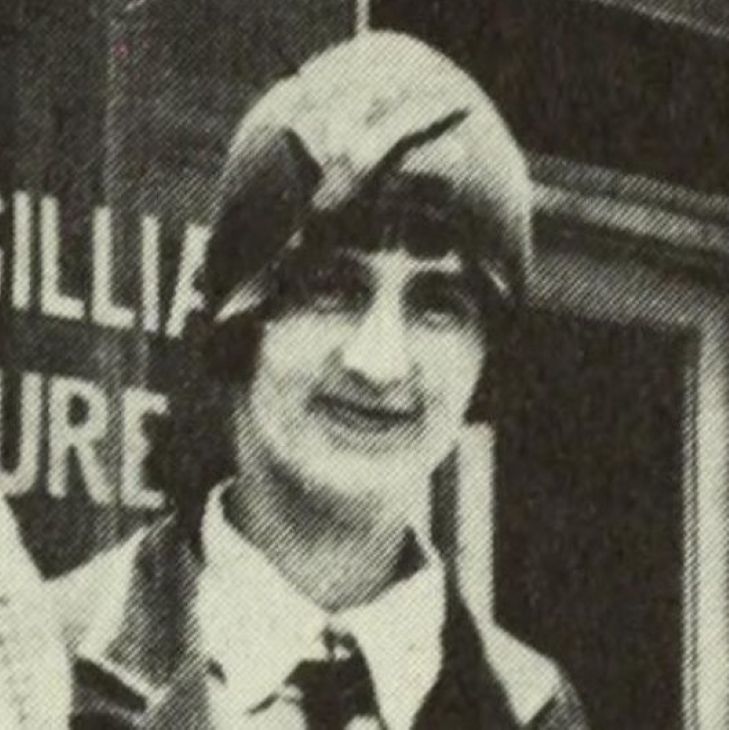
A short time ago we posted an article by Rose Wortis on the impact of the split in the Communist Party that saw the leadership majority, the so-called Lovestoneites, expelled as ‘Rightists’ had on the new T.U.U.L. orientation to building ‘Red Unions.’ Here Scotland-born textile worker and former leader of the T.U.U.L.’s National Textile Workers Union expelled as a supporter of Jay Lovestone, with her perspective.
‘The Convention of the Textile Workers’ by Ellen Dawson from Revolutionary Age (C.P.-Majority). Vol. 1 No. 6. January 15, 1930.
THE recent convention of the National Textile Workers Union is a good example of how an organization with the greatest possibilities for growth can be crippled and paralyzed by false policies and destructive methods. It is a real warning to all Party members and all revolutionary workers of what is ahead for us in all mass organizations and in all mass work if the wrong policies of the Party are not immediately changed.
The “new line” of the Party had already done great damage to the Union even before the Convention. Because of their support of the struggle of the C.P.-Majority Group both Dawson and Pires had been removed in the most mechanical manner from leadership in the Union. Previous to that Weisbord had been removed as Secretary. Eli Keller was chosen to replace him. But in the end Keller hesitated in carrying through the destructive line of the Party in the Union which means the destruction of the Union–and so Keller also was “removed” as Secretary without any authority or any ceremony. He was simply “put out” and a committee of three–J.P. Reid, Clarina Michelson, and Martin Russak–was “chosen” to take the place of Secretary until the Convention. Of these Clarina Michelson had never worked in a textile mill, Martin Russak was until recently a student in New York University, and even J.P. Reid who has good traditions, had not been working in a textile mill for a number of years. The few weeks before the Convention were full of confusion and demoralization.
The Convention was prepared on a narrow factional basis. No attempt was made to stimulate the initiative and activity of the workers and to elect the delegates from below. On the contrary the mechanical hold of the Party was paraded at every opportunity and “control from above” was the order of the day. In getting delegates to the Convention all efforts were made to keep out the “Lovestoneites” and everybody else who was suspected of having an opinion of his own or of expressing any criticism. But in doing this they also kept out some of the best non-Party workers and put the whole convention into a straight-jacket.
Some examples will show how the Convention was “prepared.” From Passaic there came only one delegate who was working in a textile mill at the time. On the other hand the Passaic unit of the Young Communist League as well as the Paterson unit and other units sent delegates to the textile workers convention! In New Bedford, instead of having mill meetings to elect delegates they had a “general meeting” at which Nahorsky, the organizer, brought in a slate and if it happened that those elected were not the same as the slate, Nahorsky disregarded the votes and himself “elected” his slate. Only three out of the many New Bedford delegates were non-Party workers! Keller, a member of the Executive Board, actually working in a silk mill in Paterson was not permitted to participate in the Convention.
It was officially claimed that there were over 200 delegates, “representing 32,000 members of the Union and 240,000 workers in the industry.” This is wild exaggeration. Even the number of delegates was exaggerated–there being no more than about 150. But that was nothing to the exaggeration in regard to the membership and to the “workers represented”–the figures were based on nothing but imagination, pure and simple. With such methods no organization can be built and the confidence of the workers won.
The Convention was carried on in the same spirit of narrowness and suppression. At the very beginning, when greetings e and the like were being sent, Keller got up and made a proposal to send greetings to the striking shoe workers of New York–which was greeted with hisses! Russak even made a motion not to allow Keller to make any motions at all! The attempt was also made by Nahorsky and Ben Wells (neither of whom ever worked in a textile mill) and their “strong arm” squad to get Ellen Dawson out of the hall, but without any success. Throughout the whole Convention Dawson, Pires, Keller and Weisbord were bitterly attacked and this seemed to be the main task of the Convention.
Reid reported for the National Executive and Beal on the South. Amy Shechter reported on Women’s Work and Sophie Melvin on the Youth–neither of them had ever been in a textile mill in their lives. The reports consisted of very little except the high-sounding empty phrases which sounded “revolutionary” but actually hid a complete lack of understanding of the real concrete tasks before the Union. Bill Dunne was the “general supervisor” of the Convention–that itself shows what sort of Convention it was.
There was practically no real discussion from the floor. Whatever discussion took place was very general and was fit more for a mass meeting than for a Convention. This was not the fault of the delegates but of the way the Convention was prepared and run and of the character of the reports.
The resolution adopted and the decisions of the Convention show that it made no real effort to tackle the problems of the textile workers in a realistic manner. The resolution is full of bombast and concentrates upon fighting the “renegades” and “right wingers.” The decision to call a general strike in the silk industry in February or March as well as a general strike in the whole textile industry at a time when the Union is disunited and demoralized and when no preparations have been made shows how adventurist and unrealistic the strike policy was.
The Convention elected an “executive council” of 41, but the real control lies in the hands of a small group. Hardly any of those who really participated in the militant textile struggles of the last four years (Passaic, New Bedford, South) are now in the leadership. Neither Weisbord, nor Keller, nor Dawson, nor even Murdock is on the big council. The new secretary of Union is Clarence Miller, who never worked in a textile mill in his life and who has never shown any ability in any direction. The miserable conditions of the textile workers in the United States, their lack of organization and the continual betrayals of the A. F. of L. bureaucrats makes the development of a militant union movement among them absolutely necessary. The workers are becoming more and more ready to struggle. In the past the National Textile Workers Union accomplished very much in the face of the greatest difficulties in supplying real leadership to the textile workers. But the “new line” in the Union which brings in disunity and weakness into its ranks, which deprives it of the services of valuable comrades, which makes it impossible really to tackle the great problems in an effective way constitutes a great menace to the Union. It must be overcome if the Union is going to develop.
1. It is interesting that this is the second textile convention from which Keller and I have been “thrown out.” We were expelled from the convention of the United Textile Workers in 1928, just before the formation of the N.T.W.U. But there were given the floor for four hours to defend ourselves!
Workers Age was the continuation of Revolutionary Age, begun in 1929 and published in New York City by the Communist Party U.S.A. Majority Group, lead by Jay Lovestone and Ben Gitlow and aligned with Bukharin in the Soviet Union and the International Communist (Right) Opposition in the Communist International. Workers Age was a weekly published between 1932 and 1941. Writers and or editors for Workers Age included Lovestone, Gitlow, Will Herberg, Lyman Fraser, Geogre F. Miles, Bertram D. Wolfe, Charles S. Zimmerman, Lewis Corey (Louis Fraina), Albert Bell, William Kruse, Jack Rubenstein, Harry Winitsky, Jack MacDonald, Bert Miller, and Ben Davidson. During the run of Workers Age, the ‘Lovestonites’ name changed from Communist Party (Majority Group) (November 1929-September 1932) to the Communist Party of the USA (Opposition) (September 1932-May 1937) to the Independent Communist Labor League (May 1937-July 1938) to the Independent Labor League of America (July 1938-January 1941), and often referred to simply as ‘CPO’ (Communist Party Opposition). While those interested in the history of Lovestone and the ‘Right Opposition’ will find the paper essential, students of the labor movement of the 1930s will find a wealth of information in its pages as well. Though small in size, the CPO plaid a leading role in a number of important unions, particularly in industry dominated by Jewish and Yiddish-speaking labor, particularly with the International Ladies’ Garment Workers’ Union Local 22, the International Fur & Leather Workers Union, the Doll and Toy Workers Union, and the United Shoe and Leather Workers Union, as well as having influence in the New York Teachers, United Autoworkers, and others.
PDF of full issue: https://www.marxists.org/history/usa/pubs/revolutionary-age/v1n06-jan-15-1930.pdf

