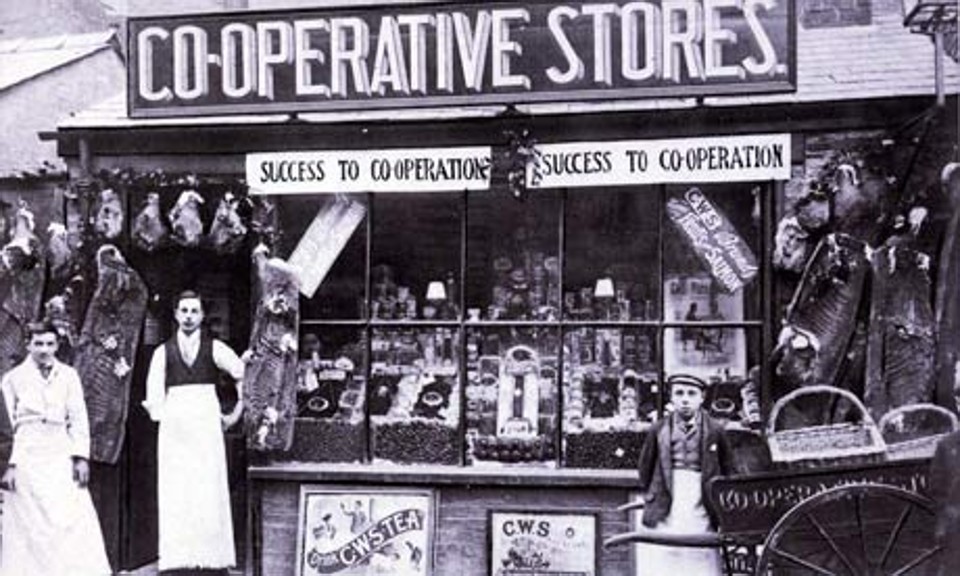
Murphy on the fraught Communist relationship with Cooperatives.
‘Communist Aims in the International Co-operative Movement’ by J.T. Murphy from International Press Correspondence. Vol. 7 No. 41. July 14, 1927.
In every country outside the Soviet Union the Communists are accused of having no interest in the Co-operative movement apart from that of disruption. No matter what proposals they make, they are looked upon with suspicion. The proposals are rarely examined, motives are ascribed to the movers of the proposals, and usually the discussion takes the form of a tirade upon the suspected motives of the proposers rather than the relation of the proposals to the problems that lie before the co-operative movement. This has been the case in our experience in practically every country during recent years.
It is difficult to know what our opponents really mean by disruption. If we say that by disruption they mean that we desire to give the co-operative movement another direction than that which it is taking at the present time, they would indignantly deny it. They would argue at once that all co-operators have the right to have their opinions and to seek for changes in the co-operative movement if they think it desirable. To which we can only reply it may be so, providing that the changes suggested are not made and suggested by Communists.
It is difficult to say other than this from our experience. For example, the British Co-operative News refuses to discuss anything with the Communists, although the editor and his correspondents may talk about the Communists, may misrepresent them, may distort their proposals to their heart’s content. In the American co-operative movement we have a very similar position where all kinds of articles are being utilised in a campaign to hound the Communists from the co-operative movement in America. The recent correspondence between the Centrosoyus and the German Co-operatives is sufficient evidence of the cordial relations of the German co-operatives to anything associated with the Communists. Yet what are the aims of the Communists in the co-operative movement throughout the world?
Our aims can be summed up comprehensively as follows: We seek to clear the co-operative movement of illusions as to what it can and cannot accomplish in the midst of capitalism to prevent the co-operative movement from being utilised as an instrument of the bourgeoisie and to harness its great powers in the struggle of the workers against the capitalists. Probably no movement is so full of illusions and so susceptible to the cultivation of illusions. Here is the great recruiting ground for the idea that by the development of the economic resources of the co-operative movement it will be possible to pass peacefully to Socialism, i.e., the workers will have no need to fight against the bourgeois state but out of their own meagre economic resources they can build up an economic power which will outcompete the trusts and all the mighty powers of bourgeois enterprise.
With this leading idea running through all their propaganda the co-operative movement becomes a nursery of pacifism. Where this has led the co-operative movement, we know only too well both in the experiences of the Great War of 1914-18 and in the present war on the Chinese Revolution. In both cases the co-operative movement has been quietly harnessed to the Governments conducting the war.
It is characteristic of the co-operative movement that rarely do its leaders make any attempt to fundamentally examine the course which the co-operative movement is taking and question at all these basic defects. They proceed in a truly petty bourgeois fashion and practice the gospel of laisse faire. Naturally, when the Communists come along and challenge them on these fundamental issues of the class struggle, they are annoyed. The more annoyed they become, the more violently they are transformed into ardent supporters of the most reactionary bourgeoisie. Nevertheless it is our task to expose these illusions and to tell the truth to the co-operators concerning the road upon which it is being directed by its present leaders.
But our work consists not only in negative criticism and exposure of false ideas but in putting forward proposals based upon the principle of developing the co-operative movement in the interests of the class which gave them birth and which alone can utilise them as a means to a new social order. i.e., the proletariat. For example, this principle governs our proposal for the united action of the co-operative movements and the trade unions in their respective struggles. On the one hand, we propose that the co-operatives should function as the commissariat of the workers in the strike actions of the unions. On the other hand as a means of making this course of action effective, our work is not confined simply to the days when strike action is upon us, but is directed to bringing in the workers en masse into the co-operatives as a most effective means of economising their resources and preparing for strike action with their unions. What disruption there can be in such a proposal, it is difficult to see.
Yet many things flow from this line of policy. It necessitates an advocacy of the investment of trade union funds in the co- operative movement, it provides facilities for the education of the workers and the use of their own resources as a class, it facilitates an extensive mobilisation of class resources and the means of neutralising a considerable element of the bourgeoisie in the class struggle. But whatever facilities it may provide in this direction, it cannot take away the necessity of making clear to the masses the fundamental direction which such a movement takes in its relation to the bourgeois state.
This brings us at once to a further dividing line between us Communists and the Reformists who still hold the reins of the co-operative movement. The latter make a creed of political neutrality, and the more they defend it the more they become the advocates of the preservation of the existing order. Our aim in this respect cannot be avoided however much we may offend those who accuse us of disruption. If it is disruption to tell the workers the truth concerning the relation of the state to the working class movement and to show from experience, even from co-operative experience, the need for conquering this state, then we are disrupters. There is no political neutrality in the co-operative movement and can be none. There is either loyalty to the working class or loyalty to the bourgeoisie.
In place of “political neutrality” we place the class aim of the proletariat and insist that any attempt on the part of the co-operatives to ignore this issue plays into the hands of the enemies of the co-operative movement. Hence, as in the realm of economic struggles we seek a united front of the trade unions and the co-operatives in the common struggle against the bourgeoisie, so in politics, we seek to harness the co-operatives to the working class movement and to give it a distinctly proletarian character and aim.
It follows most logically that, as the struggles on these issues are not entirely local issues but part of international class war issues of the age, our aims are similar in relation to the international aspects of the co-operative movement. For the same fundamental reasons that we combat the isolation of the co-operatives from the labour movement and the mass struggles of the workers in the various countries, we insist upon the need of combatting the so-called neutrality policy of the International Co-operative Alliance and set before international co-operation the necessity of transforming this body into an Alliance governed by working class principles working in co-operation with a single international trade union alliance governed by similar principles.
It is this policy and aim which has governed our criticism of its policy in the British coal strike and its line of action and its illusionary propaganda in connection with the Economic Conference of the League of Nations. In the coal strike it deserted the masses, and in the economic conference it has gone forward with a programme which is hardly distinguishable from that of the experts of the League of Nations itself.
Therefore, in setting forth our policy and our aims within the co-operative movement of the whole world, we Communists feel that in no wise are we the disrupters of this movement but are the real custodians of its interests. We destroy its illusions and bring it face to face with reality. We reveal to this movement who are its enemies and show how to conquer them. We face the co-operative movement therefore neither with apologies nor with fear, but with the certainty of victory. Along this path the Communist Party of the Soviet Union has led the co-operative movement of its Republics triumphantly. Along this path the Communist Parties of other countries will yet lead the international co-operative movement to similar victories.
International Press Correspondence, widely known as”Inprecorr” was published by the Executive Committee of the Communist International (ECCI) regularly in German and English, occasionally in many other languages, beginning in 1921 and lasting in English until 1938. Inprecorr’s role was to supply translated articles to the English-speaking press of the International from the Comintern’s different sections, as well as news and statements from the ECCI. Many ‘Daily Worker’ and ‘Communist’ articles originated in Inprecorr, and it also published articles by American comrades for use in other countries. It was published at least weekly, and often thrice weekly. A major contributor to the Communist press in the U.S., Inprecorr is an invaluable English-language source on the history of the Communist International and its sections.
PDF of full issue: https://www.marxists.org/history/international/comintern/inprecor/1927/v07n41-jul-14-1927-inprecor-op.pdf

