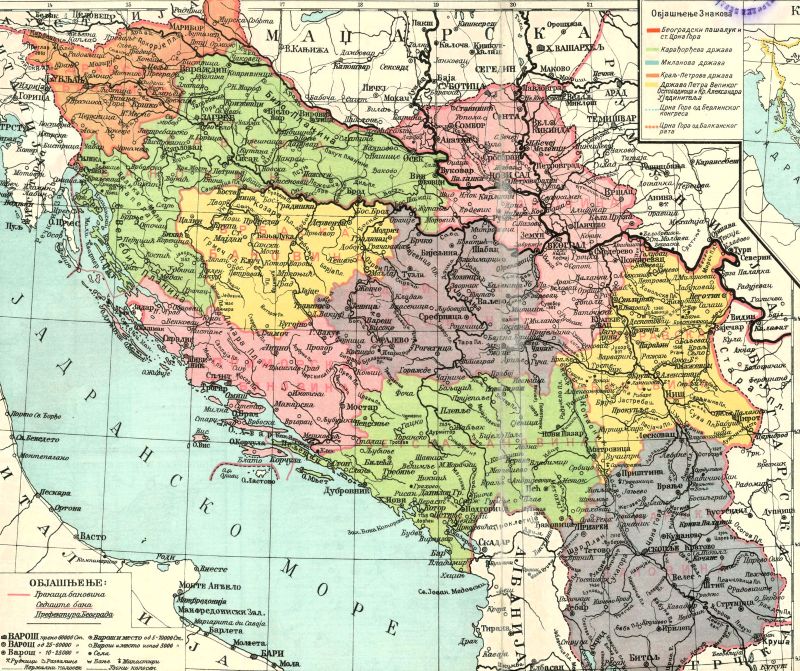
The maps of Yugoslavia redrawn, with traditional ethnic and national regions reshuffled to ensure the domination of the Serb ruling class, with no good coming to anyone else. On October 3, 1929 the “Kingdom of Serbs, Croats, and Slovenes” was renamed the “Kingdom of Yugoslavia” by King Alexander I. A useful explanation of the specific moves below.
‘The Political Significance of the New Administrative Division of Yugoslavia’ by P. Dragashevatz from International Press Correspondence. Vol. 9 No. 61. October 25, 1929.
Now that the new map of Yugoslavia and the statistical figures regarding the new administrative distribution have been published, this blow of the Great-Serbian dictatorship against the oppressed nationalities in Yugoslavia is apparent in all its brutality and ruthlessness.
The administrative re-distribution of the country has done away with all the old national frontiers. Croatia, which no regime hitherto dared to ignore and which possesses national conditions of a thousand years’ standing and a national culture of its own, has simply been extinguished as a state by the new regulations. Montenegro, which tor centuries preserved its independence and liberty against the attacks of the Turks and Western Powers, has now been eliminated from the map the world. Kosovo, a purely Albanian province which after the Balkan wars was violently separated from the rest of Albania, has now been divided into three fractions so as to facilitate the work of ousting and exterminating the Albanians. Bosnia with its century-old traditions has ceased to exist.
The main object the dictators have in view in this concoction is the arbitrary establishment of a Serbian majority in most of the provinces. This object has been attained in five provinces out of nine, viz. in the Danube, Drina, Morava, Durbas, and Zeta areas. To attain this end, recourse was had to the most arbitrary combinations.
The Danube province has been made to embrace the Voyvodina and a large part of Serbia, so as to establish the proportion of the Serbs, Germans, Magyars, Rumanians, Croatians, and other non-Serbian nationalities inhabiting the Voyvodina, Banat, Batchka, and Barania in great numbers in a sense favourable to the first-named. Official statistics show e 1,380,413 inhabitants of the Voyvodina to have consisted 514,124 Serbs and Croats and 866,289, or about 78 percent, other nationals (328,123 Germans, 382,070 Magyars, 74,094 Rumanians, 67,886 other Slavs, etc.).
The Drina province, which has a Serbian majority, has been made to include the purely Croatian district of Vukovar, which is too small to disturb the said proportion. This district again had been wrenched from the province of Vrbas, which in it might have influenced in such way as to give it a Croatian-Moslem character. Parts of Bosnia and Croatia have been very cleverly pieced together to form the Vrbas province and to give it a Serbian majority of 406,500 against 304,000 Croats and Moslems. This province has also been deprived of the Croatian district of Travnik, which has been replaced by the addition of the purely Serbian district of Dvor, so as to strengthen the Serbian majority.
The purely Croatian district of Travnik, eliminated so that it should not disturb the Serbian majority, has been added to the Litoral province which is a purely Croation area, the character of which was in any case not to be altered.
So as to destroy the Albanian majority in Kosovo and at the same time paralyse Montenegro, the province of Zeta has been formed of part of Kosovo and the whole of Montenegro, so that the Serbo-Montenegrin element should be in the majority. So as to enhance this effect, the Albanian districts of Kuchitrn and Podaievo were excluded and added to the Modava province, which is purely Serbian and cannot be harmed by such an addition.
The historical designation of “Banovina” which has been given to the new provinces is in itself a trick to dupe the Croats. Croatia having while under Austrian rule for centuries been divided into “Banovinas” and governed by “Banuses”. But while this expression in former times stood for something typically Croatian, nay, for Croatia itself, the present Banovinas” are nothing but administrative districts in which national Croatian characteristics have been obliterated, while the “Banuses” are administrative officials subject to the Ministry of the Interior, of which, like the prefects, they are merely executive organs.
By this division of Yugoslavia, the dictatorship has not only abolished national territories; in the artificially formed Serbian provinces it has managed to comprehend the most important economic regions of the country. These five Serbian “Banovinas” comprise the most important mining areas and the largest timber industries and are also the most fertile agricultural regions. Besides this, they are linked up by the strategically valuable railway line from the Danube to the Adriatic. The outcome of this administrative reform of the dictators may be summed up as follows: Croatia has been deprived of more than half of the purely Croatian territory, which has gone to make up “Serbian” provinces. Montenegro, the Voyvodina, and Albanian Kosovo have been nationally destroyed. Macedonia has been united with part of Kosovo and with the Serbian district of Vranye, the whole making up the “Serbian” province of Vardar.
Statistics in regard to area and population best serve to show the Serbian depredations. The five provinces with a Serbian majority form a total area of 136,034 square kilometers, with about 6,290,000 inhabitants; together with the province of Vardar, which the dictators have proclaimed to be Serbian and which they are determined to render Serbian by force if needs be, the Serbian provinces aggregate 175,000 square kilometers, with 7,695,000 inhabitants. The non-Serb provinces including the province of Vardar, have 111,816 square kilometers and 5,505,000 inhabitant’s; without Vardar they figure at 72,250 square kilometers and 4,160,000 inhabitants. The true proportion of nationalities in the country, however, is 4,450,990 Serbs to 8,000,000 non-Serbs.
So as to wipe out the last traces of the individual nationalities, the hoisting of national (Croatian or Slovene) flags, which were hitherto used side-by-side with the official Serbian colours, has been prohibited.
International Press Correspondence, widely known as”Inprecorr” was published by the Executive Committee of the Communist International (ECCI) regularly in German and English, occasionally in many other languages, beginning in 1921 and lasting in English until 1938. Inprecorr’s role was to supply translated articles to the English-speaking press of the International from the Comintern’s different sections, as well as news and statements from the ECCI. Many ‘Daily Worker’ and ‘Communist’ articles originated in Inprecorr, and it also published articles by American comrades for use in other countries. It was published at least weekly, and often thrice weekly.
PDF of full issue: https://www.marxists.org/history/international/comintern/inprecor/1929/v09n61-oct-25-1929-inprecor.pdf

