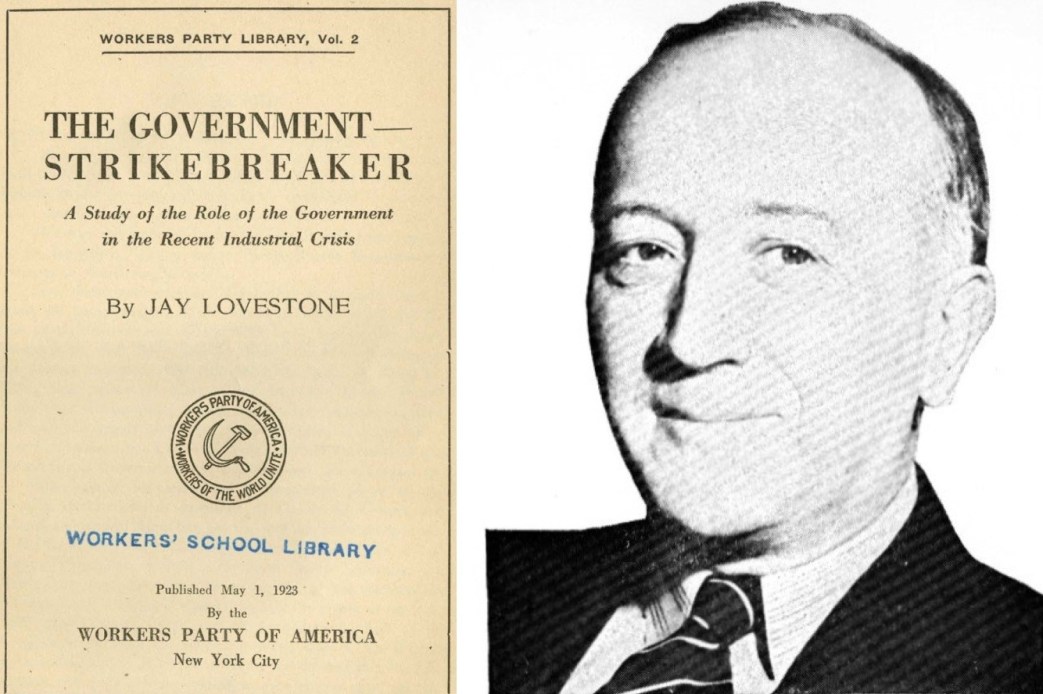
Would the U.S. working class have to pass though first a Social-Democratic, or even a lessor Labor Party ‘stage’ before being able to absorb to the Communist perspective and therefore, should not Communists focus on building such parties rather than an explicitly Communist Party? This was central factional division in the Communist Party of the mid-1920s, and while in the context of larger Comintern debates, it was firmly rooted in the U.S. situation and conditioned by a long-standing disagreement among the left. An excellent window into that debate is Foster’s evisceration of a substantial book by Jay Lovestone dealing with among other conflicts, the 1919 steel strike, in large part led by Foster.
‘Lovestone’s Labor Party Book’ by William Z. Foster’ from the Daily Worker. Vol. No. January 7, 1925.
IN the present party discussion, one of the main contentions of the C.E.C. is that the farmer-labor Communists tend strongly to liquidate the Workers Party by pushing it and its interests into the background and by making their “class” farmer-labor party an end in itself. With high indignation the self-styled “Marxian trunk” of our party repudiate this accusation. They declare that with them the farmer-labor party is the merest instrument for the building of the Workers Party, and that they never for a moment forget that they must use it to develop the prestige and leadership of the Workers Party amongst the masses.
After which, it is highly instructive to take a look again at Jay Lovestone’s book, “The Government–Strikebreaker.” This book is a striking proof of the correctness of the contention that the “class” farmer-labor party slogan, as proposed by the minority, leads directly, under present conditions, to opportunism and liquidation of the Workers Party. Lovestone’s book is labor party propaganda pure and simple. It ignores the Workers Party altogether.
“The Government-Strikebreaker” has 371 pages. It is by far the most pretentious literary effort ever made by the Workers Party; and the subject it deals with–the government as a class organization and what to do about it–is one of the most vital consequence. In this book, considering all the expenditure of money and effort, and with such an important subject, was a splendid opportunity for the Workers Party to make effective propaganda for itself. Indeed, in the very nature of the subject, the book, to be of real value to the Workers Party, had to demonstrate clearly that the Communist program alone indicates the only way the workers can emancipate themselves, and that the Workers Party is the only party capable of leading the working class to the overthrowal of capitalism.
But Lovestone’s book does none of this. It forgets entirely the main objective of building the Worker’s Party. It is concerned only with the formation of a labor party. The book appeared in 1923. Lovestone, like Pepper, and so many others, was already obsessed with the labor party-ism which at present so sharply characterizes him. He undertakes an elaborate analysis of the capitalist state, showing how it operates as an instrument of the capitalist class against the working class. But then, instead of bringing the Workers Party to the fore, by demonstrating its function as the vanguard of the proletariat and by outlining its immediate program and ultimate goal, he actually leaves the Workers Party out of the picture altogether. His book degenerates into nothing more or less than an argument for a labor party. This costly publication, which should have been a powerful exposition of Communist principles, policies, and organizations, turns out to be merely propaganda for the labor party.
The extent to which Lovestone shoves aside our party is almost incredible. In the whole bulky volume the Workers Party is actually mentioned only once. That and no more.
This lonesome mention occurs on page 334, when Lovestone merely incidentally, in his usual role of disinterested spectator, remarks briefly that the W.P. delegates were not seated at the C.P.P.A. conference In Cleveland in 1922, So Intent is he on boosting the labor party as an end In Itself, that he does not even consider it worthwhile to state why they were not seated or what their program was. Indeed, at no point in the whole book does he even indicate that the Workers Party favors the formation of a labor party, or tell why it does, or what its labor party policy is. He says absolutely nothing about the big fight the Workers Party was then making throughout the labor movement for the labor party. He does not point out the limitations of a labor party, nor does he even remotely indicate the necessity for the revolutionary Workers Party to lead the workers to the revolution. He is so intent upon making propaganda for the labor party that he ignores the Workers Party completely.
This systematic suppression and obliteration of the Workers Party is what the farmer-labor Communists call keeping the Workers Party in the foreground and exploiting the labor party movement for its benefit. But we of the C.E.C. majority dub it what it actually is, a policy of opportunism and liquidation. Lovestone’s book is an advocacy of the labor party as an end in itself. There is no other conclusion possible from a reading of the book. While Lovestone Indicates the class character of the state and at least hints that the workers must abolish it, he by no means says that the Workers Party is necessary to do the job. His analysis leads merely to an argument for the formation of a labor party. The assumption is that such a party is sufficient. From the text there is no chance that a reader could get any information about, or an appreciation of the Workers Party and Its role. The Wackers Party is simply not in the book. Seemingly its only function is to humbly pay the heavy bills for this opportunistic labor party propaganda and to modestly put its name on the book cover as the publisher.
In his recent article, Comrade Manley estimates that $50,000 had been directly spent in our labor party propaganda. This is a fair estimate, although Comrade Ruthenberg evasively disputes it. To it should be added the high cost of Lovestone’s book, which in labor party propaganda deluxe. Since his book came into question, the minority comrades who engineered its publication are very shifty and indefinite about what it cost to produce. But considering the extensive research work done and the expensive make-up of the book, it must have cost $3,000, if not more.
Comrade Lovestone wrote the book In his beat opportunistic style. Not only did he keep the Workers Party out of it altogether, but he also carefully edited out revolutionary expressions and references. He was desperately anxious to be respectable and to make a good showing with the labopartyites. It is a glowing example of the kind of propaganda our party should not make.
In the present party discussion, Comrade Lovestone constantly exudes quotations, however inappropriately, from Marx, Lenin, Zinoviev, and other revolutionary leaders. An inexpert reader would conclude that these men were the great originators and defenders of the “class” farmer-labor party. But in his opportunistic “The Government-Strikebreaker,” Lovestone disposes with them very nicely. He does not quote one of them. Although Lovestone attempts the fundamental Communist task of analyzing the capitalist state, explaining the robbing of the workers through the wages system, and of finding a remedy for this exploitation, he never finds it necessary to mention the names of Marx or Lenin, or of any other world-known revolutionist once in the entire book. In fact, except for myself (I am quoted a number of times) all the authors cited are thoroughly respectable bourgeois. Not even the taint of socialism is upon any of them, much less Communism.
In making his opportunistic analysis of the state and in providing his quack remedy of a labor party, Lovestone had little use for the sayings of revolutionists, American or foreign. When he analyzes the state his authorities are not Marx or Lenin, but Woodrow Wilson, Beard, Fiske, McMaster, Bryce, and similar. When he wants an authority on the exploitation of the workers he tells us what was said by Representative Ricketts, whoever he may be. Various reactionary politicians and economists illuminate his points on wages. Sen. Shields and Allen Smith expound on the class nature of the courts and the “class character” of the persecution at Herrin was most forcefully “exposed” by A.W. Kerr, attorney for the defense–I thought the Workers Party had had something to say upon that subject.
Lovestone’s book deals largely with the textile, mining, and railroad strikes of 1922. But not a word does he say about the policy of the Workers Party, or of the part played by it in these struggles. In the whole book there is not a single quotation from the Worker or from any statement of the Workers Party. On the other hand, the book is just packed with quotations from reactionary papers, politicians, labor leaders, and economists. When he indicates the growing class consciousness of the workers in the struggles mentioned, he cites not the Worker, but the Railway Clerk. When he wants an appraisal of the significance of the Herrin trial, he takes it from a manifesto of the Illinois farmer-labor party. So it goes, all through the book. Respectables and fakers crowd one another’s heels, so much so that there is no room, or, in Lovestone’s conception, need for revolutionaries. The Workers Party and the revolutionary movement in general are kept well in the background. This fits in very nicely with the labor party conclusions at the end. One thing that makes me feel queer is the various quotations from the Labor Herald and myself. How come we in such respectable company? We are the only revolutionary sources quoted in the entire book. Why pick on us, Comrade Lovestone? What did we ever do to you that you should include us in such ultra-orthodox company? But, perhaps, the explanation is that by calling the Labor Herald “the wellknown trade union magazine” and myself “one of the ablest and leading advocates of amalgamation,” you figure that we are kosher enough to get by. Certainly you do not link us up any way with the Workers Party, whose identity you are so careful to suppress all through the book. Since, in the party discussion, I have pointed out that Lovestone’s book advocates the labor party as an end in itself, the minority comrades are making the most desperate efforts to explain it away. They say my own writings are no good. But even if we admit this, how can it excuse the self-admitted great Marxian, Lovestone, for his [word smudged]? They also say that even Lenin sometimes wrote pamphlets without directly advocating the Communist Party.
But can we (as yet) compare Lovestone with Lenin? And whoever heard of Lenin, who about all others taught the principle of always keeping the Communist Party in the forefront, writing a 371-page book, leaving all mention of the Communist Party out of it, and concentrating his whole argument in a demand that the working class work for a party rival to the Communist Party? No one, of course, Then the argument is made that Lovestone’s book has been translated in Russia. But what of that? lends no endorsement of his farmer-labor party deviations. The Russians are far from endorsing in toto all that they translate and publish. This is a matter of common knowledge. They have translated Upton Sinclair’s books, the life of Henry Ford, Taylor’s works, and many others far from Communist in conclusions.
That Lovestone and his minority followers may squirm as they will. But his book speaks for itself. It is a clear.
The Daily Worker began in 1924 and was published in New York City by the Communist Party US and its predecessor organizations. Among the most long-lasting and important left publications in US history, it had a circulation of 35,000 at its peak. The Daily Worker came from The Ohio Socialist, published by the Left Wing-dominated Socialist Party of Ohio in Cleveland from 1917 to November 1919, when it became became The Toiler, paper of the Communist Labor Party. In December 1921 the above-ground Workers Party of America merged the Toiler with the paper Workers Council to found The Worker, which became The Daily Worker beginning January 13, 1924.
PDF of full issue: https://www.marxists.org/history/usa/pubs/dailyworker/1925/1925-ny/v02a-n246-jan-07-1925-DW-LOC.pdf

