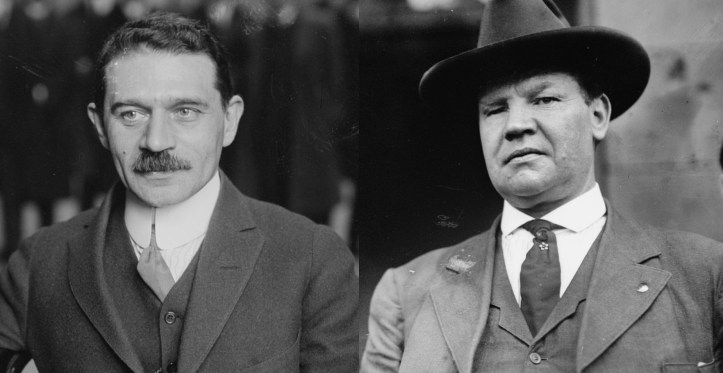
The reformist lawyer debates the revolutionary miner at Cooper Union, hostile territory for the Left with the Hillquit-supporting New York Call making no attempt to hide the encouragement for their corner. These were not academic debates, genuinely impacting the course of the Socialist movement. Immediately following William D. Haywood’s resounding 1911 insurgent left wing election victory to the Socialist Party’s seven-person leading National Executive, the seriously rattled the right-wing at once began a campaign against Haywood and his left supporters, culminating in the S.P. changing its constitution at the 1912 National Conference, adding “Article 2, Section 6” making membership incompatible with one who “advocates crime, sabotage or other methods of violence.” Charged with its violation by the State Committee of New York, Haywood, though not expelled, was removed from the N.E.C. in February, 1913.
‘Hillquit and Haywood Clash in Debate on Party Tactics’ from The New York Call. Vol. 5 No. 12. January 12, 1912.
Hillquit and Haywood Argue Over Labor Union Question.
COOPER UNION FILLED
Great Interest Shown in Discussion of Attitude Toward Organization.
The first of a series of meetings for the discussion of the various problems confronting the Socialist party of America was held in Cooper Union last night with Julius Gerber, organizer of Local New York, which has arranged these meetings, presiding.
The big hall was jammed to the doors and the audience followed every word of the protagonists with breathless interest.
The meeting was a sort of family affair, only holders of red cards being allowed in the hall. A few Socialist Labor party men smuggled themselves into the crowd on borrowed S.P. cards. They were promptly recognized and Chairman Gerber, asked that they leave the hall, which they did.
The subject of the discussion last night was “What shall the attitude of the Socialist party be toward the economic organization of the workers?”
William D. Haywood and Morris Hillquit were the debaters. Each of them was given an hour, the time being divided as follows: half an hour for the outline of the debate by each speaker, then each one got twenty minutes for rebuttal and finally ten minutes for closing the discussion. Haywood opened the discussion. The burden of his arguments in the main was that the Socialist party should go among the workers and begin a propaganda for Industrial unionism, for one big union, He assailed the American Federation of Labor and said that the Socialist party is acquiescing in the policy of the American Federation, which was a distinctly anti-Socialist and capitalist policy.
Industrial Form Superior, But–
Hillquit in his reply to Haywood said that there can be no question in the mind of any Socialist that the industrial form of organization is superior to the craft organization. But he did not believe that the Socialist should begin preaching industrialism outside of organized labor. The Socialist party, he said, should keep up Its policy of trying to reach the workers in their present unions. The policy has been successful, Hiliquit said, as Is shown by the fact that every ag union affiliated with the American Federation of Labor has Socialists in important positions, as well as in the rank and file. These men have been elected to these positions by the rank and file, he said, because they were Socialists.
Haywood continually shifted from an attack upon the A. F. of L. to a criticism of Hillquit’s views on industrial organization. The A. F. of L. is a job trust, he said, and asked whether such an organization, which is a “capitalist organization” and against the Socialist party, should be supported by the Socialist party of America. He quoted President Taft, who praised the A. F. of L. for its conservatism and anti-Socialist stand. In support of his statement that Hillquit is tied to the A. F. of L. view of the labor problem and that Hillquit’s Socialism is not Socialism. He showed an agreement made between the Cloak Makers and their employers after their strike in the summer of 1910, which contained such expressions as designed to avert violent contests between the cloak makers and their bosses for all time, to establish fair and harmonious relations between both parties to the agreement.” Hillquit was one of the men whose names appeared on the agreement,
Hobnobbing with A. F. of L.
He also cited a resolution National Executive Committee by Hillquit. Berger and others addressed to the heads of the A.F. of L. for financial backing in the Los Angeles mayoralty campaign. Such hobnobbing with the A, F. of L leaders, Haywood thought, was un-Socialistic. Haywood opened his address with the following epigrammatic sentences:
“One big union is a synonym for Socialism. One big union should be the slogan of every Socialist agitator in the workshop and on the platform.”
Haywood then read a passage from Marx, in which Marx said that “trade unions fail generally by limiting themselves to a guerrilla war.” He quoted resolutions from the newly formed British Socialist party, in which a decided stand was taken Against the craft unions of Great Britain and in which the general strike was advocated. The same resolution condemned the leaders of the craft unions and charged them with betraying the workers in the recent strike.
“I propose,” Haywood said, “to tie here tonight Comrade Hillquit with such labor leaders. He compromises and arbitrates the working class on the economic field.”
Haywood then tried to show that Hillquit’s attitude on the labor question is the same as the attitude of the A. F. of L. leaders and of the Civic Federation heads, for the Civic Federation heads advocate compromise.
No Militia Under Socialism.
Haywood capped the climax by reading extracts from Hillquit’s book on “Socialism in Theory and Practice,” in which Hillquit said that Socialists advocate a sort of national democratic militia modeled on the Swiss army.
Secretary of War Stimson, Haywood said, is advocating the same scheme now and he concluded:
“I never knew that under Socialism we were going to have militia. This is not a part of Socialism or of the Socialist program.”
Hillquit’s reply to Haywood was devoid of personalities except in as much as Hillquit was forced to clear himself from the attacks made upon him by his opponent.
Hillquit said:
“I hope Haywood will not continue to connect me with the A. F. of L and the Civic Federation as he has threatened to do. It will only be a waste of time. This debate is not a battle of wits, but an honest endeavor to gain some light and clarity on some vital subjects before the Socialist party.
Hillquit Stands by International.
“I have no new message for you. My stand on the economic question, the stand taken by the Socialist party of this country, is the stand of the International Socialist party, The British Socialist party, which Haywood quoted as authority for his views, is not the real Socialist party of England. It has no standing in the International Socialist movement. The passage he read from Marx nowhere endorses the general strike. In the passage quoted Marx speaks of political action and shows that the present action of the trade unions in insufficient.
“The Socialist party is doomed to failure unless it has the support of labor.” Hillquit then defined political and economic action as the two arms of the Socialist movement. But political action, he said, is the right arm, the stronger arm, of the two, because it means class action and therefore more potent action. “The political organization of labor,” Hillquit said, “is today somewhat more important. It does not, of course, mean the neglect of economic organization. The trade unions are the best recruiting field for the Socialist party.”
As to Industrial Action.
Coming to the question of industrial unionism, the subject under discussion, Hillquit said there are three things to be considered in deciding the attitude toward the question.
First–Is the industrial form of organization superior as a weapon on the class struggle?
Second–Is it in the province of the Socialist party to work for industrial unionism?
Third–If it is, shall we work for industrialism in the ranks of the A. F. of L, or shall we go out and create a new labor movement in the hope that we may create something better? Hillquit then answered each of these questions.
“I fully believe,” he said, “that the Industrial form of organization is superior to the trade form. On this there is no difference of opinion between us. The industrial form of organization is more in accord with the organization of capital. But I do believe that a great many of our Comrades are exaggerating the importance of the form of the structure of organization. What is important is to enlighten the workers) themselves. Turn the A. F. of L. into an industrial organization without changing the spirit of the men and they will be reactionary.
They will be against Socialism all the same. Enlighten the craft unionist in the A.F. of L. make a Socialist of him and he will be an industrialist. The important thing is to imbue the worker with Socialist spirit with the spirit of solidarity. The proper form of organization will then find itself.
Outside Party’s Province.
It is not within the province of the Socialist party to make propaganda for industrial unionism. There is even a positive danger from such advocacy of industrialism. Our over enthusiastic industrialist advocates are prone to form new labor organizations, and this is a blow to the Socialist movement. The Industrial Workers of the World is an example of what I mean. This new organization is doing nothing but creating dissension within the Socialist movement. The A.F. of L. pays no attention to the I.W.W. It knows nothing of it. But in the Socialist movement it is creating trouble all the time. It is embittered over its failure and is sowing dissension. The I.W.W. movement, I say without hesitancy, is an anarchist organization.
Hillquit then cited the progress which Socialism has made within the ranks of the trade unions that are affiliated with the American Federation of Labor and showed that instead of Socialists turning their backs on the American Federation of Labor and abandoning it as a “capitalistic” organization, they had better redouble their efforts on it and before long it will be pretty largely a Socialist organization.
The personal attacks upon Hillquit by Haywood were answered by Hillquit briefly and with striking convincingness.
Haywood’s chief argument was that Hillquit and Berger truckled down to the A. F. of L for financial assistance during the mayoralty campaign in Los Angeles. Hillquit replied that this thing had been done before, notably in the case of Haywood himself. When he was tried for his life. assistance was asked in his behalf from the A. F. of L. and the organization which Haywood now brands as a capitalist organization did much to save Haywood’s life. Great Applause for Hillquit. A tumultuous applause greeted these remarks of Hillquit, and Haywood himself looked somewhat abashed.
As for the citation from Hillquit’s Socialism about national militia, Hillquit said that this was not an invention of his, but it was the thing adopted by the International Socialist movement. It did not mean that there would be a military in the future Socialist state. Such an army was stipulated for pending the slow and painful struggles for the future state of Socialist Commonwealth. As for the contract between the cloak makers and their bosses read by Haywood, Hillquit said that he was only one of three arbitrators to whom the controversy was submitted. He was not the lawyer for the union. And in spite of Haywood’s fault finding, this agreement had improved the conditions of the cloak makers, had given their delegates the opportunity to enter shops and see that they are safe for the workers to toll in and has strengthened the union generally. “Haywood says,” Hillquit concluded, “that industrial unionism and Socialism is the same thing. You applaud this. Instead of applauding him, why don’t you ask him for proof that it is the same thing. It is his assertion stands merely as a declamation.”
As Haywood’s Final Reply.
Haywood took the floor to reply in This final ten minutes.
He declared there is nothing in common between the policies of the American Federation of Labor and the Socialist party. The former, he said, is craft conscious as opposed to the class consciousness of the latter. He went on to show that by high initiation fees, curtailment of apprentices and even closing of books, membership is kept down and would-be members excluded. This results, Haywood said, in the condition in many of the jails he had visited in various parts of the country, where he found many young Americans, deprived of the opportunity to learn a trade, driven to crime and its resulting punishment. Commenting on Hillquit’s reference to the fact that it was the American Federation of Labor’s membership that was largely responsible for the freeing of Haywood, the speaker declared the imputation to be unfair, arguing that, while he was sensible and grateful for the work that had been done on his behalf, those who secured his freedom did not therefore have his policy at their disposal. “I could,” he said, “have changed my policy without going to jail.”
He went on to say that he had never advocated anything else but the organization of the workers as one, man, and that he had believed and still believes the craft form of organization to be “ethically unjustifiable and tactically suicidal.”
At the same time he urged the necessity for political action, the political power to be used, not after the social revolution, but under present conditions, citing as an instance of its use the turning of the police against strikebreakers instead of against strikers,
Haywood explained that in criticizing the American Federation of Labor he criticized its leaders, who were members of the Knights of Columbus and of the Civic Federation executive.
Hillquit Finds Mystery Deep.
In taking the floor to close the debating. Hillquit declared that the mystery had deepened, seeing that Haywood did not oppose the rank and file of the A. F. of L. but the members of the Executive Committee of the Civic Federation.
Upon Haywood’s remarking that it was the policies of the A. F. of L. he opposed, Hillquit declared that these policies represent the mental attitude of the rank and file of the membership of the A. F. of L. and went on to urge that by educating the rank and file in the principles of Socialism the rank and file would leave Gompers, Mitchell and Morrison behind, and asked what, if Haywood believes in the rank and file, was the reason for the debate.
Hillquit declared that in the course of this controversy an unfair method had been pursued. That was typified in Haywood’s arguments against those members of the Socialist party who are opposed to rival organizations and I.W.W.ism, when he assumed that his opponent stood for the conservatism. corruption and reactionary policy of the labor unions, and then lambasted Gompers, Morrison and Mitchell as though these men were the same men as his Socialist party opponents.
The difference between the speaker’s policy and Haywood’s, Hillquit declared, was that the former, while condemning the policies of Samuel Gompers, made efforts to educate the rank and file, while Haywood was ready to kick over and destroy the whole A. F. of L.
Declaration of Neutrality.
In closing, Hillquit quoted the declaration of neutrality by the Socialist party on all questions concerning the internal affairs and methods of organization of the labor unions. Since that declaration great progress had been made by the Socialist propaganda in the A. F. of L. and Max Hayes was quoted where he gave a long list of labor unions in the A. F. of L. that had elected Socialists to the most responsible official positions because they are Socialists and known as such, Hillquit also quoted Hayes as showing that many unions, once separate, are closing their ranks and becoming more powerful in accordance with the idea of industrial organization.
Hillquit urged that in view of the tremendous strides made during the last two or three years by the Socialist party in winning the confidence of the tank and file of the labor unions, as shown by the victories in Schenectady, Milwaukee and many other cities, consequent upon the neutral policy of the party, it would be absurd and foolish to alter that policy. He pointed out that the Socialist party for the first time in America has secured the power and dignity of a social and political force, that it had done so since it had left the policies of the S.L.P., and declared that he stood for the policy that had meant and would still mean success.
The New York Call was the first English-language Socialist daily paper in New York City and the second in the US after the Chicago Daily Socialist. The paper was the center of the Socialist Party and under the influence of Morris Hillquit, Charles Ervin, Julius Gerber, and William Butscher. The paper was opposed to World War One, and, unsurprising given the era’s fluidity, ambivalent on the Russian Revolution even after the expulsion of the SP’s Left Wing. The paper is an invaluable resource for information on the city’s workers movement and history and one of the most important papers in the history of US socialism. The paper ran from 1908 until 1923.
PDF of full issue: https://www.marxists.org/history/usa/pubs/the-new-york-call/1912/120112-newyorkcall-v05n012.pdf

