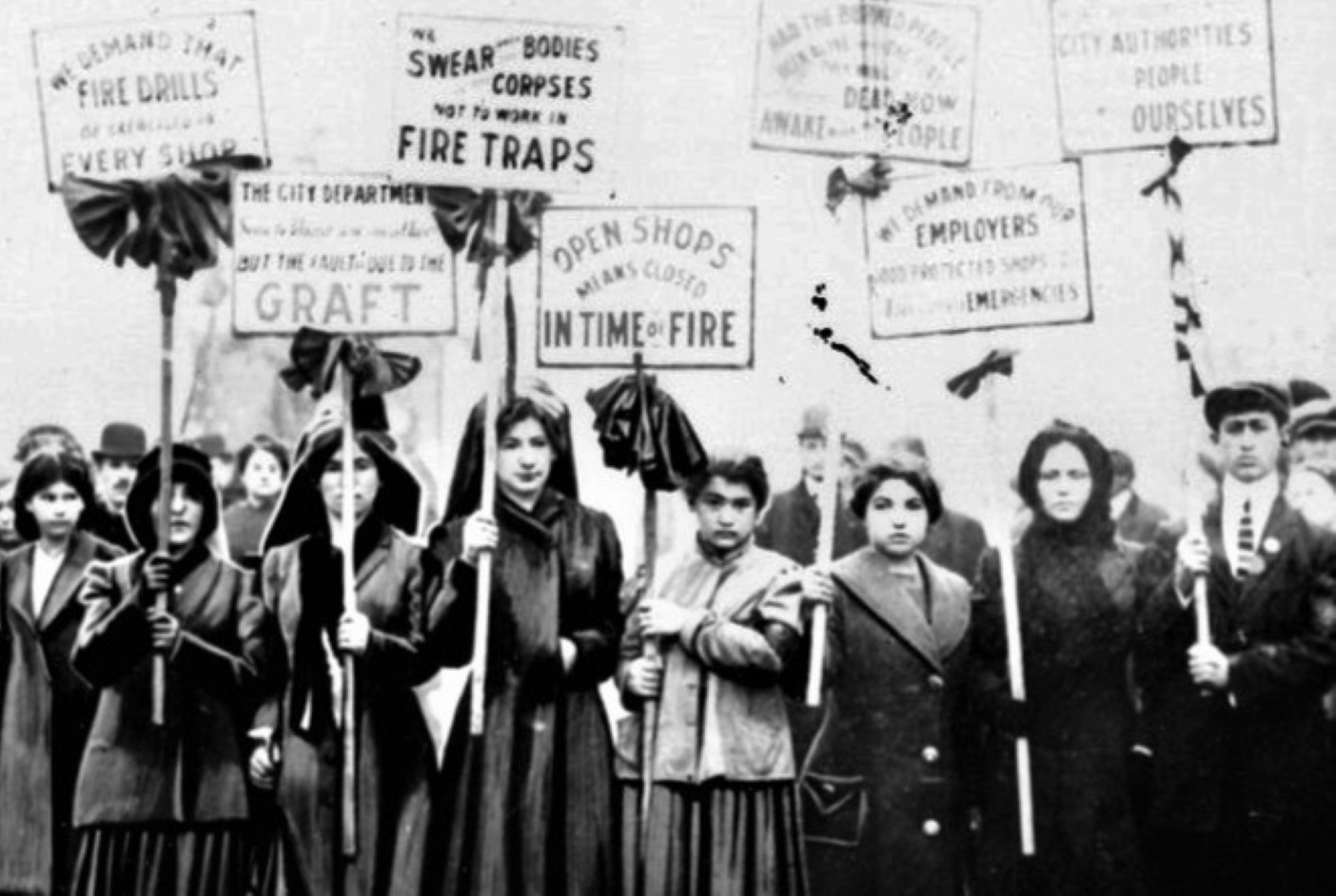
Mailly reports on the Boston convention of the National Women’s Trade Union League held during that watershed year for women’s labor organizing, 1911.
‘Militant Workingwomen in Convention’ by Bertha H. Mailly from St. Louis Labor. No. 546. July 22, 1911.
Then rise as you ne’er rose before!
Nor hoped before!
Nor dared before!
And show as ne’er was shown before,
The power that lies in you!
Stand all as one!
‘Till right is done!
Believe, and Dare, and Do!
These words, sung over and over again by the chorus of girlish voices, was the key-note to the proceedings of the Third Biennial Convention of the National Women’s Trade Union League of America, held during the week of June 12 to 17 in Boston. This body, consisting of 77 delegates from seven industrial centers of the United States, as well as one fraternal delegate from Germany, was most significant for what it symbolized, the increasing and threatening importance of woman in the industrial field, and the advance of the organization of working women into trade unions. It also voiced the sympathetic and business-like co-operation of trade unionists and non-trade unionist women to secure labor legislation on class-conscious lines.
When the Women’s Trade Union League was founded, in this same city of Boston, in 1903, at a convention of the American Federation of Labor, not more than five women members of trade unions were present. At this latest convention there were in all 53 members of trade unionists, representing 25 different trades. In the last two years the League has doubled its membership, and there are now seven branches, located in Boston, Chicago, New York, St. Louis, Kansas City, Mo., Springfield, Ill., and Baltimore. Denver was granted a charter at this very convention, and so many are the calls from working women all over the country to organize branches that the League finds it difficult to solve the problem of organization. The branches in the West seem more closely affiliated with men’s trade unions than in the East, the league in Kansas City having been organized in response to the demands of the trade union men of the city, and remaining closely related to them.
Among the delegates were many who have stood forth as heroic figures during the great industrial struggles of the last two years. “The world-old struggle between human slavery and human freedom is being fought out in this age on the battlefields of industry,” said Mrs. Raymond Robins, national president of the League, in her report to the convention. And it was as actual fighters in the hand-to-hand conflicts with the employing class that these young strike leaders came to the Boston meeting.
There was little Clara Lemlich, whose words, “I’m tired of talking and doing nothing. I move we go on general strike,” at the now celebrated meeting at Cooper Union, in November, 1909, precipitated the great strike of the 30,000 shirt-waist makers of New York, which strike, it is safe to say, would have failed had not the Women’s Trade Union League of New York put all its resources and fighting strength at the service of the strikers.
There were also three young girls, all recruits to the trade union movement within the last year, who told the stories of their respective struggles in a way that thrilled the listeners with the vision of the woman who is to come. Tall, slender Julia Pugh, from Springfield, Ill., told how the Retail Grocery Clerks of that city were organized after repeated failures and thereby secured a raise in the minimum wage from three dollars and a half to nine dollars a week.
Pearl McGill related the story of the deadly conditions under which the pearl button makers of Muscatine, Iowa, worked until they were forced to strike, and how then, with the help of the Chicago Women’s Trade Union League, the workers won their principal demand, the right to organize. When the strike was over, Pearl went through the Mississippi Valley, organizing other pearl button workers. Rosy and sturdy, and looking as though just off the farm, as indeed she was a very few years before, she was the center of one of the convention festivities, a boat trip down beautiful Boston harbor to Nantasket, which was turned into a celebration of Pearl’s–what do you think?–well, her seventeenth birthday.
The third of this trio of militant young sisters in toil, Mollie Lipshitz, appealed in broken English for the financial aid of the League in preparing for a general strike of White Goods Workers in New York, which she declared must come in the trade because of the brutal treatment of the workers in it. “What can be worse?” said Mollie, “than starvation wages, long hours, to have to pay for our electric power, and then not be safe in the factories?”
Three typical trades and three typical girl agitators! And their number is increasing daily–which is the hope and the certainty of the eventual freeing of working women from the industrial blight that takes away “the glory and strength of motherhood, the dream and music of childhood.”
It is impossible to mention all those who, like Agnes Nestor, the able organize of the Hat Trimmers of New York, or Helen Marot, the indefatigable secretary of the league in New York; Mabel Gillespie of Boston, Emma Steghagen of Chicago, Mrs. D.W. Knefler, president of the St. Louis League, have worked so long for the organization of working women that they can be called veterans in the cause.
But while youth predominated, there were present, also, women of mature years and experience in the general labor movement. One was Mary Semerad, a white-haired cigar worker from New York; another was Alice Henry, editor of the official organ of the League, Life and Labor, while one of the touching incidents had for its central figure, gray-haired, sweet-faced Mrs. Winifred O’Reilly, 75 years, old, mother of Leonora O’Reilly of New York, and herself a worker for years in the field. Mrs. O’Reilly was elected unanimously “Honorary Delegate from the whole trade union world to this convention,” and when called upon for a speech, she went to the stage, smiled shyly upon the young, vital faces before her, and said: “I’ve never made a speech in my life. I’m so happy I could cry. All I can say is, I’m not worthy of it.” Then some one started singing William Morris’ “The March of the Toilers” and all joined in, some with their voices trembling a little.
Singing, by the way, was a feature on all occasions that called for an expression of feeling. Songs were frequently improvised by the different groups of delegates. On the Boston harbor trip a group of college students had to give up their melodies about “Clementine” and “The Star- Spangled Banner” and beat a hasty retreat before the jubilant voices of the girls singing the praises of an “eight-hour day and higher pay.” I say a circle of these girls singing at a shirt-waist dance given in their honor, all grouped around little Rose Schneiderman of New York, who was leading them, and when one remembers how often these very girls have picketed in rain and snow during their strikes, with every risk of bodily injury from hired thugs and arrest, one realized how important a part in the destiny of the working class will be played by the hope and sentiment if working women, joined to understanding and training, such as they are getting now in the trade union and Socialist movement.
The international character of the working women’s movement was symbolized in the presence of the fraternal delegate from Germany, Miss Gertrude Israel, who came over specially to represent the organized women in her trade, the Commercial Union of Women Employes, with 30,000 members, with headquarters in Berlin: Miss Israel occupied almost one entire session in an interesting report of the methods and aims of organized labor in Germany, and especially of her own union, which, although large, differs from the women’s unions in this country, inasmuch as it seems to be paternalistic rather than militant, accomplishing ameliorating results for its members. These take the form of sick benefits, employment and legal enquiry bureaus, and a home for aged members, whereas the unions in America aim to directly improve the actual working conditions of women. Miss Israel spoke ably in English, was accorded an ovation at the close of her report.
Though there was no lack of joviality and fun during the convention, let it not be thought that any time was wasted. The amount of work accomplished was very great, and that with remarkable efficiency, quickness and understanding, with at the same time full freedom of discussion. Which led Arthur Caroti, the Italian organizer for the League in New York and former Socialist member of the Italian Chamber of Deputies, who was present at the convention, though not as a delegate, to confide to a friend, “almost it makes me feel ashamed I am a man.”
The happy location of the Boston League headquarters in one of Boston’s quaint, old curving front houses, just separated by a narrow cobbles-stone street from the convention hall, Barnard Memorial Hall, promoted intimate acquaintance among the delegates and a better understanding of the various problems of the different leagues. The delegates were heartily entertained by the Boston League, perhaps the most enjoyable, though one a trifle saddening, of these occasions being the automobile excursion to the beautiful grounds of Wellesley College, the foremost institution of learning for wealthy young women in the country. The delegates were escorted over the grounds in groups by students of the college and observed with a marked absence of comment the opportunities for education and enjoyment there displayed–opportunities which every girl should have, and which come unsought to the few, while not one of the delegates, representing the many, could ever, ever attain them with all her striving.
At last one remarked, while climbing a daisy covered hill to the astronomical observatory, “How can we expect these girls ever to understand us and our troubles and struggles?” And another observed quietly, “1 think any of us who were not Socialists before can hardly help being such after seeing all this.”
A long-running socialist paper begun in 1901 as the Missouri Socialist published by the Labor Publishing Company, this was the paper of the Social Democratic Party of St. Louis and the region’s labor movement. The paper became St. Louis Labor, and the official record of the St. Louis Socialist Party, then simply Labor, running until 1925. The SP in St. Louis was particularly strong, with the socialist and working class radical tradition in the city dating to before the Civil War. The paper holds a wealth of information on the St Louis workers movement, particularly its German working class.
PDF of full issue: https://www.marxists.org/history/usa/pubs/missouri-socialist/110722-stlouislabor-w546.pdf

