In drawing a picture of ‘Comrade Shishkin,’ Olgin gives us insights into life in the Soviet Union’s first decade.
‘Factory Committee Chairman Comrade Shishkin A Picture Drawn from Life’ by Moissaye J. Olgin from Workers Monthly. Vol. 4 No. 10. August, 1925.
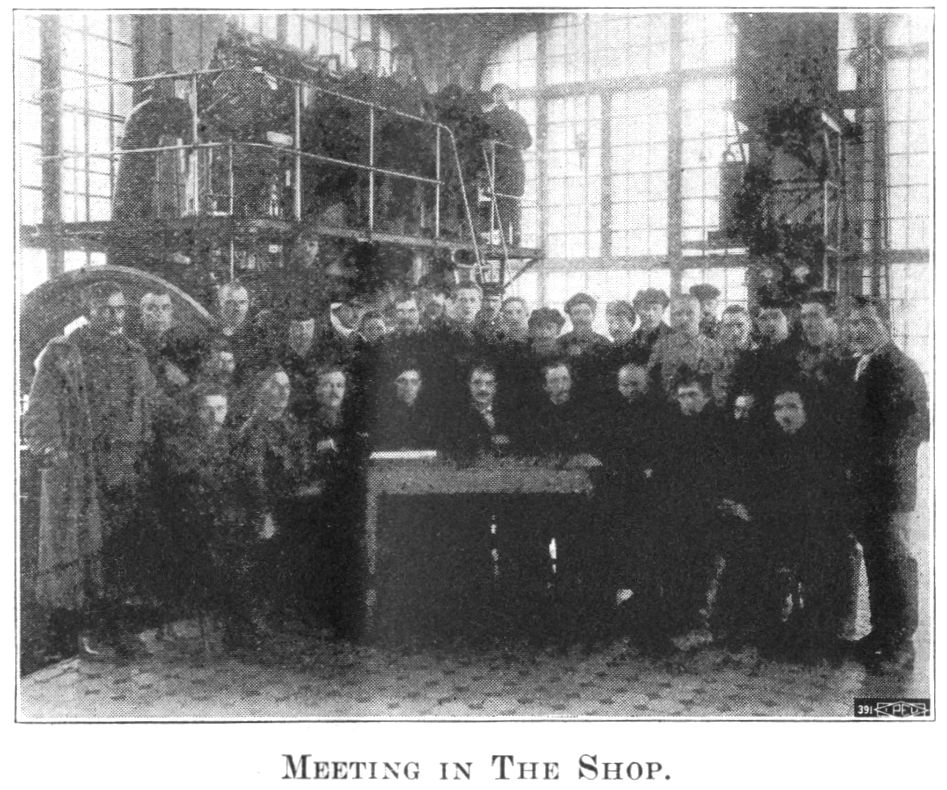
OUR first steps on factory premises lead us to the office of the Factory Committee. In this particular factory the Factory Committee occupies two rooms in a low building which has all the earmarks of a temporary abode. The horrible years 1918-1921 wrought havoc on the human material as well as on the buildings of the factories, and this cabin has apparently been constructed to replace an older and more comfortable house. In the first room, behind a wooden bar, Comrade Sishkin is seated at a small table. In the second room we find his secretary and a girl typist.
The factory Committee is the most conspicuous and many-sided factory organization. It is the general staff of the workers in each establishment. It is the connecting link between the mass of the local workers and their industrial union, between the workers and the organs of the state. It is one of the channels through which all the measures and all the ideas of the republic pour into the rank and file workers. First of all, however, it is the organ that represents all the workers of the factory between one general meeting and the other.
The general meetings of all the workers take place twice a month. At those meetings where the workers personally state their opinions and formulate their demands, decisions are taken on many of the most vital problems of factory life. Every six months the general meeting elects a Factory Committee. At present Ivan Ivanovitch Sishkin is the chairman of the committee.
It is by men like Shishkin that Russia is now governed. Workers of the Shishkin type form the backbone of the new order. It, therefore, will not be out of place to gain closer acquaintance with this revolutionary worker.
He is thirty-seven years old, but the air of boyish innocence makes him look much younger. He has a weathertanned face, vivid dark eyes and a nervous mouth. He wears no beard or mustache but his face is always covered with several days’ growth. His manner is simple, he hardly raises his voice, and it is impossible to imagine him in a state of rage. Altogether he is a mild, friendly, good-humored Russian whose perfect ease does not betray the harsh and strenuous deeds he has suffered through.
He hails from the village, from a family of very poor peasants. When he was seven he was sent to school. It was a miserable little school in a backward village. Catechism was the main subject. Arithmetic, geography, history were hardly taught. The school was under the supervision of the local church. The commandments had to be learned by heart. When the boy heard “Thou Shalt Not Kill,” he very innocently asked the teacher, “How is it that one kills in war?” The question showed an inquisitive mind, but the teacher told him to go home and never return. He was then nine years of age. The family lived on bread and porridge. There were times when little Vanja with his brothers and sisters tasted meat only twice a month. Later, father died. Mother wept days and days. To maintain the children, she had to beg, after a day of crushing labor on the landlord’s fields.
Little Vanja had to go to work. When he was eleven he was placed in a small textile factory near the village, and from that day on for over a quarter of a century he has remained in the industrial system of his country.
It was poor work at the beginning. The factory used hand looms. The hours were long. The pay was miserable. At the age of fifteen Ivan moved to a textile factory in the city of Orechovo where the methods of production were similarly primitive.
Who put rebellion into the heart of the young worker? In his mature years he is unable to trace the sources of his revolutionary spirit. “It seems to me this is my nature. From childhood on I could not stand landlords, priests, policemen.” His dissatisfaction was entirely elemental. In his youth he received no political education. He was hardly able to read and write. However, when a strike breaks out in his textile factory, Ivan, still a youth of nineteen, finds himself an active member of the strike committee. He distributes leaflets and pamphlets.
For such illegal activities he was arrested and sent back to his native village there to remain under strict police surveillance. The young Shishkin had already tasted of the wine of struggle. The revolution of 1905-6 had swept over the country like a scorching gale. Shishkin, rich with the experience of a town worker, attempts to organize the vidage against the landlord. A successful strike for higher wages is carried out under his leadership. For this feat he is put into prison for a term of eight months.
Free again, he found himself on the blacklist. To gain entrance into a factory he had to use his brother’s passport. From the age of twenty-one till the age of twenty-six he worked in a modern textile factory as a helper to the electrician. It is there that he got his first acquaintance with electric wire and cables. His work in that factory ended because of his participation in strike preparations. He was fired and driven out of factory premises “in 24 seconds.”
Shishkin now has greater ambitions. He is strong, active, self-reliant. He is a skilled worker. With infinite pain he has taught himself to read and understand a paper and a magazine. He has a taste for reading. Youth and the wish for a richer life drive him to the capital. He goes to Moscow where he obtains a job in the factory now known as Russcable Number Three.
Moscow broadens his outlook. His revolutionary spirit becomes more ardent though he still has no connection with any of the existing revolutionary parties. His protest against the employers, the police and the “master class” in general exhibit much of the elemental. Any revolutionary party calling for action was sure to find in Shishkin a friend. He had hardly settled in his new place when he was caught distributing leaflets among the workers of his shop. He had a hard time extricating himself. The intervention of older employes helped him this time.
Then came the war. It was a “great shake-up,” as Shishkin told me. A number of workers fell under the influence of patriotic propaganda. The foremen insisted the war was being waged in defense of Russian independence against German aggression. However, part of the workers hated the war from the start. As to Shishkin, he could see no reason for hostilities. “There is no difference between myself and any German,” he said to his fellow-workers. “I suppose if we cut his flesh the German would feel pain the same as we do. Why, then, should we fight?”
That was seditious talk and Shishkin would have been discharged if his skilled labor had not been indispensable. The factory was making war material, labor had become scarce, and Shishkin was an expert worker. He was warned time and again to desist from undesirable discussions but the job was not taken away from him. Being indispensable in the factory he was also exempt from military service.
The war dragged on and the “undesirable discussions” became even more heated. The workers lost all fear of their superiors Throughout the country, the impending catastrophe spread dark forebodings. Everybody became tense with expectation Shishkin, a rebel by nature, cursed the war-lords, cursed the traitorous tzarist generals, cursed the bosses who were coining money, “filling barrels of gold,” out of the peoples’ misery. The prices were mounting and bread was becoming scarce. Then, like a thunderbolt, came the March revolution. Meetings were held on the factory premises—for the first time in the history of Russia. Members were elected to the Soviet of Moscow. Shishkin felt like “walking on the air.” For a few days he was in a delirium of mad joy. Still, the effect of those first revolutionary days was to make him look for organizational and ideological guidance. Activities in the factory threw him closer to Sidoroy, now the secretary of the Communist nucleus, and a number of others who, by a quick process of selection, became the spokesmen of the factory. The group decided to get connected with the Bolshevik Party. This was accomplished a week after the fall of the monarchy, through the aid of a woman worker who hailed from Shishkin’s native village and knew some Bolsheviki. The leading group joined the Bolshevik Party and began to work under its direction.
Throughout the summer of 1917 there were three parties active in the factory: the Mensheviki numbering about eighteen adherents, the Socialist-Revolutionaries (S.R.) with a stronger following, and the Shishkin-Siderov group of Bolsheviki. There was a fierce struggle for influence between the Bolsheviki and the S.R. Innumerable discussions and meetings took place, floods of literature poured into the factory. In the end the Bolsheviki prevailed. Shishkin’s group managed to gain control over all the workers’ organizations created after March. The strongest of these new-born organizations was the Factory Committee, which gradually assumed control of the business of the factory administration.
These were stirring times. Immediately after the March revolution, the question of wages came up. The workers were unwilling to continue work on the old terms. A wave of strikes brought, first, the eight-hour day, second, an increase in wages. At that time, the unions being still weak, the brunt of the burden of leading the workers in their struggles fell on the Factory Committees. The latter soon revealed themselves everywhere as the strongholds of the workers. Conferences of factory committees were held throughout the country and demands formulated. Both the employers’ organizations and the Provisional Government looked askance at these new proletarian nuclei, but the committees felt their strength; they often made laws for themselves disregarding the government authorities and working in co-operation with the then extra-legal power, the soviets. In this way the Factory Committees gained control over the hiring and firing of workers, over the order and distribution of work. Later they mixed in the price-fixing and banking activities of the factory administration with a view to prohibit profiteering.
In the Factory Committee of this particular factory, Shishkin became one of the most active members. He manifested good organization abilities and understanding of the workers’ psychology. Through the Bolshevik group, the idea of seizing power penetrated into the factory. By the end of the summer we find the Factory Committee drawing the workers into the Red Guard. The question of armed uprising was the order of the day. The Factory Committee obtained revolvers to arm nearly all the Bolsheviki workers. The employers were cowed into silence. The leadership of the Bolshevik Party was followed by an overwhelming majority of the non-partisan workers.
This supremacy, however, was not reached without struggle. At one time in the course of the summer, the S.R.’s had gained control over the shop committee. They did not maintain their power, because they had no definite program of action. Under their leadership discipline slackened, the workers became restive. The Bolsheviki conducted a vigorous propaganda for confiscation of the factory in order that its closing down by the employers might be prevented. After a brief period of indecision the workers held new elections and the Bolshevik slate won complete victory. Shishkin was made chairman of the shop committee and under his leadership the workers fought the November revolution. Immediately after the access of the Soviets he was charged with the duty of safeguarding revolutionary order in the district adjoining the factory. This implied the right of search and seizure. Shishkin was now a Commissar. He had red guards at his command. He became a part of the newly created proletarian administration.
It appears that he did well, for several months after the November events he was made chief of the militia (revolutionary police) of the Rogoshsko-Simonovsxy district. He had to quit factory activities, as his new duties left no time for anything else. The Rogoshsko-Simonovsky district is a vast suburban area populated by workers mainly. It contains industrial establishments, railway shops, and storehouses. To keep order in that district in times of great upheaval was no mean task. Where did Shishkin acquire the experience and the knowledge of law for his new duties? “We learned as we worked,” is his explanation. “Life made us find the proper methods of work. As to laws, the revolution was creating them every day. We could not fail to know them. Quite often we of the district were instrumental in creating new revolutionary laws. We saw what was good for, the workers and we gave the bourgeoisie no quarter.” There was no bridge between Shishkin and the bourgeoisie, no community of experiences, no way of conciliation. Those members of the bourgeoisie and intelligenzia whose houses were searched by order of Shishkin, looked upon him as an abysmal brute, while Shishkin looked upon them as “whitehands” and exploiters. It was civil war in its most dramatic manifestations.
Shishkin, gentle, almost timid, overwhelmed by the avalanche of events, ardent in his revolutionary faith, proved a good officer. In 1919 he was promoted to the position of manager of the commissariat of the militia in his district; later he was drafted into the Red Army and sent to eastern Russia against Kolchak. By the time he arrived at the front, Kolchak’s retreat from Ufa assumed a catastrophic character. Shishkin was ordered to remain in Ufa where he was made chief of the intelligence force of the region. Later he was made commander of the forts along the Belaya river. In 1921, after the cessation of hostilities on the various internal fronts, he was returned to Moscow tin the capacity of special commissar (party representative) on the Alexandrovski railroad. His duty was to supervise the work, to prohibit sabotage, to detect counter-revolutionary activities. Later, he was given a similar appointment on the Yaroslavski line.
These were all administrative, military and police activities dictated by civil war and the necessity to establish the new order. The year 1922 witnessed a revival of economic activities. Skilled workers were gradually called back to their shops. The Labor Commissariat issued a decree ordering all electricians to return to their industrial units. It was obedience to this decree that Shishkin, rich with three years’ experience in the heat of revolutionary struggle in various regions of his country returned to his home factory. This was in September, 1922. Up to July of the following year he worked at the bench as a rank and file worker. Then he was elected member of the factory committee and finally was made its chairman.
He merits the respect of his fellow-workers. He is not a student. His general education is meager, His party education never exceeded the course of “political A.B.C.,” which he attended on several occasions and in which he passed examinations. “There is no time to study,” he says. “One is happy when he has time to read his paper after the day’s activities.” But he has the practical knowledge of the factory, the industry and the union. He seems to live in absolute peace and harmony with the workers.
His activities are as follows: He is chairman of the factory committee, chairman of the cultural committee, chairman of the production conference, member of the factory school committee.
Shishkin has a wife and two children. He draws the average wage of the workers of his shop and his degree of skill. He receives no other remuneration.
The Workers Monthly began publishing in 1924 as a merger of the ‘Liberator’, the Trade Union Educational League magazine ‘Labor Herald’, and Friends of Soviet Russia’s monthly ‘Soviet Russia Pictorial’ as an explicitly Party publication. In 1927 Workers Monthly ceased and the Communist Party began publishing The Communist as its theoretical magazine. Editors included Earl Browder and Max Bedacht as the magazine continued the Liberator’s use of graphics and art.
PDF of full issue: https://www.marxists.org/history/usa/culture/pubs/wm/1925/v4n10-aug-1925.pdf

