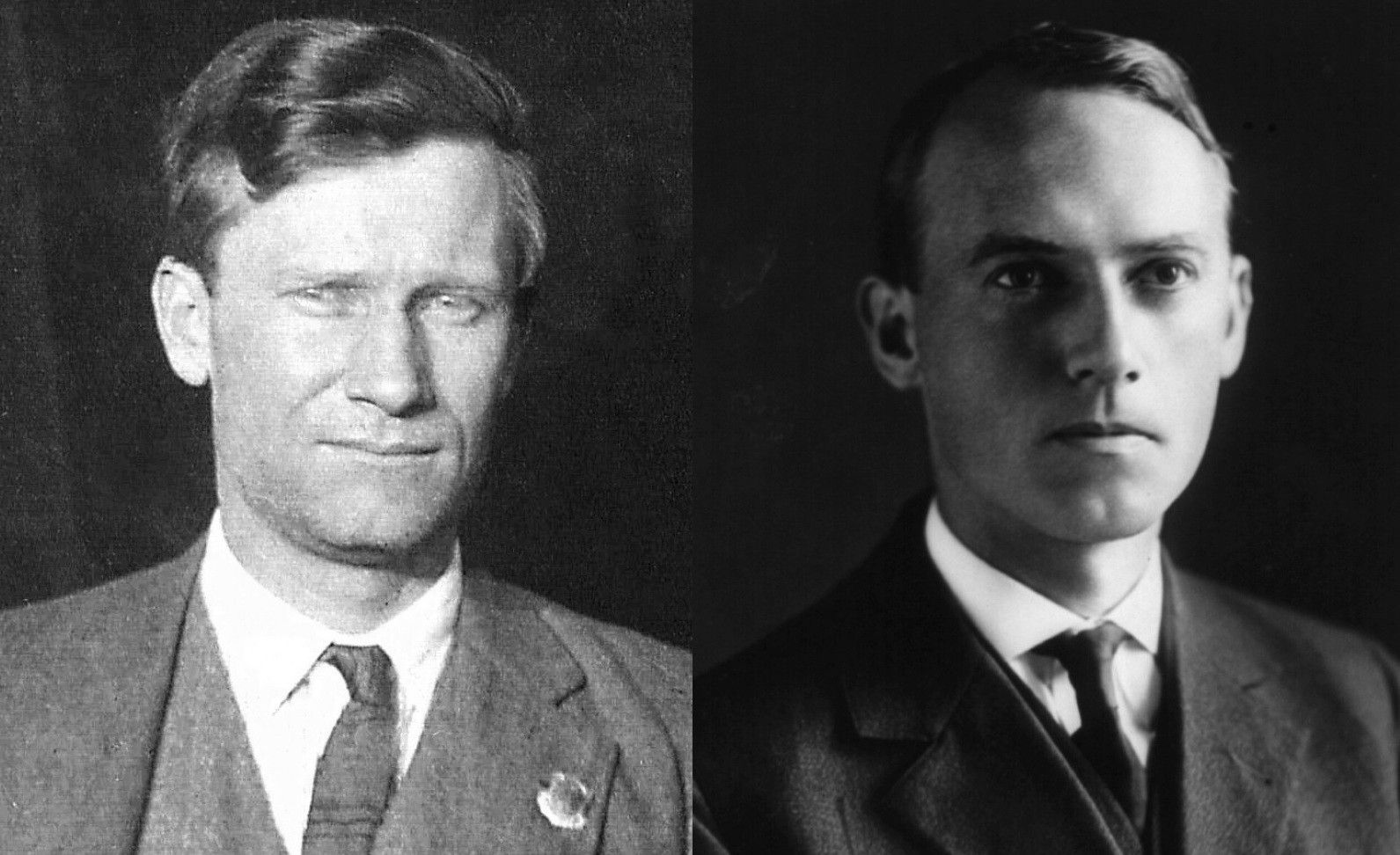
Socialism has always, and wrongly, been portrayed by its enemies in the U.S. as an import of foreign radicals. However, given that the U.S. working class has also always been a multilingual and multi-racial one, finding an ‘American’ lingua-franca for the class struggle has consistently been a difficult, and constantly changing, task for the workers’ movement. Ever since German-speaking comrades creating the Socialist Labor Party in 1877 elected the native-born, Eastern and English-speaking Phillip Van Patten as its first leader, an ‘American approach’ has been sought by Marxists. Here, the debate is taken up again with Workers (Communist) Party leader James Cannon responding to a published lecture by a then leading intellectual of the Socialist Party who had recently traveled the middle west reporting back on the profile of radicalism in the area. A leading left-wing voice for most of his many decades, Scott Nearing would join the Communist Party a few years following this article.
‘Scott Nearing and the Workers Party’ by James P. Cannon from The Worker (W.P.). Vol. 6 No. 263. February 24, 1923.
Not long ago Scott Nearing took a trip through the Middle West to see what was going on in the labor movement. Then he studied the membership statistics of the Socialist Party and the Workers Party. He put the figures and the facts together and announced his conclusions in a lecture at the Rand School, the temple of Socialism as explained away by Algernon Lee.
First he said: “The Socialist Party has had its day…Since 1912 membership has steadily declined…Through the Middle West recently I found the Socialist Party almost extinct.”
His second conclusion was: “The Workers Party has fallen heir to the present radical political situation in the United States.”
Through the oversight of The Call’s Editor, the lecture was printed in the Sun- day magazine section on Feb. 4th. This has created a panic in the “socialist” ranks, and some lively speculation in wider circles. Scott Nearing is just about the last piece of marketable merchandise in the depleted stocks of the Socialist Party, and if he leaves, the red flag of the auctioneer is very apt to wave where the red flag of revolution had no chance.
James Oneal, with the manner of a man laboring under a heavy burden, gravely discusses the matter in last Sunday’s Call. Under the somewhat optimistic title of “The Future of the Scialist Party,” he drops his familiar role of the impartial historian for that of the disinterested accountant, and tries to “figure” Scott Nearing out of his conclusions. Oneal’s figures are just about as reliable as his history; to say which, it seems to me, should be a sufficient answer to him.
Scott Nearing is a significant figure. In a movement which, as yet, is too much given to loose thinking and careless, exaggerated statement, he stands out conspicuously as a tireless student, a painstaking searcher after facts, a master of simple, homely exposition. But he is much more than that. We have not forgotten the rebel professor who got himself kicked out of the bourgeois universities, the courageous fighter against the imperialist war who ran for Congress in the war years as a revolutionist. This, in my opinion, is the real Scott Nearing. This is the man who fired the imagination of the radical workers and took a firm hold on their affection.
It is not the Socialist Party alone that has been stirred by this lecture. Many interpretations are being put upon it by that large body of radicals who stand hesitant between the old movement and the new. The rumor is already abroad that he has joined the Workers Party. This, unfortunately, is not the case. He is not yet ready, it seems, to go the full length. He is on the way to Communism but has not yet arrived. He admits that our party is alive and going forward while the Socialist Party “has had its day” and “is almost extinct.” He sees that we have the field and says we have “fallen heir to the situation.” Nevertheless he still has questions and criticisms. He says we have the chance, but he is not sure that we are going to make good with it.
Tens of thousands of radical workers in America are in that position today. More than half of the former members of the Socialist Party stand outside of any political organization. The collapse of the I.W.W. as a revolutionary factor has left many good proletarian fighters without a center to call their own. The trade unions are honeycombed with virile militants who are looking for a lead. This is the living material out of which we must build our party. We must overcome their doubt and hesitation and pessimism, answer their questions, prove our party to them by its deeds, and bring them into our ranks. Because Scott Nearing represents, in a way, the frame of mind of these workers, because of his great prestige amongst them, we are obliged to answer his questions seriously and carefully. He says of the Workers Party:
It is built to represent the American worker? So far the radical movement has represented the European worker in the United States. The opportunities for a radical political party are as great as, or greater than ever before; the important problem before the Workers Party is to get radical ideas before the workers. Its second and more serious problem is to establish proper relations with Moscow. Moscow is strong; the Workers Party is weak; Moscow can dominate without any trouble.
So, it appears, he is most concerned about the “Moscow” problem, and he vaguely associates it with the familiar question of the role of the foreign-born workers in the American movement.
Oneal grasps at this straw and says, with the profound air of a man announcing a great new discovery:
The movement that does not have its origin in the native workers, that does not have for its leadership native American workers who understand the psychology of the American working class or the economic history back of that class, certainly can never “fall heir” to the movement in the United States.
Then he says the Workers Party cannot meet this qualification because it “accepts dictation from Moscow.”
Well, we have had some discussion on this point in our own ranks; and “Moscow” played a part in the final settlement of it. I am not sure that we approached the problem from the same viewpoint. In our party discussions on this question, we who fought for the idea of an “American” party had in mind a party capable of adapting itself to the conditions prevailing in America and shaping its tactics to fit the present stage of the class struggle here; keeping alive to the traditions and habits of the American workers; taking root in the native soil; and, to a certain extent, merging and making itself one with the American labor movement. We never put the question on the vulgar basis of birthplace. We did not ask “Where were you born?” but “Are you prepared to think and act in terms of the concrete class struggle in America?” In the very nature of things a movement founded on this conception will find its principal leaders among the native workers; but not a single foreign-born worker who is ready to fight realistically should be excluded.
To take any other position is to run away from reality, to ignore the facts of American industry and the American labor movement as they are today. The foreign-born workers are a big factor in American industry; they play a very important part in the American labor movement; and a party that is striving to fit itself to American conditions as they really are, and not merely to be “American” in the narrow, nationalistic sense, will aim to bring every intelligent fighter amongst them into its ranks.
The fraternal union of native and foreign-born workers in our party; realistic tactics adapted to the concrete situation in America; leadership of the movement, as a rule, in the hands of the native workers that is the sound point of view finally adopted in our party. And who said the final word in favor of it? The “Moscow Dictators!”
The American movement was thoroughly discussed at the Fourth Congress of the Communist International. All sides were heard. Abundant material was presented. Comrades experienced in all phases of the class struggle stated their opinions. The result was a decision which is embodied in a letter from the Executive Committee of the communist International to the American movement. It is printed in full in this issue of The Worker, and those who fear the influence of Moscow on the American party should read it all. On the question just dealt with here it says:
The immigrants, including communists, who have emigrated to America from Europe, play an important part in the American labor movement. But it must not be for the movement forgotten that the most important task is to arouse the American-born workers out of their lethargy. The Party must systematically and willingly assist American-born workers, whenever the opportunity offers, to play a leading part in the movement.
Scott Nearing says we must “establish proper relations with Moscow.” That is precisely what we have done. We have established proper relations with Moscow, and that has been the salvation of our movement. But our idea of proper relations does not coincide with his. And International Federation of autonomous National parties, for which he spoke in his lecture, will not suffice in this period of intensified class struggle on a worldwide scale. An International that is not centralized cannot act; and action is what counts in revolutionary times. Federalism was one of the basic weaknesses of the Second International the International which collapsed when the first gun was fired in the imperialist world war, with most of its various national “autonomous units” rushing in defense of their respective capitalist “Fatherlands.”
No, we flatly reject the idea of a decentralized International because it is fundamentally unsound in theory and has worked out most disastrously in practice. We think in terms of the International class struggle. That struggle can be waged successfully only if the proletarian vanguard in all countries is firmly united into one centralized Communist World Party.
It is true that the Workers Party has only a fraternal affiliation with the Communist International, but that is for other reasons than fear of “Moscow Dictation.” Our attitude is determined not only by theory and observation on the international field. We have had independent experience with the Communist International and we have learned to trust its leadership. We have gone to it with many tangled problems, and it has never yet failed to find a solution. The instance cited above is only one of many where the International has intervened to set our party straight in its tactics.
We who have fought for a realistic party have found our best friend in “Moscow.” On the trade union question, in the struggle for the proper appreciation of election campaigns as a means of propaganda and agitation, in the fight against the dogma of illegalism in principle in all these controversies which have been shaking our movement to its foundations the Communist International has thrown the weight of its authority on the side of common sense.
On the basis of our study and our experience we have “established proper relations with Moscow.” We aspire to make out of the Workers Party a genuine communist party in the true sense of the word. That is, a party which faithfully and unfalteringly defends the interests of the working class at every turn of the road; a party that is at once flexible and rigid realistic enough to bend and shape its tactics to the requirements of the given situation, yet ever firm in principle, never losing sight of the final aim of revolution; a party good enough to claim the right to be an integral section of the Communist International and strong enough having its roots deep in the labor movement to defend that right in the face of all persecutions.
We have not yet made such a party in America, but we are on the way to it. We have contended against great difficulties. Government persecution shattered the party in its first year, driving it underground and forcing it for a long time into an illegal existence. It has been torn by internal dissension and factional controversy. It has suffered deeply from a number of splits. In its inexperience it was unable to avoid some tactical mistakes which set it back for a time. But the American communist movement has survived it all. It is fighting its way back into the open. It has overcome the worst of the internal dissension and splits, and is today more firmly united than ever before; it is correcting past tactical mistakes and will make fewer of them in the future.
Homogenous political parties are not built in a day. The heavier the task the party sets for itself, the longer and more painful is the process by which it proves its methods and its human material in the forge of experience. It takes years to make a Communist party because it undertakes the most arduous and dangerous duties. It is the party of never-ceasing struggle; the only truly revolutionary party. The hand of the whole bourgeois world is against it from the hour of its birth. A Communist party always fights against the heaviest odds. A Communist party always goes “against the current.” In the struggle itself, by its victories and defeats, by faltering half-measures and costly mistakes, through strife and persecution, it must find for itself the right road.
The four years that have passed since we organized the Left Wing in the Socialist Party have been trying ones, indeed. The factional controversies, the splits, the persecutions, the mistakes, have been enough to discourage all but the stoutest hearts. But we can look back now in the light of our experience and the experience of other Communist parties and see that these manifestations were not unhealthy. They seem to happen in every country. They are merely the pangs which inevitably accompany what Zinoviev has aptly called “The Birth of the Communist Party.”
When we consider what we had to contend against during the past four years, we have every reason to be encouraged with our accomplishments. We can safely say now that the most dangerous formative period is behind us. Our original nucleus is still intact. The heavy blows of persecution have not been able to break us up. The best fighters in the Left Wing of the labor movement the “militant trade unionists” are moving toward us. We are without a serious rival in the field of revolutionary activity. We have broken with the Socialist Party opportunists and overcome the “Leftism” in our own ranks which paralyzed our own movement for a time, and well-nigh destroyed it. Our great opportunity is at hand. The whole party is alive with the aspiration to build a big movement, and if we keep our heads cool and avoid serious mistakes we will realize that aspiration. Without self-deluding optimism we can agree with Scott Nearing that “The Workers Party has fallen heir to the present radical political situation in the United States.” I go one step farther and say, the Workers Party will make good with its opportunity.
PDF of full issue: https://www.marxists.org/history/usa/pubs/theworker/v04n263-feb-24-1923-Worker.pdf

