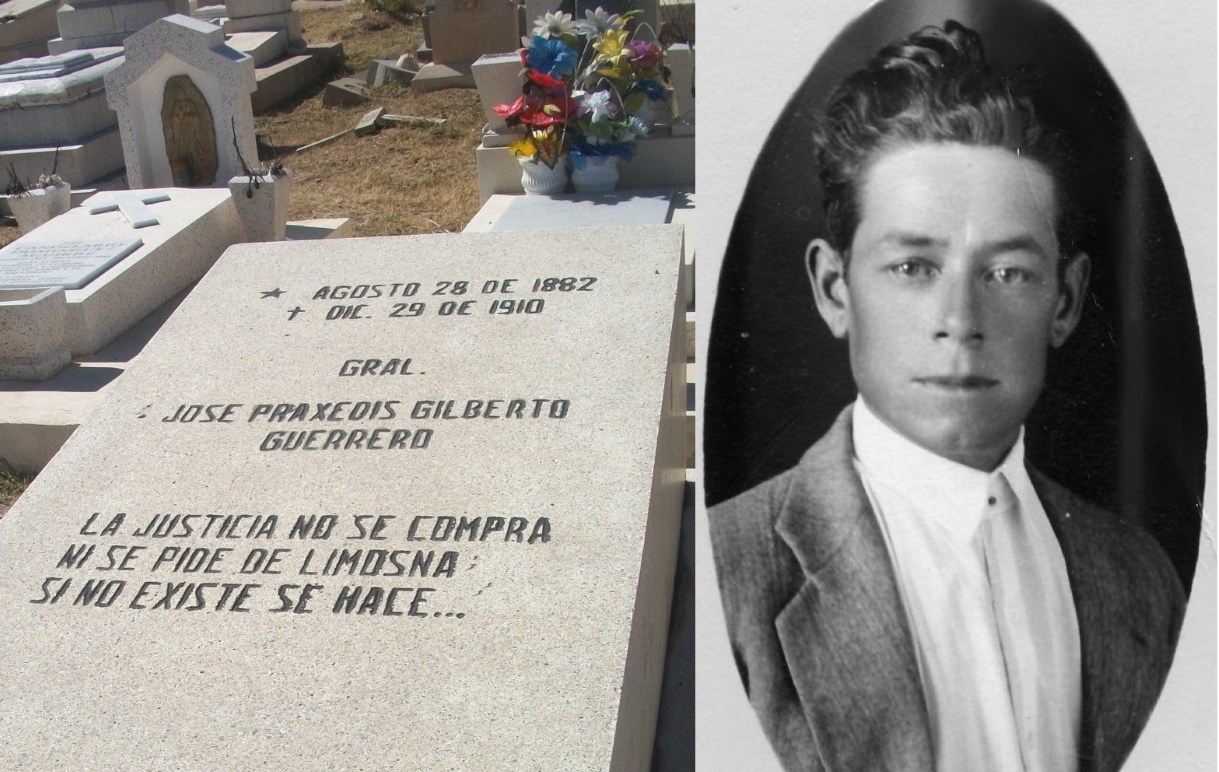
Hearing of his death in disputed circumstances during the Revolution, Magon pays tribute to his co-worker in the Partido Liberal Mexicano, the leading radical journalist and insurgent Práxedis G. Guerrero.
‘Práxedis G. Guerrero is Dead’ by Ricardo Flores Magon from Regeneración (Los Angeles). No. 20. January 14, 1911.
(Translated by “El Cronista”)
Latest information coming from the representatives of the Liberal Party Junta, residing in the city of El Paso, Texas, confirms the circulated rumors with regard to the fate suffered by the second secretary of the organising board of the Liberal Party, Praxedis G. Guerrero, in the mountains of Chihuahua.
Guerrero is dead, says the delegate of the Junta. On the glorious day of Janos Praxedis G. Guerrero, the young fighter for liberty, gave up his life.
Praxedis has died and yet I can not reconcile my mind to that sad fact. I have gathered data, I have made investigations. I have analyzed the data, I have subjected the results of the investigations to the crucible of the most severe criticism, and yet all indications point inexorably to the fact that Praxedis is no more, that he is gone. But in the face of all the deductions of reason my sentiment revolts in the hope of despair, calling out to the wounded heart as a softening balm the faith: “No, Praxedis is not dead, the dear brother is still among the living.”
Wherever I go I seem to see him at all times as of old with his eyes of full and rich sunshine, expecting to meet him working away on the typewriter in the office, or at his favorite places, and every time I am reminded of his eternal absence, an icy hand seems to grasp my throat. So good he was of heart, our brother, of such modest, truly, noble spirit!
I think of our conversations, of our communion, words of manifestations of a high spirit. I recall his intimate confessions. “I do not think that I shall survive this revolution,” our hero told me repeatedly with a little smile that filled my heart with anxiety. I, too, believed that soon he would be gone: he was so bold and brave!
Praxedis was an unceasing worker. Never did I hear his lips utter a complaint of fatigue under his heavy tasks. Always he was at his table, bent over his work, writing, writing, those brilliant articles that hold a place of honor in the revolutionary literature of Mexico; articles permeated with sincerity, articles of beauty in form and thoroughness in thought. Often times he told me: “How poor is the human language. There are no terms that could convey exactly what we think. How much does a thought lose of exuberant grace and of beauty when it is set down on paper!” And, verily, that man of extraordinary abilities knew how to form true pieces of art out of the coarse material of the human languages.
Self-denying and modest of nature, he never asked anything for himself. At various times we insisted that he should buy a suit of clothes. But he never permitted it to be done. “All for the cause!” he said with a smile. One day, when he seemed to be getting rather thin, I advised him that he should eat better, as all he took was a few vegetables. And he retorted: “I could not stand it to feast on better dishes with the thought that right at this moment there are millions of human beings who have not even a piece of bread.”
And all this he did with the child-like sincerity of the true apostle, with the grand simplicity of a saint. Neither fiction nor affection were in his inner make-up. His clear, high forehead was the reflex of all his thought. Praxedis came from one of the rich families of the state of Guanajuato. With his brothers he inherited an estate. From the products of this hacienda he could have comfortably lived in idleness. But first of all he wanted to work for freedom. By what right could he rob the peons of the product of their toil? With what justification could he retain the land which the toilers had drenched with the sweat of their brow? Praxedis gave up his share of the inheritance and joined his brothers of toil to earn his bread by his own hands, free from the remorse of gaining his livelihood by exploitation of his fellow beings.
Praxedis was almost a child when he hired out to do manual labor after having given up the luxury, the riches, the almost animal pleasures of the bourgeoisie. He did not come to the ranks of the proletariat, defeated in the struggle for life, but as a volunteer enlisting with the proletariat to place all his strength of brawn and brain in the service of all the oppressed. He was not a derelict of life taking up pick and shovel as a last resort, on the contrary, he was the apostle of a great idea out of his own free will giving up all joys of Ilving to teach by the example of his own life the truth, justice and power of the sublime thought agitating his mind.
And this splendid specimen of the best manhood, the “Imparcial” designates as a bandit. In glaring headlines that notorious sheet of infamy, reporting on the happenings at Janos, tolls it readers that there died “the terrible bandit, Guerrero.” Bandit? [How then can you define a good man? Ah, rest in peace dear brother, thou shalt not remain unavenged. I hear the voice of destiny calling me not to forgot!
Speaking of Praxedis G. Guerrero it is impossible to leave unmentioned the name of his alter ego, of that other horo who fell under the bullets of that glorious fight of Palomas in the spring of 1908. Do you remember him? His name was Francisco Manrique, another young man of Guanajuato, who also renounced his right of inheritance in order that he should not be compelled to exploit his fellow beings. Praxedis and Francisco, a beautiful pair of dreamers of a better humanity, were inseparable comrades, whom only death could tear apart, and that not for long.
In the brilliant article written by Praxedis on the fight of Palomas he speaks of Francisco Manrique as follows:
“I knew Pancho from earliest childhood. We sat upon the same bench in school. Then, in the years of youth we traveled together the road of exploitation and misery, and in later years our ideals, and hopes, and efforts centered upon the revolution. We were brothers as only few can be. No one could know him better than I do and fathom the beauties of his intimate life–he was a youth of profound goodness in spite of a character rugged like a stormy sea.”
Praxedis was the soul of the movement for freedom. Unhesitatingly it can be said that Praxedis was one of the purest, worthiest, most intelligent self-denying and bravest men that ever espoused the cause of the disinherited, and the vacancy caused by his departure can never be filled. Where can a man be found so free from personal ambitions of any kind, all brain and heart, brave and active as he was?
The proletariat has hardly yet realized the enormous loss suffered in that man.
Without exaggeration it may be said that it is not Mexico that has lost one of her best sons, but that it was all humanity, for Praxedis was a fighter for the freedom of all.
And yet, I can not grasp the loss and give credence to the terrible reality. At any moment a hope hidden deep within my heart tells me that a comforting telegram is to come saying that Praxedis is still among the living. The brutal truth can not destroy in the deepest recesses of my heart a last remnant of hope like a flickering light ready to succumb. And my tortured mind still hopes to meet him in his favorite haunts, in the office where we used to dream with him the dream of the dawn of social emancipation, and my restless eye seeks the martyr bent over his table of toil, writing, writing, writing.
RICARDO FLORES MAGON.
Escrito Por Trabajadores Y Para Los Trabajadores. Regeneración is easily one of the most important, radical Spanish-language papers in U.S. history, and given its role in an actual revolution, one of the most important in any language. Regeneración was the official organ of the Mexican Liberal Party, an anarchist and later anarcho-syndicalist party. The paper was founded in 1900 by Flores Magón brothers; Jesús published the paper with his brothers Ricardo and Enrique writing, and Liberal Party leader Anselmo Figueroa editing. With imprisonment, illegality, revolution, exile, and war getting in the way of publishing, the paper went through several phases since its beginnings. In 1904, the paper moved its production to San Antonio, then St. Louis, and then Los Angeles where it would stay for nearly a decade. Jesús returned to Mexico City where he published a more moderate version of Regeneración, while Ricardo continued published the increasingly radical one in the U.S. Regeneración, expanded with the revolution, and in 1910, the paper added in English language section, edited by British anarchist William Charles Owen. With natural allies in the growing I.W.W., the paper served as an organizing tool in the Mexican Revolution and was instrumental in popularizing the struggle with U.S. audiences and workers. 20,000 copies were circulated weekly at its height. The paper ran afoul of the U.S. authorities well before the rest of the left did in World War One and ended printing for good in 1918. Ricardo Flores Magón was in constant legal battles until his final arrest in the 1918 Palmer Raids for violation of the Espionage Act, along with thousands of other radicals. He died, some say was murdered, in Leavenworth Prison on November 21, 1922.
PDF of full issue: https://www.marxists.org/history/usa/pubs/regeneracion/1911/n20-jan-14-1911-reg.pdf

