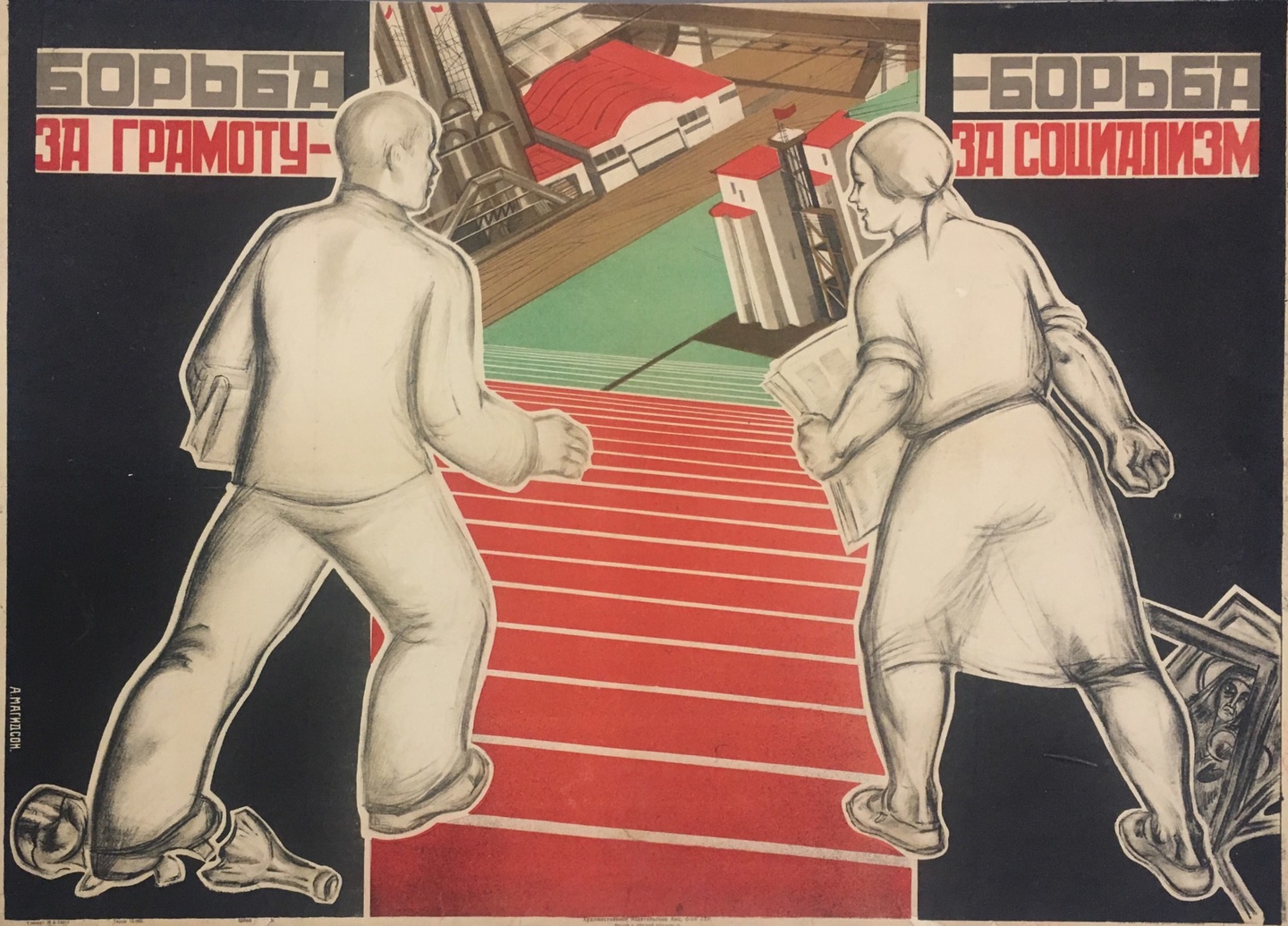
The director of the Soviet state printing house says without a rise in the cultural level, without reading, no revolutionary transformation is possible. A statement seemingly more true today than then.
‘The Book–Weapon of the Proletariat’ by A. Khalatoff from Labor Defender. Vol. 4 No. 11. November, 1929.
(Director of the Soviet State, R.S.F.S.R., Printing House)
THE Proletarian Revolution takes out of the hands of the class enemy the sharp weapon of the printed word, and turns the book and periodical press over to the will of the working class in its struggle for the building up of socialist society.
The revolution gives rise to the most difficult and most important problem of organizing publication and distribution of literature on a different basis. The book must be tied to social construction with unbreakable bonds, must be made an elastic and sure weapon of this construction.
The Soviet Government has placed at the foundation of the book industry the State Publishing House of the R.S.F.S.R., which, together with the State Publishing Houses of the Federated and Autonomous Republics, becomes the center and main socialist base of book publishing in the Soviet Union.
Since the existence of the Soviet Government the State Publishing House of R.S.F.S.R. has issued 25,000 titles and over 500,000,000 copies of books d magazines comprising about one-half of all the Soviet book production of general importance.
It is, therefore, not surprising that the Tenth Anniversary of the State Publishing House, celebrated in May, became the jubilee of the Soviet Book, the day on which the country checked up the work done, reviewed its books, and placed before it new book problems.
Drawing up the balance, we must admit that in all stages of the Revolution–at the time of the armed defense of the November victory, in the period of the rebuilding of our economy and socialist reconstruction–the book was a strong factor in the success of our struggles. No doubt, many mistakes were committed and serious mistakes too; the cultural front is not yet spread to the fullest extent, but the general conclusion can be only of a positive nature for it is impossible to deny the enormous quantitative and qualitative growth of the Soviet book.
Very significant is the coinciding of the Tenth Anniversary of the Soviet book with the ratification of the Five-Year Plan for Socialist Construction of the U.S.S.R. The Five-Year Plan for Socialist Construction signifies the advance of our construction work to a higher level. The Five-Year Plan becomes possible on the basis of our political and economic successes and is closely bound together with the spread of the cultural revolution.
The solving of the enormous problems raised by the Five-Year Plan cannot be considered aside from the increased wave of cultural revolution the arming of the working and peasant masses with knowledge and culture. In this process of the cultural growth of the toilers the book takes the decisive role. In the world of questions raised by the Five-Year Plan, all our past work in producing and distributing books becomes a timid, hardly satisfying beginning.
First of all comes the broadening of the front of our activities. The book publishing industry must be prepared for the new speedy rise of its production, both in the line of a more comprehensive treatment of all branches of knowledge, and in aiding the new cadres of toilers, advancing to higher steps of culture.
We will be able to achieve this only on condition of a speedy development of the technical base of our book printing industry. We must develop the paper industry of the Soviet Union and reconstruct the obsolete branches of the printing industry without delay.
Mass books, like “Cement,” uniting the masses with all our political and economical struggles, becomes the central point on the book-front. Here we must start the offensive, raising the role of “mass books” in the general mass of book production, raising and collecting new cadres. of authors, lowering the price of the book, and finding new means of spreading it. Through the mass book the Five-Year Plan should become the property of the masses.
The strengthening of the struggle on the cultural and ideological front, as result of the sharpening of the class struggle in connection with the efforts of the petty bourgeois elements to resist the successful offensive of the working class in its socialist construction, must be our main. problem for the immediate period.
The basis underlying the success of this work, the guarantee for overcoming all the difficulties before it, is the immediate drawing of the masses into the production and spreading of the book. With the hand of the workers, the Soviet book–the weapon destructive to bourgeois ideology and most necessary for the proletariat in socialist construction–is being forged!
Translated by Sam Miron.
Labor Defender was published monthly from 1926 until 1937 by the International Labor Defense (ILD), a Workers Party of America, and later Communist Party-led, non-partisan defense organization founded by James Cannon and William Haywood while in Moscow, 1925 to support prisoners of the class war, victims of racism and imperialism, and the struggle against fascism. It included, poetry, letters from prisoners, and was heavily illustrated with photos, images, and cartoons. Labor Defender was the central organ of the Scottsboro and Sacco and Vanzetti defense campaigns. Editors included T. J. O’ Flaherty, Max Shactman, Karl Reeve, J. Louis Engdahl, William L. Patterson, Sasha Small, and Sender Garlin.
PDF of full issue: https://www.marxists.org/history/usa/pubs/labordefender/1929/v04n11-nov-1929-LD.pdf

