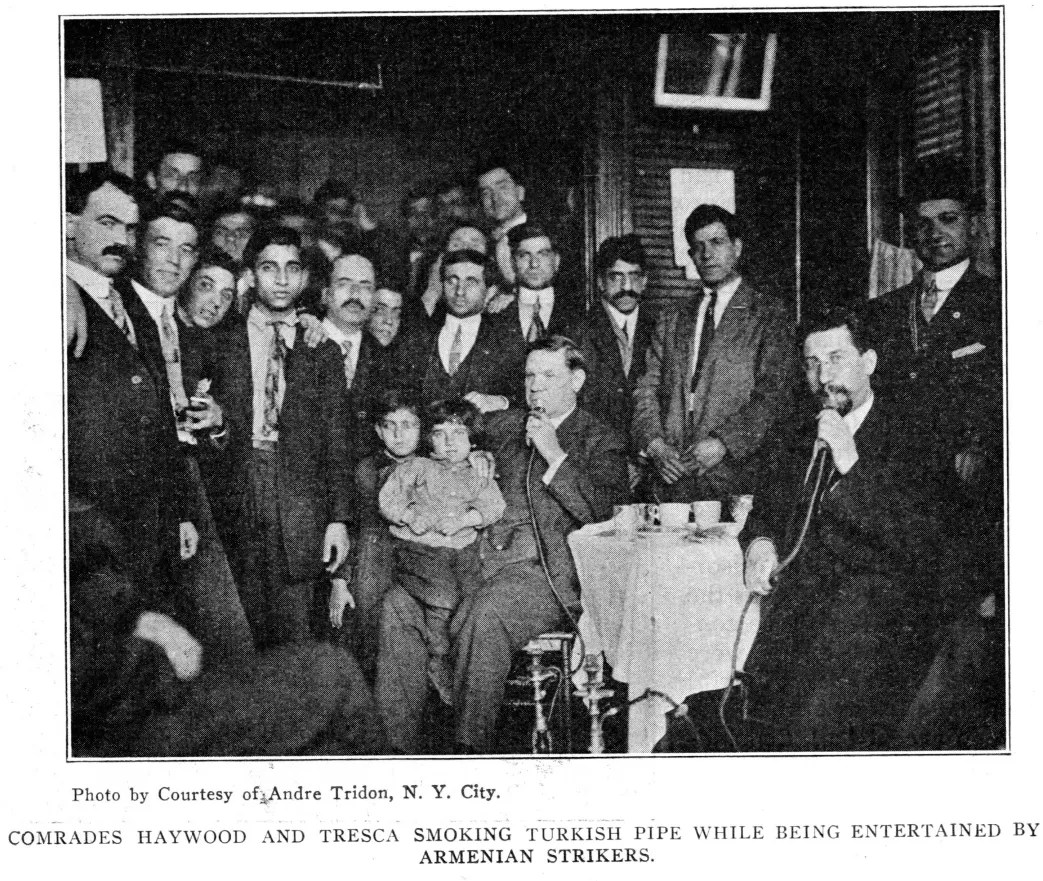
Ewald Koettgen reports on the start of the 1913 strike in Paterson against the newly imposed loom system and that city’s silk milks. Led by Local 152 I.W.W., ‘Paterson’ quickly became a byword for what is best in the U.S. radical labor tradition. Koettgen (recorded in a variety of spellings), grew up in a textile mill, was a veteran New Jersey silk worker, I.W.W. organizer and G.E.B. member, best known for his leadership in the 1913 Paterson Silk Strike.
‘Big Strike in Paterson’ by Ewald Koettgen from Solidarity. Vol. 4 No. 10. March 1, 1913.
Six Thousand Silk Mill Workers Now Out Against Four Loom System—I.W.W. In Charge
(Telegram to Solidarity.) Paterson, N.J., Feb. 28. General strike in full swing. Six thousand silk mill workers now out. More expected to come out. Police tried to break strike by trying to run Gurley Flynn, Tresca and Quinlan out of town. They refused, and were arrested, charged with “inciting to riot.” Flynn out on $1,000 bail. Expect others out tomorrow.
(Special to Solidarity.) Paterson, N.J., Feb. 25. Just about a year ago the great strike of textile workers of Lawrence, Mass,, came to an end, the workers coming out victorious. This victory gave the thousands of textile workers new hope and new courage. Everywhere they wanted to organize in the I.W.W. and fight under its banner.
The silk workers of Paterson also caught the spirit. About a year previous the mill owners had succeeded in starting the 3 and 4 loom systems in the H. Doherty mill. At that time the workers were organized in the United Textile Workers, A. F. of L and that organisation did not make any efforts to stop the attempt of the mill owners. When the workers caught the spirit of Lawrence the Socialist Labor Party gang jumped into the breach, sailing under the name of the I.W.W. Radolph Katz, better known as DeLeon’s man Friday, went before the workers and presented himself as an organiser of the I.W.W. Having been an organiser of the I.W.W. in 1907 and 1908, he was able to fool many workers. When asked by some of the workers if he represented the organization which won the Lawrence strike, he would say yes. The result was that a general strike in the broadsilk mills was started
The whole S.L.P. was sent to Paterson, the workers believing that they came on strike against the 3 and 4 loom system, responded nobly. But instead of fighting the 3 and 4 loom system they were asked to fight for a minimum price list. This price was such bungling piece of work that it was found in many mills that it would mean a reduction in wages if adopted. The strike was managed in the regular S.L.P. style, and the workers went back to work utterly defeated, discouraged and unorganized. The bosses had the upper hand, and the 3 and 4 loom system spread rapidly to about 20 or more mills Mr. Katz tried to make political capital out of it by running for congress on the Socialist Labor Party ticket and making a personal campaign. But they made such a poor showing on election day that they have never been heard from since.
The workers, believing that Local 152, I.W.W., succeeded in convincing the workers in some of the largest mills that they were in the wrong organization. They joined Local 152 and have remained there since. The majority, of the workers were utterly demoralised, and would not listen to any organisation. Their condition had become fierce. But Local 152 kept up the agitation, and in one year’s time has succeeded in instilling new hope and new fighting spirit into the workers. A strike against the 3 and 4 loom system was started three weeks ago in the Henry Doherty Co., the first mill which started the system, and which is also the largest mill in Paterson. Of course, this mill is backed up by the bosses association and Local 152 found it necessary to issues call for a general strike to knock out this 3 and 4 loom system once for all.
Monster mess meetings are being held, and the workers see new hope and are ready for another fight. The local is growing by leaps and bounds.
What the Loom Fixers’ and Twisters’ Union and the Warpers’ Union, both affiliated with the A. F. of L., will do remains to be seen. They have not come out in the open so far. It is to be hoped that they will stand by their fellow workers and not remain at work, helping the bosses defeat the rest of the silk workers.
The most widely read of I.W.W. newspapers, Solidarity was published by the Industrial Workers of the World from 1909 until 1917. First produced in New Castle, Pennsylvania, and born during the McKees Rocks strike, Solidarity later moved to Cleveland, Ohio until 1917 then spent its last months in Chicago. With a circulation of around 12,000 and a readership many times that, Solidarity was instrumental in defining the Wobbly world-view at the height of their influence in the working class. It was edited over its life by A.M. Stirton, H.A. Goff, Ben H. Williams, Ralph Chaplin who also provided much of the paper’s color, and others. Like nearly all the left press it fell victim to federal repression in 1917.
PDF of full issue: https://www.marxists.org/history/usa/pubs/solidarity-iww/1913/v04n10-w166-mar-01-1913-solidarity.pdf

