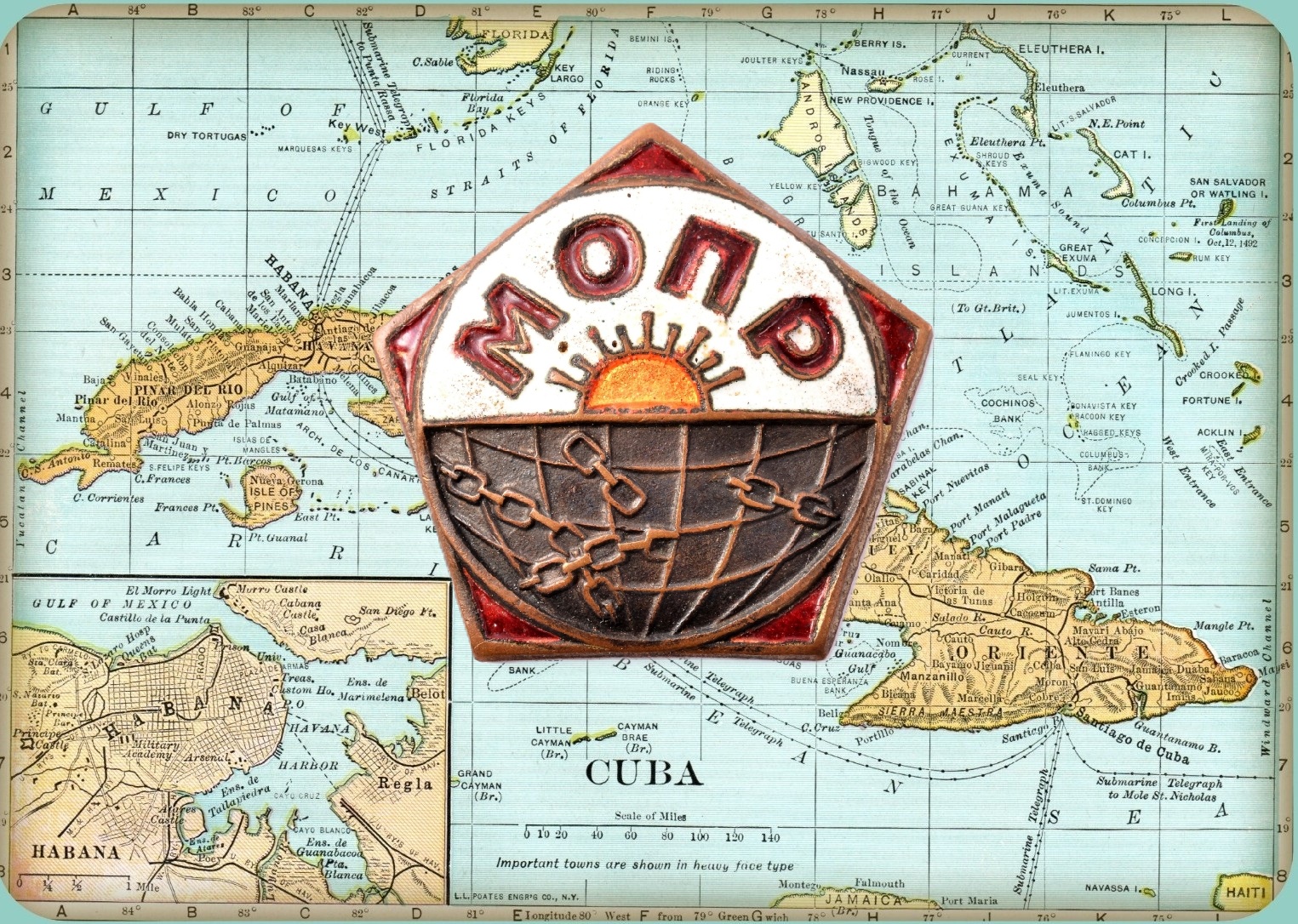
Patterson, representing the International Labor Defense, attends the founding conference of the Cuban section of the International Red Aid (MOPR), Defence Obrera International (D.O.I.). Held in secret in conditions of illegality and extreme repression during the revolutionary mid-1930s, the conference faced two big challenges; moving beyond its Communist base, and championing and winning the masses of Black labor in the island’s racially divided working class.
‘The Convention of the Cuban I.R.A.’ by William L. Patterson from International Press Correspondence. Vol. 14 No. 39. July 13, 1934.
On May 16 and 17 the First National Convention of the Defence Obrera International (D.O.I.) of Cuba took place. The sessions were secretly held in Havana, the D.O.I. being outlawed by the so-called liberal Mendieta regime. The Convention made a complete review of the political and organisational position of D.O.I. Ninety-one delegates were present, representing every province in the country, most of its basic industries, the intellectuals. Negro masses. Eighty of the delegates were men and eleven were women; seventy-three white, sixteen Negro, and two Chinese.
The fact that sixty-five of the delegates were members of the Communist Party of Cuba and of the Y.C.L. definitely stamps the Convention as narrow. This narrowness was reflected in the composition of the leading cadres, the greater percentage of whom were intellectuals. The composition of the Convention also reflects the weaknesses of the preparatory work. This was largely due to the loss of contact with the masses after D.O.I. had led great struggles of the masses against the Cespedes regime and, in the early days of the Grau San Martin administration, had led the mass struggle in opposition to it. Despite these weaknesses in preparation, which were recognised by our comrades under the conditions of extreme illegality and of the sharp terror, the presence of 26 non-Party members, coming as they did from basic organisations, is evidence of the deep-going influence of D.O.I.
The presence of Comrade William L. Patterson, National Secretary of the American Section of the International Red Aid and a representative of the Mexican Section of the International Red Aid, were concrete expressions of the international working-class solidarity now being developed in the Americas.
The return of Grau San Martin from exile in Mexico occurred only two days before the Convention opened. This event was of tremendous significance to the Convention and was correctly analysed but not sufficiently dealt with. Grau had been driven from Cuba when American imperialism viewed this step as the best possible one to check the revolutionary upsurge of the masses and the growing student movement. Driving him out, however, left no crystallised opposition” to Mendieta under the control of a pawn of Wall Street. The danger was that the inability of Mendieta to acquire any influence over the masses offered a more fabourable opportunity to the revolutionary organisations to operate. The very fact that they had been driven underground would create sympathy for them, even though it militated against their freedom of action.
The report dealt at length with the defence activities of D.O.I. It was upon the basis of this analysis of its achievements within the period of the last year that a thorough-going examination of the shortcomings was made. From the analysis of its achievements, which were unquestionably the result of the correct application of the line laid down by the E.C. of the I.R.A. for our Cuban comrades, they were able definitely to disclose the basic character of our weaknesses and the causes for this. At the same time the question of the necessary remedial measures were correctly approached.
The early stages of the discussion in the Convention brought out clearly the various conceptions held even by leading comrades of the role and the tasks of D.O.I. Some of the leading cadres in the Communist Party and some of the leading Communist elements who were working in D.O.I., overcome by the tremendous difficulties confronting an illegal Party, were for placing the burden of carrying the Communist programme forward upon D.O.I., rather than aiding D.O.I. to develop the necessary campaign to give the Communist Party again a legal status. The fight for the legality of the Party of the working class is a struggle for workers’ rights, a struggle for democracy.
The Convention brought out clearly one of the basic fallacies of this conception of the role and tasks of D.O.I. Comrade Patterson, speaking on this question, carefully analysed the social composition of the Party of the working class and that of D.O.I., and showed the absolute impossibility of expecting an organization–such as is D.O.I. to carry out the tasks of the Party.
The Convention worked out a programme to meet the unbridled terror against the Communist Party, the revolutionary trade unions, the Negro masses, the unemployed workers, and also to win the great mass of workers under the influence of the reformist organisations.
A new National Executive Committee of 21 members was elected. Six of these were Negroes, one a Chinese. This is the first time in the history of D.O.I. that Negro workers have been placed upon the Executive Committee. The discussion around the Negro question brought out the tremendous weaknesses of D.O.I. on this field.
Approximately 35 per cent. of the Cuban population is Negro. The exploiters have divided this mass within itself, giving to the Mulatto certain privileges denied the blacks, and pitting one against the other. In the province of Oriente the Negro population constitutes approximately 90 per cent. of the whole. There is the Cuban black belt, the homeland of the oppressed Negro nation of Cuba. The existence of democratic rights to these people means in the last analysis the granting to them of the right of self-determination. D.O.I. endorsed the demands launched by the Party of the working class for the right of self-determination for this group. It accepted the slogan of full social, political and economic equality for Negroes as its own.
The presence of six Negro comrades on the leading committee, of D.O.I will strengthen its influence among the Negro masses. The development of campaigns around the vicious discrimination and segregation of which they are the victims will draw these masses as by a magnet into the ranks of D.O.I.
But the First Congress of D.O.I. also had its tremendously important lessons for the sections of the I.R.A. in the United States of America and Canada. The high political level attained by the Cuban workers, the tremendous revolutionary possibilities opening before them, cannot help but give impetus to the revolutionary movement in the United States.
International Press Correspondence, widely known as”Inprecorr” was published by the Executive Committee of the Communist International (ECCI) regularly in German and English, occasionally in many other languages, beginning in 1921 and lasting in English until 1938. Inprecorr’s role was to supply translated articles to the English-speaking press of the International from the Comintern’s different sections, as well as news and statements from the ECCI. Many ‘Daily Worker’ and ‘Communist’ articles originated in Inprecorr, and it also published articles by American comrades for use in other countries. It was published at least weekly, and often thrice weekly. Inprecorr is an invaluable English-language source on the history of the Communist International and its sections.
PDF of full issue: https://www.marxists.org/history/international/comintern/inprecor/1934/v14n39-jul-13-1934-Inprecor-stan.pdf

