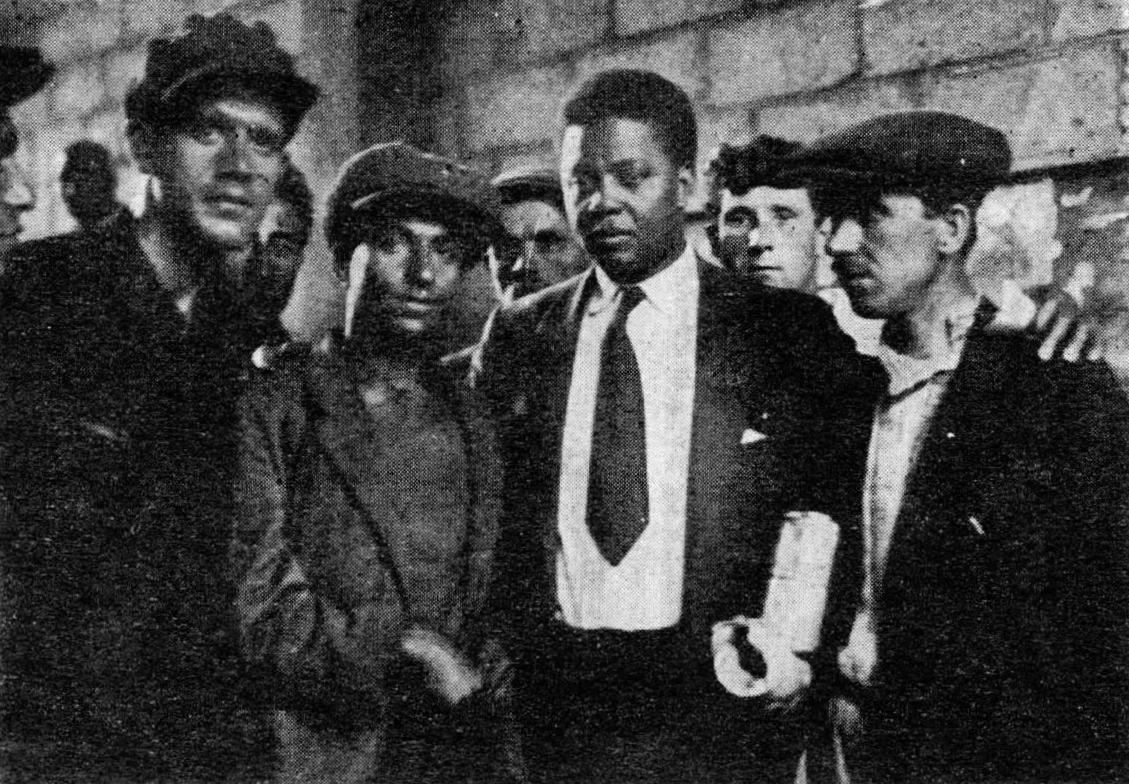
Speaking as chair of the International Trade Union Committee of Negro Workers, Ford gives his report to the Firth Profintern Congress on its work, particularly with a critical assessment of the historic, recently-held First International Conference of Negro Workers in Hamburg, Germany in June, 1930.
‘Report of the Work of the International Trade Union Committee of Negro Workers’ by James W. Ford from Negro Worker. Vol. 3 No. 11. November 1, 1930.
REPORT OF THE WORK OF THE INTERNATIONAL TRADE UNION COMMITTEE OF NEGRO WORKERS OF THE R.I.L.U.
Reporter Comrade James W. Ford.
Comrades: In America, we usually refer to the Negro work, women work, and youth work as the holy trinity, I am now bringing before you the final link in the holy trinity.
For the first time Negro work is being brought seriously to the attention of the international congress of the R.I.L.U. The importance of the Negro problem to the revolutionary trade union movement has been pointed out, comrades, from time to time on a number of resolutions of the Red International of Labour Unions and the Executive Bureau of the R.I.L.U. We have seen since the war a growing number of Negro toilers and workers that have been drawn into the various industries in the various parts of the world that supply for us the basis for organise, the Negro toilers to participate in the revolutionary movement.
We have, comrades, in America, for example, since the war seen the bringing in of over two millions of Negro workers into the main industries of the United States. These toilers have been brought from the agrarian and the agricultural regions of the United States into industry as a fundamental part of the proletariat of the United States. The Negro toilers of the U.S. in addition to class exploitation have the special problem of racial oppression. This exploitation manifests itself in the degree of rationalisation, the speeding up of the workers and general exploitation of the workers in America by the American capitalists.
Therefore, the Negro workers in America are in a position to play a very important role in the revolutionary struggle of America, but not only in the industrial sections. The Negro workers at the present moment show themselves as a factor in the agrarian movement. The present agrarian crisis in the United States along with the industrial crisis is a fundamental characteristics of the American crisis and is particularly affecting the Negro toilers in America, as a matter of fact the majority of the Negro toilers are in the agrarian and agricultural regions of the South. This tremendous crisis brought about by the mechanisation of the farms and the cotton has thrown millions of Negro toilers off the farms and chased them into the cities where they aggravate and make worse the general crisis of capitalism in America.
In the industrial centres of America, in addition to the tremendous exploitation through rationalisation, the Negro toilers who are a large part of the unemployed army in America, numbering some 500,000 workers and with their families and other dependents numbering upwards of a million so that specifically, comrades, we can say the significance of the Negro toilers in America, in the present industrial and world crisis of capitalism, is very great.
But not only in America in the colonial territories and in the colonial world the Negro toilers too are being drawn into the present crisis, of capitalism, and this crisis is throwing them into more militant struggle.
In S. Africa, where the majority, the great majority of the working population is the native toilers, rationalisation, the industrial crisis, and the intense agrarian crisis has thrown them into the struggle and they are a big factor against the bourgeoisie in S. Africa. The agrarian crisis has thrown millions of these workers into the cities, The task of the organisation of the Negro toilers in South Africa is a big factor in the present revolutionary struggle of the world proletariat.
Then in other sections of the world, in West Africa where we have colonies of British imperialism Gambia, Nigeria, the Gold Coast, Liberia, the crisis has manifested itself in the over production of a number of the special products of this area, agricultural products, cocoa, rubber, a number of other products especially produced in this area. The crisis here also has made itself felt especially on the Negro toilers and natives of this section.
In the West Indies, here we have a similar example, where the crisis manifested itself by the throwing of more and more of the native and most terribly exploited Haitian workers, Cuban workers, (where there are a great number of Negroes), Jamaican workers Trinidad workers, etc., out of work. There the workers, especially the native workers are terribly exploited by the imperialists of England, France and America. There are many other sections of the world to where the Negro toilers are being drown into struggle.
Comrades, this position of the Negro toilers throughout the world has made them a very powerful force in the revolutionary movement.
The fact that their exploitation has made them more militant in the present period of the crisis has been demonstrated by a number of revolts, a number of uprisings, a number of expressions of restlessness of the Negro toilers against imperialism.
We have seen, for example, in Equatorial Africa in 1929 for the first time a significant uprising of the native workers in this part, against the brutal oppression of French imperialism. This uprising had many characteristics of a organised and a more or less well-organised effort on the part of native workers against French imperialism.
In South Africa we have had during the last period a number of manifestations of the struggles of the workers through strikes in Rhodesia, strikes of natives and whites in Johannesburg and in a number of points in South Africa. We have seen the militancy of the Negro toilers expressing itself in the West Coast of Africa. We have seen recently the great uprising of the native workers in which native women have taken the leading part against exploitation through taxation of the natives. In this uprising more than 500 native workers, the majority of them women, were shot down by the forces of British imperialism, directed by the so-called “Labor Government”. In other parts of Africa we have had similar expressions of the revolt of the Negro toilers in Gambia, Sierra-Leone. In the United States of America, where the crisis has made the bourgeoisie exert greater force and oppression on the Negro workers, expressing itself in the increased lynching of Negroes, by the enforcement of laws (on the statutes for over fifty years), charging Negro and white organisers with the death penalty for the organisation of Negroes and whites in the same organisation. Despite this the Negroes are beginning to show restlessness and beginning to excite the bourgeoisie and to intensify the present crisis.
All of this shows the present significance of the Negro toilers in the different parts of the world in the international revolutionary movement. The work of the International Trade Union Committee of Negro Workers organised by the Executive Bureau of the Red International of Labor Unions has been determined, comrades, by in the first place, the political line laid down by the 4th Congress of the R.I.L.U. on Negro work. It has been determined by the conditions which I have just described, subjectively and objectively manifesting itself in the movements of the Negro workers, and by the [unreadable word]. These conditions of the Negro toilers have also been determined by this general situation described to you by comrade Losovsky.
Work among the Negro toilers up to the IV Congress and even up to the resent time has not been carried out sufficiently by the sections of the R.I.L.U. It was for this reason that the Executive Bureau of the R.I.L.U., after the IV Congress of the Red International set up an International Trade Union Committee of Negro Workers. Little work had been done before the IV Congress, other things had hindered the development of the trade union movement and the revolutionary movement among the Negro toilers. Amongst these hindrances and amongst these things was first the illusion that had existed among a number of sections of the Red International of Labour Union, and particularly Chauvinism, that existed in the working class as a whole, and the general underestimation of the Negro work. A general laxity in Negro work had been determined in this period because of these manifestations of Chauvinism that had existed in the white working class for over a century.
During the period which is covered by this report and which has been characterised by the growing militancy of the Negro toilers, the main work of our Committee has been concretely, the following political and organisational tasks: First the work of our Committee has been to carry on a struggle against this Chauvinism that expressed itself in the various movements and among the working class. For example in the United States of America, where the Chauvinism that had existed up to this time was of the gravest kind, it had absolutely hindered all work among the Negro toilers in the United States on the part of the revolutionary trade union movement. This is the first point.
The second point was the task of awakening the class consciousness of the Negro masses. The class consciousness of the Negro masses had been hindered in the first place because of the Chauvinism of the white working class and because of intense racial and nationalist tendencies among the Negro population.
The third point, the question of the stimulation of the organisation of the Negro toilers was another problem that our Committee has been attacking.
Fourth, the question of the organisation of an international conference of Negro toilers. These, comrades, have been the main points upon which the work of the international committee has been carried on.
In the accomplishment of these tasks we have not only attacked that Chauvinism, but we have tried to actually assist by concrete measures, the fight of the struggling against Chauvinism and the assisting of the Negro toilers.
The Executive Bureau of the Profintern has from time to time discussed the problems of Chauvinism, has passed a number of important resolutions on this question and has also taken a number of organisational steps to rid the various sections from these hindrances to the movement of the Negro toilers. Another center of activity where the Negro trade union movement has affiliated to the R.I.L.U. is in South Africa.
In South Africa during the last period we have given very special assistance organisationally and given special direction as to how to organise the active workers in South Africa, how to bring them into the organisational plans for building a revolutionary movement and building revolutionary trade unions in South Africa.
In addition to this, also, our Committee has sent representatives to the various sections affiliated to the Red International of Labour Unions. We have, for example, during the last year sent represents to the French section of the R.I.L.U., to the German opposition in Germany, to the Belgian section and made special efforts in France and also in the United States, representatives to stimulate and to carry forward these organisations of Negro work.
During last August at the Conference in Vladivostok contacts were made with Negro seamen for the purpose of stimulating the work among the seamen into organisation.
As to the 4th point comrades, in the work of our Committee. That is, the organisation of an International conference of Negro workers. This question was first raised by the representative of the Negro committee at the Second World Congress of the League Against Imperialism held at Frankfurt, Germany, last year. Also at the Executive Committee session of the League Against Imperialism the question was raised about the Negro toilers, about the organisation of an international conference.
And, finally, this conference was held in Hamburg, Germany, in July of this year.
Now comrades, coming back to some of the points I have touched upon I want to point out that the position that the R.I.L.U., the Executive Bureau of the R.I.L.U., on the Negro question has been correct. For example the struggle against Chauvinism, what do the facts show in this case.
What have we experienced by the line laid down by the R.I.L.U. with regards to the organisation of Negro toilers. Let us take the United States. Again for example take the work in the Southern part of the United States, we have the most intense form of racial prejudices, we have made efforts against Chauvinism, against race prejudices amongst the workers, the line has been correct for the organisation of black and white workers into the same revolutionary trade union organisation.
In Gastonia, the great strike at Gastonia, what after all was the central ides, the central point in Gastonia? The central point in Gastonia was the Negro question, the central point in Gastonia which frightened the bourgeoisie was the fact that the Red Trade unions under the instructions of the Executive Bureau of the R.I.L.U. had correctly advocated the joint unity of black and white workers in this struggle in the South.
The issue therefore was a correct issue, a correct revolutionary policy. Some of our comrades resisted this idea, but the results show that the line was correct, because even in the South, the backward white workers reacted favourably to the line that we laid down, for black and white workers were accepted upon the same basis, that they must unify as one class against the exploiters, in the Southern part of the United States, to the extent of white organisers and white workers in the South defending Negro organisers against lynch mobs of the bosses. This shows that line was correct. That the central issue was the organisation of the Negro workers into the red unions of the R.I.L.U.
The political significance of the Negro toilers in the South has been thus raised to a very high level; a big political task for organising the working class in America for the struggle against American capitalism. Also in the South, through great effort we have been able to get Negro workers as organisers to come into the South to organise black and white workers, as well as having white organisers in the South for the organisation of the Negro and white workers. For you comrades, who do not understand the peculiar significance of this in America, this was one of the greatest tasks that the revolutionary trade unions have faced in America during the present period.
As to South Africa, what are the facts? Here also we have had to deal with the question of chauvinism and outline the correct policy; the majority of the workers are the native workers. These workers, therefore, must be the center of gravity and the basis of our organisations, particularly in the mines and in the agricultural sections of South Africa. We, in the Executive Bureau have consistently agitated and instructed our comrades to penetrate the great mass of the native workers and we have had an increased participation of the native workers into the movement in South Africa and have had new cadres of native workers drawn into the movement. However, we have a great deal of work to do in this connection still. Also in connection with this general line we have had the affiliation of the Native Federation of Unions in South Africa to the R.I.L.U. in February, 1929. And also, to show the correct line has been carried out we can take the simple example that even in South Africa a number of native tribes that had no trade union basis for organisation had heard of our program and made direct application for affiliation to the R.I.L.U. In South Africa, too, the question of the struggle for a native Republic has been a main task.
What are the results generally with regard to the line of the R.I.L.U. in Negro Work? We find in every section where our comrades have made the least effort at more activity of even amongst the white workers has been carried on, and has manifested itself in the assistance on cooperation with the organisation of the Negro workers. All of this shows that the line of the Executive Bureau has been correct and must be followed out and that heretofore our comrades have not entered sufficiently into before, and even now, to the line of the Executive Bureau.
As to other point, the response of the Negro toilers to our efforts to raise their class consciousness and to organise and develop their movement. In the United States of America, since the 4th Congress, Negro toilers are showing a determination and willingness to join the Red Unions and are being more and more influenced by the Red Unions.
More and more Negro worker have understood the line of the R.I.L.U., have heard for the first time the policies of the R.I.L.U. Many of the Negro workers have broken away from Garveyism, the Negro reformism, and come to the red unions as a result of our correct policy.
We have already referred to the tribes in South Africa, native tribes, tribes that are very backward, that have come under the influence of our correct line. In South Africa the natives also have been struggling against the Negro trade union reformism, which has expressed in the leadership of Kadalie, who has affiliated the organisation of the Native workers to the Amsterdam International.
But what is important these organisations have lost their influence and decreased in numbers as the organisations affiliated to the R.I.L.U. have increased in numbers.
The participation of the Negro toilers in the leading cadres of the work has been most helpful in stimulating the class consciousness of the Negro toilers increasing their activities in the trade union movement, the revolutionary trade union movement. The agitation that the Negro committee of the Executive Bureau has carried on against special exploitation against the Negro workers, for example, the Vestris disaster in which we sent out an appeal to the Negro toilers has particularly attracted the attention of large numbers of Negro seamen in the various parts of the world.
As to the awakening of the class consciousness of the Negro toilers, let us take for example, the great Haitian demonstration on the part of the American workers in 1929, December, against the massacre of the Haitians by the United States marines. What, comrades, was the effect from an international point of view of stimulating the Negro toilers to class consciousness? The fact that a large section of the white working class in America had demonstrated in solidarity with the Haitian workers against the United States imperialism. It was for the first time that the workers saw a revolutionary movement in America supporting their struggle. Not only in Haiti, but in Jamaica, in Trinadad, in a number of Caribbean colonies, this simple demonstration on the part of the working class of America considerably influenced the class consciousness of the Haitian workers, of the Negro workers as to the solidarity of the revolutionary movement with regards to their struggle.
Let us take some of the results in South Africa and in the United States. I have already said that the Non-European federation of trade unions has developed considerably as a result of the renewed activity of the revolutionary elements in South Africa to carry out the line of the Executive Bureau. Organisations in other sections of South Africa have been stimulated by this activity.
In the United States, the red trade unions and every union and every League of the T.U.U.L. have for the first time we find a larger and larger number of Negro workers, participating in the activities of the Red trade unions. In a number of unions we have a large number of Negro toilers as members of these unions.
In France we have had some results from our agitation there on the part of one Negro comrade Koyate who has made special efforts to organise some of the Negro workers residing in France.
As to another point, and that is the question of the organisation of the International Conference of Negro Workers. Here I must give some facts about the shortcomings about the achievements and results. When we consider the political significance of the Negro toilers at the present period of capitalism, we can readily understand the great political significance of this International Conference held at Hamburg in July. In the preparation a great, deal of agitation was carried on throughout the various sections where the Negroes are. This has aroused the Negro toilers in the various parts of the world to the necessity of organising the trade union movements in their countries. It not only aroused the Negro toilers, but aroused the wrath and anger of the bourgeoisie against our efforts to organise the Negro toilers. However, there were some very serious shortcomings in the organisation of this conference, in the preparations that have been made for it and in the help and assistance rendered by the sections affiliated to the Red trade union center.
In the first place we must point out that we in the center made many mistakes and had many shortcomings of a political as well as a technical character. With very little experience in organising conferences, it was quite natural that we would have many serious shortcomings as to how to draw larger and larger masses of Negro toilers in the preparations for this conference. We in the center did not sufficiently push the sections of the Red trade unions to help us in this movement. But the most serious shortcomings in our conference and in the preparations was the shortcoming of the Red sections. For example the Minority Movement in England rendered practically no assistance in the organisation of this conference despite the fact that we had planned to hold the conference in the center of British imperialism itself, London. The Minority Movement rendered very little assistance, comrades in trying to assist them in getting delegates from among the seamen from the colonies of the British Empire. The same thing may be said of the French affiliated Red unions who did nothing with regards to bringing Negro workers from the French colonies to our conference Also in Belgium section. In the United States we were not sufficiently broad in our campaign for organisation of the conference and bringing the wide masses of Negro toilers in the participation for the election of delegates to the Negro Conference.
As a result of these shortcomings, comrades, this poor representation, poor participation and poor preparation showed itself in the composition of our Congress. Our Congress was arranged originally to be composed of 25 delegates from various sections of the Negro world. We had only 17, we had 7 delegates from the United States, all workers from the factories, we has 2 delegates from the Gold Coast, one from Gambia, one from Nigeria, a white delegate from S. Africa, representing the native trade union, a delegate from Jamaica and other. Other delegates were supposed to come to our conference did not arrive, because of difficulties. Some of these comrades have only arrived to our conference in the last few days here at Moscow.
At this conference we took up, the main political task that the Negro boilers face at the present time. The task in the economic struggles of the Negro workers, the task of struggling against Social Fascism, the fascism of the Amsterdam International and the American Federation of Labour, holding the workers back, actually participating in the execution of the Negro toilers as it expresses itself in a number of the colonies, where, Belgian Socialists, English socialists, French socialists were. We have outlined there a complete programme of struggle against Negro trade union reformism, we have outlined a detailed pro gramme for the trade union organisation of the Negro toilers in their struggle for shorter hours of work, in the struggle against speed-up system of the rationalisation system, this especially exploits the Negro toilers, also the most important question of forced labor amongst the Negro toilers was taken up.
This is perhaps one of the biggest political tasks that we have before us in the organisation of the Negro toilers, this is forced labor seen in South Africa, West Africa, Jamaica, Haiti and all of the colonies, and even to a certain extent in some parts of the United States.
Another very important political question was the question of the struggles of the Negro toilers against the war which is in preparation. Our conference pointed out the particular significance of the Negro toilers in the last war, how the imperialists drew them into the war to be used as cannon fodder and even how at the present time they are preparing great armies of Negro toilers to be used in the next war against the revolutionary trade union movement and also against the Soviet Union.
These political tasks were taken up in quite some detail. These political tasks were outlined to the Negro toilers at this Conference. These are the basis for the preparation of a future conference of the Negro toilers, and will be the basis for continued efforts to organise the Negro workers in the different sections of the world in the coming period.
Comrades, I have spoken of the shortcomings with regards to the preparation of our Conference in Hamburg. It is necessary now to deal with some shortcomings with regard to work among Negroes. We have already seen that repeatedly the Executive Bureau of the R.I.L.U. has continued to instruct the Red sections to give more attention to the organisation of the Negro toilers. But what has been the attitude of all of our sections? In some cases the attitude amongst the reformist and right elements has been the same attitude as the social reformists’ but of course there were kicked out of the movement that is, an attitude of indifference to the organisation of Negro toilers, an attitude of Chauvinism to the Negro toilers, of opportunism in the organisation of the Negroes. The Negroes have had experiences with the white working class, as with the boss class oppression, slave-drivers, at least with the reformist section. This section is the right hand of the bosses in the exploitation of the Negro. Therefore, the Negro toilers have the right to be suspicious of the organisation of the white working class, even suspicion of the revolutionary trade union organisation and, comrades, we must say frankly, we must approach this question frankly, and say that even among the Red trade union sections of the R.I.L.U., among the revolutionary trade unions affiliated to the R.I.L.U., especially the opportunists, that the Negro toilers also have a right to be suspicious of them and their so-called “superior” attitude towards them. They have the right because of this to be suspicious that the Red unions may have the same policy towards them as the Amsterdam International, as the American Federation of Labour, because for fifty years the Negro workers have felt the special racial abuses of the white working class and they have not seen very much difference between any of them, at least in an organisational point of view. I say again that the opportunist leadership in the Red Trade Unions have led to this condition. We must drive them out of the Red Unions.
I think the Red International of Labour Unions and the Executive Bureau has been correct in insisting that our sections should give more attention to the organisation of the Negro toilers. But comrades, again we must say that our sections have done nothing towards the organisation of the Necro toilers, towards drawing the Negro workers into the revolutionary movement We can take them one by one. England, the M.M. in England has done nothing and even in the United States although there is a change as a result of the struggle that has been carried on, still there is not sufficient work being done in America.
With regards to the line laid down by the R.I.L.U., Comrades, I think that the 5 Congress and the delegates must seriously consider this question, seriously approach this question, seriously give a very self-critical approach to this question, seriously analyse it, and frankly say to themselves what they have not done and what they propose to do. However, comrades, I don’t think that it is time for us to make too many promises, but actually time to get down to work to carry out the policies and line of the Red International.
Comrades, we have come at the 4th Congress, we have brought forward the question of the Negroes to the 4th Congress, but even yet we find that this question has not been carried out in all sections. We have now at the 5 Congress of the R.I.L.U. for the first time a Brazilian representative of the Negro toilers in Brazil, and we must say from that conversation that we had with him, we discover in Brazil the same problem, the same struggle there that we have had in the other parts of the world. The workers in Brazil have not yet actually got down to the organisation of the workers Brazil, have not yet got actually down to the fundamental task of organising the agrarian workers in Brazil, because our comrades there have not yet seen that the agrarian problem is the fundamental problem in Brazil, and that the great majority of the Brazilian workers are Negro toilers. So I want to place this question before our Brazilian comrade and I want to invite the participation of our Brazilian comrades on this tribune to state quite frankly before this Congress what is the situation in Brazil, why is it that we cannot have a delegation of the movement Bazil here before, what the attitude of the white comrades has been, we have in a disguised form the manifestations of Chauvinism, manifestations of white chauvinism. With regards to the Brazilian organisation these problems must be analysed by our Congress.
Now, comrades, we have talked of the shortcomings, we have talked of the political successes of the Negro toilers, the question now is what are our tasks and tactics, in the present and coming period and the growing revolutionary struggles of the workers in the first place demand more and more attention by all our sections to participate more and more in these struggles.
For example, one important political task is the self-determination of the Negro toilers in, the various parts of the world and in particular in the United States, of the actual putting forward of the slogan of self-determination in the Southern part of the United States.
Concretely we have a number of tasks that must be operated by all actions in the carrying out of the line of the R.I.L.U. in the drawing of the Perro toilers into the revolutionary movement, these tasks are concretely:
1. To help and assist the new international trade union committee of Negro workers that has been recently reorganised at the Hamburg conference of Negro toilers. In the main the tasks are the strengthening of the existing contacts and connections with the Negro toilers in the various parts of the world, the establishment of new connections with the Negro toilers in the various parts of the world.
2. The popularisation among the Negro masses of the principles and the resolutions of the revolutionary class struggle.
3. To assist in the organisation of peasant organisations and the drawing of them into direction and connection with the R.I.L.U.
4. To disseminate information about conditions of work and life of the Negro toilers.
This is to be particularly disseminated among the white working class in the imperialist countries, to struggle against white chauvinism in the ranks of the working class, to struggle against Negro reformism and Necro nationalist ideologies and Negro trade union reformism, particularly in South Africa and in the United States.
The next task, generally, is to assist in the preparation for a second, international conference of Negro workers. We have a task in the great continent of Africa where we shall have a special section of our work. There we must strengthen and build the Negro organisations of the Negro workers in South Africa, Gambia, Nigeria, Sierra Leone, the Gold Coast, and a number of other points for the building of a revolutionary trade union movement, for the participation of the white revolutionary movement in the advanced countries in this development. The sections of the Rea trade unions in France must develop their colonial sections and actively organise them and have special sections for the organisation of the Negro workers and seamen in their sections there. This must be done in France, England, and the U.S.A.
Comrades, in conclusion I have not had time to outline all of the tasks that are before us at the present moment, but I think in conclusion, in spite of all, that we are on the road for the first time for the organisation of the Negro toilers. I think we can say that the Executive Bureau of the R.I.L.U. and the R.I.L.U. itself has for the first time brought forward the question of the organisation of the Negro toilers. Not only have gained organisational results, but also worldwide influence among the Negro toilers, and contrary to the opinions of certain sections of the R.I.L.U. trade unions; particularly in America, where they had the policy that the Negroes were reserves of capitalist reaction, that the Negro toilers are a fundamental part of the revolutionary trade union movement and are assisting the development of this movement to a higher level and at the present time assisting in shaking the very foundation of capitalism in America. The R.I.L.U. can be said to have penetrated the whole world and brought the Negro workers into the revolutionary movement under the leadership of the new Executive Bureau and will carry forward what we have already accomplished, the bringing of millions of millions of Negro toiler into the revolutionary trade union movement not only for the establishment of socialism in the Soviet Union, for establishing and bringing of a workers’ government in every section of the capitalist world, for the bringing of great majority of toilers into the revolutionary movement, for the overthrow of imperialism.
First called The International Negro Workers’ Review and published in 1928, it was renamed The Negro Worker in 1931. Sponsored by the International Trade Union Committee of Negro Workers (ITUCNW), a part of the Red International of Labor Unions and of the Communist International, its first editor was American Communist James W. Ford and included writers from Africa, the Caribbean, North America, Europe, and South America. Later, Trinidadian George Padmore was editor until his expulsion from the Party in 1934. The Negro Worker ceased publication in 1938. The journal is an important record of Black and Pan-African thought and debate from the 1930s. American writers Claude McKay, Harry Haywood, Langston Hughes, and others contributed.
PDF of full issue: https://www.marxists.org/history/international/comintern/negro-worker/files/1930-v3-special-number-nov-1st.pdf

