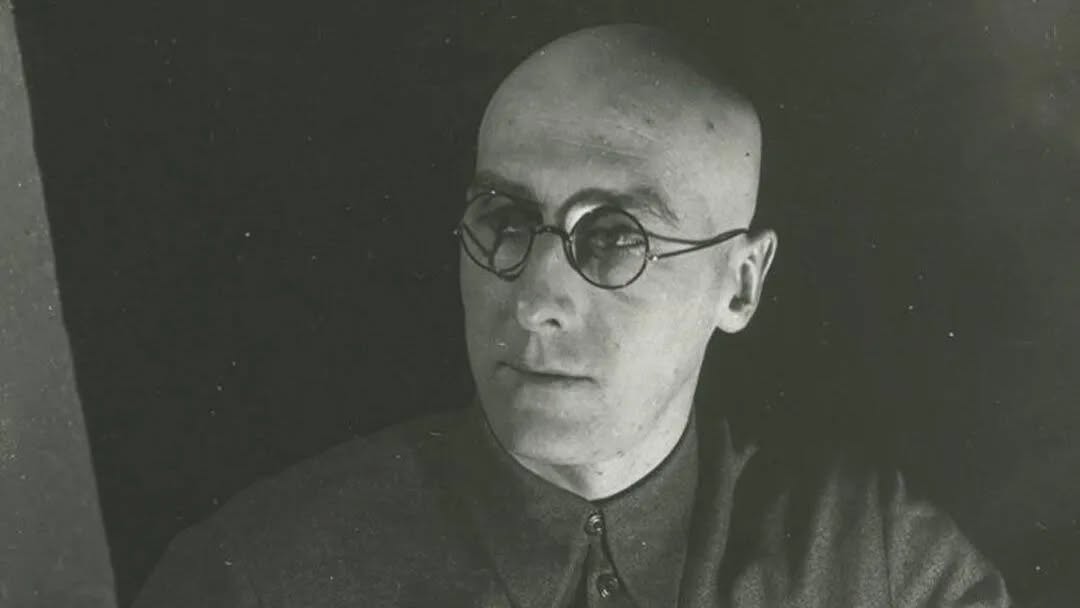
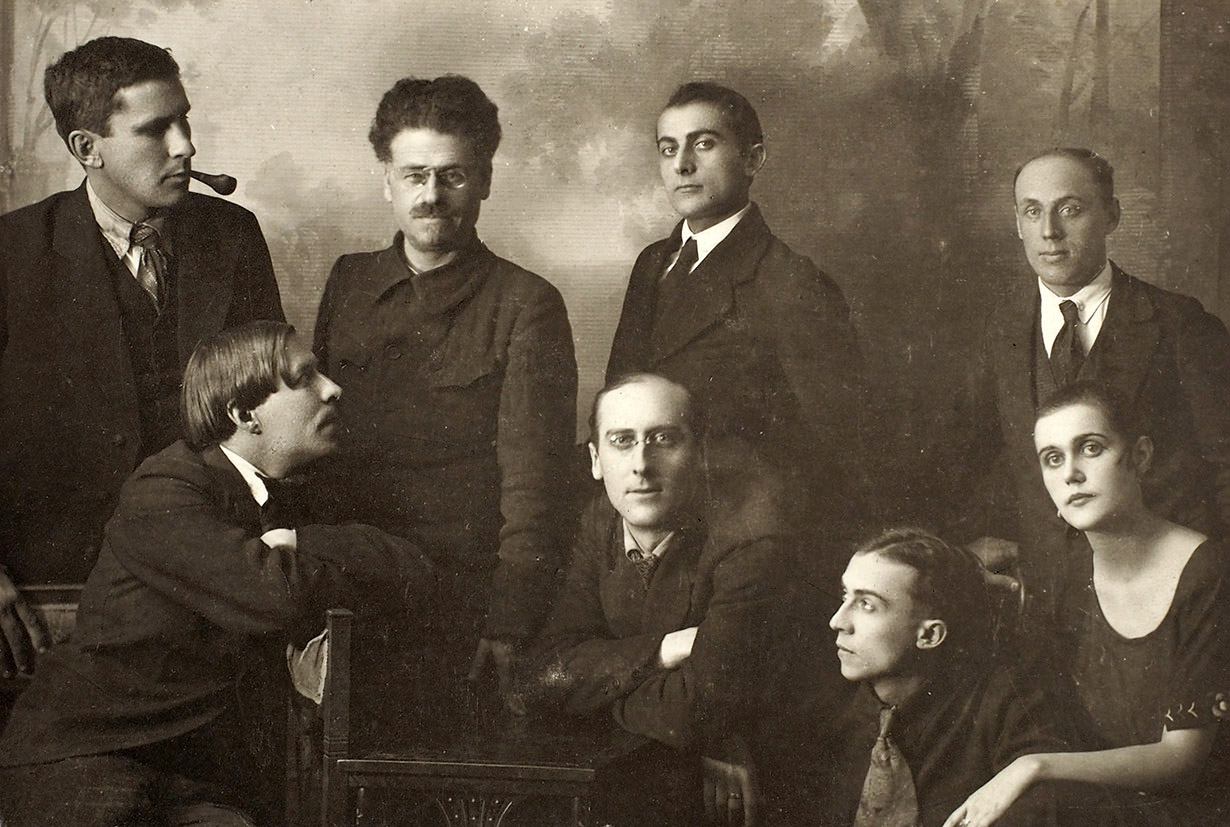
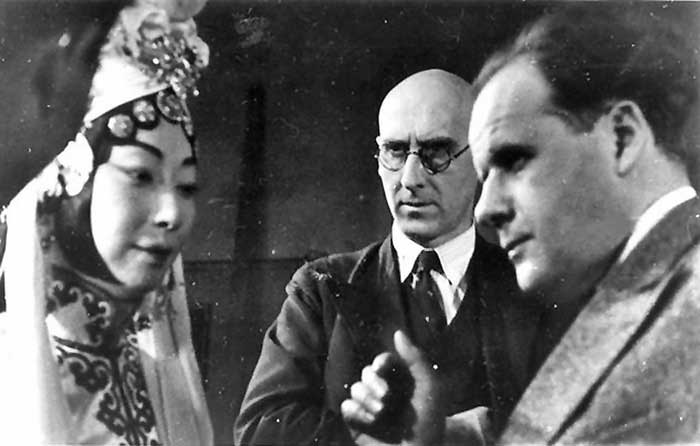
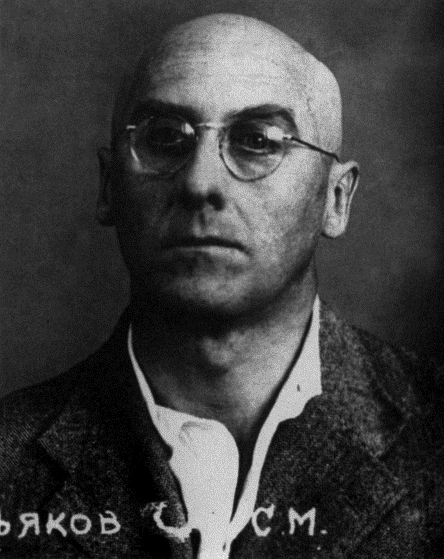
Sergei Tretyakov began his significant literary career publishing futurist poems while in Moscow law school in the years before 1917. Serving in the Red Army in in the Russian Far East, he details below how events in Vladivostok under occupation inspired his first book of poems in 1919. In the early 1920s he became part of the Proletcult movement and began working in theater with Eisenstein. Writing for Pravda, he lived China for two years, which inspired his most well-known works outside of Russia, Roar China, in 1926. Adapted for stage by Meyerhold, Roar China was translated and performed around the world. He was a founder of LEF, Left Artist Front, with Myakovsky, and edited its journal. A leading Soviet voice in the International Union of Revolutionary Writers, he traveled Europe widely in the early 30s, where he began a relationship with Brecht, who he translated into Russian, and other arts figures. Like so many of that revolutionary generation, especially those with international connections, his life was taken in the Purges, murdered (or possibly took his own life to prevent execution) on September 10, 1937. Reading this, know the fantastical charge was ‘spying for Japan.’
‘Autobiography’ by Sergei Tretyakov from International Literature. No. 3. 1933.
January 1920. The Golden Horn, on the Bay of Vladivostok. Innumerable battleships and cruisers, Troop-ships with bulging sides swallowing up soldiers in their holds. Flags of all sorts hanging from mast-heads, All this means that Kolchak and Co. have collapsed, that troop trains are at a stand-still on miles and miles of Siberian railway lines, that the ranks of the interventionists, grown indifferent both to their white-guard protegés and to each other, mutually showering reproaches and contumely, are fleeing along the narrow passage of the railway line, on either side of which the marshy plain of Siberia is alive with Red partisan risings.
The first to leave are the English, the French, the Czechs. The Japanese—closer neighbours—merely shuffle up and down the road, to look as if they too were leaving. But they have no intention of going away. On the contrary, the departure of their allies and rivals will leave them with a freer hand. The metal of the white armies is turning red in the forge of the civil war.
The Red partisans, in their goat-skin jackets and their high caps adorned with ted ribbons, entered Vladivostok on the 31st of January in the best of spirits. Behind them are the forests through which they roamed with only a few cartridges to each rifle, and not a drop of medicine, behind them the nipping Siberian frosts, which bit at their toes through the holes in their boots.
Their commander is the 20 year old bolshevik Lazo, who organized disgruntled peasants, angry gold-seekers, miners stranded in the Siberian swamps, a scattered folk, feeling more than they understand, and very often recognising no will but their own, into the Red Army.
The citizens of Vladivostok hid behind drawn blinds, peeping out timidly from the cracks in them at the partisan ranks filing through the principal street. They feared bloodshed.
But no blood was shed. Instead, work began. The true masters of the districts drew up inventories of houses, streets and stores. Human will, energy and creative power—everything was reckoned up. The faces of the dockers continually holding meetings in the port of Egerssheld wore real smiles for the first time in many weeks. Everybody felt in these days a resuscitation of the early days of the revolution.
At first power remained in the hands of the municipality. But factory and mine contingents were already beginning to show signs of life, village was beginning to call to village. Preparations were on foot for election to the Soviets. Meetings were continually held. The poets wrote songs for the workers. The Military Soviet, under Lazo, organized barracks, food, clothing and instruction for the troops.
But we were not alone in Vladivostok. Stumpy little sentries in greenish khaki coats, with epaulettes sunk in their shoulders stood at gates of warehouses. They patrolled the streets, white muslin cones on their mouths–“anti-influenza,” not anti-gas masks.
And then there are the members of their consulates, bright-eyed and smiling. They are clothed in sober kimonos, but the hieroglyphic monograms of their exalted names are woven into the sober kimonos. They are Samurai, knight-errants, the representatives of ancient splendour, which entails upon them the duty of protecting the weak and the sick, of holding to their word, of being just.
Of an evening geishas from the Japanese tearooms sing plaintive melodies, reminding the officers of their rainy native land and of the flowering cherry-trees. Japanese hair-dressers look after the toilet of the soldiers. Japanese watch-makers in the corner shops see that time is accurately measured by their clients’ watches, and perhaps keep their eyes open for a few other things too.
But why do their soldiers swarm over the town around the flattened remains of what were once the forts of Vladivostok, why do they surround these forts with barbed wire? Why do their sentries approach so close to our barracks? Why are barricades of sand-bags rising at the principal cross-roads, while machine-guns peep out from behind them, and the subtle, acrid rumour spreads: “We fear attack?”
How can they fear attack while their battleship the Hizen lies at anchor, a huge grey hulk, and their troop-trains scour the railways?
On the evening of April 4, a few poets, including Aseyev (whose song of Budenny is sung throughout the Soviet Union), go down to the town by Tiger Hill, which hangs over the port of Egersheld, the station, and the network of streets.
The streets are empty. The town lies in a pit of darkness. And suddenly the searchlight of a battle-ship is flung over it. And suddenly a machine-gun raps out. Once for a beginning, then three times, then again and again.
A file of Japanese soldiers goes by at a run. Others a the side begin calling to each other the moment the machine-gun barks. In the rear, shots are heard, and answering shots from “Rotten Corner” can just be made out in the stillness and darkness of the pause. This is where our biggest barracks are situated.
Thus began the famous Japanese attack of April 4, 1920.
All night they threw bombs at the Red Army barracks. All night, with strange fury, they peppered the empty building of the government headquarters with machine-guns. They fired on Red partisans on their way back to Manchuria to the fight which had been going on for two-and-a-half years and was not yet over. The military Soviet, with Lazo at its head, was seized and thrown into dungeons.
But the severest punishment was meted out to the Koreans suspected of revolutionary activities. Looking like surgical-assistants in their white gowns, these silent soldiers were subjected to merciless treatment. A line of them was pressed against the wall, bare-footed on the iron grating of the station floor. Their relations squatted on their heels on the other side of the road and watched them being tortured. Loathing gleamed in the eyes of the tortured men. I have been told that a Korean whose arms were bound spat out the food put in his mouth by a pitying Japanese sentry…
And then they were taken on to a ship. And after that the people of Vladivostok were for long chary of eating meat sold on the crabmarket.
The whole Japanese population of Vladivostok surged into the streets on the fifth of April. Laundry-men, hair-dressers, watch-makers, and street-walkers by the hundred, poured into the streets like herrings at spawning-time. The houses of the demonstrators were adorned with yellow flags like poached eggs—white with a yellow disk in the middle.
The demonstrators carried similar flags. For that day they were the lords of the town.
The American consul went in person to congratulate General O-oi in command of Japanese troops, “on the occasion of the adherence of Vladivostok to Japan” much to the worthy General’s astonishment.
“But of course!” said the American, “There are Japanese flags all over the town!”
The embarrassed O-oi explained that it was a misunderstanding, and ordered the flags to be taken down.
Chinese had to be hired to take down the flags.
In these days of rage and impotency the authority of the bolsheviks grew to enormous dimensions. Many a die-hard enemy of the Soviets was taught that day by the Japanese a lesson of loyalty to his own country. The Japanese could not find even among the most hardened political intriguers any one to take over power in the shattered city.
Vladivostok remained without any ruling authority for three days.
We poets wrote poems which were like vows. On the evening of April fifth I took my poem to a newspaper-office which had only survived by accident of being situated in a remote yard. The paper continued to appear from sheer habit.
In my poem I wrote that behind the clenched teeth of the Vladivostok workers who had been driven to the wall, there were accumulated names for the tyrants, in comparison with which “blackguard” and “scoundrel” would sound as fragrant as lilies of the valley.
I wrote that the Japanese machine-guns were sewing-machines, sewing the red shirts of the future, for a Japan as yet only in embryo.
I wrote that we would find within ourselves the will-power and self-control to turn the sharp points of hatred in our burning eyes into the sharp points of bayonets.
This was my first poem after I went into the street with a rage distorted face on the day of the great wrath. From it dates my reckoning as a poet-revolutionary.
Before I left for China I had begun to work in the theater with Eisenstein, the well-known film-producer. Together we organized performances of great expressive and propaganda quality. Eisenstein’s productions of The Sage, and Car You Hear, Moscow?, and Meyerhold’s Magnificent Cuckold, and World Upside-Down (my work, this last), gave rise to the “Blue Blouse” troupes, which afterwards provided material for the German propaganda theatre-groups.
But in China under the influence of journalistic propaganda in Pravda, I changed the very principle on which I wrote my plays. This was no deliberate plan for propaganda-influence, such as, for instance, I drew up for my play Can You Hear, Moscow?, which was sheer invention from beginning to end. No, I began to use actual occurrences in daily life, and seek a base for propaganda in the class-struggle itself.
Thus it was that Roar China! came into being. It is of interest to note that among those to brand this play as “mere” propaganda—and there were such—was the newspaper-article.
The enemy scented the true nature of the play.
Mere reporting, in the form of isolated articles, is not enough. Facts demand more profound treatment, more all-round treatment, in their dialectical and their dynamic aspects.
This necessity gave birth to the idea of the bio-interview, to a long work which really amounted to a biographical novel, written by the journalist with the aid of the interview-method.
Dissatisfied with the inventions of authors and their cut and-dried types drawn up on the basis of many individuals, according to individual observation, I endeavoured to look for a personality representing in itself class, social-background and epoch.
An actual human being became the theme of my book—my student-pupil with whom I was on the friendliest terms.
I mobilized all the information on China which I had accumulated, and began on this basis, conversations spread over six months with the man who became for me at the same time collaborator and chief character in my book.
The result justified the means. The type was correctly chosen, his biography carried features which turned out to be typical for all his contemporaries.
Thus it was that a book came about which was at the same time fiction and research work.
The bio-interview method turned out to be very fruitful and I am told books are at present being written on these lines in Germany.
Myself, I am progressing from it. With the collaboration of the German writer Otwald, I am writing The Director, a double bio-interview in which one character is interviewed in the Soviet Union and the other in Germany. Both characters are of the same age and occupy analagous situations, and these analogies should bring out with special relief the distinctions (arising from the mutually opposing social-economic systems in which they move and have their being) between them.
I am working by the bio-interview method on the history of a veritable tangle of human lives, interviewing a whole brigade, composed of the most various types, and following the course of these separate human rivulets as they are crossed by the horizon of the years, meeting according to the will of historical law, in order finally to become the brigade of a single, revolutionary shock-action.
While far from imagining that I am creating a literature which will place me in the select company of those gifted with the ‘divine spark’, I do believe that the interview method, with such handy and simple sources as diaries, minutes, newspaper-interviews and letters, is accessible to many.
Our actuality is more marvellous than the wildest fantasy. The changing of human-beings and their background is the more striking the deeper these processes go into out life and become an idiom which can be used on paper; the greater the development of these processes, the richer we shall be in knowledge of our daily life and, consequently the better-armed in the struggle for the morrow.
But to return to the business of writing.
Ever since my visit to China the travel-essay has predominated in my work. I have travelled through the Caucasus, crossed Mongolia and Siberia, made winter journeys on aero-sledges, and all this broadened my outlook and helped me to accumulate a great mass of knowledge. But here again began that same process, which in my Chinese essays led me to the bio-interview —the need to deepen my knowledge so that it should lead to a veritable and unified world-outlook.
Just at that time great controversy was going on among Soviet writers on the question: is it enough for a writer to be merely a writer, or does he need some other profession? It has now become obvious that as soon as the material he has accumulated is exhausted the man at the desk needs to plunge himself into some sort of definite activity in order to renew the supply of raw-material from which his literary works are constructed,
Just at this time books written not by professional-writers, but by research-workers, scientists, and public personages were attracting special attention. It even looked as if such books were putting so-called pure fiction in the shade.
At the very moment the first fruits of that remarkable phenomenon in Soviet literature, to be formulated a year or two later under the life-giving influence of the five-year-plan, began to show themselves.
I mean the challenge made to literature by the shock-workers.
The shock-worker’s book was the book of the real worker, the worker who had not abandoned the factory bench. Its theme was the real every-day life of our factories, its heroes the author, bis comrades and all the living human-beings around him,
These books were no mere diaries or memoirs, they summed up working-class experience, more, they showed how the process of socialist construction is forging out a worker for voluntary, communist labour.
And in these books the errors of the superficial reporter—the tourist, the amateur taking in everything in five minutes—are not to be found. In every line the author is responsible for his biography and his paragraphs do not require that he look at something, or ask somebody something—the information in each paragraph has been obtained with the author’s muscles, with his own energy, his own progress.
Such is the general basis for the intensifying of the study of actuality—interest in real, live people—and this it was that led me to become a reporter-activist, a participant in construction over a considerable period, responsible for each stage in it, instead of a mere reporter-observer.
In this way my two kolkhoz books, The Challenge and A Month in the Country, afterwards published in Germany under the common title Feld-Herren (Masters of the Fields) were constructed.
In these essays I combined prolonged observation and characteristic phenomena of reconstruction in the countryside and among the peasantry at the most important moments in their life—the period of collectivisation and the liquidation of those village vultures, the kulaks, as a class.
At the same time they are informative essays of a newspaperman acting as sentry at an important moment in construction.
Finally these essays are the record of the organizational work and the summary of concrete proposals, by one kolkhoz worker to the whole kolkhoz cultural front.
Here, working on collective farms in this our marvellous epoch of the five-year-plan, I developed the idea of continuous cinema and photographic observation, for people and things change with such rapidity that by noting down these changes on the celluloid, it should be possible in two or three years to construct a true first-hand picture of the historic bound now being made by our country “from the realm of compulsion to the realm of freedom.”
It was with the greatest delight that I heard from Comrade Mezhericher, a Soviet cinema-man, that my proposal for continuous photographic observation had been the spiritual father of a series of cinema “topicals.”
I sometimes remember how, scribbling verses in my school-days, I felt the lack of themes, of something to write about. This feeling of emptiness was in complete accordance with the hopelessness of outlook of the “intellectual” under capitalism.
And now all I complain is that there are only twenty-four hours in a day and night, and not a hundred-and-twenty-four, and that I cannot work simultaneously in Dnieprostroi, Magnitostroi and Kuzbas, that I cannot climb the Pamir with Krilenko, search the Hibin with Ferman, circle the polar shores with Schmidt, dig in the Donbas with Liebhart and Kartashev, and dam the Volga with Alexandrov. It is here that we feel how great and splendid real life is, and how inadequate is isolated human energy.
This is why subsequent notes for my books will be for works requiring the joint forces of many people.
One such is a Hand-book to Socialism in Moscow and other towns, another is Itineraries, a new sort of guide-book, telling the traveller what at is that he sees through the window of the train, thus making the journey itself as instructive as a university course.
Before me, with song and machinery, kolkhoz workers pass over the fields of this seething land. Young communists are assembling at shock-rates the biggest blast furnaces in the world.
Workers at their lathes are investigating hitherto unknown fields of geology, at the frontier stand Red Army men, the streets of the towns are traversed by Soviet citizens, and from the sight of each of them my writing-zeal increases, for each of these people is a veritable unwritten book, and only the revolution can put the pen into their hands, and teach them to write this book and still better than all books of print and paper made by the efforts of these people, directed by the bolshevik will of the working class, is the most wonderful book of all—our every-day socialist life.
Literature of the World Revolution/International Literature was the journal of the International Union of Revolutionary Writers, founded in 1927, that began publishing in the aftermath of 1931’s international conference of revolutionary writers held in Kharkov, Ukraine. Produced in Moscow in Russian, German, English, and French, the name changed to International Literature in 1932. In 1935 and the Popular Front, the Writers for the Defense of Culture became the sponsoring organization. It published until 1945 and hosted the most important Communist writers and critics of the time.
PDF of full issue: https://www.marxists.org/subject/art/literature/international-literature/1933-n01-IL.pdf

