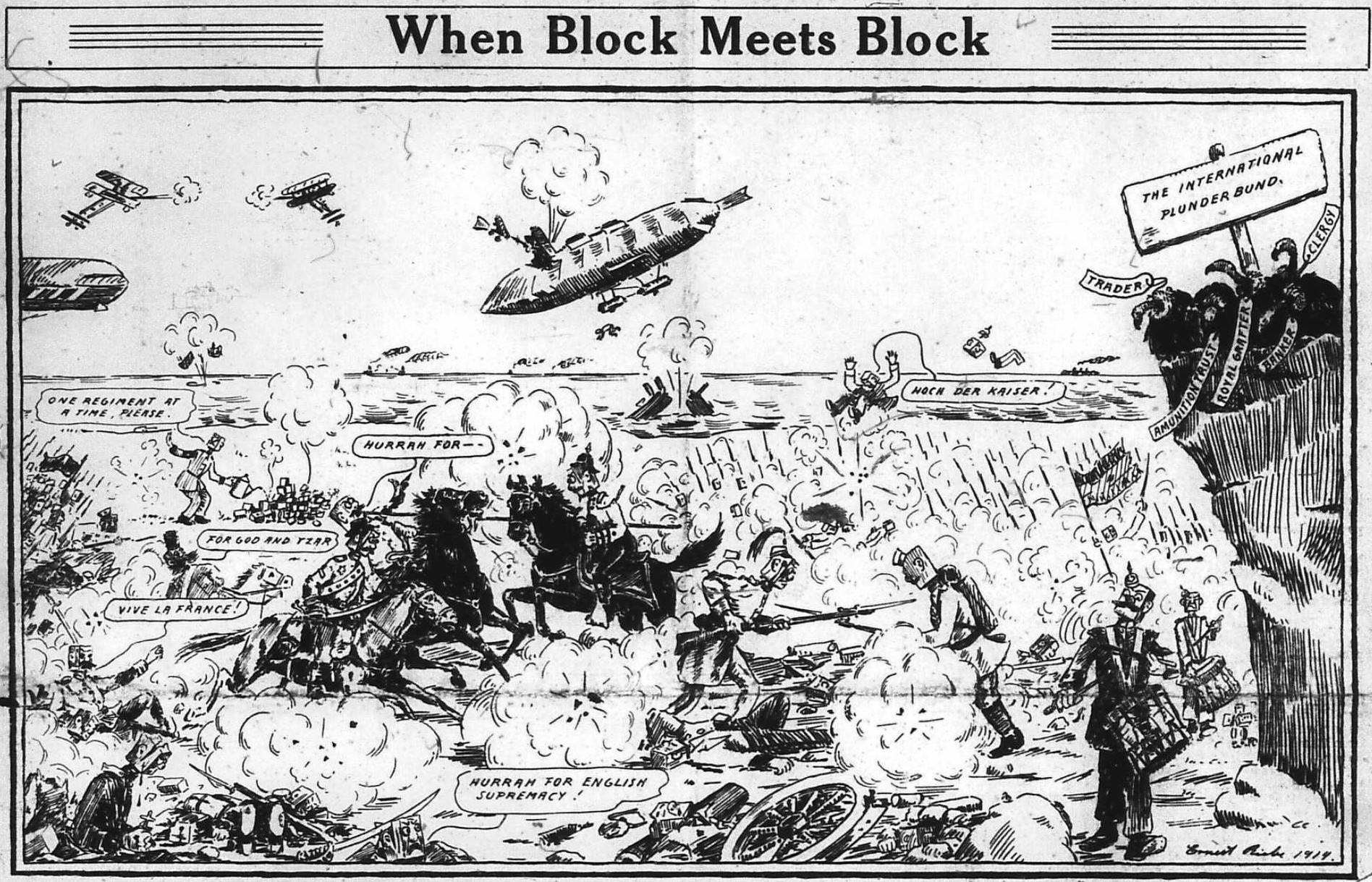
Solidarity editor B.H. Williams and the cartoonist and creator of ‘Mr. Block,’ Ernest Riebe respond to the outbreak of the First World War.
‘When Block Meets Block’ by B.H. Williams from Solidarity. 5 No. 243. September 5, 1914.
The purely sentimental side of the European, murderfest is just now overtaxing the descriptive powers of capitalist editors and space-writers. The horrors of machine-made murder on a wholesale scale are being set forth at length by correspondents, artists and others gifted with descriptive powers. Quotations from great military commanders of the past, who aptly described war as HELL, are sandwiched in between stories of weeping women and suffering children, whose “breadwinners” are sent away to die on the battlefield. “Diplomats” of the various powers at war with one another, give out interviews telling how, in the name of humanity, they tried to prevent the conflict, but failed because the other fellow was the aggressor. Meanwhile, the sinister, cold-blooded, “unsentimental” capitalists behind the war moves are carefully concealed from view, while their crowned puppets only are mildly criticized for their “greed” and “ambition.” “Patriotism” is being glorified, and UNKNOWN “heroes” lauded as they are being murdered by wholesale.
All of which is misleading, as of course it is intended to be. Also it is nauseating, to a SOCIAL REBEL, nauseating as capitalist hypocrisy is generally. It overlooks one important fact, namely, that the war victims are WILLING victims, with few possible exceptions, not numerous enough to affect the morale of charging regiments of war-mad slaves. “Patriotism,” like other superstitions that beset the working class, has been inbred through thousands of generations. It has been carefully nurtured, along with “religion” and other superstitions, as the greatest asset in control of the ruling class. It has been an indispensable aid, at all periods of “civilization,” in advancing the interests and expanding the power of our masters. In the period of real “barbarism,” before the era of economic classes, there was nothing hypocritical about war. It was purely a question of food. Some tribe of barbarians, finding its “happy hunting-ground” insufficiently stocked with food for its needs, deliberately overflowed onto the preserves of some other tribe. War ensued, without diplomacy or appeals to “humanity.” All members of both tribes took part in the fight, and the victors shared the spoils in common. What was left of the beaten tribe contented itself with a smaller food-preserve, or moved on over the surface of the earth in search of pastures new.
Warfare was open and above board, and the purpose of warfare clearly understood by all. Not so, however, when the “State” superseded “tribal communism.” The same “urge” to war existed, on a larger scale than before. The need for expansion, whether in the form of more soil for cultivation, or water outlets for commercial purposes, became ever more pressing. But the “state,” unlike the primitive communal society, no longer consisted of equals of kinsmen. It consisted rather of classes, with different interests, whether conscious of the fact, or not. The ruling class, which took the least active part in warfare, and benefitted most by it, naturally assumed the job of engineering the war game. Since the slaves were to do the fighting, they must be trained to willingly leave their peaceful pursuits when called by their masters. Hence the slaves must be imbued with “patriotism.” As an instance, we observe the war movements of Greek and Roman rulers, in the literature handed down from that period. Counter movements, such as slave revolts, disaffections of groups of citizens, base and sordid tales of internal squabbles, were largely suppressed, as far as future generations were concerned, and we today still feel the effects of Greek and Roman “patriotism” in the glowing speeches and lyric and epic poetry still circulating in our schools and colleges. Ruling classes of all ages have not been slow in passing along useful material for the education of their slaves. As a consequence of the development of the “state” from its feudal or agrarian form to the modern commercial state, the interests of ruling classes became more or less intertwined. In spite of that fact, however, commercial aggression gave rise to wars on an even bigger scale. But there must needs be some “rules.” “International law” appeared on the chessboard. “Diplomacy” developed into a fine art. If you want to see how “fine” it is, study the history of Great Britain, which has surpassed all other nations in diplomacy, as well as in aggression and world-conquest. We are all “falling” for English diplomacy these days, through its control of the news columns of American capitalist papers. British capitalists have the greatest commercial interests to protect; why shouldn’t they make use of cunning as well as forcible measures to protect them? Meanwhile, other national capitalist interests are under the same necessity, including those of the United States; hence the sentimental (hypocritical) outcry against war coupled with the glorification of “patriotism” in this country. The capitalist class must never permit its mouthpieces to lose sight of the “patriotic salve” for the souls of its slaves. Hence the modern war-game appears more intricate, complex and alluring than ever before, despite its counteracting influences, supposed to be generated through the labor movement. The slaves are still WILLING WAR-VICTIMS.
What’s to be done? Harp on the sentimental? Descant upon the horrors of war? Draw pictures of desolated fields heaped high with human skulls? Leave these to the sentimentalists: they will derive ample material for such from the present murderfest in Europe. The I.W.W. task appears different. So far as we have any influence in an educational sense, let us bend our efforts towards making war appear RIDICULOUS in the eyes of the slaves. The mass of slaves seem immovable to the horrors of war when the war drums are throbbing in their ears; they may be moved to some extent by a realization of how foolish they appear in the eyes of their enlightened fellow workers. Our cartoonist has expressed the idea on the front page. “When Block Meets Block” reveals the utterly stupid and ridiculous character of modern “patriotism” far more effectively than a thousand pictures of desolated battlefields or of weeping widows and orphans. Besides, it may help to open the slaves’ eyes to the ridiculousness of capitalism in general, and the necessity of overthrowing the same, in order that they may get something out of life besides poverty and misery, along with the chance to become dead “heroes” for the greater glory and power of their masters.
The most widely read of I.W.W. newspapers, Solidarity was published by the Industrial Workers of the World from 1909 until 1917. First produced in New Castle, Pennsylvania, and born during the McKees Rocks strike, Solidarity later moved to Cleveland, Ohio until 1917 then spent its last months in Chicago. With a circulation of around 12,000 and a readership many times that, Solidarity was instrumental in defining the Wobbly world-view at the height of their influence in the working class. It was edited over its life by A.M. Stirton, H.A. Goff, Ben H. Williams, Ralph Chaplin who also provided much of the paper’s color, and others. Like nearly all the left press it fell victim to federal repression in 1917.
PDF of full issue: https://www.marxists.org/history/usa/pubs/solidarity-iww/1914/v05-w243-sep-05-1914-solidarity.pdf

